Monday, September 1, 2014

Kate Moss, supermodel as phenomenon, sees the millions pour in


Kate Moss

Kate Moss, supermodel as phenomenon, sees the millions pour in


With her two companies reporting record earnings, passing 40 has opened the door into a new and growing market
BY DAMIE DOWARD AND TESS REIDY
The Observer, Sundady 10 August 2014

kate moss
Modelling for Topshop: 'she has an enduring agelessness and ability to be a really successful canvas’.
There are models, there are supermodels … and there is Kate Moss. Turning 40 has only boosted her earning power, according to accounts filed last week by her two companies. They show she has defied a whiff of scandal and predictions of decline, reflecting a revolution in how the fashion industry is responding to women consumers, say commentators.
Accounts for her main company, Tilly Church Ltd, show that last year it had more than £9m in the bank and was owed a further £5m. A second company, Skate LLP, was sitting on more than £5m in the bank last year – and was owed a further £1m.
In total it means the two companies had £20m in cash, much of it in the bank and some owed to them, compared with about £17m in 2012, the year she appeared with several other supermodels celebrating British fashion at the closing ceremony of the London Olympics. The event, watched by billions around the globe, helped to confirm Moss, who hit 40 in January, as one of the most recognisable people on the planet and cemented her brand.
In the same year, Forbes placed her second on its top-earning models list, with an estimated $9.2m. Once money owed to creditors is factored in, last year Moss's two companies had net assets of £16.7m. And, while their accounts make it difficult to separate how much of her wealth was earned and how much was accrued from investments and interest, they suggest 2013 might turn out to be her most lucrative year to date.
"The fact that she's doing so well is testament to her enduring agelessness and ability to be a really successful canvas, but also she is perfectly placed to reflect the growing market of 40-plus women who have money to spend in fashion and beauty," said fashion commentator Caryn Franklin. "At last companies are waking up to this. There used to be a definite cut-off point in modelling but that's changing, and I hope the careers of other 40-plus models will start to take off. Ultimately, it's female consumers who will lead the trend by responding to more realistic role models in terms of age and where they choose to buy their produce. It's the power of the purse."
Ger Tierney, executive fashion editor of i-D Magazine, said Moss's longevity was also partly down to a reaction against "the increasingly short lifespan of models' careers that has become a depressing norm.
"Women want to connect with a character, they want a strong woman and no longer buy into the next long-limbed schoolgirl to turn up bright-eyed and bushy-tailed at fashion week. It's easy to connect with Kate because we've grown up watching her career, her personal life, her high and her lows. She has become humanised over the years and is more marketable than ever."
Moss has contracts with a range of brands including Matchless, Rimmel and Topshop, for whom she is a designer. There have been questions about whether her second collection for the high-street chain, launched earlier this year, has been a total success.
Topshop entrepreneur Sir Philip Green dismissed suggestions that some items in her latest collection had not sold well after they ended up in the sales: "The range was very, very successful and we waited until the end of the season to clear whatever was left. There's nothing untoward, whether it's got Kate Moss in it, or any other brand; what we've got left at the end of the season around the globe, we sell. Nothing sells 100%, whatever it is – it doesn't exist in any business."
Moss's sustained earning power is all the more remarkable given that some commentators wrote her off almost a decade ago. In 2005, following her short-lived relationship with singer Pete Doherty, she found herself immersed in allegations of drug-taking. Although she was never charged, a number of major brands dropped her from their campaigns.
"People said that would end her career," said Ellis Cashmore, professor of culture, media and sport at Staffordshire University and author of Celebrity Culture. "But in fact the opposite happened. She came back with renewed vigour. Scandal can be a valuable resource."
Cashmore drew comparisons between Moss and David Beckham: "Beckham is a prodigious endorser, too. And both now have their own imprimatur. There are not too many people who can draw the crowds by saying almost nothing and just turning up. She is a brand in her own right."
Approaching 40 does not appear to have dimmed Moss's appetite for exposure. Last December she appeared in the 60th-anniversary issue of Playboy magazine. In the same month, she was honoured at the British fashion awards acknowledging her contribution to the industry during a career spanning a quarter of a century.
Cashmore suggested Moss was riding a wave that started a couple of decades ago when companies looked beyond Hollywood stars to find people to endorse their brands: "A clutch of supermodels who emerged in the early 90s benefited from this trend, people like Naomi Campbell and Cindy Crawford. Moss is their younger sister. She belongs to the second generation of supermodels and is a phenomenon."

LIFE IN THE LIMELIGHT

1988 Talent spotted at JFK airport, New York, at age of 14.
1990 Appears in the Face.
1993 Fronts Calvin Klein campaign.
1999 Appears with other supermodels on the millennium cover of American Vogue.
2002 Gives birth to daughter, Lila Grace
2005 Goes out with Pete Doherty. Allegations of drug-taking see brands including H&M desert her. Moss issues apology but never admits to taking drugs.
2006 Wins model of the year.
2007 Time magazine names her one of the most influential people in the world.
2011 Marries musician Jamie Hince.
2013 Poses for Playboy.


Read also


The 100 best novels / No 50 / Mrs Dalloway by Virginia Woolf (1925)


The 100 best novels


written in English

No 50

 Mrs Dalloway 

by Virginia Woolf (1925)


Woolf's great novel makes a day of party preparations the canvas for themes of lost love, life choices and mental illness

Monday 1 September 2014

I
n the spring of 1924, Virginia Woolf, then in her 40s, gave a famous lecture, later published as the essay Mr Bennett and Mrs Brown, in which she declared that "we are trembling on the verge of one of the great ages of English literature". She might have been speaking about herself. In the next 15-odd years, before her suicide, Woolf would transform the English literary landscape forever. She would innovate (To the Lighthouse); she would flirt (Orlando); she would provoke (A Room of One's Own) and, privately, would dazzle herself and her friends with a stream of letters (and diaries), all of which reveal a writer's mind at full tilt.


Woolf is one of the giants of this series, and Mrs Dalloway, her fourth novel, is one of her greatest achievements, a book whose afterlife continues to inspire new generations of writers and readers. Like Ulysses (no 46 in this series), it takes place in the course of a single day, probably 13 June 1923. Unlike Joyce's masterpiece, Woolf's female protagonist is an upper-class English woman living in Westminster who is planning a party for her husband, a mid-level Tory politician.As Clarissa Dalloway's day unfolds, in and around Mayfair, we discover that not only is she being treated in Harley Street for severe depression, a familiar subject to Woolf, but she also conceals a troubled past replete with unarticulated love and suggestions of lesbianism. Equally troubled is the novel's second main character, explicitly a "double", a Great War veteran who fought in France "to save an England which consisted almost entirely of Shakespeare's plays". Septimus Warren Smith is suffering from shell shock and is on his way to a consultation with Clarissa's psychiatrist. Mingled with the preparations for the party, the stream-of-consciousness exploration of Mrs Dalloway's inner state is broken by an irruption of senseless violence when Septimus, who is waiting to be taken to an asylum, throws himself out of a window. News of Septimus's suicide becomes a topic of conversation at Mrs Dalloway's party, where Woolf indicates Clarissa's deep sympathy for the dead man's suffering. The novel ends unresolved, but on a note of suspenseful menace. "What is this terror?" writes Woolf. "What is this ecstasy?" Her mature work would be devoted to exploring these questions.


A note on the text

Mrs Dalloway, published by the Hogarth Press with a striking Vanessa Bell dust jacket on 14 May 1925, was a novel that grew out of two previous short stories, Mrs Dalloway in Bond Street and The Prime Minister. The latter makes his appearance at the party at the end of the novel. Clarissa also appeared in Woolf's first novel, The Voyage Out, as well as in five of her short stories.
Mrs Dalloway's literary influence can be seen in Michael Cunningham's The Hours and perhaps also in Ian McEwan's novel Saturday, which takes place on a single day, 15 February 2003.


Three more from Virginia Woolf

To the Lighthouse (1927); Orlando (1928); A Room of One's Own (1929).


THE 100 BEST NOVELS WRITTEN IN ENGLISH
007 Emma by Jane Austen (1816)
014 Fair by William Thackeray (1848)  
031 Dracula by Bram Stoker  (1897)
035 The Call of the Wild by Jack London (1903)
036 The Golden Bowl by Henry James (1904)
039 The History of Mr Polly by HG Wells (1910)
040 Zuleika Dobson by Max Beerbohm (1915)

041 The Good Soldier by Ford Madox Ford (1915)
042 The Thirty-Nine Steps by John Buchan (1915)
043 The Rainbow by DH Lawrence (1915)
044 Of Human Bondage by W Somerset Waugham (1915)
045 The Age of Innocence by Edith Warthon (1920)
046 Ulysses by James Joyce (1922)
047 Babbitt by Sinclair Lewis (1922)
048 A Pasage to India by EM Forster (1922)
049 Gentlemen Prefer Blondes by Anita Loss ( 1925)
050 Mrs Dalloway by Virginia Woolf (1925)

Sunday, August 31, 2014

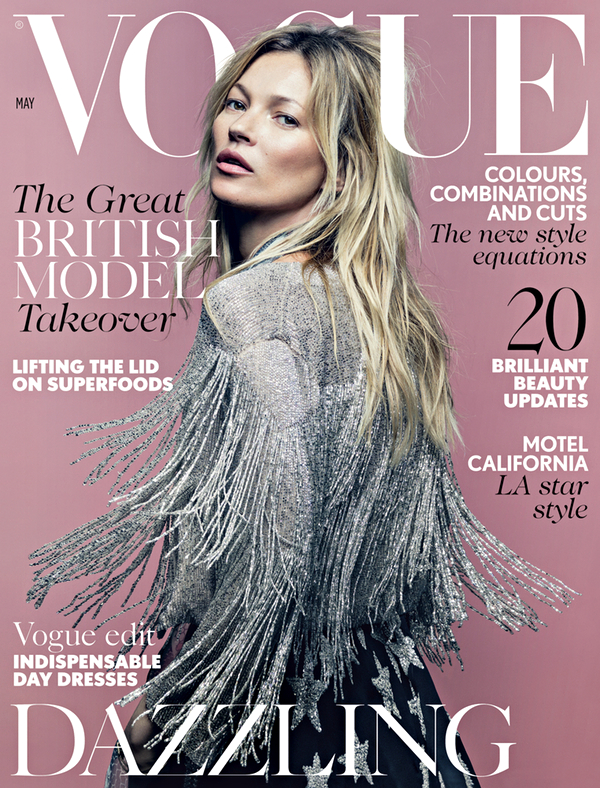
Is this the Kate Mossiest Vogue cover of all time


Is this the Kate Mossiest Vogue cover of all time?


Starring Kate Moss, this Vogue cover is styled by Kate Moss wearing clothes designed by Kate Moss for Topshop

Wednesday 2 April 2014 13.30 BST
Kate Moss on VogueView larger picture
Kate Moss on the cover of Vogue. Photograph: Craig McDean
Is this the Kate Mossiest cover of all time? It stars Kate Moss, was styled by Kate Moss, who is now a contributing fashion editor at Vogue, and Kate Moss is wearing an outfit designed by Kate Moss. The clothes – from Moss's upcoming Topshop collection – are incredibly Mossy, too, all vintage-influenced tassles and stars. Kate Moss' name does not appear on the cover, probably because if you're not sure who she is given the breadth of Kate Moss signifiers here you are not part of Vogue's target audience.
Freja Beha Erichsen, for VogueFreja Beha Erichsen, styled by Kate Moss for Vogue. Photograph: Craig McDean
Inside, Moss has also styled model Freja Beha Erichsen as Kate Moss, with leather rock'n'roll shorts and a 1970s-influenced chiffon top and hair that could be described as "just been pulled out of a mosh pit". Photographed by Craig McDean, the full shoot will be in the May issue of Vogue, out on Monday 7 April.


Ian McEwan / I'm only 66

 Ian McEwan: 
'I'm only 66 – my notebook is still full of ideas'
In Ian McEwan's book The Children Act, a high court judge must decide whether a teenage boy lives or dies. In his own life, the novelist feels mortality pressing in – but, he says, he's enjoying himself far too much to slow down just yet
by Robert McCrum
The Observer, Sunday 31 August 2014


‘Privileged existence’: Ian McEwan photographed  by Karen Robinson for the Observer New Review earli
‘Writing is a delightful, privileged existence – assuming you can live by it’: Ian McEwan photographed by Karen Robinson for the Observer
Ian McEwan was in a reflective, autumnal mood when we met recently to talk about his new novel, The Children Act. It's a mood that echoes the dominant note of this short book. McEwan's prose has always been pared down but the full foliage of, say, Atonement, has now become the thinning leaf of The Children Act, whose title refers to the landmark legislation of 1989 governing the welfare of minors.
  1. The Children Act
  2. by Ian McEwan


This sombre tale of barely 55,000 words is a study in grey, a characteristically haunting examination of unarticulated love, of an old marriage in crisis, and a mature woman at the end of her tether. "I wanted," says McEwan, in his forensic, slightly nasal but commanding drawl, "to get inside the mind of a woman who is professionally totally engaged, but with turmoil in her life, who comes into a situation in which all kinds of buried feelings are stirred up…"
Fiona Maye is a high court judge who presides in the family division. She's flinty, cerebral and childless. Her legal judgments exhibit a crisp and even-handed prose that's "almost ironic, almost warm". Like McEwan, she loves classical music, especially Bach. Unlike him, she can also perform it as an amateur, especially the second Partita. This makes her sound horribly over-accomplished but McEwan says he did not want her to be "a goody two-shoes". Still, with her "godly distance", she may be colder to the reader than he realises.

Meet the autor / Esther Freud / I realised the book I'd been writing for 18 months was awful


Esther Freud: 'I realised the book I'd been writing for 18 months was awful'


The author of Hideous Kinky on her childhood memories of watching her father, Lucian Freud, paint, and how abandoning one novel led to another, about the architect Charles Rennie Mackintosh
Interview by Alice O'Keeffe
The Observer, Sunday 31 August 2014
Esther Freud at Edinburgh's international book festival earlier this month
Esther Freud at Edinburgh's international book festival earlier this month Photograph: Murdo Macleod
Esther Freud was born in London in 1963. Her first novel, Hideous Kinky (1992), was made into a film starring Kate Winslet. After publishing her second, Peerless Flats (1993), she was named one of Granta's best young British novelists. She has since written six novels, including Love Falls and Lucky Break, and teaches creative writing at the Faber Academy.
Your new novel, Mr Mac and Me, is about Charles Rennie Mackintosh's stay in Walberswick, Suffolk, during the great war, which ended in disaster when locals mistook him for a spy. What drew you to this material?
Someone told me about Mackintosh in Suffolk about 10 years ago, saying it was a good story. I thought it was a good story, but that it wasn't my story. In the end, I slowly found my way into it in the process of writing another book. There came a moment – one of life's worst, and best, moments – when I realised that everything I had been working on for the last year and a half was awful. It was a horrible realisation at the time, but it ended up leading me to this book.

Saturday, August 30, 2014

Colombians wary as former Escobar hitman gets ready to walk free from prison


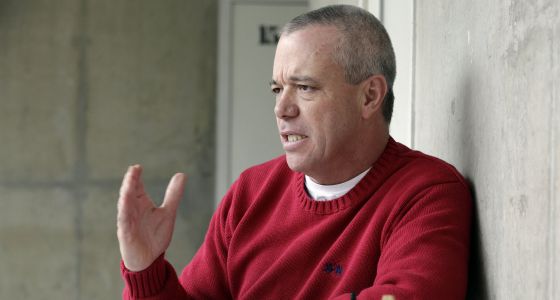
Jhon Jairo Velásquez Vásquez, better known as “Popeye,” in 2013. / CARLOS ORTEGA (AFP)

Colombians wary as former Escobar hitman gets ready to walk free from prison

“Popeye” has served 23 years after killing hundreds under reign of Medellín cartel chief

Jhon Jairo Velásquez Vásquez, the sole survivor of a group of hitmen who fought the Colombian state alongside drug lord Pablo Escobar, is about to walk free after 23 years in prison.
Popeye, as he is better known in the underworld, was 29 when he was sent to jail. Now 52, he is spending his last hours at Cómbita penitentiary, two hours away from Bogotá, where he has served the last 12 years of his conviction. The gang member benefited from term reductions through work and study schemes, and is reported to have paid $4,500 for access to parole.
His release, scheduled for Tuesday afternoon local time, comes amid heavy security measures. Popeye has confessed to scores of murders during Escobar’s reign of violence. While behind bars, he cooperated with authorities to help clear up some of the most painful events of the 1980s and 1990s.
Colombians are not indifferent to the release of a man who once headed the group of hired killers at the service of the world’s most powerful drug kingpin. Popeye has coldly admitted that he ordered 3,000 people killed when his boss, the head of the Medellín cartel, was fighting the government to avoid extradition.

Popeye will be under surveillance for good conduct for four years
That particular war cost the lives of hundreds of police officers, journalists, judges, lawyers and politicians. Last week marked the 25th anniversary of the assassination of presidential candidate Luis Carlos Galán.