Showing posts with label William Thackeray. Show all posts

Monday, January 2, 2023

Jonathan Swift by William Makepeace Thackeray

Jonathan Swift by Charles Jervas

Jonathan Swift

by William Makepeace Thackeray
 
 
IN treating of the English humourists of the past age, it is of the men and of their lives, rather than of their books, that I ask permission to speak to you; and in doing so, you are aware that I cannot hope to entertain you with a merely humorous or facetious story. Harlequin without his mask is known to present a very sober countenance, and was himself, the story goes, the melancholy patient whom the Doctor advised to go and see Harlequin—a man full of cares and perplexities like the rest of us, whose Self must always be serious to him, under whatever mask or disguise or uniform he presents it to the public. And as all of you here must needs be grave when you think of your own past and present, you will not look to find, in the histories of those whose lives and feelings I am going to try and describe to you, a story that is otherwise than serious, and often very sad. If Humour only meant laughter, you would scarcely feel more interest about humorous writers than about the private life of poor Harlequin just mentioned, who possesses in common with these the power of making you laugh. But the men regarding whose lives and stories your kind presence here shows that you have curiosity and sympathy, appeal to a great number of our other faculties, besides our mere sense of ridicule. The humorous writer professes to awaken and direct your love, your pity, your kindness—your scorn for untruth, pretension, imposture—your tenderness for the weak, the poor, the oppressed, the unhappy. To the best of his means and ability he comments on all the ordinary actions and passions of life almost. He takes upon himself to be himself to be the week-day preacher, so to speak. Accordingly, as he finds, and speaks, and feels the truth best we regard him, esteem him—sometimes love him. And, as his business is to mark other people’s lives and peculiarities, we moralize upon his life when he is gone—and yesterday’s preacher becomes the text for to-day’s sermon.

Friday, December 2, 2022

Book Review 014 / Vanity Fair by William Thackeray


Vanity Fair

by William Makepeace Thackeray

1848


“Vanity Fair is a very vain, wicked, foolish place, full of all sorts of humbugs and falsenesses and pretensions.”

Thackeray’s ‘Vanity Fair’ draws its name from ‘The Pilgrim’s Progress’. It was published in nineteen monthly instalments, and as with many Victorian novels shows some evidence of padding – the scenes in continental Europe at the end of the novel in particular were quite obvious word-count filling.

Thursday, March 1, 2018

Food in books / The goat curry in William Thackeray's Vanity Fair


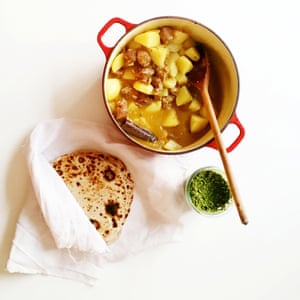
‘A chili,’ said Rebecca, gasping. ‘Oh yes!’ She thought a chili was something cool, as its name imported… Photograph: Kate Young/Little Library Cafe


Food in books: the goat curry in William Thackeray's Vanity Fair


Becky Sharp’s first encounter with a chilli in Vanity Fair is a scorching reminder of how badly words can deceive. What would her delicate palate make of Kate Young’s fragrant concoction?

By Kate Young for The Little Library Café, part of the Guardian Books Network

Kate Young
Thu 5 Nov 2015 10.58 GMT


“Give Miss Sharp some curry, my dear,” said Mr. Sedley, laughing. Rebecca had never tasted the dish before. “Do you find it as good as everything else from India?” said Mr. Sedley. “Oh, excellent!” said Rebecca, who was suffering tortures with the cayenne pepper. “Try a chili with it, Miss Sharp,” said Joseph, really interested. “A chili,” said Rebecca, gasping. “Oh yes!” She thought a chili was something cool, as its name imported, and was served with some. “How fresh and green they look,” she said, and put one into her mouth. It was hotter than the curry; flesh and blood could bear it no longer. She laid down her fork. “Water, for Heaven’s sake, water!” she cried.

Vanity Fair, William Makepeace Thackeray

When I was fifteen, I scored a job in one of the best Indian restaurants in Brisbane. I had spent the six months previous smelling of oil and cod (my first job was in a fish and chip shop) and was setting myself up for five years of a uniform perfumed by Indian spices. The latter was infinitely more exciting, and so stimulating in terms of my culinary education. I spent the quieter evenings peering over the shoulders of the chefs, watching as they hooked charcoal dotted naans out of the tandoor, tossed a secret blend of aromatic spices around a pan and flung samosas and pakoras into smoking hot oil.
At the end of every shift I would take a scoop of curry (I worked my way through most of the 50+ dishes in my years there) and settle in with a book at an empty table. It was a great way to spend my teenage years, and ignited a long-held passion for Indian spices. Now that I have a career in food in my sights, I wish more than anything that I could go back and write down everything I saw go into those extraordinary dishes.
I hadn’t read Vanity Fair until last year, when hearing a snippet of the BBC’s 20-part adaptation hooked me immediately. It had been on my reading list (and my bookshelf) for such a long time and I was so pleased to finally discover this sharp satire of English life in the mid-19th century, centred on two women, Becky Sharp and Amelia Sedley. It’s a bleak study of humanity. Thackeray’s characters, though occasionally sympathetic, are generally heavily flawed; anti-heroine Becky Sharp is manipulative, selfish and vain, demonstrating an almost complete lack of morality. And yet, she’s so richly layered that I find her an intriguing and even occasionally – against my better judgment – identifiable character. Especially, for me, in the moment above.
The recipe below is the simplest of curries – a classic fragrant spice mix with some meat, potatoes and stock. Similar to a British stew, in many ways, but unlike anything Becky Sharp would have tasted before. The chefs at Taj Bengal (the restaurant I worked in) used to trick us all the time, hiding super hot chillies in the middle of our curries, and then poking their heads out from the kitchen to observe the moment our delicate palates would discover them. Red-faced, laughing gallantly, I would always struggle, like Becky, to hide the pain felt after taking a huge bite out of a chilli. You think I would have learnt the first time.

Goat Curry: the recipe

Serves 4 generously
Ingredients 

5 cloves of garlic 
Thumb sized piece of ginger 
2 long green chillies 
30g ghee (or rapeseed oil) 
2tsp cumin seeds 
1tbsp coriander seeds 
1 stick cinnamon 
2 brown onions 
700g goat meat (shoulder is good, and use mutton or lamb if you can’t find goat)
1/2tsp turmeric
1/2tsp cayenne pepper 
500ml vegetable stock 
400g potatoes

Equipment 

Mortar and pestle or food processor or knife and chopping board
Heavy bottomed frying pan or casserole dish with a lid
Wooden spoon
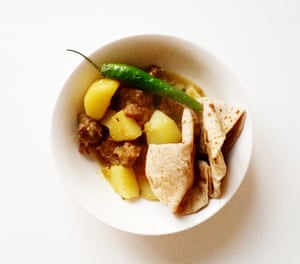

The simplest of curries – a classic fragrant spice mix with some meat, potatoes and stock. Similar to a British stew, in many ways, but unlike anything Becky Sharp would have tasted before. Photograph: Kate Young/Little Library Cafe

1 Bash (in a mortar and pestle), blitz (in a food processor) or chop (with a knife) the ginger, garlic and chillies to a paste. Warm the ghee in the pan over a low heat and add the paste. Fry for five minutes until almost overwhelmingly fragrant. Keep the paste moving so that it doesn’t stick to the pan and burn.
2 Bash the cumin seeds and coriander seeds and add them too, along with the stick of cinnamon. Fry on a low heat for a further five minutes. Dice the onions and stir them through, frying for ten minutes until soft and translucent.
3 Dice the meat into 2cm pieces and tip these in too. Increase the heat to medium. Add the turmeric and cayenne pepper and coat the meat in the spices while browning it on all sides.
4 Add the stock and bring to the boil. Reduce to a low simmer, cover with a lid and cook for an hour until the meat is tender. Add some more stock if the goat is drying out at any point.
5 Peel and chop the potatoes into 2cm dice and add this too. Stir, then cook, with the lid on, for a further twenty minutes. The potato should be tender and the meat meltingly soft.
6 Serve the curry with chapatis, naan or rice and some chutney or hot lime pickle. It’s also (along with every other curry I’ve eaten) perfect for reheating the next day.
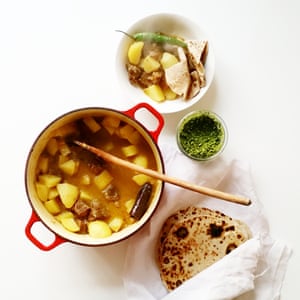

Serve with chutney or hot lime pickle. Photograph: Kate Young/Little Library Cafe

THE GUARDIAN


Monday, December 23, 2013

The 100 best novels / No 14 / Vanity Fair by William Thackeray (1848)


The 100 best novels: No 14 – Vanity Fair by William Thackeray (1848)


William Thackeray's masterpiece, set in Regency England, is a bravura performance by a writer at the top of his game


Robert McCrum
Monday 23 December 2013 06.52 GMT


Vanity Fair jumps out of this list as a great Victorian novel, written and published deep in the middle of a great age of English fiction. Indeed, so commanding was Thackeray at the height of his powers (some say he never wrote as well, or as sharply, again) that Charlotte Brontë even dedicated Jane Eyre (no 12 in this list)to the author of Vanity Fair.
One hundred years after the publication of Clarissa (no 4 in this series), Thackeray not only revels in the possibilities of the genre, he even illustrated his own work with some decidedly inferior woodcuts. Vanity Fair was published in serial form (including some memorable cliff-hangers, for instance Becky Sharp's revelation of her marriage to Rawdon Crawley) from January 1847 to June 1848. Thackeray, on top form, cheerfully exploited an ebullient tradition, transcending all his previous efforts as a writer, novels such as The Luck of Barry Lyndon (1844).


Early drafts of the book, which had the working title "a novel without a hero" lacked the all-important figure of William Dobbin, a thoroughly good and likable character who owes much to Thackeray himself. "Vanity Fair", a title that came in a eureka moment to the author in bed one night, actually derives from Pilgrim's Progress (no 1 in this series) and refers to the fair set up by the devils Beelzebub and Apollyon in the town of Vanity. Unlike Bunyan, Thackeray was hardly a die-hard Christian, but rather a man who relished a life of pleasure and luxury, and who, on the evidence of his letters, found much of the Bible either ludicrous or distasteful. As a title, however, "Vanity Fair" set the tone of the novel in its depiction of a society, rather as "The Bonfire of the Vanities" did for Tom Wolfe (who also illustrated his own work) in 1987.
Thackeray's intention was satirical and realistic. Writing mid-century, he set his masterpiece in Regency England during the Napoleonic wars, intending the lessons of his tale to be applied equally to his own times. In contemporary terms that would be like a modern literary novelist setting their scene during the second world war, or the blitz.

The climax of the novel comes with the battle of Waterloo. Unlike Tolstoy, whose War and Peace was influenced by Vanity Fair, Thackeray was squeamish about military matters, and chose to leave most of the fighting off-stage. This makes the irruptions of violence all the more shocking, as in the death of George Osborne, "lying on his face, dead, with a bullet through his heart" on the field of Waterloo, which occurs almost exactly halfway through the narrative.
Thackeray was highly conscious of his audience and repeatedly breaks off from his story to buttonhole and tease his readers ("the present chapter (8), is very mild. Others – but we will not anticipate those"). The tale, however, will not be denied for long. Upwardly mobile Becky Sharp, and her sweet, devoted friend, Amelia Sedley, are perfectly matched by the caddish rake, George Osborne, and clumsy, decent William Dobbin. The social trajectory of each pair gives the narrative an almost perfect symmetry.


The key to the novel's magic, in addition to the delight it takes in the Regency pageant, probably lies in the contrast between scheming Becky, one of fiction's great female protagonists and awkward, dutiful William whose unwavering love for Amelia mirrors Thackeray's own passion for another man's wife.
Finally, however, for all its realism, Vanity Fair is a bravura performance by a writer who has found his theme. As the serialisation of the novel that would transform its author's reputation draws to a close, Thackeray himself concluded his tale with a nod to the gaudy theatricality of the whole business: "Come children, let us shut up the box and the puppets, for our play is played out."


A note on the text

Vanity Fair, subtitled "A Novel without a Hero", was first serialised in Punch, then published (from the same typesetting) by Bradbury & Evans of Bouverie Street in July 1848. A revised and more definitive text appeared in 1853, without illustrations. Vanity Fair was the first of Thackeray's books to appear under his own name. As a further sign of his self-confidence, in the introduction to the 1848 edition, dated 28 June, the author acknowledges "the kindness with which it has been received in all the principal towns of England… where it has been most favourably noticed by the respected conductors of the public Press, and by the Nobility and Gentry. He is proud to think that his Puppets have given satisfaction to the very best company in this empire."

Some other Thackeray titles:

The Yellowplush PapersThe Luck of Barry LyndonPendennisThe History of Henry EsmondThe Newcomes.


THE 100 BEST NOVELS WRITTEN IN ENGLISH
007 Emma by Jane Austen (1816)
014 Fair by William Thackeray (1848)  
031 Dracula by Bram Stoker  (1897)
035 The Call of the Wild by Jack London (1903)
036 The Golden Bowl by Henry James (1904)
039 The History of Mr Polly by HG Wells (1910)
040 Zuleika Dobson by Max Beerbohm (1915)
041 The Good Soldier by Ford Madox Ford (1915)
042 The Thirty-Nine Steps by John Buchan (1915)
043 The Rainbow by DH Lawrence (1915)
044 Of Human Bondage by W Somerset Waugham (1915)
045 The Age of Innocence by Edith Warthon (1920)
046 Ulysses by James Joyce (1922)
047 Babbitt by Sinclair Lewis (1922)
048 A Pasage to India by EM Forster (1922)
049 Gentlemen Prefer Blondes by Anita Loss ( 1925)
050 Mrs Dalloway by Virginia Woolf (1925)