The 100 best novels
written in English
No 58
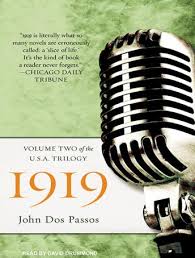
Nineteen Nineteen
by John Dos Passos
(1932)
The middle volume of John Dos Passos’s USA trilogy is revolutionary in its intent, techniques and lasting impact
Robert McCrumb
Monday 27 October 2014
J
ohn Dos Passos is largely forgotten now but, as we’ll see, his influence continues to reverberate throughout 20th-century American literature. He was born in 1896, contemporary with F Scott Fitzgerald (No 51 in this series) and a year before Thornton Wilder and William Faulkner (No 55 in this series). His response to the great war (in which, like Hemingway, he served as an ambulance driver) and communist revolution, to which he was passionately attached as a young man, was to become a novelist with the instincts of a journalist, and a fictional reporter with the insight of a storyteller. His friend, the great critic Edmund Wilson, wrote that Dos Passos was “the first American novelist to make the people of our generation talk as they actually did”.
 |
| John Dos Passos |
His masterpiece, published in 1938 as USA, is a massive (1,300-page) trilogy that recounts the evolution of American society during the first three decades of the 20th century, and whose best volume, Nineteen Nineteen, first appeared in 1932. By then, the thrills and glamour of the jazz age had become soured by the crash, the depression, and the rise of fascism. Dos Passos, however, was still a committed communist who wanted to depict the gulf between rich and poor in America, as well as to explore the lives of ordinary people in the aftermath of the great war. Nineteen Nineteen, which is partly set in the Paris of the 1920s, develops the narrative techniques of the first volume, The 42nd Parallel, with its “Newsreel” and “Camera Eye”, devices inspired by modernist innovation and emerging mass communications. There is also a lot of sex and violence, described with raw, documentary candour.
Dos Passos, like his innovative contemporary EE Cummings, played with typography and layout. To the reader, his books are works of art. As an accomplished artist himself, Dos Passos also painted his own book jackets, with striking modern images. Some sections (Camera Eye) are stream-of-consciousness evocations of mood and place, based on Dos Passos’s own experience, and intercut with biographical essays on contemporary American figures, great and small. The momentum is relentless, the reportage vivid and brilliant. USA is as jerky and authentic as an old newsreel, and just as much of its time. Today, in 2014, Jane Smiley’s trilogy, The Last Hundred Years, is a more conventional, mainstream attempt to explore aspects of the American century from the point of view of an Iowa farming family, the Langdons. Deliberate or not, Smiley’s book is an unconscious tribute to John Dos Passos.
A note on the text
I first read USA as an impressionable teenager, in a massive and battered (I think) Penguin. This must have been an offset from the Harcourt Brace edition which first published The 42nd Parallel, Nineteen Nineteen and The Big Money in a single volume titled USA in January 1938. This volume came at a turning point in the author’s life. He had travelled to Spain with Ernest Hemingway and found his communist beliefs challenged by the murderous behaviour of some communist elements associated with the republican side in the civil war. Indeed, Dos Passos and Hemingway fell out over their differing responses to this. After their disagreement, the author of For Whom the Bell Tolls wrote to his friend F Scott Fitzgerald that Dos Passos was a second-rate writer with no ear, and “also a terrible snob”.
After the second world war, Houghton Mifflin published USA in a deluxe edition in three volumes with colour endpapers and illustrations by Reginald Marsh. (I have a cheap paperback version of this in which the majesty of Dos Passos’s intentions is still evident.) The first printing of the illustrated edition was fewer than 1,000 copies, but in due course the mass-market edition sold in thousands.
Dos Passos has had some unlikely champions. Jean-Paul Sartre considered him the greatest writer of his time and was heavily influenced by Manhattan Transfer in the writing of The Reprieve (1947). In America, Dos Passos’s attention to documentary detail in fiction was taken up and reinterpreted in many different ways by Gore Vidal, Truman Capote and Norman Mailer. In the Library of America edition of 1996, Dos Passos’s masterpiece found its permanent home.
Three more from John Dos Passos
Manhattan Transfer (1925); The 42nd Parallel (1930); The Big Money (1936).
THE 100 BEST NOVELS WRITTEN IN ENGLISH


 , I just don’t have the appetite for another 800 pages of this trilogy. The novels are intended to stand alone and I am going to take the author at his word on this (even though many online reviews argue that reading the whole trilogy is the only way to properly appreciate its constituent parts).


