Showing posts with label Jerzy Kosinski. Show all posts

Monday, September 15, 2025

The Mystifyng Nine Lives of Writer Jerzy Kosinski


Jerzy Kosinski

THE MYSTIFYING NINE LIVES OF WRITER JERZY KOSINSKI


Bob Vickrey
NOVEMBER 1, 2014 

A restless publishing conference crowd appeared slightly impatient as it awaited the arrival of acclaimed novelist Jerzy Kosinski for his scheduled luncheon speech at the Copley Plaza Hotel in Boston. Kosinski was running noticeably late for an appearance that would officially launch his forthcoming book later that year.

Saturday, October 3, 2020

Jerzy Kosinski (1933-1991)


Jerzy Kosiński

14.06.19333.05.1991

Jerzy (Nikodem) Kosiński (born under the surname of Lewinkopf, also used the pseudonym of Joseph Novak) was born on June 14, 1933 in Łódź, died in 1991 in New York.


Kosiński studied under the supervision of Józef Chałasiński at the University of Łódź. He graduated with a diploma in political science and history. After earning his degrees, he became an assistant at the Institute of History and Sociology at the Polish Academy of Sciences (PAN). In 1957, he left Poland with a scholarship to the United States where he stayed permanently. In 1965, he received the American citizenship. Kosiński obtained grants from the Guggenheim Fellowship (1967), Ford Foundation (1968) and the American Academy (1970). Kosiński graduated from Columbia University. He lectured at Yale University, Princeton University, Davenport University and Wesleyan University. Among many honours and distinctions, Kosiński received the prestigious National Book Award (1969), National Institute of Arts and Letters Award (1970) and Le Prix du Meilleur Livre Étranger (1966). He was also honoured by the American Academy of Arts and Letters. In 1973, he was appointed the President of the American PEN Club. He held the chair for two terms. Kosiński was the President of Oxford Institute of Polish-Jewish Studies.

Friday, October 2, 2020

Jerzy Kosinski / Art


La voix du sang
René Magritte

ART

by Jerzy Konsinki


The principles of true art is not to portray, but to evoke.


Wednesday, February 15, 2012

Philip Routh / The Rise and Fall of Jerzy Kosinski


THE RISE AND FALL OF JERZY KOSINSKI
by PHILLIP ROUTH
_______________________

THE PINNACLE

Fifty years ago Jerzy Kosinski stepped off a plane at Idlewild Airport. The 24-year-old from Poland arrived in New York with little money and few contacts – two of his early jobs were parking lot attendant and movie theatre projectionist – but he swiftly rose to a pinnacle. One from which he would precipitously fall.
      Fall indeed. Many today would ask: Who is Jerzy Kosinski?
Jerzy Kosinski      Foremost, he was a writer.
     His first novel, The Painted Bird, published in 1965 (eight years after Kosinski's arrival), was heralded as a classic by the likes of Elie Wiesel and Arthur Miller. Widely translated, it received France's Prix du Meilleur Livre Etranger.
       Steps, his second novel, won the National Book Award in 1969.
        Being There (1971) was made into a film starring Peter Sellers. Kosinski's screenplay was cited as best of the year by The Writers' Guild of America and The British Academy.
       His next five novels were best sellers.
          He served two terms as president of P.E.N., the international organization of writers and editors.
          There was an award from the American Academy of Arts and Letters and teaching stints at Princeton and Yale, but Kosinski's renown extended beyond the written word.
           He was a 12-time guest on Johnny Carson's "Tonight Show."
          He played a small but significant role in the movie Reds, directed by his friend Warren Beatty (he got billing over Jack Nicholson).
          He would have been at the Beverly Hills home of another Hollywood friend, Roman Polanski, on the night that Polanski's wife Sharon Tate and four others were murdered by members of Charles Manson's "Helter Skelter" family; but, on his flight from Paris to Los Angeles, his luggage was unloaded by mistake in New York, which delayed him by a day.
         He posed half naked for the cover of The New York Times Magazine.
         Away from the public spotlight, at dinner and cocktail parties held in New York penthouses, Kosinski was on a first name basis with the famous – Henry Kissinger, fashion designer Oscar de la Renta, theatre critic John Simon, Senator Jacob Javits – and also with those anonymous bankers and industrialists whose decisions drive the world's economy. He was often the center of attention, for he had the gift of beguiling.
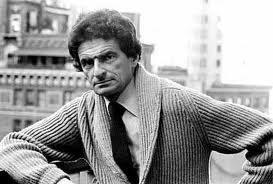
          His appearance was striking. His face was framed by a dense mass of tightly-curled black hair. His eyes, under wizard-like brows, were large, black and bright. His nose had the hook of a predatory bird's beak. His mouth, unusually long and thin, seems, in photographs, to be clamped shut like an oyster shell.
           But that mouth opened, and out came exotic stories told in an exotic accent. Accounts of his adventures in the cryptic world of communist Poland and the Soviet Union, chilling tales of his childhood in Nazi-dominated Eastern Europe, stories about his visits to sex clubs that catered to every desire.
          Kosinski was a kind of emissary, one dressed in suit and tie, bringing dispatches from life's underbelly. Yet he did it with a raconteur's wit, and he always retained a sense of mystery. Did he participate in the sexual circus he described or was he just an observer? In all his stories, what was truth, what was made up?
         Despite his free-wheeling lifestyle, Jerzy Kosinski had a wife. She did not accompany him on his night time prowls (other women did), but it was entirely due to her that he was in a room entertaining the affluent and powerful.
          Before the marriage he had been an academic studying social psychology and had written two books of anti-communist essays under the pseudonym of Joseph Novak. Mary Hayward Weir, the widow of an industrialist, admired his writing, which led to their first meeting. She employed the young man to catalogue the books in her library.
           When they married Jerzy was 29, Mary 47.
          Kosinski was suddenly part of a world that included a Park Avenue duplex, homes and vacation retreats in Southampton, London, Paris, Florence. There were servants, a private jet, a boat with a crew of seventeen. And, of course, those parties.
         The marriage ended after four years (two years later Mary died of brain cancer). Though his life of opulence was over, he had published The Painted Bird, and thereafter his writing provided him with a substantial income. He traveled extensively, skied, played polo.
       Shortly after Mary Weir's death, Kosinski began a relationship with Katherina (Kiki) von Fraunhofer, a descendent of Bavarian aristocracy. After 20 years together, they married; four years later, in 1991, Jerzy Kosinski committed suicide. He was 57.

THE FALL
        Eight years before he got into a bathtub and put a plastic bag over his head, the writing career of Jerzy Kosinski had been fatally damaged. The first blow came in the form of a Village Voice articled entitled "Jerzy Kosinski's Tainted Words."Jerzy Kosinski
        Three major accusations were made.
       One was that Kosinski didn't deserve credit as the author of his books. Someone came forward claiming that he had written The Painted Bird; others said that Kosinski wrote it in Polish and that the translator had not been acknowledged. As for the seven episodic novels that followed, it was alleged that Kosinski provided the ideas but editors did the actual writing; the books were, in effect, ghostwritten.
       Another accusation was plagiarism -- that Kosinski filched the concept and structure of Being There from a 1932 Polish novel entitled The Career of Nikodem Dyzma by Tadeusz Dolega Mostowicz.
           The third accusation was the most damning. Kosinski had always insisted – at parties, in interviews, in writing – that he was the boy in The Painted Bird (which, he said, was not strictly a novel but was "auto-fiction"). This nameless boy, who has black hair and black eyes and is thus suspected of being a Jew or a Gypsy, is six when World War II breaks out. He wanders from village to village. In the first printing the locale is central Poland, but in every subsequent edition it is Eastern Europe. For four years he is witness to and victim of horrific cruelty and barbarism – committed not by the Nazis but by peasant villagers, who are superstitious, ignorant and brutal. After being thrown into a pit of excrement, in which he nearly suffocates, the boy loses the power of speech. At the end of the novel he regains it.
          Poles who read the book were highly indignant about how they were depicted (for 23 years the novel was banned in Poland). Then accusations from Polish researchers began to emerge. Kosinski's story was a lie. He had not suffered atrocities at the hands of Polish peasants. Instead, he and his family had lived through the years of Nazi occupation not only in safety, but in comfort. And their protectors? – Poles.
         Documents, personal accounts and even photographs were produced. In the Polish version, the Jewish Lewinkopf family, to escape the Nazis, moved from Lodz (where the Lodz ghetto and the nearby Chelmno Extermination Camp would claim hundreds of thousands of Jewish lives) and changed their name to Kosinski, a common Polish one. They lived in the homes of Poles and their true identity was concealed by Poles. They carried on their lives as Catholics. Jerzy was baptized and received Holy Communion; he served as an altar boy. The Lewinkopf/Kosinski family was in fearful hiding, but not in a potato cellar or barn. They even employed a maid.
      The Poles branded Jerzy Kosinski a Holocaust profiteer because the novel, which drew critical comparison with The Diary of Anne Frank, was immediately granted the status of a chronicle of the Holocaust.
      But Anne Frank was in that attic. If you take away the authenticity of The Painted Bird, what is left?

TRUTH
Jerzy Kosinski      Truth can be elusive. The information about Kosinski's rise and his years of success should be fairly accurate, since it is a matter of public record or comes, undisputed, from multiple sources. But the accusations that precipitated his fall present problems. I encountered so many contradictory and questionable "facts" that everything I read became suspect. I began to believe nothing.
       Kosinski – the man who, according to both friends and foes, liked to operate from behind smoke and mirrors – was no help in clearing up matters. One example: When he writes about his relationship with Mary Weir, what emerges is a picture of a devoted couple separated only by her tragic death. Why does he omit the fact that they divorced? Could it be that he did not want his marriage to a wealthy socialite 18 years his senior to be perceived as a career move? Reading Kosinski on his personal life, I constantly sensed I was being steered in a direction that suited his purposes.
      I consulted two highly-respected texts. Contemporary Authors, published by Gale Research, relates the story of how Kosinski, as a boy, lived through the experiences depicted in The Painted Bird, while American Writers (edited by Jay Parini) bluntly states that Kosinski lied about his wartime experiences; he was safe with his parents. Two teams of "experts," working with the same information, came to opposing conclusions.
          At this point I decided to take a different approach in this essay – a personal one. Though my emotions will come into play, they will be in response to Kosinski's work, not to the man. I'll rely on simple logic, and for my texts I'll use the novels he wrote (or didn’t write).
         The easiest accusation to tackle is the one about plagiarism. I believe that a Polish novel entitled The Career of Nikodem Dyzma exists, but I find no indication that it was translated into English. So I cannot compare it to Being There. Still, how could a novel written in Poland in 1932 correspond closely to the adventures of Chauncey Gardiner (a.k.a. Chance the Gardener) in New York in the 1960s? Television had not been invented in 1932; Chance is a product of television. He moves into the lofty realms of corporate wealth. Being There remains strikingly relevant to the media-driven America of 2007. Kosinski may have borrowed the premise of the idiot whose simpleminded utterances are interpreted as profundities, but he had to considerably shape this premise to fit his purposes.
         Did Kosinski write his novels? I came across no solid, unassailable proof that he didn't: only people making those claims and others refuting them (some being editors stating that they did nothing more that normal editorial work on his books). We do have Kosinski's admission that he was not only very receptive to editorial advice, but that he actively solicited help. He would send copies of a novel-in-progress to friends, asking them to mark places that "didn't sound right" (he lacked confidence in his command of the English idiom). He was a compulsive reviser. In his 1972 Paris Review interview there is a facsimile of a galley proof page of Passion Play with Kosinski's handwritten changes. A note states that, between the first and third set of galley proofs, he shortened the novel by one third, cutting over 100 pages. This can be seen as a sign of insecurity. But insecurity is no fault – not if it motivates the writer to work hard to get it right.
         I find Kosinski's novels to be stylistically similar. The prose is detached, flat, terse, and it has an emotional remoteness that is unique. The voice of the novels comes across as that of one person.
         Next we move to the thorniest accusation. Even though documents, personal testimonials and even photographs have been produced by Polish researchers which "prove" that Jerzy Kosinski spent his boyhood in safety, I had my doubts. Documents can be forged, personal accounts can be fabricated, old photographs of a black-haired boy do not constitute evidence. Could resentment about how Kosinski depicted the Polish peasant have led to a campaign to discredit his book?
           On the other hand, those who see The Painted Bird as a realistic portrayal (the words "brutal truth" are often used in reviews) may be predisposed to accept as true that which isn't. We expect monsters when we think about Europe in the throes of World War II, and Kosinski provides them in abundance. That these monsters are not jack-booted Nazis would seem to undermine the Holocaust connection. The explanation given by his supporters is that Kosinski's broad theme was the victimization of the powerless; if the evildoers in this firsthand account were peasants in Poland, so be it. Kosinski's comments on the novel's title corroborate these arguments. He states that he witnessed, as a child, a favorite entertainment of villagers. They would trap a bird, paint its feathers vivid colours, and then release it. When the painted bird returned to its flock the other birds attacked and killed it.
       The first time I read The Painted Bird, I was unaware of these complexities. I believed that the book was a fictionalized account of events which the author had actually experienced. But as I moved from one gruesome scene to another I lost that belief. A gut feeling grew, and a strong one. These things never happened.
        In chapter four a miller gouges a plowboy's eyes out with a spoon. In chapter five a mob of women attack a character named Stupid Ludmila; one of them pushes a bottle filled with excrement up her vagina and kicks it so that it breaks; then they beat her to death. In chapter six a carpenter is devoured by rats.
         Any one of these horrors might be accepted as the truth, but the stringing together of one after another (and many more follow) is highly suspect. I came to believe that I was reading the fantasies of a sick mind.
        All this is done artfully. Kosinski establishes a pervasive sense of dread; he builds up to each event with deliberation; he describes it with imagery that penetrates deep into the reader's consciousness. I am not questioning the power of the writing. I am questioning its morality. Detractors have called the novel pornographic, contending that it excites a form of lust. Some act out that lust, in basements with bloodstained concrete floors. Marauding armies seem to be infected with it. Leaders of countries have conducted reigns of terror based on it. It’s a deplorable but undeniable part of the history of man. And, as a confirmation of its existence in the here and now, there are writers and filmmakers who make millions by providing grisly fare to a public that wants to vicariously enjoy it. Kosinski recognized that his novel had this appeal. In an interview conducted seven years after the novel was published, he talks of readers who "pursue the unusual, masochists probably, who 'want' sensations. They will all read The Painted Bird, I hope."
          But, as befits the man, Kosinski's literary ambitions were extravagant. If The Painted Bird was to be considered a serious work of art, he knew that its sensationalistic aspects must be overshadowed. What redeeming element could raise it above its parade of repellent scenes? How could he get a reputable publisher to consider the novel? The solution was something an expert dissembler like Kosinski was well-equipped to carry off. What greater significance, what greater validation could he bestow upon the novel than to claim it to be the truth?
         At parties held in Mary Weir's penthouse, Kosinski told stories of his childhood during the war. Since these parties were well-represented by the artistic set, people in publishing were present. It is easy to imagine Kosinski taking a senior editor aside -- suddenly serious, his black eyes intense – and confiding that the stories weren't fabrications, that they had actually happened to him. And more, much worse than anything he had spoken of. But he had written about these things. It was something he was compelled to do, to tell it all.
         Executives at Houghton Mifflin promoted the book as a true account of what the author endured, and it was widely accepted as such by critics, most of whom gave it extravagantly glowing reviews. With his first novel, Kosinski had reached a pinnacle.
         Stripped of its authenticity, The Painted Bird is still a Holocaust novel. It is not about the acts of peasants but about the damaged psyche of Jerzy Kosinski. I believe that as a boy he hid in comfort, but he was still hiding from monsters. Hiding from the trains that took Jews to extermination camps, where they were herded into ovens. Of these things he surely knew, and they haunted his thoughts.
         The cover of my Bantam edition of The Painted Bird shows a detail from the Hell panel of Hieronymus Bosch's "The Last Judgment." The painting is crowded with grotesque tortures that fascinate and repel. But was Bosch ever in hell? Did he witness what he depicted? We are seeing the same type of sickness that afflicted Kosinski, though Bosch's was religiously motivated. There is no indication that Kosinski had any religious beliefs. He may have worshiped power. It would have been one of the childhood lessons he absorbed into his blood and bones, along with lessons about the need to lie, the need to hide. But power was most important. It is the prevailing theme of his work. Steps, his second novel, is composed of brief, disconnected episodes that portray variations on the relationship between victim and victimizer. Brutality is present, though not nearly to the intensity as in The Painted Bird. In Steps the means of subjugation are mainly psychological.
        The Painted Bird can be seen as an exercise in power. It is an attack on the reader's sensibilities. It is also an act of seduction, for Kosinski entices the reader into complicity with his dark inner world. As the miller twists the spoon in the plowboy's eyes, we are made both victim and victimizer.


ETERNITY
Jerzy Kosinski        The 1982 Village Voice article and the swirl of controversy that followed it marked the end of the literary career of Jerzy Kosinski. The string of novels that he was producing every two or three years came to a halt. One more book, The Hermit of 69th Street, was published six years after the article appeared. It was long (over 500 pages) and was about an author besieged by false accusations. It quickly sank into obscurity.
         Whatever Kosinski felt inwardly, he did not live the life of a hermit. He devoted much time and energy to social and humanitarian causes. He worked for the creation of the Jewish Presence Foundation, aimed at "empowering" Jews. He also was involved with the establishment of AmerBank, the first Western bank chartered in post-communist Poland.
         He still had money; he still traveled; he still had friends. It is fitting that Kosinski’s last night was spent at a crowded party in an Upper East Side townhouse. Fitting because that's where his life of fame and fortune began.
         The party was given by the author Gay Talese. According to The New York Times, Talese detected no signs of depression. "Last night, he was moving in and out of the crowd as I've seen him on so many occasions."
         Kiki told police that she had last seen her husband at 9 p.m., before he left for the party. The next morning she found him in his bathroom (they had separate bedrooms and bathrooms). He was naked in a tub half-filled with water, a plastic shopping bag twisted around his head. She said that he had been depressed about a heart condition. He had left a note in his office. In it were these words: "I am going to put myself to sleep now for a bit longer than usual. Call the time Eternity."
          In researching his death, I again came across conflicting reports: the seriousness of his heart condition is definitely in doubt; some accounts of his suicide include barbiturates washed down with alcohol.
           In the end, I don't understand Jerzy Kosinski. At some level, he must have judged his life as successful. Using his talent, wits, boldness and determination, he went far, if you consider the boy growing up under the most menacing of shadows. Was he happy? There is so much darkness in his novels, I wonder how much brightness there was in his life (inside him, in the place he kept hidden). I am left with a sense of pity, which I'm sure he would not want me to feel. He would prefer respect. And I can grant him that.
          In the last moments of his life he again displayed an indomitable will. For Jerzy Kosinski, old age, with its frailties and loss of independence, was something he chose not to deal with. He 'chose.' He acted. He would not be a victim -- even of Time.


Monday, February 13, 2012

Jerzy Kosinski / A Controversial Novelist


Jerzy Kosinski
A CONTROVERSIAL NOVELIST

A controversial novelist, Jerzy Kosinski first stunned the literary world in 1965 with The Painted Bird--a graphic account of an abandoned child's odyssey through wartorn Eastern Europe--which some critics consider the best piece of literature to emerge from World War II. Kosinski's second novel, Steps, was equally successful and won a National Book Award in 1969. Other novels, all part of an elaborate fictional cycle, followed; though Kosinski labeled them fiction, his books parallel his real-life experiences, earning him the reputation of a writer who mingles art and life.
         The only child of Jewish intellectuals, Kosinski enjoyed a sheltered childhood until he was six years old. Then Hitler invaded Poland, disrupting the young boy's family and irrevocably altering the shape of his life. As Jews, Kosinski's parents were forced into hiding, and eventually the child was entrusted to a stranger's care. Though he was soon placed with a foster mother, she died within two months of his arrival, and, until the end of the war when he was reunited with his parents, young Kosinski wandered from one remote peasant village to another, living by his wits. By the time he was nine, Kosinski had been so traumatized by his experience that he was struck mute. "Once I regained my speech after the war, the trauma began," he told Barbara Leaming of Penthouse. "The Stalinist [system in Poland] went after me, asking questions I didn't want to hear, demanding answers I would not give."
         When the State refused to grant him and his family permission to immigrate to the West, Kosinski used the deceptive techniques he had mastered as a runaway to plot his escape. He was twenty-four, a doctoral student at the Polish Academy of Sciences in Warsaw, when he undertook an elaborate and dangerous ruse. Inventing four academicians in four different branches of learning, Kosinski contrived to have them sponsor him for a research project in the United States. It took him over two years to obtain the passport and the necessary travel documents, but by the winter of 1957, he was ready. He arrived in New York City a few days before Christmas-- friendless, penniless, and with only a rudimentary knowledge of the spoken American idiom.
         After his arrival, Jerzy Kosinski became an American success story. Quickly mastering the language, he enrolled in a Ph.D. program, launched a writing career, and married the rich widow of an American steel baron. A prize-winning photographer, Kosinski was also an amateur athlete and, according to the New York Times Magazine, "a polo-playing pet of the jet set." In 1981, he added a screen debut to his list of accomplishments, earning critical praise for his portrayal of the Soviet bureaucrat Grigory Zinoviev in Warren Beatty's film Reds. Despite the tremendous variety that characterized both his personal and professional life, Kosinski remained deeply committed to writing: "Fiction is the center of my life," he told Margaria Fichtner in a Chicago Tribune interview. "Anything I do revolves around what I write and what I write very often revolves around what I do."
          To gather material Kosinski frequently prowled the streets of New York and other cities, sometimes traveling in disguise. "I like to go out at night," he told Ron Base in the Washington Post. "I like to see strange things, meet strange people, see people at their most abandoned. I like people who are driven. The sense of who they are is far greater."
         Though Kosinski cloaked these experiences under a fictive mask, critics have said the autobiographical elements of his writing are unmistakable. "Mostly, in his novels," wrote Barbara Gelb in the New York Times Magazine, "he describes actual events as a newspaper reporter would, altering details only slightly to fictionalize them." Detroit News staff writer Ben Brown agreed, delineating the following similarities between Kosinski and his characters: "Like the boy wanderer in The Painted Bird (1965), Kosinski was an abandoned child, wandering alone through the rural villages of Eastern Europe during World War II. Like the emigrant photographer-social scientist in Cockpit (1975), Kosinski, also a photographer-social scientist, escaped from [Poland] by creating a hole in the post-Stalinist bureaucracy through which he could slide to freedom in the West. By view of his marriage ... Kosinski was surrounded by the kind of vast inherited wealth he gave Jonathan Wahlen in The Devil Tree (1973). And like Fabian in ... Passion Play [1979] ... Kosinski is an expert horseman [and] an avid polo player." In fact, according to Ron Base, Kosinski "never strays far from his own life in order to discover his novels' protagonists, and given the life he leads, who can blame him? Everything including his past and present seems calculated to yield a novel every three years or so."
          But Ross Wetzsteon believed it is not calculation, but necessity which motivated Kosinski's pen: "He [was] fated to become a writer in order to survive. To admit his past is real would be to allow it to cripple him; to admit his fiction is autobiographical would be allow himself to be devastated by the horror of its experiences. `I am not the person who experienced those horrors,' Kosinski is saying, but rather, `I am the one who conquered them."' And Kosinski, writing in Notes of the Author on "The Painted Bird," reinforced this point of view: "We fit experiences into molds which simplify, shape and give them an acceptable emotional clarity. The remembered event becomes a fiction, a structure made to accommodate certain feelings. If there were not these structures, art would be too personal for the artist to create, much less for the audience to grasp. There is no art which is reality; rather, art is the using of symbols by which an otherwise unstateable subjective reality is made manifest."
          The "subjective reality" that is "made manifest" in Kosinski's fiction is the ability of the individual to survive. "The whole didactic point of my novels is how you redeem yourself if you are pressed or threatened by the chances of daily life, how you see yourself as a romantic character when you are grotesque, a failure," Kosinski told Ben Brown in a Detroit News interview. Though the theme is recurrent, Kosinski approaches it differently in each book as Lawrence Cunningham explained in America: "At times, as in The Painted Bird, the individual is the victim of society, while in Cockpit, a Kafkaesque secret agent named Tarden wages a one-man war against the whole of society and those members of it who epitomize the brutality of that society. In Being There ... the hero of the novel betrays the whole of American society not because of his power or viciousness, but because of his simplicity, naivete and sheer ignorance of how the culture game is played." Notwithstanding these differences, Cunningham believed the novels share the same moral ambivalence: "In Kosinski's ... universe there is, at the same time, grand moral testimony to the worth of the individual and a curious shrinking from the common bonds of trusting humanity.... Kosinski is a survivor. If his experience has not permitted him to teach us much about human relationships, it has been, nonetheless, a vade mecum [or manual] of making it in this very tough world."
          And what makes this "alien world" of Kosinski's so frightening, according to Elizabeth Stone, is the sharp chill of recognition it causes the reader to feel. "In the lives of Kosinski's characters, there is something of ourselves," she wrote in Psychology Today. "Kosinski's novels pierce the social skin and go deeper. They are all accounts of the self in extreme psychological peril, and they make sense the way dreams make sense. Whatever they say to the rational mind--about police states, political prisoners, and social evil--to the anarchic primitive troubled sleeper in all of us, the novels recreate the aura of nightmare paranoia, rouse fears of psychic petrification, depersonalization, engulfment.... His characters chronicle not only what, at its worst, the world is like, but also what, at our worst, it feels like. His thematic preoccupations are the dangerous deceitfulness of appearances: isolation, loneliness, anxiety, and violence in a Hobbesian world.... And what each novel probes is: given an infinitude of dangers--many of them dangers of our own perceptions--by what strategies can we survive?"
          Not surprisingly, the survival techniques his characters employ are similar to tactics Kosinski himself used. One, according to Stone, is giving voice to experience--as Kosinski does in his writing, and as the nameless protagonist of The Painted Bird does when he regains his speech. Another is by cultivating invisibility and turning it into an advantage--which Kosinski does when he travels in disguise and which Levanter of Blind Date does when he rapes a girl from behind, thus preventing her from identifying him. Though Kosinski said repeatedly that he never saw himself as a victim, critics maintain that his characters--and even Kosinski himself--are obsessed with revenge. While he preferred to view revenge as a "defense rather than an obsession," Kosinski did not disagree. "My characters often defend themselves against entrapments by oppressive societies," he told Barbara Leaming. "I see revenge as the last vestige of the eminently threatened self. When I was a student at the Stalinist university and the party threatened me with prison unless I would reform or openly perform an act of self-criticism and repent, I warned them, `Don't forget, if I go down, some of you will go with me.' Revenge can be a positive force--the victim's final dignity."
          In Kosinski's case, retaliation for the injustices he suffered under the Communist system came with the publication of his first book, a nonfiction collection of essays, written when he was a student in the United States for about two years. Described by Barbara Gelb as "a strongly anti-communist tract," The Future Is Ours, Comrade: Conversations with the Russians became an instant best seller and was serialized by the Saturday Evening Post and Reader's Digest. It was the first of two books that Kosinski would write on communism and, like the subsequent No Third Path: A Study of Collective Behavior, it was published pseudonymously. Kosinski's reasons for taking a pen name remain unclear. Kosinski told Ron Base, "I didn't think my spoken English was good enough [to publicly defend my sociological methods, my ethics and philosophy, he added in a note to CA.] So I published it under the pen name Joseph Novak." But earlier Kosinski had offered Washington Post Book World interviewer Daniel J. Cahill a different explanation: "When you're a student you're supposed to read serious books--not publish them. The pen name allowed me to conduct my studies uninterrupted by the controversy that my books triggered among my fellow students and professors. A side benefit of a pen name is that it allows you to recommend your own books, to those who don't know you've written them, as the very best on the subject--without ever feeling immodest."
          One of the people who read the first Novak book was Mary Weir, the thirty-one year old widow of steel magnate Ernest Weir. More than fifty years her senior, Ernest died leaving his wife a fortune. "In addition to a Park Avenue apartment, there were houses in Hobe Sound and Southampton, a permanently reserved floor at the Ritz in Paris and a large suite at the Connaught in London, as well as a villa in Florence," reports Barbara Gelb. Mary Weir read The Future Is Ours, Comrade shortly after a trip she had taken to Russia and agreed so wholeheartedly with Kosinski's observations that she wrote him a fan letter. Kosinski, in a characteristic blending of fact and fiction, recounted the event in his novel Pinball. "Long ago," says Domostroy, one of its protagonists and, Kosinski told CA, an obvious stand-in for the author, "when I had received enough fan letters to know how similar they all were, I received one unusual one. The writer, a woman, said she knew me only from my work, ... but her analysis ... was so acute, as were her perceptions of ... the undercurrents of my life, ... that I was flat-out enthralled."
          They arranged a meeting, but Mary, knowing that Kosinski had envisioned her as a frail, elderly widow, impersonated her own secretary to put him at ease. Himself a master of disguise, Kosinski was charmed when he discovered her trick, and the couple was married in 1962. In the Cahill interview, Kosinski described their life together and how it enhanced his art: "During my marriage, I had often thought that it was Stendhal or F. Scott Fitzgerald, both preoccupied with wealth they did not have, who deserved to have had my experience. I wanted to start writing fiction and, frankly, was tempted to begin with a novel that ... would utilize my immediate experience, the dimension of wealth, power and high society that surrounded me, not the poverty I had seen and experienced so shortly before. But during my marriage I was too much a part of Mary's world to extract from it the nucleus of what I saw, of what I felt. And as a writer, I perceived fiction as the art of imaginative extraction. So instead, I decided to write my first novel The Painted Bird about a homeless boy in the war-torn Eastern Europe, an existence I've known but also one that was shared by millions of Europeans, yet was foreign to Mary and our American friends. The novel was my gift to Mary, and to her world."
          Although the book initiated Kosinski's career as a novelist, it came at a time of personal tragedy. Mary died of an incurable illness in 1968. "In a curious way," wrote Ron Base, "her death provided him with the ultimate freedom. Now he could draw on all the possibilities of his life without worrying about embarrassing wives and children." Though he did pursue these themes in a number of later books, his next novel is similar in setting and theme to The Painted Bird. "The protagonist-narrator of Steps is alternately the dark-complected boy of Kosinski's first novel ... and that same boy as an adult," observed William Plummer in the Village Voice. A series of seemingly unconnected, and often brutal, episodes, the book, according to Stanley Kauffmann in the New Republic, "is a piercing view of [Kosinski's] past as part of the world's present. For me, the title does not signify progress from one place to another or from one state to another, but simply action about experience: steps taken to accommodate experience and continuing reality to the possibility of remaining alive.... The book says finally: `Hell. Horror. Lust. Cruelty. Ego. Buy my hell and horror and lust and cruelty and ego. Life is--just possibly--worth living if we can imagine it better and imagine it worse."'


         Steps won a National Book Award in 1969; however, Kosinski thought the attitude of the publishing world toward literature was changing. "Today that book would not win," he told Carol Lawson in a 1979 interview for the New York Times Book Review. "There is a heavy sentimental climate in the book community in New York." His assessment appears to have been correct: When, as an experiment, a young reporter retyped Steps and submitted it under a different name, he found that it went unrecognized and rejected by every major publishing house--including the one that had originally printed it. Undaunted, Kosinski reworked the incident and included it in his 1982 novel, Pinball.
         Even at the time it was published, Steps aroused controversy. While critics generally agree that the book is beautifully written, several, including Geoffrey Wolff writing in New Leader, question its morality: "Kosinski's power and talent are not in doubt. I can think of few writers who are able to so persuasively describe an event, set a scene, communicate an emotion. Nonetheless, the use he has set his power to is in doubt. His purpose is serious, I am sure, but he misreads our tolerance. He has created what never was on land or sea and arrogantly expects us to take his creations, his self-consuming octopus, his other monsters, as emblems." Echoing this sentiment, Robert Alter wrotes in the New York Times Book Review that Steps "is scarcely a novel at all but rather a series of discontinuous erotic jottings, sometimes brutal, generally deficient in feeling, and finally repetitious." According to New York Times reviewer Christopher Lehmann-Haupt, the problem is not just what Kosinski writes, but how he writes it: "Lacking a sense of the language, and thus lacking any style of his own, the author gropes for any passable cliche. It is just what happens in bad pornography."
        Kosinski bridled at such comparisons. "Pornography views sex as physical, not spiritual," he told Barbara Leaming. "It does to sex what totalitarianism does to politics: it reduced it to a single dimension. But for me, as for all my fictional characters, sex is a spiritual force, a core of their being, indeed, the pro-creative basis for self-definition." Those critics who find his heavy doses of sex and violence gratuitous don't understand what he's trying to do, Kosinski maintained. "I am astonished again and again at how superficially people read books," he told Ben Brown of the Detroit News. "I know what I write. I know why I do it the way that I do it. There's no greater sense of responsibility than (my own). But I have a certain vision of literature I will not sacrifice for sentimental critics brought up on Fiddler on the Roof."
           Among those critics who do appreciate Kosinski's writing is Arnost Lustig, who wrote in the Washington Post Book World that "Kosinski develops his own style and technique, trying to avoid the classical plot and trying not to get lost in a limitless and chaotic jungle without beginning, middle and end. His style is in harmony with his need to express new things about our life and the world we do live in, to express the inexpressible. Sometimes his way of writing and the structure of [Blind Date] reminds one of a steam engine where energy grows to the point where it either explodes or moves forward. Accumulating stories of different, sometimes ambiguous meaning, giving to himself as well as to the reader the same chance for interpretation, he traces the truth in the deepest corners of our outdoor and indoor lives, of our outer appearance and our inner reality."
          A perfectionist about his work, Kosinski wrote slowly and rewrote extensively, averaging two to three years per book. For example, he rewrote Passion Play, his 1979 novel, almost a dozen times and then further altered it in three different sets of galleys and two page-proofs, where he condensed the text by one-third. Above his ten percent publisher's allowance, Kosinski had to bear the cost of such corrections. He did not, however, complain. "When I face the galley-proofs I feel as though my whole life was at stake on every page and that a messy paragraph could mess up my whole life from now on," he told Daniel J. Cahill. "As I have no children, no family, no relatives, no business or estate to speak of, my books are my only spiritual accomplishment, my life's most private frame of reference, and I would gladly pay all I earn to make it my best."
         To that end Kosinski regularly and, he told CA, "openly" employed free-lance editors to help him review his manuscripts. The types of alterations his assistants made (collating corrections, checking galleys against retyped manuscripts, and watching for the inadvertent repetition of an action or a word) were purely mechanical activities in Kosinski's opinion. But Geoffrey Stokes and Eliot Fremont-Smith of the Village Voice disagreed, charging in the June 22, 1982 issue that "Kosinski's ethics and his very role as author have been seriously challenged." While the Village Voice allegations covered a broad spectrum, ranging from complaints that Kosinski lied about his past to charges that his first two books were actually written and financed by the Central Intelligence Agency, the most serious accusations concerned Kosinski's unacknowledged dependence on his assistants. Fremont-Smith and Stokes alleged that Kosinski not only wrote The Painted Bird in Polish and had it secretly translated into English but, in his later novels, depended upon his free-lance editors for "the sort of composition that we usually call writing."
         As proof, the reporters offered the testimony of several free lancers formerly in Kosinski's part-time employ, including John Hackett, now professor of English at the University of Texas, Barbara Mackey, now assistant director at the Denver Arts Center, and Richard Hayes, a former professor of drama at New York University and the University of California, Berkeley. While none of these people saw themselves as Kosinski's "collaborators," both Hackett, who worked on Cockpit, and Hayes, who assisted with a draft of Passion Play, insisted they were more than "mere" proofreaders, the former noting that he helped with the manuscript, the latter saying that he "invested [Kosinski's] language with a certain Latinate style." However when Mackey, the assistant who worked on The Devil Tree, was contacted by the Washington Post Book World for a follow-up story, she insisted, "I did nothing but editing," and went on to criticize what she called the Village Voice's "shoddy journalism." Furthermore, she continued, Stokes asked her "leading questions" and assured her that their discussion was off the record and that he would get back to her about permission to use her name.
        A number of Kosinski's publishing house editors also came to his defense. In a Publishers Weekly article, Les Pockell, the editor of Passion Play and The Devil Tree, said that the charges were "totally ludicrous. It's clear no one in the article is asserting that he or she wrote the book." Because Kosinski was "obsessive" about his writing, Pockell continued, "he retained people to copy edit. It's always a situation of submitting recommendations to an author to approve or not approve, and the recommendations are always a reaction to the author's material." And Pockell told the Los Angeles Times Calendar that he felt Stokes and Fremont-Smith "played upon the ignorance of the general public about the conventions of publishing" and added that "to turn Kosinski's working methods into something sinister makes one wonder about their motives."
       In a letter to the Village Voice, Austen Olney, editor in chief of Houghton Mifflin, said: "I have been marginally involved with the three Kosinski novels published by Houghton Mifflin and can attest to the fact that he is a difficult and demanding author who makes endless (and to my way of thinking often niggling) corrections in proof. I have been sometimes overwhelmed by his flamboyant conceits and his artful social manipulations, but I have never had any reason to believe that he has ever needed or used any but the most routine editorial assistance. The remarkable consistency of tone in all his novels seems to me sufficient evidence that they all come from his hands alone."
        But perhaps the strongest reaction to the Village Voice charges came from Kosinski himself. While affirming the reporters' first amendment right to print the piece, Kosinski told the Washington Post Book World that "there is not a single factual thing in that article." Furthermore, he informed the Village Voice reporters: "Not a single comma, not a single word is not mine--and not the mere presence of the word but the reasons why as well. This goes for manuscript, middle drafts, final draft, and every f----ing galley--first page proofs, second and third, hardcover editions and paperback editions." Nonetheless, the controversy has taken its toll. Comparing himself to an injured victim, Kosinski told the Washington Post Book World, "Like any other assassination, the damage has been done."
        In the aftermath of the controversy the New York Times published a 6,000 word feature article by John Corry, examining the origin as well as the nature of the various charges made against the author. "Jerzy Kosinski," he writes, "has become a man defined by rumors.... His works are being discredited by rumors because his life is being discredited by rumors. That he is a writer is almost incidental. He is an intellectual, a creative person, under ideological attack. The ideology was born in Eastern Europe, and so were the most damaging rumors. They have been around for seventeen years, only now they have grown more insistent."
        Despite the shadow that Stokes and Fremont-Smith cast on his writing career, Kosinski's acting debut remains an unqualified success. Critics were delighted by Kosinski's portrayal of the Soviet bureaucrat Grigory Zinoviev in Reds. Observes the Time magazine critic: "As [journalist John] Reed's Soviet nemesis, novelist Jerzy Kosinski acquits himself nicely--a tundra of ice against Reed's all-American fire." Newsweek complimented Kosinski's "delightfully abrasive" performance, comparing him to "an officious terrier gnawing on the bone of Marxist-Leninist dogma."
       In a London Times interview, Kosinski explained how Warren Beatty, who not only directed but also starred in the film as John Reed, elicited the performance: "[Beatty] hired as extras for members of Zinoviev's committee recent Soviet emigres who had moved to Spain. They hadn't learnt foreign languages yet. They spoke only Russian. Being Soviet, they didn't like me because I was a Pole and I've lived in America for 25 years. They thought I was a very bad actor. And they regard Zinoviev in the blind way of Soviet propaganda as a Jewish cosmopolitan who, although he helped Lenin to power, was executed by Stalin in the 1930s purges, probably justly. [In such an atmosphere] I was thrown back on my Soviet past; I felt frightened and disillusioned. And Warren Beatty/John Reed would come in with his naivete and his sweet American smile telling me, as Reed, that he wanted to see his wife and, as Beatty, about the problems he was having with the film. And I, both as Zinoviev and as Kosinski, sat there saying: What do you know of the troubles of life? What do you know of authentic pain and grief and anguish.... The hostility transferred itself to my acting."
       Ironically, Kosinski's initial reaction to Beatty's invitation was to turn the offer down. "But then," Kosinski told CA, "Barry Diller, the head of Paramount called me and asked me about my decision. He said, `You used to be known to seek new exploits, and to go after a new experience so you'll have something to write about. You have never played in a movie. Why don't you want to do it?' I mumbled something about being uncertain about portraying someone else--without creative control, which as a novelist I retain in my own work. Then Barry said, `Well, think again. As an actor you can certainly afford to turn such a chance down. But should you--as a novelist?' I reflected. `Tell Warren I'll be on the set tomorrow,' I said, mentally already packing my bags."


http://www.angelfire.com/linux/whitney/authors/kosinski.html


Friday, February 10, 2012

Jerzy Kosinski / Steps


Jerzy Kosinski
STEPS

One of the many small vignettes that comprise Jerzy Kosinski’s 1968 book Steps begins with the narrator going to a zoo to see an octopus that is slowly killing itself by consuming its own tentacles. The piece ends with the same narrator discovering that a woman he’s picked up off the street is actually a man. In between, he experiences sexual frustration with a rich married woman. The piece is less than three pages long.
          There’s force and vitality and horror in Steps, all compressed into lucid, compact little scenes. In terms of plot, some scenes connect to others, while most don’t. The book is unified by its themes of repression and alienation, its economy of rhythm, and, most especially, the consistent tone of its narrator. In the end, it doesn’t matter if it’s the same man relating all of these strange experiences because the way he relates them links them and enlarges them. At a remove, Steps is probably about a Polish man’s difficulties under the harsh Soviet regime at home played against his experiences as a new immigrant to the United States and its bizarre codes of capitalism. But this summary is pale against the sinister light of Kosinski’s prose. Consider the vignette at the top of the review, which begins with an autophagous octopus and ends with a transvestite. In the world of Steps, these are not wacky or even grotesque details, trotted out for ironic bemusement; no, they’re grim bits of sadness and horror. At the outset of another vignette, a man is pinned down while his girlfriend is gang-raped. In time he begins to resent her, and then to treat her as an object–literally–forcing other objects upon her. The vignette ends at a drunken party with the girlfriend carried away by a half dozen party guests who will likely ravage her. The narrator simply leaves. Another scene illuminates the mind of an architect who designed concentration camps. “Rats have to be removed,” one speaker says to another. “Rats aren’t murdered–we get rid of them; or, to use a better word, they are eliminated; this act of elimination is empty of all meaning. There’s no ritual in it, no symbolism. That’s why in the concentration camps my friend designed, the victim never remained individuals; they became as identical as rats. They existed only to be killed.” In another vignette, a man discovers a woman locked in a metal cage inside a barn. He alerts the authorities, but only after a sinister thought — “It occurred to me that we were alone in the barn and that she was totally defenseless. . . . I thought there was something very tempting in this situation, where one could become completely oneself with another human being.” But the woman in the cage is insane; she can’t acknowledge the absolute identification that the narrator desires. These scenes of violence, control, power, and alienation repeat throughout Steps, all underpinned by the narrator’s extreme wish to connect and communicate with another. Even when he’s asphyxiating butterflies or throwing bottles at an old man, he wishes for some attainment of beauty, some conjunction of human understanding–even if its coded in fear and pain.
          In his New York Times review of Steps, Hugh Kenner rightly compared it to Céline and Kafka. It’s not just the isolation and anxiety, but also the concrete prose, the lucidity of narrative, the cohesion of what should be utterly surreal into grim reality. And there’s the humor too–shocking at times, usually mean, proof of humanity, but also at the expense of humanity. David Foster Wallace also compared Steps to Kafka in his semi-famous write-up for Salon, “Five direly underappreciated U.S. novels > 1960.” Here’s Wallace: “Steps gets called a novel but it is really a collection of unbelievably creepy little allegorical tableaux done in a terse elegant voice that’s like nothing else anywhere ever. Only Kafka’s fragments get anywhere close to where Kosinski goes in this book, which is better than everything else he ever did combined.” Where Kosinski goes in this book, of course, is not for everyone. There’s no obvious moral or aesthetic instruction here; no conventional plot; no character arcs to behold–not even character names, for that matter. Even the rewards of Steps are likely to be couched in what we generally regard as negative language: the book is disturbing, upsetting, shocking. But isn’t that why we read? To be moved, to have our patterns disrupted–fried even? Steps goes to places that many will not wish to venture, but that’s their loss. Very highly recommended.


http://biblioklept.org/2010/08/22/steps-jerzy-kosinski/


Saturday, November 13, 2004

Jerzy Kosinski / Being There


ADAPTATION OF THE WEEK

Inspired by Chance

Jerzy Kosinski's Being There (1979)


Andrew Pulver
Saturday 13 November 2004
Author: Jerzy Kosinski (1933-91) survived the Nazi invasion of Poland (during which he apparently lost the power of speech) and became an academic in the communist regime. He emigrated to the US in 1957 and his first novel, The Painted Bird (1965), became a key addition to "Holocaust literature".

Having fortuitously avoided the Manson murders in 1969 - he was due to be Sharon Tate's dinner guest, but missing luggage meant he cancelled his visit - Kosinski completed Being There in 1970. His literary celebrity was assured - he even took a sizeable role in Reds (1981), playing a Bolshevik. However, in 1982, an article in the Village Voice accused him of plagiarism, as Being There was apparently taken from a Polish bestseller, The Career of Nikodem Dyzmy by Tadeusz Dolega-Mostowicz. Depressed by the reception of his subsequent work as he tried to prove his credentials, Kosinski committed suicide in 1991 after taking an overdose and taping a plastic bag over his head.


Story: A modern equivalent of the "feral child" tales popular in central Europe in the 18th and 19th centuries, Being There focuses on the figure of Chance the gardener, raised in complete isolation, except for TV.
Forced to leave the house where he lives and works by the death of his employer, Chance is taken in by an influential financier, Benjamin Rand, and his young wife, Eve, after a car accident. Known as Chauncey Gardiner after his name is misheard, Chance becomes a celebrity after his simple pronouncements about gardening are taken as meaningful political metaphors.
Eve falls in love with him, and plans to marry a bewildered Chance after Rand's death.
Film-makers: Hal Ashby (1929-88) was Norman Jewison's editor in the 1960s, working on The Cincinatti Kid (1965) and The Thomas Crown Affair (1968).
As a director, he became a key figure in the Hollywood new wave of the 1970s with Harold and Maude and The Last Detail, before finding popular success with Shampoo and one of the first post-Vietnam films, Coming Home. Playing Chance had been a long-term ambition for Peter Sellers. He sent Kosinski a telegram soon after the book's publication. But it was only towards the end of his life, when he was already ill with heart trouble, that he could get the project off the ground.
How book and film compare: Kosinski worked on the screenplay, and the film follows the path of the novel scrupulously. Kosinski inserts considerable embroidery and adds extra scenes, such as Chance's confrontation with the teen gang on his first day in the street.
The film's iconic sequence of Chance walking across the surface of a cemetery lake, however, was a last-minute inspiration of Ashby's. Ashby also personally edited in his preferred end-sequence - of Sellers repeatedly messing up a line - in all the cinemas showing the film on its first release after the producers refused it.
Inspirations and influences: The kind of symbiotic relationship with TV that Chance enjoyed became a popular theme in ensuing decades, from Martin Scorsese's The King of Comedy (1983), which elaborated on the idea of a viewer confusing TV and reality, to Ben Stiller's The Cable Guy (1996), in which a TV obsessive has no identity other than the one that he culls from the airwaves.