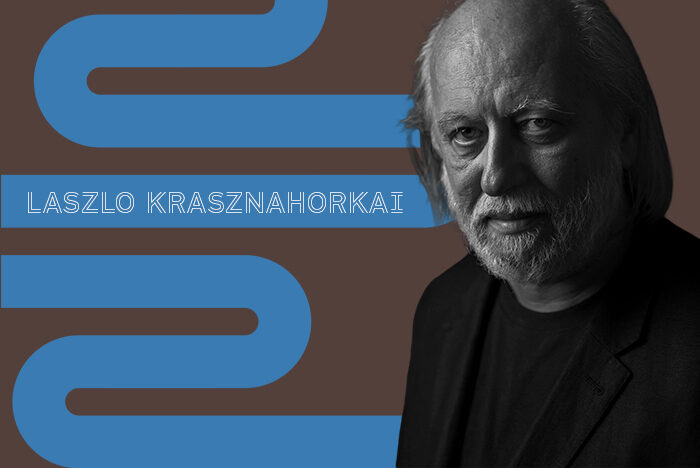
Showing posts with label László Krasznahorkai. Show all posts

Sunday, May 10, 2026

Interviews / László Krasznahorkai


INTERVIEWS

László Krasznahorkai

The Nobel laureate insists on the reality of the present

by Hari Kunzru

THE LAST TIME I saw László Krasznahorkai, he declared his love for me. Admittedly, he was making a rhetorical point about his singular prose style, and we were speaking in front of an audience at an art gallery, but it still felt good. Krasznahorkai is the author of an extraordinary body of fiction, which has made him one of Hungary’s most prominent writers and a perennial candidate for the Nobel Prize. His collaborations with the filmmaker Béla Tarr have brought the bleak, existentially freighted atmosphere of his early work to cinema audiences around the world. His narratives consist of single unbroken sentences that seem to have an almost infinite flexibility, swerving from labyrinthine philosophical musings to earthy humor. In his opinion, experiences such as love—particularly love that has taken time and courage to express—cannot be contained in short phrases. The full stop, he has said in the past, “belongs to God,” and the flow of his writing has a profound humanism. It isn’t the fragmented interiority of the old modernist “stream of consciousness,” but a kind of all-encompassing curiosity about the world, which carries the reader along in its current.

An Angel Passed Above Us by László Krasznahorkai


An Angel Passed Above Us

by László Krasznahorkai  
Translate by
 John Batki

“. . . stets das Böse will, und stets das Gute schafft.”

“. . . forever strives for Evil, and forever does Good.”

—Goethe, Faust

Friday, October 10, 2025

László Krasznahorkai wins Nobel Literature Prize


László Krasznahorkai 
by Agustin Sciammarella

Hungarian author László Krasznahorkai wins Nobel Literature Prize

Laszlo Krasznahorkai

IMAGE SOURCE, GETTY IMAGES

    • Author, Emma Saunders
    • Role, Culture reporter

László Krasznahorkai has won this year's Nobel Prize in Literature.

The Hungarian author was recognised "for his compelling and visionary oeuvre that, in the midst of apocalyptic terror, reaffirms the power of art".

Thursday, August 28, 2025

I Don’t Need Anything from Here by László Krasznahorkai


I Don’t Need 

Anything 

From Here


by László Krasznahorkai

I would leave everything here: the valleys, the hills, the paths, and the jaybirds from the gardens, I would leave here the petcocks and the padres, heaven and earth, spring and fall, I would leave here the exit routes, the evenings in the kitchen, the last amorous gaze, and all of the city-bound directions that make you shudder, I would leave here the thick twilight falling upon the land, gravity, hope, enchantment, and tranquillity, I would leave here those beloved and those close to me, everything that touched me, everything that shocked me, fascinated and uplifted me, I would leave here the noble, the benevolent, the pleasant, and the demonically beautiful, I would leave here the budding sprout, every birth and existence, I would leave here incantation, enigma, distances, inexhaustibility, and the intoxication of eternity; for here I would leave this earth and these stars, because I would take nothing with me from here, because I’ve looked into what’s coming, and I don’t need anything from here.


Translated, from the Hungarian, by Ottilie Mulzet.


László Krasznahorkai is the author of “Seiobo There Below,” “Satantango,” and the collection of stories “The World Goes On.” In 2015, he won the Man Booker International Prize.


THE NEW YORKER


Saturday, May 23, 2015

My heroes / George Szirtes and my other translators by László Krasznahorkai


George Szirtes, Hungarian poet and translator. Photograph: Graham Turner


My heroes: 

George Szirtes and my other translators by Lászlo Krasnahorkai

This year’s Man Booker International prize winner on waiting eight years for his first novel to be translated – ‘my publishers were in deep despair’


23 May 2015

I

have had six translators into English but the first was George Szirtes, who was born Hungarian but moved to England as a child and relearned the language as an adult. I knew his poetry and felt I understood his sensibility. When my publisher asked who would be a good translator, I suggested him. George said: “OK, but I’m not a translator, I’m a poet.” My publisher replied: “Krasznahorkai wants you, so we’re prepared to be patient.” He began with my second novel The Melancholy of Resistance and it took years. Afterwards, for Satantango – which was my first novel – there was no question as to who would be asked to do it. It took eight years and my publishers were in deep despair. For years nothing happened and then suddenly it was ready, and it turned out we were absolutely right to wait. After that, George said he wanted to go back to being a poet but he suggested a new translator, Ottilie Mulzet. It was a big risk because Seiobo There Below has unusually long sentences and the task was to somehow find a new Krasznahorkai English. As George is a poet he had always wanted to catch the essence, a mood; Ottilie wanted to make a more exact translation. In each language the relationship is different. My French translator found 100 mistakes, because the French language can’t play with shades of meaning in the way that Hungarian does. My Spanish translator let the whole text flow through his heart and found a very fine, very fragile language. In Ecuador, a circle of friends made a private translation of my book Animalinside, a collaboration with the artist Max Neumann. In China once, I was speaking at a university about my books and said that, unfortunately, you couldn’t read them there, and someone in the audience put their hand up and said that there was a translation of Satantango on the net that had been done chapter by chapter by people who loved it. Of course, I was delighted.