|
| Jane Birkin |
The Many Faces of Jane Birkin
By Katherine Cusumano
November 9, 2015
In Jane B. par Agnes V. (1988), Jane Birkin plays a muse, her unkempt hair strewn with flowers; Ariadne, the daughter of King Minos of Crete; Laurel of Laurel and Hardy; a Spanish folk dancer; Joan of Arc; Tarzan’s Jane; the lounging subject of an oil painting by Titian or Goya; and herself—past, present, and future. The film seamlessly blends fiction and biography as interpreted by Birkin’s friend and collaborator, Belgian director Agnès Varda. Each vignette comments on a life of performance: Ariadne is pursued, ball of thread in hand, by a menacing black camera; Birkin interrupts her folk dance to express her dismay at the scene’s kitsch; and a moment when Birkin shows Varda around her apartment diverges into a mundane monologue about Birkin’s affection for staircases and family photographs, and her dislike for her answering machine.
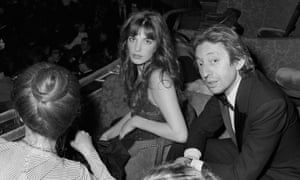 |
Serge Gainsbourg and Jane Birkin in Paris in 1973. Photograph: Michel Clement/AFP/Getty Images
|
Varda has now overseen the restoration of Jane B. par Agnes V. and Kung-Fu Master!, a companion film that depicts a mother of two (Birkin, whose actual children Charlotte Gainsbourg and Lou Doillon play her fictional children) falling in love with a young boy (Varda’s son Mathieu Demy). Neither film has previously been accessible to American audiences; Jane B. par Agnes V. has never had an American theatrical release. The two films spill into one another. A moment when Birkin proposes the plot for a film turns into Kung-Fu Master!, while certain lines of dialogue become repeated motifs criss-crossing between films. Where does real-life end and performance begin? Varda seems to ask. “Même si on déballe tout, on ne dévoile pas grande chose,” Birkin says directly into the camera. Or, as translated by the subtitles, when you show it all, you reveal very little.
Taken as a pair, the movies offer different perspectives on Birkin’s life, career, and talent. “Kung-Fu Master! was my world, but Jane B. was Agnès,” Birkin says, giving credit to Varda for “anything that was refreshingly different.” But Birkin doesn’t do herself justice. Now 68, Birkin emerged as an “it-girl” and fashion icon in her native London during the Swinging ’60s and caused a minor scandal with her role in Michelangelo Antonioni’s 1966 film Blow-Up. When she arrived in Paris in 1968, she quickly became the artistic and romantic partner of Serge Gainsbourg (actress Charlotte is their daughter). Often described as his “muse” (though not by herself—”it seems a bit pretentious,” she says of the label), she became a fixture of the French artistic scene thanks in part to their scandalous duet “Je t’aime… moi non plus,” which infamously ends in a woman’s orgasmic moans. (It was eventually banned by the BBC, as well as on Swedish, Italian, and some French radio programs.) And, yes, she’s the namesake of that crocodile-skin Hermès bag.
We caught up with Birkin during a break from her tour of performances with French actor Michel Piccoli—the two have staged readings of Serge Gainsbourg’s songs without music, most recently in Canada and with upcoming performances in Paris. “For the moment, I’m working on nothing at all,” she says.
KATHERINE CUSUMANO: Do you think that your work reads differently in French and English?
JANE BIRKIN: It’s a bit of a trap, because I have a very English accent in French. When I came to France in 1968, I couldn’t speak French. I learnt it with Serge Gainsbourg, and I learnt the slang. I never knew about masculine and feminine, and the tenses were always very difficult. The accent’s much better now because I did the theater. I had to work twice as hard as everybody else. Un ou une, and all of that, at the same time, I have to admit, I liked being trouble. When I made mistakes, people used to laugh. I could have learnt better, but I’ve always liked to make people laugh.
CUSUMANO: Do you feel different in France than you do in England?
BIRKIN: Certainly. In France, I’ve been a part of the furniture for so long. [Fifteen or 20 years ago], I was working as an assistant on Jacques Doillon’s film as the script girl, and I was so late to catch an airplane to London to be with my sister. It was her birthday, so I was running along the streets and tried to hail a taxi. There was a taxi who was putting his little hood on because he had finished work, but when he saw it was me, he said, “Oh, I’ll take you!” He wouldn’t let me pay, so I arrived at Charles de Gaulle having had this charming taxi man, and when I went up to Air France, they put me in first class. The wonderful trip went on. I arrived in London airport, and I was terribly, terribly late, so I rushed for the taxi line, and [the driver] said, “What’s the address?” I said, “I don’t know. If we go there, I’ll be able to recognize it.” He said, “That fucking woman in that fucking taxi doesn’t even know the fucking address,” and I nearly fainted. He dropped me off at Bushy Park, and I went through the park, running with my suitcase. I arrived at my sister’s house and collapsed into tears. She said, “You’re spoilt.” I said, “Yes, I am. I’m spoilt. That’s exactly what I am.”
CUSUMANO: Did it make you want to go back to France immediately?
BIRKIN: No, I’ve actually had more fun with my sister these past few years, going to her house. I don’t have anything of my own there anymore. My mother’s house has gone in Chelsea. It was such a fabulous house on the Thames. I think the children were miserable when I had to give it up. Everything sort of collapsed after that. The Christmases haven’t been the same—nothing will be the same anyway because of my daughter Kate, who died. It’s something that was for a different age. I have fun with my sister. I can go to art galleries with her, and just have crumpets for tea and not do that much. I love it in London.
CUSUMANO: For Kung-Fu Master!, was there ever any pushback to making a movie about such a taboo subject as the Oedipal relationship between a mother and a young boy?
BIRKIN: I don’t even know whether one could do it these days. But in those days, it seemed to me so normal, because it had really happened. My daughter Kate was giving a party in the house, and there was a little boy who left something at home. He wanted to come by the following day to pick up something he’d left. I thought this could make a really great story. Voila. It seemed very normal.
CUSUMANO: A lot of Jane B. was filmed in your home, with Agnès just with the camera on you. Is it possible to forget that you’re being watched?
BIRKIN: No. But it’s quite exciting, as long as you’re not requested to look into the camera. I always found that very indecent and difficult to do.
CUSUMANO: Why do you find that difficult?
BIRKIN: It’s like looking at the Peeping Tom who’s looking at you. You can pretend it isn’t really happening, and you give it your best as an actress, but if you’re supposed to look into the hole of the camera, then you’re sort of saying, “I know that you’re watching.” I’ve always found it a bit embarrassing.
CUSUMANO: When you are creating a role for yourself that is based in experience, where does you being Jane end and being a character begin?
BIRKIN: I wrote a screenplay of a film that I did as a director but not as an actor, a movie called Boxes. I got everything out— all the difficulties of being a mother, the guilt, leaving the fathers. The way I could see things was always by my way of looking at things. I got all the fathers to come, saying it wasn’t like that, saying, “It’s just your memory, it’s so selective, it’s as selective as a washing machine.” I was pleased to have given the men the capacity of feeling whatever they might have felt to be separated. I liked writing the dialogue for them, and against me, if you see what I mean.
CUSUMANO: There’s a line in Jane B. when you say, “What I’d like more than anything is to make a film about me as I am.” Do you think that you accomplished that?
BIRKIN: In little episodes in Jane B.
CUSUMANO: Do you think it’s possible to make a film that encapsulates a self?
BIRKIN: I don’t know. It was interesting seen by Agnès, but on one’s own, I think it’s limited.
CUSUMANO: Did you have an idea of where it was going when you started?
BIRKIN: No. I was overcome with admiration for Agnès’s knowledge on paintings. Agnès’s aesthetic of the whole thing worked very well. It was wonderful to put yourself into tableaux. It really was her. The thing she did most beautifully was to create all those paintings.
CUSUMANO: It does have a very painterly quality in the way that it’s composed of these different vignettes. In one of those vignettes, you are cast as a literal muse of Greek mythology as a way of talking about the muse to the artist. How do you feel about the label “muse”? I feel like that’s ascribed to you quite a lot.
BIRKIN: As it was a part of my life, I didn’t really think of myself as being a muse. I’m delighted that people think that I inspired Serge in any way, and I suppose that was the theme for Agnès—that’s why, she put it into the film, because of me and Serge.
CUSUMANO: Do you think that, in terms of mythology, the muse is secondary to the artist in any way? The muse in Jane B. seems like she can’t really exist without her artist.
BIRKIN: It’s quite flattering to be somebody’s muse. It never hung me up in any way, because Serge was always writing records. Right until the end, he wrote things for me. I think he realized that I could sing his pain, his difficulty, perhaps more than he wanted to do himself, which meant that I was necessarily a sort of female version, or a B-side of a record. That wasn’t necessarily the thing that showed, because Serge was much more aggressive than that. He went for things that were absolutely extraordinary in their strangeness and never wanted to go back and to repeat what he had done. He was bounding forwards. I realized my good fortune that he didn’t drop me like I think I might have dropped me. He went on writing probably the most beautiful songs, like “Runaway From Happiness”—”Fuir le bonheur”—and so I was lucky.
CUSUMANO: Do you have a favorite part of making a movie?
BIRKIN: I loved having a crew. I loved being the person who woke at six in the morning and knew where to put the camera. I loved watching the actresses cry, and to know that if you were clever and didn’t do too many rehearsals, that it just came that way. I understand the joy of having a female actress like Charlotte [Gainsbourg] and watching her give everything, and be able to capture it.
JANE B. PAR AGNES V. AND KUNG-FU MASTER! OPEN THIS FRIDAY, NOVEMBER 13 AT LAEMMLE ROYAL IN LOS ANGELES
INTERVIEW