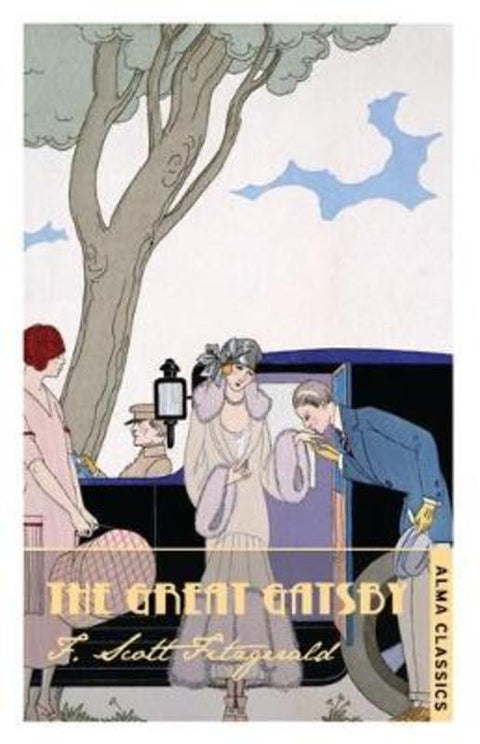
THE GREAT GATSBY
by
F. Scott Fitzgerald
VI
About this time an ambitious young reporter from New York arrived one morning at Gatsby’s door and asked him if he had anything to say.

THE GREAT GATSBY
by
F. Scott Fitzgerald
VI
About this time an ambitious young reporter from New York arrived one morning at Gatsby’s door and asked him if he had anything to say.
THE GREAT GATSBY
byWhen I came home to West Egg that night I was afraid for a moment that my house was on fire. Two o’clock and the whole corner of the peninsula was blazing with light, which fell unreal on the shrubbery and made thin elongating gli. nts upon the roadside wires. Turning a corner, I saw that it was Gatsby’s house, lit from tower to cellar.
' ' ' '
THE GREAT GATSBY
by
F. Scott Fitzgerald
IV
On Sunday morning while church bells rang in the villages alongshore, the world and its mistress returned to Gatsby’s house and twinkled hilariously on his lawn.
AlamyTHE GREAT GATSBY
by
F. Scott Fitzgerald
III
There was music from my neighbour’s house through the summer nights. In his blue gardens men and girls came and went like moths among the whisperings and the champagne and the stars. At high tide in the afternoon I watched his guests diving from the tower of his raft, or taking the sun on the hot sand of his beach while his two motorboats slit the waters of the Sound, drawing aquaplanes over cataracts of foam. On weekends his Rolls-Royce became an omnibus, bearing parties to and from the city between nine in the morning and long past midnight, while his station wagon scampered like a brisk yellow bug to meet all trains. And on Mondays eight servants, including an extra gardener, toiled all day with mops and scrubbing-brushes and hammers and garden-shears, repairing the ravages of the night before.
Imágenes de GettyTHE GREAT GATSBY
by
F. Scott Fitzgerald
II
About halfway between West Egg and New York the motor road hastily joins the railroad and runs beside it for a quarter of a mile, so as to shrink away from a certain desolate area of land. This is a valley of ashes—a fantastic farm where ashes grow like wheat into ridges and hills and grotesque gardens; where ashes take the forms of houses and chimneys and rising smoke and, finally, with a transcendent effort, of ash-grey men, who move dimly and already crumbling through the powdery air. Occasionally a line of grey cars crawls along an invisible track, gives out a ghastly creak, and comes to rest, and immediately the ash-grey men swarm up with leaden spades and stir up an impenetrable cloud, which screens their obscure operations from your sight.
![]() |
| Mía Farrow and Robert Redford in The Great Gatsby |
Then wear the gold hat, if that will move her;
If you can bounce high, bounce for her too,
Till she cry “Lover, gold-hatted, high-bouncing lover,
I must have you!”Thomas Parke d’Invilliers
In my younger and more vulnerable years my father gave me some advice that I’ve been turning over in my mind ever since.
“Whenever you feel like criticizing anyone,” he told me, “just remember that all the people in this world haven’t had the advantages that you’ve had.”
The actor dances his insecurities away and wells up at a particular Eric Clapton song. But which double act brings out his inner cockney?
The first song I fell in love with
When I was a little boy, we had a caravan on the Isle of Sheppey, and I remember hearing My Sweet Lord by George Harrison one summer. It’s about searching for God, and I’ve always thought the way it moves from Hallelujah to Hare Krishna is really beautiful.
![]() |
| Actress Marisa Abela and actor Eddie Marsan film a scene for the Amy Winehouse biopic ‘Back to Black’ in London. Neil Mockford |
Like Amy Winehouse, “Back to Black,” the new biopic about the late British singer, has been no stranger to controversy.
In the case of the film, opinion has been fiercely split about director Sam Taylor-Johnson’s decision to have actress Marisa Abela sing – instead of lip-sync to – Winehouse’s recordings.
![]() |
Eddie Marshan |
You know his face. Over the last 20 years, the British character actor Eddie Marsan has distinguished himself by playing complex villains and characters teeming with thoughts, who don’t—or can’t—articulate their ideas. He’s the rare actor who creates characters you can feel for, even if they’re terrifying. His unforgettable turn as Scott, a volatile driving teacher in Mike Leigh’s Happy-Go-Lucky [2008], who coaches his cheerful student, Poppy, to turn corners “expecting the worst” is both hilarious and powerful. He’s brought nuance and pathos to Reg, a solitary laborer, in Leigh’s Vera Drake [2004]; John May, a civil servant who arranges funerals for people who have died alone in Still Life [2013]; Reverend John, who counsels Benicio del Toro’s born-again Christian ex-convict in 21 Grams [2003]; and Terry Donovan, the brother of the main character on the current Showtime crime drama Ray Donovan. This spring, he stars in 7 Days in Entebbe as then-Israeli defense minister Shimon Peres, and he’s part of the highly-anticipated superhero action-comedy Deadpool 2.
![]() |
| Eddie Marshan |
Your new role in Sky 1's detective drama Thorne sees you playing a detective who seems embittered but also slightly infatuated by his professional partner, DI Thorne (David Morrissey). Do you have any close "bromances" in real life?
Yeah, I do. I don't have many – I'm not a great social animal. I have my family and I have my work and then I have three very close male friends and that's it. But we speak every day and it's very fulfilling. I was brought up in a house full of three older sisters, yet I do have intense, close friendships with male friends.
Were your sisters nice to you when you were growing up?
Both nice and nasty. When you're the youngest and the only boy, you get spoilt but you get told you're spoilt so you don't get to enjoy it very much. I was the only man in the house because my parents divorced and my dad moved away when I was 13.
You played a murderer in Pierrepoint, a snarling villain in Hancock and a psychologically unhinged driving instructor in Happy-Go-Lucky. Does the darkness of your characters ever stay with you?
It doesn't have enough time to stay with me because I'm always going on to the next thing. Major film stars tend to do a film and then have a couple of months off. I'm not a major film star, I'm a jobbing actor. By necessity, you have to let go. Having said that, I was paid to be angry for six months forHappy-Go-Lucky. That stayed with me. I had a few bad temper tantrums before my wife said to me: "I think you should get out of character."
Do you think actors make too much of a fuss about their work?
I see all these people talking about acting as a great spiritual thing. It's not. There's no great mystery to acting. It's a very simple thing to do but you have to work hard at it. It's about asking questions and using your imagination. The trick to acting is not to show off, it's to think the thoughts of the character. I was lucky because when I started acting, it was doing jobs above pubs. I learned to act in anonymity so by the time people saw me, I knew what I was doing. I was crap for years but no one saw me being crap. It's a trade you learn.
Apparently you like to listen to different kinds of music to get you into character?
Yeah, very much so. With Tughan [Marsan's role in Sky1's Thorne], it was Phil Collins and Spandau Ballet. My job is not to be Eddie Marsan. You pay to see me disappear.
What did you listen to for Happy-Go-Lucky?
He was into Depeche Mode. His hair, his jeans and jackets were all stuck in the mid-1980s because he was a man terrified of change.
Is it different from what you listen to on your own iPod?
Yeah. I listen to a lot of jazz. I'm a big Sinatra geek. I love Chet Baker.
You grew up on a council estate in east London, the son of a lorry driver and a teaching assistant. Did your family understand why you wanted to become an actor?
They didn't at first. A lot of it was due to financial reasons. I had a good job as a printer in the East End. Before the unions destroyed it, that job was very lucrative. But my family were very good about encouraging me.
What I love about the East End is that there's a great perseverance, determination and courage. What I dislike about it is that there is sometimes a celebration of ignorance. In my family, there was no celebration of ignorance. They'd come and see Chekhov or Shakespeare. I've got a sister who got a first in her degree. We don't sit around watching TV all the time. The depiction of working-class families on council estates you see in films and on television, the idea that people are somehow lazy spongers – that's not my recollection. David Cameron talks about "broken Britain". Well, I lived on a council estate for 25 years and if I misbehaved, someone knew about it. He's talking a load of crap.
There's an assumption, isn't there, that people who live on council estates should aspire to leave?
Yeah, people don't want to escape. The only reason they would is if you tell them there's something better to escape to. Don't get me wrong – I have a very middle-class life in Chiswick in west London but I don't think I'm happier here than in Bethnal Green.
So do you take exception to the supposed "social realism" of films such asFish Tank?
Certain moviemakers don't patronise the East End but there is – it may be well-meaning – a lot of desire to rescue people. With 90% of people on a council estate, you go into their house and it's spotless, the children are going to school, their sons are learning to be plumbers. Maybe 5% are dysfunctional – alcoholics and drug-takers. And then you get people saying: "Right, that's what we're going to make a film about." But if you look at the class that left Eton or Harrow, 10% of them aren't fine either. You've got to be careful you make a film about people, not about social issues.
How much of your professional success has been dependent on the quirkiness of your face?
Loads of it, because a lot of actors who are good-looking get people saying: "We love the way you look – you would have to be the lead part, but we've already got Brad Pitt." With me, the way I look, the money people don't care who plays that part. Now I try to hide my face most of the time, to be honest with you. I don't want to look like me on screen.
Are you recognised on the street?
Yeah, sometimes I do get people coming up to me. They're always very nice. I went swimming the other day and my wife was watching and she said: "You know, it's funny, it's when you've got no clothes on, no one recognises you." I said: "What are you saying? That I should do more love scenes?"
Do you wear Speedos?
No way. I'm a typical dad: long shorts.