From a "richly atmospheric" novella to a "virtuosic" debut – this is the very best fiction of the year, as chosen by BBC journalists.
The Director to Flesh: The 25 best books of 2025
Rebecca Laurence and Lindsay Baker
Simon and Schuster, Scribner, Knopf Doubleday Publishing Group
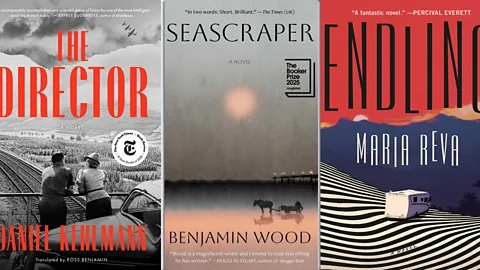
The Director by Daniel Kehlmann
This part-fictionalised historical novel from the bestselling German-language novelist and playwright Kehlmann explores themes of art, power and complicity through the complex life of one of the great Austrian film-makers of the Weimer era, GW Pabst. Pabst flees the Nazi regime to LA, then fails to find success amid Hollywood's Golden Age (Kehlmann imagines that he is ghosted by Greta Garbo and Louise Brooks, actresses he discovered). Upon Pabst's return to his homeland, he is hired by Goebbels to make films for the Reich's Ministry of Propaganda. "The crux of The Director is whether it's weakness or necessity that makes Pabst compromise", writes the LRB. "A book about dreams and of dreams within dreams…", writes The New York Times, "The Director itself is a marvellous performance – not only supple, horrifying and mordantly droll, but fluidly translated and absolutely convincing." (RL)
Mick Herron’s Slow Horses, Belinda Bauer’s obsessive world of bird egg collectors, Uketsu’s innovative Japanese detective mystery – and more
Laura Wilson Tuesday 2 December 2025
If we get the heroes we deserve, then Jackson Lamb, foul-mouthed and slovenly ringmaster of a circus of failed spies, is truly the man for our times. WithClown Town(Baskerville), the ninth book in Mick Herron’s state-of-the-nation satire/thriller mashup series, hitting the bestseller lists, and the fifth series of the Slow Horses TV adaptation streaming, this has been the author’s year. In the latest outing, Lamb and his stable of “losers, misfits and boozers” are well up to the mark as secrets about an IRA double agent threaten to come to light, exposing the seamier side of state security for a story of loyalty and betrayal.
Complicity and culpability, as well as class and professional ethics, are the subjects of Denise Mina’s The Good Liar (Harvill). When the creator of a revolutionary blood splatter probability scale realises that its flaws may have led to an unsafe conviction, she has to decide what to do about it. Tense and powerful, this is a sobering reminder of how the human element can undermine an apparently objective scientific method. The Confessions by Paul Bradley Carr (Faber) ventures into similar territory to terrifying effect. It takes place in an all-too-plausible future in which the world has become reliant on a decision-making algorithm; things go catastrophically awry when the AI tool begins to feel remorse for some of its decisions, and carnage results.
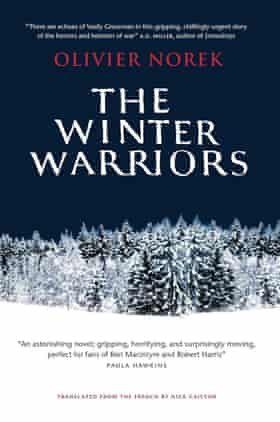
Equally topical, although for different reasons, is the French author Olivier Norek’s astonishingly compelling The Winter Warriors (Open Borders, translated by Nick Caistor), which tells the true story of the Soviet Union’s 1939 invasion of Finland and the incredible feats of Simo Häyhä, the Finnish sniper so effective that Stalin’s terrified troops called him “the White Death”. The second book in Joseph O’Connor’s Rome Escape Line trilogy is another superb testament to humankind’s bravery and resilience. Continuing the story of resistance fighters in Nazi-occupied Italy, The Ghosts of Rome (Harvill) is just as moving and immersive as its predecessor, My Father’s House.
The Northern Irish writer Eoin McNamee is known for literary reimaginings of real crimes, but in The Bureau (Riverrun) he uses family experience of running a bureau de change near the Irish border as the jumping-off point for a tale of black-marketeering in the 1980s, set against a background of political violence and centring on the doomed relationship between a married gangster and his young mistress. Time, place, skewed morals and machismo are powerfully evoked in beautifully spare prose.
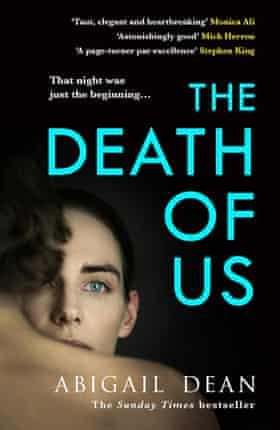
Abigail Dean’s third novel, The Death of Us (Hemlock), deals with the impact of a crime – in this case a violent home invasion, leading to rape – on a marriage. Twenty-five years later the perpetrator, who has committed a string of similar offences, some ending in murder, is caught and tried, with the now divorced Edward and Isabel giving impact statements. Dean weaves both their points of view, past and present, for an exceptional psychological thriller that is also a love story, focusing on the years before and after the terrible event lays bare the fault lines in their relationship.
Belinda Bauer brings back Patrick Fort, protagonist of her 2013 novel Rubbernecker, in The Impossible Thing (Bantam), a tale set in the obsessive (and now illegal) world of bird egg collectors. Switching between 1920s Yorkshire, when young Celie Sheppard reverses her impoverished family’s fortunes by stealing a rare red egg from a guillemot, and the 21st century, when Patrick is trying to track down the burglar who stole an “old egg” in an ornamental box from his neighbour, this funny, moving and unpredictable novel is a treat.
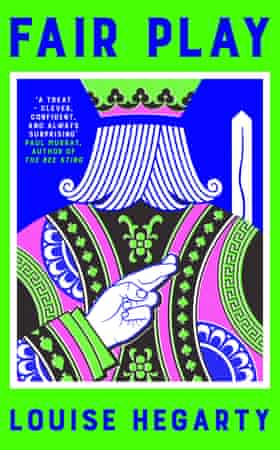
The straightforward cosy crime novel is still incredibly popular, but some authors are borrowing its tropes and conventions to explore different themes. Louise Hegarty’s distinctive debut, Fair Play (Picador), is the finest example of this. It begins conventionally enough with a murder mystery-themed house party, during which a genuine death occurs. The rug is then pulled sharply and repeatedly out from under the reader’s feet as two storylines emerge: one a metafictional Golden Age pastiche, full of knowing asides and tricksy fun; the other a painfully realistic account from the point of view of the victim’s sister, lonely and confounded by grief. The result is an ingenious take on how we make sense of both life and death.
The Japanese YouTuber Uketsu, real identity unknown (he wears a papier-mache mask), is responsible for what must be the most idiosyncratically unsettling crime novel of the year. Strange Pictures(Pushkin Vertigo, translated by Jim Rion) is a sequence of connected mysteries with visual as well as narrative clues, beginning with creepy artwork by an 11-year-old girl who was arrested for matricide. It’s heartening to see that the genre remains as versatile and dynamic as ever.
The return of Nobel laureate Han Kang; film-making under the Nazis; stuck in a time loop; Scandinavian thrills; and essential stories from postwar Iraq
John Self
1 December 2025
We Do Not Part Han Kang, translated by e yaewon and Paige Aniyah Morris (Hamish Hamilton) The Korean 2024 Nobel laureate combines the strangeness of The Vegetarian and the political history in Human Acts to extraordinary effect in her latest novel. Kyungha, a writer experiencing a health crisis (“I can sense a migraine coming on like ice cracking in the distance”), agrees to look after a hospitalised friend’s pet bird. The friend, Inseon, makes films that expose historical massacres in Korea. At the centre of the book is a mesmerising sequence “between dream and reality” where Kyungha stumbles toward Inseon’s rural home, blinded by snow, then finds herself in ghostly company. As the pace slows, and physical and psychic pain meet, the story only becomes more involving. This might be Han’s best novel yet.

 Simon and Schuster, Scribner, Knopf Doubleday Publishing Group