Showing posts with label Sally Rooney. Show all posts

Thursday, August 21, 2025

Sally Rooney to Percival Everett / The 24 best books of 2024 27 December 2024 Rebecca Laurence and Lindsay Baker


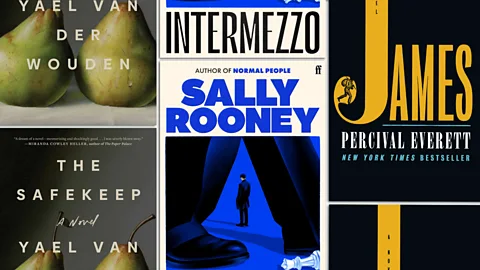
Simon & Schuster/ Faber/ Doubleday Book covers of: The Safekeep, Intermezzo and James (Credit: Simon & Schuster/ Faber/ Doubleday)Simon & Schuster/ Faber/ Doubleday

From an intense tale of two brothers to a stunning Booker winner – the very best fiction of the year.


Sally Rooney to Percival Everett: The 24 best books of 2024

Rebecca Laurence and Lindsay Baker

Intermezzo by Sally Rooney

Launched late in the year to the feverish fan hoards was the fourth instalment in the so-called "Rooneyverse". In a slight departure from the norm, Intermezzo's protagonists are two men: Peter, 32, a talented but troubled barrister, and his 22-year-old chess-prodigy brother, Ivan, both working through grief and family tensions following their father's recent death. Elsewhere, however, there were plenty of Rooney's familiar beats to be enjoyed – tangled relationships, frequent sex, philosophical debates and deceptively simple but assured prose. "Intermezzo is perfect – truly wonderful" writes The Observer, "a tender, funny page-turner about the derangements of grief, and Rooney's richest treatment yet of messy romantic entanglements." Its review concludes by asking: "Is there a better novelist at work right now?" While The New York Times' critic was enchanted, writing: "Intermezzo is Sally Rooney with a bit more butter and cream. Yes, please, waiter. Call me a fool for love, but this oft-jaundiced reader found this meal to be discerning, fattening, old-school and delicious." (RL)

Wednesday, January 8, 2025

The best fiction of 2024


Review

The best fiction of 2024

This article is more than 1 month old

From Sally Rooney’s Intermezzo to Alan Hollinghurst’s Our Evenings, Percival Everett’s James and a host of inventive debuts – this year’s highlights in fiction

Justine Jordan

Saturday 7 December 2024


In a year of surprises – a posthumous fable from Gabriel García Márquez, a superhero collaboration between China Miéville and Keanu Reeves – the biggest news, as ever, was a new Sally Rooney novel. Intermezzo (Faber) landed in September: the story of two brothers mourning their father and negotiating relationships with each other and the women in their lives, it is a heartfelt examination of love, sex and grief. With one strand exploring the neurodiverse younger brother’s perspective, and a conflicted stream-of-consciousness for the older, it opens up a more fertile direction after 2021’s Beautiful World, Where Are You.

Wednesday, September 18, 2024

Five of the best books about female friendship


Five of the best books about female friendship

Sally Rooney, Alice Walker and Nancy Mitford are among the writers who have charted complex and profound bonds that can last a lifetime


Michaela Makusha

Thursday 12 September 2024


The joys and complexities of female friendships have long been an intriguing theme for writers, with novelists exploring their ups and downs: the mutual comfort and growth women can experience together, girlhood bonds that last decades, and the toxic codependency and competitiveness that can sometimes emerge.

Sunday, September 15, 2024

The new Irish narrative: Unruly and centered around the inner self


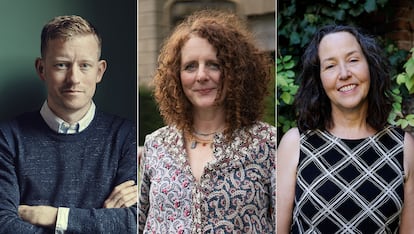
From left to right, writers Colin Barrett in 2019, Maggie O'Farrell in 2023, and Audrey Magee in 2023.

From left to right, writers Colin Barrett in 2019, Maggie O'Farrell in 2023, and Audrey Magee in 2023.ANOUSH ABRAR /

The new Irish narrative: Unruly and centered around the inner self 

The successes of Maggie O’Farrell and Sally Rooney is indicative of what has happened in the last decade to English-language literature. Is the new Irish tradition linked to the experimental writing of the past?


LAURA FERNÁNDEZ
SEP 13, 2024 - 23:00 

Irish writer Maggie O’Farrell, 52, says that if she had to take a book to a desert island, it would be James Joyce’s Ulysses. Published in 1922, it was vilified but, above all, loved and extolled. It prompted speculation that the novel as a form might be dying. For Spanish philosopher José Ortega y Gasset, it indicated that the novel had reached its ceiling, that its traditional form had to be abandoned in order for the novel to grow.

Joyce’s Ulysses is so impressive that even in its misreading it yields a new text, as Irish author Sally Rooney, 33, brilliantly explains in an article in the Paris Review. But what does this mean exactly? It means it opens out possibilities, paths, literally ways of being in the world, according to Rooney. In other words, it enlightens. Its publication marked Irish literature so profoundly that everything that mattered, from Flann O’Brien to Samuel Beckett, at the start of the 20th century, passed through rupture, absurdity, and a deliciously disproportionate formal experiment, on the fringes of any kind of margin.

Today, that mutable inner self that turned the stream of consciousness into a labyrinthian game has been transformed into a collective self. According to Luis Solano, O’Farrell’s editor at Asteroide Books, who points out that O’Farrell grew up in Scotland but must inevitably be touched by the Irish tradition, Irish literature today has more in common with the rest of the world than English or North American literaturedoes, and that is what has given it its central role.

Also the editor of Caroline O’Donoghue from Cork, author of the bestseller The Rachel Factor, Solano stresses that this global relevance may account for the fact “that the two favorite authors for the Booker this year were Irishmen Paul Murray and Paul Lynch. It is a literature of the inner self, which, although very much anchored in reality, reflects universal experiences, because its localism is not as invasive as American localism, which is more focused on the woke, or as the British, which is so isolated by Brexit.” What’s new in them, however, has been a decade in the making. Because when the crisis erupted in 2013, Ireland suddenly occupied a new role, in literary terms.

The creation of small Irish publishers, owned by editors who had returned to Ireland after being made redundant by English publishers, relaunched the country’s talent. No one had anything to lose. They were reckoning on what no one had reckoned on before. And what started as a way to make ends meet became a trend when Tracy Bohan, an agent at the Wylie literary agency, sold the first novel by Sally Rooney, then an unknown 26-year-old, to 12 countries.

Rooney had published an essay that made Bohan think she had something. By then, she had already made her debut in the The Stinging Fly literary journal, along with Colin Barrett and other new Irish authors. The Stinging Fly was a launch pad for any young Irish author worth their salt, especially after Rooney’s success. Although it has been going since 1998, it wasn’t until it was made to look like a book in 2005 that it began to be seen as part of what could make a difference — the go-to journal for publishers eager to find new voices.

“The truth is that in both oral tradition and literature, the Irish have always been recognized for being great storytellers, and brilliant at finding new ways to tell them. If we go back to the English canon from the 19th century to the present day, the great names are, for the most part, of Irish origin. Yeats, Wilde, Beckett, Joyce, Shaw, Flann O’Brien. In fact, what would the English canon be without Irish authors?” ask Albert Puigdueta and Roberta Gerhard, Rooney’s editors in Spain where the author’s latest novel, Intermezzo, is about to appear in book stores. Intermezzo is another experiment, borrowing from Joyce and Woolf’s stream of consciousness device, according to editors Emilie Pine and Michael Magee, who add that both Joyce and Woolf are representative of the different paths that Irish literature has taken today.

There is both a social portrait “with authors like Magee, who are managing to talk about the Northern Irish conflict, a taboo until recently,” says Puigdueta, and a generational portrait, which, in Rooney’s case, “is based on a classic English tradition inaugurated by Jane Austen. Austen spoke of the complexity of romantic relationships and social expectations in the 19th century, and flagged up the contradictions, vanities and defects of each of her characters. Rooney does exactly the same in her novels, but with the concerns and spirit of our time,” adds Gerhard.

The list of names that matter is endless: Claire Keegan, Audrey Magee, Donal Ryan, Jessica Andrews, Eimear McBride, 2018 Booker winner Anna Burns, Lisa McInerney, Tana French, Kevin Barry... and it grows by the minute. Did it do so before the 21st century, when few Irish authors aside from John Banville and Colm Tóibín were globally recognized? One need only look at the number of names cited above for the answer. The form, in all cases, is important, not so much because of the tradition they come from but because of the battle each one fights in a highly competitive world in which distinguishing oneself is the only way to stave off instant oblivion. This is something that Irish literature has been good at from the beginning and, though it is now centered on the inner self, it remains forever unruly and new. And, it seems, better than ever.


EL PAÍS 


Friday, March 1, 2024

Conversations with Sally Rooney / The 27-year-old novelist defining a generation


Immediacy and rawness …
Sally Rooney
Photo by Erik Voake


Interview

Conversations with Sally Rooney: the 27-year-old novelist defining a generation


Her debut Conversations With Friends saw her hailed as ‘Salinger for the Snapchat generation’. As her second book Normal People hits shelves, Rooney discusses post-crash Ireland, the eighth amendment, and being up for the Man Booker prize

Alex Clark
Sat 25 Aug 2018 09.00 BST


Sally Rooney is one of the most exciting voices to emerge in an already crackerjack new generation of Irish writers. Her debut novel, Conversations with Friends, was written in three months – although she says the first draft was in “a terrible state” – and published in the spring of last year, to great acclaim. And here comes her second, Normal People, already being spoken of as even more accomplished.

Sally Rooney’s new novel Intermezzo to be published in September


Sally Rooney


Sally Rooney’s new novel Intermezzo to be published in September

The bestselling author’s fourth novel, which will focus on two brothers, is set to be a ‘standout highlight’ of this year’s fiction titles


Lucy Knight

Thu 29 Feb 2024 14.00 GMT


The wait is nearly over for Sally Rooney’s legions of fans – the Irish writer has announced her next novel, due to be published this autumn.

Wednesday, December 29, 2021

Beautiful World, Where Are You by Sally Rooney review / The problem of success


BOOK OF THE DAY
BOOKS OF THE YEAR


Beautiful World, Where Are You by Sally Rooney review – the problem of success

Anne Enright
Thursday 2 September 2021


There has been such a lot of noise around Sally Rooney’s work, such an amount of fervour and possibly manufactured division. “The cult of Sally Rooney,” says one headline. “Why do so many people hate Sally Rooney?” asks another. The discussion cannot be about the quality of her sentences, which are impeccable, or about her tone, which is thoughtful, often sweet-minded and always rigorous. This is prose you either get or don’t get; for some it is incisive, for others banal. Which makes me wonder if it is so clean, it reflects the readers’ prejudices right back at them.

What Sally Rooney’s Detractors Misunderstand About Her Books

Sally Rooney

What Sally Rooney’s Detractors Misunderstand About Her Books

With Beautiful World, Where Are You, the novelist shows she’s her own best critic.

BY LAURA MILLER
SEPT 01, 20215:40 AM

“I find my own work morally and politically worthless,” writes Alice, an Irish novelist and one of the two main characters in Sally Rooney’s third novel, Beautiful World, Where Are You?, to the other main character, her best friend, Eileen. “And yet it’s what I do with my life, the only thing I want to do.” Alice, whose recent history resembles Rooney’s own in several aspects, has become famous thanks to her first two books and now hasn’t written a page in two years. She still does a certain amount of publicity work, however, treating this, as she explains to Eileen, as her “job.” For all the press junkets to Paris and Rome, however, she finds it a joyless labor. Alice, like her creator, loathes her celebrity, and the vile double it has spawned, a false version of Alice that some people adore and others detest. “I keep encountering this person, who is myself,” she writes in an email to Eileen, “and I hate her with all my energy. I hate her ways of expressing herself, I hate her appearance, and I hate her opinions about everything. And yet when other people read about her, they believe that she is me. Confronting this fact makes me feel I am already dead.”

But the misery of fame is really just a side-dish for Alice, who’s far more bedeviled by the belief that her vocation—inventing stories about the intimate lives of make-believe people—is unconscionable, as she puts it, “in the context of the increasingly fast, increasingly brutal exploitation of a majority of the human species.” The task of the literary novelist, she argues, is to suppress this ugly truth under a facade of high style so that, “we can care once again, as we do in real life, whether people break up or stay together—if, and only if, we have successfully forgotten about all the things more important than that, i.e. everything.” Plenty of people feel that novels preoccupied with sex and friendship—the sort of novels Rooney herself writes—are too trivial, and Alice is inclined to agree with them.

Typically, contemporary novelists speak reverently of their form, as if the result were some kind of sacred object, so Alice’s position has a refreshing lack of mummery. But Rooney undermines her character’s point by making her own novels so uncannily enthralling. In summary, her books sound like trifles of no particular interest, but in execution they’re as habit-forming as crack. The plot of Beautiful World, Where Are You, for example, concerns the love lives of Alice—who embarks on a fractious romance with Felix, a warehouse worker she meets on Tinder—and Eileen, dumped by a boyfriend on whom she wasted “half my 20s” and contemplating getting together with a childhood friend, Simon. Alice, who is still recovering from a nervous breakdown she suffered while briefly living in New York, has moved into a big house in the Irish countryside. Eileen survives on a pittance as an editorial assistant at a Dublin literary magazine.

For the first two-thirds or so of the novel, Rooney alternates between long emails exchanged by the separated friends and third-person scenes from their lives, told mostly in a striking method that restricts itself to the visible surfaces of events, as if the action were reported on by an invisible observer.  She describes what people say and do—Eileen with her phone, tapping on the icon of a social media app and entering her ex-boyfriend’s name, for example—without offering their internal feelings or deliberations. The reader doesn’t know why Felix cancels a date with Alice at the last minute, or ignores increasingly urgent emails from a guy named Damian, or even what his relationship to this guy is. Not, that is, until he explains it to Alice, and then we can’t be sure it’s the whole truth. We can guess from their behavior what’s going on in the character’s minds, but for most of the novel, the only access we get to their thoughts is what they tell each other.

The emails, by contrast, gravitate toward sweeping intellectual subjects, like Alice’s rants about fame and its corrosive effects on the culture. The contrast between these two modes of telling mirrors Alice’s novel-writing dilemma, which is really the dilemma of both women. Their emails reflect what they feel they ought to be thinking about and responding to: the dire state the world and humanity. But the objective evidence of the third-person chapters testifies that they’re preoccupied with their personal lives. Only late in the book, when the friends are finally united, do the two perspectives knit themselves together.

Even so, Alice and Eileen’s lofty political thinking is not the sort that lends itself to action beyond the making of sweeping pronouncements. Alice writes to Eileen that “markets preserve nothing, but ingest all aspects of an existing social landscape and excrete them, shorn of meaning and memory, as transactions,” and Eileen writes back, “my theory is that human beings lost the instinct for beauty in 1976, when plastics became the most widespread material in existence.” They complain, as many people in their age cohort do, rather airily about “capitalism.” They discuss the mysterious collapse of Late Bronze Age civilization in the Mediterranean, after which “literacy all but died out and entire writing systems were lost,” erasing exactly the sort of work they have devoted their own lives to. They brood over the story of Linear B, an ancient Greek script thought indecipherable until the 1950s. Alice finds it “unbearable” that what once was meaningful like this could come to mean “nothing, nothing nothing,” but she seems unaware that, as with many ancient writing systems, most of the Linear B texts that survive record transactions. Capitalism!

A confession: I find the ideological garment-rending and hair-tearing of Rooney’s protagonists endearingly comical. It came as a surprise to me that some critics took, say, the professed “communism” of Frances, the college student and performance poet who narrates Conversations With Friends, seriously and faulted Rooney’s characters’ politics as merely “gestural,” while others argued that the relationships she depicts somehow represent a form of “radical politics.” The contrast between the way these people talk about the world, the performative doom ’n’ glooming so prevalent in social media and casual conversation, and their actual, lived concerns seems the point of Rooney’s fiction. It’s ironic in the original sense of the word, not in the lazy, vernacular sense that Frances means it when she informs her married lover that she’ll only sleep with him “ironically.” There’s what Rooney’s characters say, and then there’s what they do, and in the gap between these two things is where the comic irony of her novels lies, even if Rooney sometimes seems oblivious to it herself. Alice, however, has her own number. “In public I’m always talking about care ethics and the value of human community,” she admits to Eileen, “but in my real life I don’t take on the work of caring for anyone except myself.”


The contrast between the way these people talk about the world and their actual, lived concerns seems the point of Rooney’s fiction.


Meanwhile, the ordinary loneliness of Rooney’s characters can be piercing. Both Alice and Eileen come from damaging families, with the result that prickly Alice finds herself attracted to a shrewd, skeptical man with no interest in her work and Eileen fears that any romantic relationship with Simon will end in a breakup that will cost her one of her few true friends. Their stumbling progress through the minefield of intimacy, related in Rooney’s plain prose and via several exquisitely-rendered sex scenes, has the raw, wincing tenderness of skin under a scab scratched off too soon. That literary characters serve as moral exemplars seems a childish thing to expect, and a foolish one. A novel about characters of impeccably non-gestural Marxist politics sounds both hard to imagine and fairly dull. What I, in my shameless bourgeois complacency, prefer is that the characters in a novel be, as Rooney’s are, eminently human.

“Maybe we’re just born to love and worry about the people we know and to go on loving and worrying even when there are more important things we should be doing,” Eileen writes in riposte to Alice’s indictment of her own profession, a defense upon which I cannot improve. “And if that means the human species is going to die out, isn’t it in a way a nice reason to die out, the nicest reason you can imagine? … Because we loved each other too much and found each other too interesting.”

SLATE