The inspiration for this film was the famous British brothel-keeper Cynthia Payne, in particular her rebellious adolescence spent in Worthing and Bognor, but it was just as much about my own memories of growing up in a village near Cambridge. That parochial life we captured – with every kid’s party taking place in the British Legion and all the men wearing blazers and playing crown green bowls – is taken from my dad and the older generation in my village.
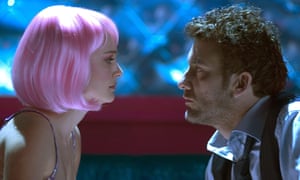
‘A visceral piece of writing’ … Natalie Portman as Alice and Clive Owen as Larry in the film of Closer. Photograph: Collection Christophel
How we made Closer – by Clive Owen and Patrick Marber
‘I wanted to write a Shakespearean scene with someone in disguise, so I went into a lesbian chatroom pretending to be a gay woman’ Interviews by Chris Wiegand Tuesday 9 July 2019
Patrick Marber, playwright
I was in Atlanta in 1996 with a tour of my play Dealer’s Choice and I was dragged along to a lap-dancing club. It seemed a potent, haunting place for a scene about power and sex. That night I wrote a version of the lap-dance scene in Closer with characters called A and B. I wanted to figure out who the guy was, who the young woman was, and what happened to them before and after.
‘At Massimo’s funeral, his film double walked behind the coffin in homage – and all the Neapolitans thought it was his ghost’
Tue 23 October 2018
Michael Radford, director
Massimo Troisi was a huge star in Italy. He loved a film I’d made called Another Time, Another Place, about Italian PoWs in Scotland. We looked at various projects to do together, and he’d bought the rights to this Chilean novel called Burning Patience, about the death of Pablo Neruda and his friendship with a 17-year-old fisherman.
He’d had an adaptation written already, but it was awful. Massimo and I started again, working with Anna Pavignano, his former girlfriend, in a beachfront hotel in Santa Monica. We made the fisherman a 40-year-old postman, played by Massimo, and Neruda’s exile was our invention, too. One moment in the book stood out. In the 1970s, Neruda had asked the fisherman to send him tape recordings of his house at Isla Negra. I saw that it could be built up as an expression of the postman’s desire to do something creative. For me, that was the key.
I called up Philippe Noiret, who looked astonishingly like Neruda. Within an hour, he called me back and said: “If you give this to anyone else, I’ll be incredibly angry.” I also needed Neapolitan actors of 70-plus who looked like fishermen in the 50s. They came in, and I recognised many of them from Fellini movies. But they were all fat, completely unsuitable. I said to the casting director: “I can’t take any of them.” He said: “Thank goodness.” He pointed to a guy sitting in the hallway with a white suit, white fedora, white shirt, white shoes and a red tie. He was smoking with a cigarette holder. The casting director said: “He’s from the Camorra. He controls all actors in Naples over the age of 70. If you take one of them, he’s going to be on the set, he’s going to have a producing credit.”
Meanwhile, Massimo, whose heart had been damaged by rheumatic fever when he was a child, had gone to Houston for a checkup. When he came back six months later, he didn’t seem like the same person.
He collapsed on the set on the third day. He was in a terrible state. He could only film for about an hour a day, so we had to work our way around it. I just shot him in closeup. Whenever there was a wide shot, we used a double. In lots of scenes, he arrives on a bicycle, but that’s not him. Every dialogue sequence was done sitting down. I made him sit on a sound stage in Cinecittà and speak his entire dialogue just in case he didn’t make it.
In the most famous sequence, the tape recordings, he was never in shot. I got the telegraph worker character to wander around with the recorder and used my own hand to double for Massimo’s with the mic in the foreground. Philippe did all his lines in French, so in the scene where they’re discussing metaphors on the beach, he and Massimo couldn’t understand what the other was saying. Yet it looks as if there’s such understanding between them.
We ran completely over schedule. After Massimo’s last day, he went to stay with his sister in Ostia. I was listening to the radio in my apartment in Rome, and suddenly it was saying he’d died. I jumped in the car straight to his sister’s. I was crying as I was driving, and suddenly realised I was being photographed by a truckload of paparazzi. At his funeral, his double walked in homage behind the coffin; all the Neapolitans, who are superstitious as hell, assumed it was his ghost.
Harvey Weinstein bought the film to distribute. I remember him saying to me: “I’m going to sell poetry to the American people.” And he did. We were nominated for pretty much every big Oscar, and it made $21m, which made it one of the highest-grossing foreign-language films of all time. It was huge in India, though I don’t think anyone purchased a legal copy. I got a letter from Haruki Murakami saying it was his favourite movie. Everybody at some point thinks about writing a piece of poetry to express the better part of themselves.
‘You’re perfect as you are’ … Massimo Troisi and Maria Grazia Cucinotta. Photograph: Ronald Grant
Maria Grazia Cucinotta, actor
After five auditions, I got the role of Beatrice, who is wooed by Massimo’s postman. It was a complete shock. I’d had a few small roles on television, but it was my first time acting in a real movie. Massimo told me: “You’re perfect as you are. I need a quintessential southern Italian girl, so just be yourself.”
I’m from Messina, Sicily, so I grew up a little bit like Beatrice, a bit wild. The most difficult thing was not to move in a modern way. Women from the 50s were more sensual. So I watched lots of Sophia Loren and Gina Lollobrigida movies.
I was nervous among all these famous people. They were all very nice, apart from when they were shouting at me. But I deserved it. I needed to learn faster. Michael was the kind of director who needs everything perfect. I had to repeat the scene when I met the postman for the first time about 50 times. Michael said: “It has to be like you’re drunk.” I said: “I’m not drunk, I’m just in love.” He said: “Love is like wine sometimes, it makes you feel happy. But not exactly happy, more like you’re in another world.” It’s not easy to understand, especially when you’re not a professional.
The impact of the film was a shock. Before I was Maria Grazia, afterwards they started calling me “La Cucinotta”. In South America, I couldn’t walk by myself in the street. I was very young, only 24. I had my best friend crying on one side, me becoming so famous, and Massimo wasn’t there. But in a way, he’s still alive through the movie. I always say: he left his heart inside it.
Pierce Brosnan on GoldenEye: crazy stunts and thigh-crushings from Xenia Onatopp
A tank flattened a camera, M called him a sexist dinosaur and his fights with Onatopp were so rough they needed a padded cell … the Irish actor recalls his 007 debut Interviews by Phil Hoad Monday 4 February 2019
Pierce Brosnan, actor
The first film I saw when I came to London as a boy was Goldfinger, which starred Sean Connery as 007. In Ireland, I had been brought up on a diet of Old Mother Riley and Norman Wisdom, so it was a bedazzling moment, seeing this lady covered in gold paint. I ended up getting a toy car with an ejector seat, but I didn’t have any aspirations to be James Bond. The character who really captured my imagination was Oddjob, Goldfinger’s bowler-hatted henchman.
I was originally offered the role of 007 for The Living Daylights. I’d done all the photos with the iconic gun pose and my late wife and I were about to toast our new life with a bottle of Cristal when my agent called and said: “It’s fallen through.” It was because I couldn’t get out of Remington Steele. The role went to Timothy Dalton instead but, by the mid-90s, the franchise had been dormant for six years because of a rights dispute. I heard rumblings that the part was available, but ignored them because I didn’t want to put myself back in that emotional vortex. Then I met the producers Cubby and Barbara Broccoli and, a week later, they called and said: “You’re in.”
The sceptics were out in full: the world felt there was no need for another James Bond. So the challenge was enormous. I didn’t want to get caught between what Sean and Roger had done. Yet, at the end of the day, my take was a little bit of what both had brought to the role. I leant towards Sean’s style, but I couldn’t deny Roger because GoldenEye was in the tongue-in-cheek style people had become used to.
It was a demanding role, physically and emotionally. I did a lot of wirework and fight sequences. They created a padded cell for the fight in the bathhouse with Xenia Onatopp (Famke Janssen), so we could go at it pretty hard. The most arduous fight was the one with Sean Bean, on the ladder over the giant radio telescope at the end. He and I spent six weeks constructing the sequence, working on it during our lunch breaks and at the end of the day with a stunt coordinator. But carrying myself as Bond was as much a mental as a physical thing. You have to hold the stage. You go in to win, full tilt to the finish line.
GoldenEye’s success was a great relief. I was prepared for the attention. Once you have that brand, you’re stamped as a Bond. It was a great irony playing a British cultural icon as an Irishman. I had a quiet chuckle to myself.
Martin Campbell, director
It’s exciting breaking in a new Bond. I did Daniel Craig’s first one, too. You’ve got something to work with. The producers had been checking other people out just in case. I think they may have looked at Mel Gibson and Ralph Fiennes. But it was obvious Pierce was the right person. You couldn’t get a better-looking Bond. Put him in a tuxedo and it’s game over, mate.
It was budgeted at $55m, which is ludicrously little by today’s standards. I think United Artists had doubts about how the audience would respond after the big gap since the last film. The press had been asking if Bond was still relevant. We decided we had to address this, so we introduced Judi Dench as M, and had her call him a sexist, misogynist dinosaur. The girls, too, were very independent – in the past, they always hung on to Bond’s coat-tails. I loved Famke Janssen’s orgasmic thigh-crushing as Xenia Onatopp.
With Bond, we used to say: “What’s never been done before action-wise?” It’s quite difficult after 16 films. GoldenEye’s bungee jump off a dam at the start was my idea. We used the Contra dam in Switzerland, which is bloody terrifying. There was no digital manipulation: the stuntman Wayne Michaels just did the 700ft jump. As they were doing the countdown, he saw the guy on the crane crossing himself. He did it perfectly the first time. I guess he didn’t want to do a second.
Director Martin Campbell (left) with Brosnan and Joe Don Baker on the set of GoldenEye in 1995. Photograph: Allstar/Eon Productions/United Artists
We were getting very tight on budget by the time we got to the tank chase through the streets of St Petersburg, so we built replica streets in the studios at Leavesden. We had three or four Soviet battle tanks, T-55s, the proverbial unstoppable force. You just let the bloody thing go and it knocks anything down. One crashed through a wall, ran over a Panavision camera and flattened it. A couple of companies turned us down for the bit where it smashes through a drinks truck. Perrier ended up getting a good ad out of it. GoldenEye was probably the first Bond film to really cash in on product placement.
I turned down Pierce’s subsequent Bond films. There’s always a madman taking over the world and a control room that has to be blown up. The producers felt the last of the Brosnan Bond films, Die Another Day, had got too fantastical, with the invisible car and the ice palace. They decided there had to be a complete rethink. That’s how Casino Royale came about.
John Berger - artist, writer, critic and broadcaster - has died at the age of 90. His best-known work was Ways of Seeing, a criticism of western cultural aesthetics. For Newsnight, Gavin Esler, met him back in 2011.
Interview
How we made: John Berger and Michael Dibb on Ways of Seeing
'Our first audience was one of fridges, cookers and washing machines'
Monday 2 April 2012 John Berger, presenter
We were a small group: Mike, me, a soundman, an editor called David Gladwell, and the director of the BBC department who commissioned it, Stephen Hearst. Stephen left us alone for six months to get on with it. Those circumstances were really special, even then; now, they are unimaginable. No broadcaster is going to give four crazy guys six months to make four half-hour films.
During those six months, we shot and reshot with total liberty, on a very small budget. We couldn't afford a studio; we were in what looked like a Nissen hut in Ealing. There was no sound-proofing and it was near a road, so if a lorry passed when we were filming, we had to stop, wait and retake.
We had thousands of disagreements, about tiny details like the timing of cuts, though they often shaped the show's overall arguments. I was the writer, but the script was the result of all our dissatisfactions and discussions; I gave a voice to those ideas.
The show argued three new things. First, that the availability of visual art had changed; people could now see images at home [in books], not just in galleries. The second was about the view of women. Although there were no women on our team, we were all in sympathy with the feminist struggles of the time. We said things about the male gaze that just weren't said on the BBC, though I wouldn't claim we were the first to think of them. The third, the most prophetic, was about the cultural importance of publicity, the way art and religion are used to encourage the buying of commodities.
We used to laugh about the lack of continuity. In those six months, my hair was cut: sometimes it's over my ears and sometimes it's not. But I was always wearing the same shirt and assumed people wouldn't notice.
The BBC showed it very late at night [in 1972], because they didn't trust us. They accepted the shows but weren't enthusiastic. Then we got hold of the turn-off rate, which, compared to other art shows, was minimal. We approached the higher-ups and said, "Look at that." Then they broadcast it at a more accessible hour.
The most ground-breaking thing we did was address the public in a way that was non-elitist, equal, really looking into their eyes. There's one point at which I say something like, "Question now what I'm saying, think about it, disagree if you want to." That voice – companionable, a little conspiratorial – was the most important thing.
Michael Dibb, director
Growing up, I had been influenced by John's writing in the New Statesman. It's rather rare to work so well with someone who has informed the way you think. We shared a political and cultural perspective; there were never arguments about the direction we were going in, only about how to get there.
John is a beautiful writer with a wonderful presence and a terrific way of verbally shaping an idea. That gave me a solid scaffolding on which I could build a collage of images and sequences. People often think [Berger's book of the same name] came first, but it would never have been written the way it was if we hadn't had months of slowly constructing the films.
Instead of making pilgrimages to galleries, the works of art came to us as reproductions – except on one occasion, when John went to the National Gallery and stood in front of Leonardo's Virgin of the Rocks. Otherwise, we filmed it all in an electrical goods warehouse. Our first audience was one of fridges, cookers and washing machines.
It was an accident that he was in front of a blue screen for most of each episode. (John, who normally wears a blue shirt, had to rush out and buy two new shirts.) We were going to inlay art works into that background, but we filmed it on film and the technology wasn't good enough; we would have had no flexibility in the edit. The blue screen gave an impression that John was delivering the tablet from on high. People have made a lot of that, but it was just a fortunate accident.
It was interesting to deconstruct the way art had been presented on television. We made the act of seeing self-conscious for the viewer; we said, 'Get up off your knees, don't worship art.' Parts two and three came from things John had written before, about the female nude and oil painting.
We didn't know what the final episode was about when we started filming. For a while it was going to be about the deconstruction of national heritage. Then, one night, John was on the Tube and realised the gestures, poses, the presentation of social and sexual relationships, all those things we had been looking at had a new life in advertising. We looked into shop windows, stared at hoardings, and built up a vast vocabulary of images for the final film.
The BBC didn't make a song and dance about the first broadcast. There were few reviews. The Radio Times did an interview with John, and didn't publish it. The whole series was a journey of discovery. I've got all the scripts, which show it was rewritten and rewritten. In all creative things, you go into a world where you flounder around for a long time before you end up with the final thing.
‘Very much a Jane Austen character’ … Kate Beckinsale, left, as Charlotte with Chloë Sevigny as Alice. Photograph: Moviestore/Rex/Shutterstock
How we made The Last Days of Disco
Kate Beckinsale and Whit Stillman on how their cult classic propelled them into a world of subway dancing, penthouse parties with DiCaprio – and free dessert
Interviews by Phil Hoad
10 July 1018
Whit Stillman, director
When I was living in New York and working on a newspaper, I’d get off work at 2am and we’d go to clubbing at Studio 54. There weren’t a lot of other places in the neighbourhood to go to. I had a tailor-made blue suit that was my sole legacy from my father. It was my magic charm for getting into the club. I was scared of Studio 54 at first – but it wasn’t in the least bit scary once you got in. My first date with my future wife was there.
Barcelonahad been a very troubled shoot: one of the few happy times was when we filmed in a disco that belonged to friends. I’d been accused of making only dialogue films, so I thought it would be beautiful if we shot a whole film in a disco. Castle Rock, who producedBarcelona, wanted to announce my next film – so they did, before I’d even starting writing The Last Days of Disco. This was a problem because another disco-era film,54, was also in production. Castle Rock did not want to come out second. It put our casting under huge pressure.I had this idea for this over-the-top character, a kind of world-beater. I happened to see John Schlesinger’s Cold Comfort Farm, and I could see Kate Beckinsale as very close to Charlotte in Last Days of Disco. Charlotte is very much a Jane Austen character, and Cold Comfort Farm was based on Austen’s Emma. We were about to cast Winona Ryder as Charlotte’s friend Alice, but my editor on Barcelona had been telling me how much I’d like Chloë Sevigny. The casting people were against her, but her audition was fantastic.
We had a $9m budget, and I wanted to knock everybody’s eyes out. We shot the club scenes in the Loew’s Jersey theatre, a baroque 1920s cinema. We were sharing it with Illuminata, a John Turturro film; they paid for the red carpeting, we paid for everything else. It was an enormous amount of work and money to fit it out, and then you have to people it with extras. In retrospect, I should have shot in a tiny little club like in Barcelona, where you put in 30 people and it looks massively crowded. But most of the extras worked as waiters, so I got many excellent free entrees and desserts in New York for the next few years.
‘I’d written it to warn my daughters of the perils out there, how guys are’ … Chloë Sevigny, Whit Stillman and his daughters, and Kate Beckinsale during filming of The Last Days of Disco. Photograph: Whit Stillman
I was in self-indulgent mode, and Castle Rock were really supportive. I elongated the shoot to 50 days, when I usually do it in less than 30. The final scene, where we break the realism and everybody on the subway starts dancing to Love Train, was shot in a defunct station attached to a transport museum; we could control a train going in and out. It’s a bunch of New York background actors who you’d normally never see dancing on screen because they don’t look young and cool. It’s great to have all these unlikely looking people cutting loose.
There were so many things working against us commercially. Boogie Nights, which came out the year before, whetted everyone’s appetite for a different kind of film: it made that disco era seem very porno and extreme. It only made $3m – the soundtrack was a bigger hit than the film. People said, “Disco wasn’t like that.” And I would say, “Which clubs did you go to?” And they’d say: “I only liked punk.”
Kate Beckinsale, actor
I only realised 20 years later that Whit had written the part for me. He never said anything, before, during or after making the film. I was offered the part at the same time as the opportunity to do Patrick Marber’s Closer at the National. I made my decision based on which made me the most anxious. This was such a stretch: I was very, very English.
I had watched quite a lot of Scorsese and turned up in New York frightened I was going to get cheese-wired on the corner of every block. Whit’s script was so funny. I remember looking at the scene in which the characters discuss the sexual politics of Lady and the Tramp, thinking: “My God, this guy’s deranged.” It’s like when you’ve got kids who are getting older and they’re having very intense philosophical discussions. It’s weirdly, wistfully amazing.
The dancing scenes weren’t hard – Whit didn’t want anything outre. We were all twentysomething actors, having a great time doing this job. Chloë, who at that point was the queen of everything cool, was really generous. She had this very fancy fur coat of a social life that she wore very casually and was very happy for you to try on. I’d find myself at a party in a palatial penthouse flat with Leo DiCaprio there.
I was OK with the film’s box-office failure, because that wasn’t how I measured its success. I had done the thing I found scary, and made lots of lifelong friends. And, over the years, I find people keep bringing up the film. Maybe its 20-year-anniversary tagline should be: why didn’t I watch it earlier?