Showing posts with label Daniel Kehlmann. Show all posts

Sunday, June 21, 2026

70 brilliant books for the summer


A person sits reading by a pond, with another person visible in the background among lush green trees

From dynamite debuts to must-read memoirs and magical children’s fiction, here’s our selection of this year’s hottest holiday reads

70 brilliant books for the summer


Leading authors Mark Haddon, Samantha Harvey, Zadie Smith select their favourites

Sat 13 Jun 2026


Fiction

Transcription

Ben Lerner

A middle-aged writer returns to his college townto record the final interview with his 90-year-old intellectual mentor. But he’s broken his phone, and doesn’t seem able to confess that it’s not recording … this anxiety dream of a beginning leads us into a series of sharp insights into family, memory, inheritance and storytelling – all that it means to be human, and how smartphones are changing our sense of the world at every level.

Friday, June 12, 2026

My top 10 by Daniel Kehlmann


Headshot of Daniel Kehlmann

My top 10
Daniel Kehlmann
Author

See the full list

War and Peace (#7)
by Leo Tolstoy
In Search of Lost Time (#5)
by Marcel Proust
Anna Karenina (#6)
by Leo Tolstoy
The Radetzky March
by Joseph Roth
Sorrows of Young Werther
by Johann Wolfgang von Goethe
Elective Affinities
by Johann Wolfgang von Goethe
The Idiot
by Fyodor Dostoevsky
The Magic Mountain (#42)
by Thomas Mann
Simplicissimus
by Hans Jakob Christoffel von Grimmelshausen
10 Ragtime (#90)
by EL Doctorow


THE GUARDIAN


Thursday, April 2, 2026

The Director to Flesh / The 25 best books of 2025

 Random House, Penguin Group The book covers of Will There Ever Be Another You; Big Kiss, Bye-Bye; What We Can Know (Credit: Random House/ Penguin Group)

Random House, Penguin Group

From a "richly atmospheric" novella to a "virtuosic" debut – this is the very best fiction of the year, as chosen by BBC journalists.


The Director to Flesh: The 25 best books of 2025

Rebecca Laurence and Lindsay Baker


Simon and Schuster, Scribner, Knopf Doubleday Publishing Group (Credit: Simon and Schuster, Scribner, Knopf Doubleday Publishing Group)Simon and Schuster, Scribner, Knopf Doubleday Publishing Group

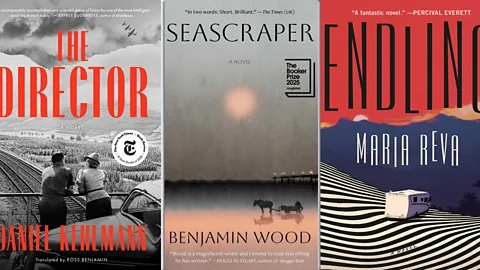
The Director by Daniel Kehlmann

This part-fictionalised historical novel from the bestselling German-language novelist and playwright Kehlmann explores themes of art, power and complicity through the complex life of one of the great Austrian film-makers of the Weimer era, GW Pabst. Pabst flees the Nazi regime to LA, then fails to find success amid Hollywood's Golden Age (Kehlmann imagines that he is ghosted by Greta Garbo and Louise Brooks, actresses he discovered). Upon Pabst's return to his homeland, he is hired by Goebbels to make films for the Reich's Ministry of Propaganda. "The crux of The Director is whether it's weakness or necessity that makes Pabst compromise", writes the LRB. "A book about dreams and of dreams within dreams…", writes The New York Times, "The Director itself is a marvellous performance – not only supple, horrifying and mordantly droll, but fluidly translated and absolutely convincing." (RL)

Saturday, January 10, 2026

The Director by Daniel Kehlmann review – the author’s best work yet


BOOK OF THE DAY
Review

The Director by Daniel Kehlmann review – the author’s best work yet

This article is more than 6 months old

This portrait of German film-maker GW Pabst and his moral struggles under the Nazis has the darkness and ambiguity of a modern Grimms’ fairytale


Nina Allan
Friday 6 June 2025


Georg Wilhelm Pabst was one of the most influential film directors in Weimar Germany, probably best known on the international stage for discovering Greta Garbo and Louise Brooks. His radical approach earned him the nickname of “Red Pabst”, and when Hitler was elected to power in 1933, Pabst reacted by taking his family to the United States. He intended to emigrate permanently, but what was supposed to have been a brief trip back to Austria to visit his sick mother saw Pabst detained inside the Third Reich for the duration of the second world war. This unfortunate turn of events had a dramatically detrimental effect, not only on Pabst’s immediate situation but on his entire postwar career.