‘She wrote the best first line – and the most chilling stories’: Stephen King on the dark brilliance of Daphne du Maurier
This article is more than 4 months old
From Rebecca to The Birds and scores more creepy short stories, Du Maurier was queen of the uncanny, writes the US horror maestro
Stephen King
Sunday 28 Septiembre de 2025
Last night I dreamt I went to Manderley again.” It’s one of the most well-known first lines ever written in a novel. Certainly the most memorable; I used it myself as an epigram in my novel Bag of Bones. Daphne du Maurier also wrote what may be the best first line in a tale of the uncanny and outre. Her classic story The Birds opens with this: “On December the third the wind changed overnight and it was winter.” Short, chilly and to the point. It could almost be a weather report.
On the jacket of du Maurier’s Vanishing Cornwall, an unidentified author wrote that “Cornwall has provided the writer with the background for her most famous novels:Rebecca, Jamaica Inn, Frenchman’s Creek, The King’s General, My Cousin Rachel, andThe House on the Strand.” (The Loving Spirit and Rule Britannia are also set in Cornwall.) While it is true that the Cornwall scenes du Maurier saw inspired her, du Maurier was far too creative to use in her novels the settings she loved unaltered. In each book, she changes settings to arrive at the atmosphere—or details—she wants. Visitors to Cornwall even shortly after a book was published could not, using the descriptions in her books, find the settings she describes.
Places you’d be desperate to avoid in real life provide a magnetic lure in books by authors from Dickens to Du Maurier and even Richard Adams
Xan Brooks
Wed 26 April 2017
M
y novel, The Clocks in This House All Tell Different Times, tells the tale of a girl who travels through a dark forest and arrives at a big house. The forest is bad but the house is arguably worse – a false sanctuary inhabited by decadent aristocrats; boozy and boisterous, on the brink of turning nasty.
At some point when writing the story, I realised I was naively blundering into a long and noble tradition of books about terrible houses, much as I’ve naively blundered into many awkward, unfamiliar houses down the years. Maybe I love these places in fiction because I hate and fear them in real life.
Below is a list of good books that fetch up at bad houses. These houses are variously frightening, unsettling or funny – but they all tap into the mounting panic and inadequacy that we (or possibly just me) feel on arriving at an unfamiliar place and realising within seconds that we don’t fit in, that we will never fit in, and that the best that can be hoped for is to avoid some awful faux pas. These are the houses where the flush doesn’t work and the doorknob comes off in your hand and where you say the wrong thing and the host decides that, on balance, he hates you.
Apologies to Sartre, but I think he had it slightly wrong. Hell is not other people; it is other people’s houses.
Rebecca is the name of the first Mrs de Winter, dead in a boating accident but still haunting the wings of lavish Manderley, on the Cornish coast. The house remains much as she left it. Her housekeeper Mrs Danvers remains stubbornly in situ, like an emissary from the spirit world. The second Mrs de Winter knows she can never measure up. It is all she can do to totter out in one piece.
At the start of her peerless 1959 novel, Jackson dispatches a quartet of thrill-seekers to conduct a paranormal experiment at a remote American mansion. Hill House, we are told, is “vile” and “diseased”. The trouble is that the woman who tells us is shy, reclusive Eleanor, who may not be altogether sound and stable herself. In this way, Jackson suggests that the scariest houses are a kind of Rorschach blot, or even a blank canvas. We bring the horror with us and sit it beside us on the couch.
In 1922, suffering from tuberculosis, Kafka sat down to write the story of K, a land surveyor desperate to gain access to a forbidding castle in order to clear up a bureaucratic error. Reports suggest that Kafka planned to have his hero eventually die in the nearby village, with his case still ongoing and his legal status in limbo – except that the author never made it that far. His death ensures that the mystery of The Castle remains forever unresolved.
Aickman was an eminently respectable Englishman (chairman of the London Opera Society, co-founder of the Inland Waterways Association) who wrote scary fiction on the side. The Hospice might just be the most purely unnerving short story I’ve ever encountered, despite (or because of) the sense that I’m not entirely sure whether anything truly terrible happens. It’s about a travelling salesman, Maybury, who stops for the night at a mysterious house that may be a hotel, or a hospital, or some kind of purgatory. Inside, the guests sleep two to a room because they hate to be alone. At mealtimes, they wolf down mountainous portions while fettered by their ankles to the table. At one point, in the night, there may have been a murder. But the rooms are too dark and the thermostat’s turned too high and besides, it’s impolite to ask awkward questions. Just eat your food; get some rest.
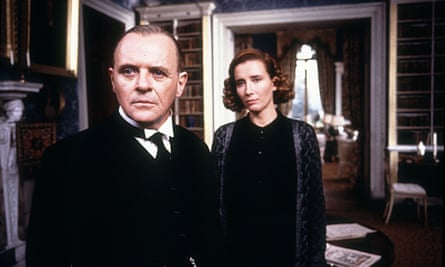
Ishiguro is the master of the dramatic side-eye, a writer who affects to position himself at one remove from the plot’s centre, quietly attending to the place settings and all but daring us to look elsewhere. The Remains of the Day, then, is the memoir of a dutiful butler (Stevens) at lavish Darlington Hall. But it is also (at heart, really) the tale of a passion that threatens to pop his starched collar and of a faithless, would-be quisling aristocracy in the runup to the second world war. Stevens clearly feels that certain doors are off limits. Ishiguro, very gently, invites us to prise them open.
Starched … Anthony Hopkins and Emma Thompson in the 1993 film version of The Remains of the Day. Photograph: Allstar/Columbia Pictures
How does one begin to navigate Danielewski’s literary hall of mirrors, let alone explain the damn thing? Ostensibly, it’s about the Navidson family, who return home to discover that their Virginia house has mutated. It’s bigger inside than out. A hallway appears out of nowhere; the spiral staircase seems without end. And audaciously, in the meantime, the book’s mutating too. Danielewski throws in references to illusory films and essays. His footnotes sprout footnotes and these lead us down the wormhole. One day I have to reread it, but the very prospect makes me nervous.
Before anyone cries foul, my defence is that a) a burrow is basically a house for rabbits and b) that the evergreen Watership Down is a book that views the world at rabbit-eye level. Oh, and c) that the rabbits in Cowslip’s warren are the most peculiarly human of beasts. Creepily so – a group of pampered, indolent aesthetes who are permitted to lounge about like minor royals so long as they turn a blind eye when the farmer wants fresh meat. Adams’s vagabond heroes initially view the warren as a place of sanctuary. But it’s a horrible place, a terrible house, where the residents sleepwalk towards the snares.
Dickens’s novel peaks early, with Pip’s visits to spooky Satis House (apparently named after a real mansion in Rochester, Kent). This is the home of Miss Havisham, still wrapped in her wedding dress, who keeps an uneaten tiered cake mouldering on the table and ensures all the clock hands point to twenty-to-nine. Dickens, of course, wrote great ghost stories in his time. But I don’t think he ever conjured a phantom quite as tragic and creepy as this.
Stumble upon this novel at an impressionable age and the experience is like walking into the middle of a firework display; dazzling and colourful and a little scary, too. Fowles rustles up a gripping tale of seduction and betrayal as cocky Nicholas Urfe falls under the spell of a puckish Greek recluse. The island estate is a laboratory, which leaves Nicholas Urfe as the rat. In playing tricks on his hero, Fowles plays beautiful tricks on us, too.
For anyone who has ever misjudged a mood, wrecked a dinner party or generally disgraced themselves in polite society, there is always Lucky Jim, one of the flat-out funniest books ever written. This hits a comedic crescendo at the home of Professor Welch and his horrific son Bertrand, where the guests are dragooned into madrigal singalongs. The first time I read this – aged 18, on a train – I wound up laughing so violently that I first knocked my drink to the floor and then pitched head-first into the aisle when trying to retrieve it. A case of idiotic real life imitating great art.
Rebecca to Rachel: 10 of the best Daphne du Maurier films
Ben Wheatley’s new version of the gothic thriller Rebecca joins an impressive list of big-screen Du Maurier adaptations
10. The Years Between (1946)
Valerie Hobson plays the wife of a British MP (Michael Redgrave), who learns her husband has been killed in the second world war. Just as she is getting to grips with her loss, preparing to marry a neighbouring farmer and taking up her late husband’s seat in parliament (where Churchill is impressed by her maiden speech), he turns up alive. Apparently, reports of his death were greatly exaggerated because he was secretly working for the Resistance. Now, he expects her to return to her housewifely duties, but everything has changed. This earnest adaptation of Daphne du Maurier’s play has not aged well.
9. Hungry Hill (1947)
“There’s terrible trouble at t’mines.” Copper John (Cecil Parker) decides to increase his fortune by sinking a copper mine into disputed land, leading to three generations of feuding families duking it out in 19th-century Ireland in this gloomy adaptation of Du Maurier’s seventh novel. Meanwhile, Fanny Rosa (Margaret Lockwood) dithers between two brothers (Dennis Price and Michael Denison), but honestly, who cares? The characters and their conflicts never come into focus as the never-ending drama plods on, with acres of stuffy exposition jiffed up only occasionally by rioting miners, exploding shacks or a staid society ball degenerating into a raucous Irish jig.
8. The Scapegoat (1959)
On holiday in France, a British teacher meets his exact double: a French aristocrat who tricks him into swapping lives. Alec Guinness plays dual roles in Gore Vidal’s adaptation of Du Maurier’s 1957 novel, directed by Robert Hamer, in whose Kind Hearts and Coronets Guinness had played eight different characters. It was a troubled production (Guinness had to help out with the directing when Hamer’s alcoholism kicked in) and the story founders on too many fudged plot points – such as the implausibility of an Englishman passing for a native French speaker without the man’s wife or mistress immediately spotting the deception.
7. Frenchman’s Creek (1944)
David O Selznick loaned Joan Fontaine to Paramount for this lavish Technicolor adaptation of Du Maurier’s 1941 historical novel, directed by Mitchell Leisen, and by all accounts she was not happy about it. But she looks fabulous in the sumptuous 17th-century gowns of an unhappily married English lady, in a very Californian-looking Cornwall, who runs off with a dashing French pirate (Mexican actor Arturo de Córdova). But it is not as camp as it ought to be, and duller than it sounds, apart from a bewigged Basil Rathbone as a creepy cad who lusts after Fontaine. Because Rathbone is always fun.
6. Jamaica Inn (1939)
Alfred Hitchcock’s last British film before he left for Hollywood was the first of his three Du Maurier adaptations – and the least successful, mainly thanks to an ego even larger than Hitch’s. The mystery-thriller elements are thrown off balance from the outset by star and co-producer Charles Laughton, hogging the limelight outrageously as a 19th-century Cornish fop who secretly finances his luxury lifestyle with the help of a gang of wreckers who lure ships on to the rocks. Maureen O’Hara, in her first major role, plays the heroine, and a full complement of great British character actors burble entertainingly as the ruffians.
https://www.youtube.com/watch?v=vVaPJxe0Qxs&t=47s
5. My Cousin Rachel (2017)
Writer-director Roger Michell delivers a classy adaptation of Du Maurier’s 1951 novel, with the plot device of the rickety garden bridge replaced by crumbling cliffs. The main reason to see this is a super performance by Rachel Weisz in the title role, conveying entire mountain ranges of emotion in just one glance as the ambiguous Anglo-Italian beauty who may or may not have caused the death of the male narrator’s cousin. Sam Claflin plays up the latter’s neurasthenia as the Englishman who can’t get to grips with female sexuality. Set in Du Maurier’s Cornwall, but filmed against beautiful Devon and Surrey landscapes.
4. My Cousin Rachel (1952)
“Rachel, my torment, my blessed, blessed torment.” Top gothic tingles as Richard Burton, all wide-eyed ingenuousness in his first Hollywood role, falls for his cousin’s mysterious widow. Olivia de Havilland is at her most alluring as the femme fatale, or is her duplicity simply a delirious fantasy dreamed up by repressed British manhood? (Either way, Burton could not stand his co-star, whose Oscar for The Heiress had, according to his diaries, gone to her head.) Beguiling noir romance directed by the reliable Henry Koster, written and produced by Nunnally Johnson, and with a score by the great Franz Waxman.
https://www.youtube.com/watch?v=0fJh2gIBOto
3. The Birds (1963)
The top three Du Maurier adaptations in this list are all pretty much perfect, so placings can be swapped around according to mood. Hitchcock’s nature-bites-back masterpiece transposes the author’s Cornwall-set short story to the picturesque Californian coastal town of Bodega Bay, with results all the more disquieting for never being fully explained when birds start pecking at farmers, teachers and children. Immaculately groomed Tippi Hedren has set her sights on apparently eligible bachelor Rod Taylor, but instead gets her hair mussed, stockings laddered and face all bloodied by dive-bombing gulls and a sadistic director at the top of his game.
2. Don’t Look Now (1973)
Julie Christie and Donald Sutherland star in another Du Maurier short-story adaptation as a married couple whose attempts to cope with tragic bereavement are derailed by a sinister clairvoyant and serial murder in the labyrinthine streets of Venice. Director Nicolas Roeg, perfectly attuned to narrative shifts in perception, evokes such a mood of doom and anticipation that it’s now impossible to visit the city without thinking of it. The central relationship is heartbreakingly vivid, and there’s a uniquely tender sex scene, but what sticks in the brain is the little girl in the red raincoat and the frankly rather shocking ending.
1. Rebecca (1940)
“Last night I dreamt I went to Manderley again.” Ben Wheatley has some big shoes to fill with his remake, because Hitchcock’s first Hollywood film, adapted from Du Maurier’s 1938 novel, gets everything right. (It won Oscars for Best Picture and George Barnes’s cinematography.) Joan Fontaine plays the shrinking violet who marries an aristocratic widower (Laurence Olivier), only to find her new husband haunted by the memory of his first wife, whose flame is still being fanned by the dead woman’s excessively devoted housekeeper, Mrs Danvers (Judith Anderson, unforgettable). Gothic romance par excellence, and a chilling portrait of psychological abuse that remains more pertinent than ever.
• Rebecca is in UK cinemas now and on Netflix from 21 October.
Ethan Rutherford is the author of The Peripatetic Coffin and Other Stories.
I'd seen the movies before reading the stories — Nicolas Roeg's masterful version of "Don't Look Now" featuring Donald Sutherland and Julie Christie; and Alfred Hitchcock's strangely flat-footed and clunky version of "The Birds" — so I thought I knew what to expect from Daphne du Maurier's fiction. I was, in fact, a little bored by the prospect of reading these stories, since I'd already seen the movies, but one day a friend insisted, loaned me her copy of Don't Look Now and just said: Trust me. I sat down while it was still light out, didn't move from the chair until dark and have had a hard time sleeping ever since.
What I love and admire about the stories collected here — and all of them are great, but I will confess to loving "Don't Look Now" and "The Birds," the two stories that open the collection, more than the rest — is that they are eventful, by which I mean: Things happen. I had been on a streak of reading collections packed with stories that hinged on small misunderstandings, or featured passive characters typing emails to one another and being sad about their inability to express themselves. There is nothing wrong with stories like this, at their best you could say this sort of story is Chekhov 2.0, but at the time I was frustrated with my own writing. In my stories, nothing much seemed to happen; I was lucky if my character was able to, say, move a couch into his bedroom. It was depressing for everyone.
And then: that long day and this book. The stories collected in Don't Look Now feature U-boats and ghost ships; murderers and femme fatales; love on the rocks; episodes of clairvoyance and psychic shock; and, of course, birds attacking humans. "Nothing's been the same since. Nor ever will be," says the narrator of "Kiss Me Again, Stranger" — and that is what you come to these stories for: each features characters who endure the strange and the extreme, and who are forever changed by the events that befall them.
Do some of these stories telegraph their endings? Do a few of them read like genre exercises? Sure, a few of them do. But the first two alone are worth the price of admission. "Don't Look Now" is a strange and intimate masterpiece: a perfect distillation of the confusion and desire that attend grief, which, as the story progresses, adventures forward through the winding streets of Venice with the logic of nightmare. And then there's "The Birds," set on the desolate coast of Cornwall following World War II, which opens with a white cloud of gulls rising and falling in the trough of the seas "like a mighty fleet at anchor, waiting on the tide" — well, you know the story, or think you do. The movie is hammy and corny, but the story — both a precursor to the zombie scenarios so familiar these days and an early herald of the sort of environmental cataclysm we find ourselves on the verge of now — is absolutely terrifying. These stories open the book, and neither, once you turn the first page, lets you go.
All the stories in Don't Look Now are, in their own way, refusals of comfort —they do not end well for the characters — but we, as readers, knew that would be the case going in. This is du Maurier, after all. The pleasure in reading this book lies in being plunged into situations that are so fraught with tension that you begin to look for a release, which, when it does come, is never from the anticipated direction. They are strange stories; they are surprising. "Are you in distress?" comes the hail from a ghost ship in "Escort." The answer, as a reader, is surely: yes. But would you have it any other way?
How far does Du Maurier's work rise above the limitations of effective genre writing? And does it matter if it's only entertainment?
Sam Jordison
Friday 14 October 2011
I
n 1938, the distinguished author VS Pritchett wrote in the Christian Science Monitor that Rebecca would be "here today, gone tomorrow". I think by now, that it's safe to say that he was wrong.
Yet while Daphne du Maurier's books have proved durable, they still haven't the reputation of those by contemporaries like Anthony Powell, Evelyn Waugh, or even VS Pritchett. She spent a great deal of her life denying that she was a romantic novelist - often in the face of concerted marketing from her publisher – but the stigma still remains.
Perhaps there's some justification. I know that before I read Rebecca I always thought of Du Maurier as a slightly more sophisticated Barbara Cartland. After I read Rebecca, I continued to think pretty much the same thing – only with the qualification that being an upmarket Barbara Cartland is all right with me. Du Maurier is nearly always entertaining, can write with real urgency, has an intriguing darker side and provides good insights into human nature – as well as plenty of stuff about galloping hooves, brooding men and women in impressive dresses.
But of course, that doesn't really do justice to the full range of her talents. She has plenty to offer above and beyond the bodice. As is well shown in stories like the subject of this month's book club, Don't Look Now, and her violent, pessimistic masterpiece The Birds, Du Maurier could be a daring and original writer, unafraid to stare into some of the most troubling parts of the human psyche.
So where does she stand?
On our opening post for this month's Reading Group, zibibbo raised the question of whether Du Maurier "might be worth taking seriously beyond her talent for cooking up macabre plots." The answer to that, according to most people posting here has been a resounding "yes". Complimentary comments have included: "she is one of the masters of having a location become a character in her work"; "it's wonderfully written"; "I find it really haunting" and "impressive".
But there have been qualifications. In a series of posts, Jericho999 wrote:
"The writing was sometimes poor and flabby - lots of 'she nodded her head up and down', that sort of thing. Also, it simply didn't create the sense of deep unease that you find in, say, Henry James's Turn Of The Screw. It doesn't play with perception in the same way.
"That sort of lack of care in the finished sentence happens again and again in Du Maurier - it's particularly glaring in Jamaica Inn. Don't get me wrong, I like her writing; I've read most of her stuff. But she's not first order. Somerset Maugham called his own output "the very top rank of the second rate", and I think the same could probably be said for Du Maurier."
Du Maurier, it seems, is middlebrow. Or possibly not, because as Jericho999 also suggests:
"I hate the word 'middle brow'. It's used by snobs to belittle other people's reading tastes! l love a Jilly Cooper as much as I love a Hemingway, in the right setting – but obviously, I wouldn't say that she's as good or adept a writer. That's kind of what I mean by Du Maurier. And I sometimes think that claims are made for her which aren't quite… accurate."
It's hard to argue with Jericho999. Middlebrow is an unfortunate term. And while I love reading Du Maurier, I can also say that her writing lacks something. It's very effective, and vivid, but aside from a few delicious lines ("Last night I dreamed I went to Manderley again"), it isn't exactly quotable. It can be flabby. And it can be (as anyone who has read Frenchman's Creek will know) overwrought.
So where do we place Du Maurier? Is she good enough to hold her own against Papa? Has she been underestimated or overrated? Or do such questions even matter so long as we continue – in defiance of VS Pritchett – to enjoy her stories?