Showing posts with label Edgar Degas. Show all posts

Monday, April 13, 2026

Hokusai and the wave that swept the world


Katsushika Hokusai / Museum of Fine Arts, Boston (Credit: Katsushika Hokusai / Museum of Fine Arts, Boston)Katsushika Hokusai / Museum of Fine Arts, Boston
(Credit: Katsushika Hokusai / Museum of Fine Arts, Boston)

Hokusai and the wave that swept the world


Jason Farago
9 April 2015

Without the Japanese printmaker Hokusai, Impressionism might never have happened. Jason Farago examines the moment when European art started turning Japanese.

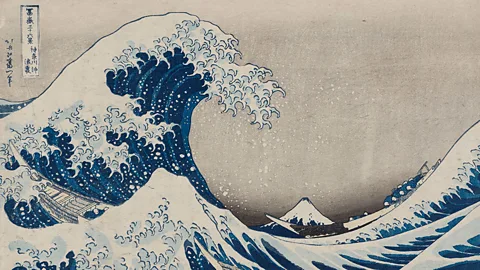
In the beginning was the wave. The blue and white tsunami, ascending from the left of the composition like a massive claw, descends pitilessly on Mount Fuji – the most august mountain in Japan, turned in Katsushika Hokusai’s vision into a small and vulnerable hillock. Under the Wave off Kanagawa, one of Hokusai’s Thirty-Six Views of Mount Fuji, has been an icon of Japan since the print was first struck in 1830–31, yet it forms part of a complex global network of art, commerce, and politics. Its intense blue comes from Hokusai’s pioneering use of Prussian Blue ink – a foreign pigment, imported, probably via China, from England or Germany. The wave, from the beginning, stretched beyond Japan. Soon, it would crash over Europe.

Monday, November 18, 2024

Little Dancer by Degas


LITTLE DANCER AGED FOURTEEN by Degas


Degas displayed the wax figure after which this bronze was cast at the sixth impressionist exhibition, in 1881. The only sculpture that he ever presented publicly, the work caused an uproar for its frank realism and use of materials. In depicting Marie van Goethem, one of the lower-class girls training at the Paris Opera Ballet, Degas fashioned the figure out of real materials, including a linen bodice, muslin tutu, satin dance slippers, a wig made of actual hair, and a ribbon to keep it in place. Her worn body, uneven skin, and wrinkled stockings challenged the idealizing tendencies typical of sculpture of the period. Such naturalism prompted the novelist and critic Joris-Karl Huysmans to exclaim, “M. Degas has overthrown the tradition of sculpture, as he has long since shaken the conventions of painting.” Following the artist’s death, the Hébrard foundry cast at least two dozen bronzes after the original, of which this is the third.

Identification and Creation

Sunday, February 4, 2018

Degas / Painting


Wainting
by Edgar Degas


PAINTING
by Edgar Degas

Painting is easy when you don’t know how, but very difficult when you do.


Wednesday, May 21, 2014

The draw of Degas

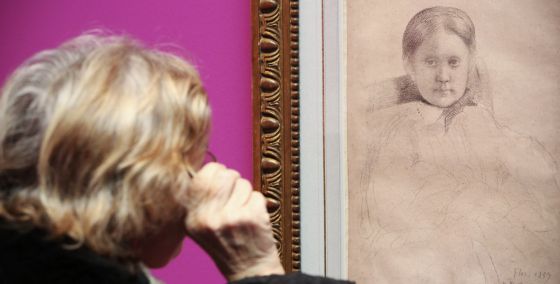
A visitor examines one of the works by Degas at the exhibition in Fundación Canal. /BERNARDO PÉREZ

The draw of Degas

Impressionist's intimate illustrations go on show at the Fundación Canal in Madrid

Drawing is a basic area of learning for many artists, allowing them to acquire the technique they will later develop in more highly considered media. Once mastered, many go on using it for tests and sketches, but also for giving form to their most intimate and dear works; those that have nothing to do with commissions or the market.
Edgar Degas (1834-1917), one of the leading figures of the Impressionist movement, considered drawing to be the basic foundation of his art, using it both in his deep studies of the great masters, as well as to portray his family and friends and outline the works that he would later create on canvas.
The collection of Robert Flynn Johnson, curator emeritus of the Fine Arts Museums of San Francisco, totals more than a hundred works by the French artist that are now on show at Madrid's Fundación Canal after touring the world.

The show contains a number of the artist's early works, many of them on public display for the first time
Johnson is also the curator of the exhibition, which explores Degas' working methods and personality. What, though, brought him to invest so much of his time - almost 40 years - and savings collecting the French artist's works on paper? "He is the artist who is most interested in people's spirit," he explains. "Unlike other Impressionists, who were more devoted to landscapes and still-lifes, Degas was inspired by people. All of his drawings reveal his personality. As occurred with many others, the drawings are almost never finished. They capture the emotion or the inspiration of the moment. What also interests me about him is his curiosity about everything: painting, sculpture, etching, photography." Degas, Johnson adds, is also the sharpest observer of human nature since Rembrandt.
Titled Edgar Degas. Impresionistas en privado (Edgar Degas. Impressionists in private), the show contains a number of the artist's early works, many of them on public display for the first time. They include drawings of his family and friends, self-portraits and detailed copies of works by the great masters hanging in the Louvre. After those come the pieces in which he tackles the same topics as his paintings.
Above all Degas was an experimenter, and the exhibition also features etchings, an odd collection of photos and his monotypes. As a counterpoint, there are also works by artists who were in some way related to the French genius, including Cézanne, Manet, Ingres, Fantin-Latour and Toulouse-Lautrec.
Edgar Degas. Impresionistas en privado. Until May 4 at Fundación Canal, C/ Mateo Inurria 2, Madrid. www.fundacioncanal.com