Showing posts with label Paul Auster. Show all posts

Wednesday, April 22, 2026

Ghost Stories by Siri Hustvedt review – life after Paul Auster


Siri Hustvedt


REVIEW

Ghost Stories by Siri Hustvedt review – life after Paul Auster

What’s it like to lose your partner of more than 40 years? The novelist and essayist reflects on going from ‘we’ to ‘I’


Sukhdev Sandhu
Tuesday 21 April 2026

‘After all the horrible things we’ve been through,’ he said to me, ‘if I die of cancer, it will make a bad story’: Siri Hustvedt on losing Paul Auster


Siri Hustvedt
Photo by Chris Buck


‘After all the horrible things we’ve been through,’ he said to me, ‘if I die of cancer, it will make a bad story’: Siri Hustvedt on losing Paul Auster

First there was the double tragedy that tore the family apart – then came a deadly diagnosis. The writer reflects on life after the death of her novelist husband


Siri Hustvedt
Sunday 19 April 2026


Iam alive. My husband, Paul Auster, is dead. He died on 30 April 2024, at 6.58pm here in the Brooklyn house where I am now writing these words. He was diagnosed with non-small cell lung cancer in January 2023. But before that, in early November 2022, Paul had a CT scan in the emergency room at Mount Sinai West hospital. The radiologist spotted a mass in his right lung and noted it might be cancer.

Siri Hustvedt to write a book about her late husband Paul Auster


Siri Hustvedt


Siri Hustvedt to write a book about her late husband Paul Auster

This article is more than 1 year old

The American writer is 120 pages into a memoir about her relationship with the New York Trilogy author, entitled Ghost Stories


Lucy Knight

Thursday 17 October 2024

Siri Hustvedt has revealed that she is working on a memoir about her late husband, Paul Auster, author of the acclaimed New York Trilogy.
Tuesday, June 18, 2024

Five essential novels by Paul Auste


Paul Auster
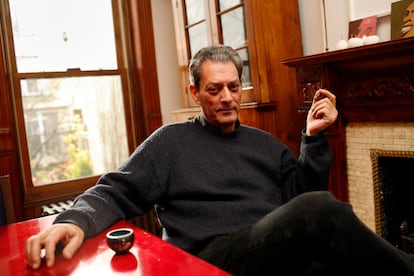
Paul Auster, at his home in Brooklyn on December 29, 2006.TIMOTHY FADEK (GETTY IMAGES)

Five essential novels by Paul Auster

New York City was a fundamental character in the work of the American writer, whose plots played with the idea of chance and spoke of love and friendship


ANDREA AGUILAR
1 May 2024

He published his first book of poems half a century ago and his first essay, The Invention of Solitude, in 1982, but it was with his novels throughout that decade and the following ones that the Paul Auster phenomenon took off. His stay in France in his youth marked his literary vision, but few authors are so deeply associated with a city, with a place as diverse and legendary as New York, as Auster was. The author, who died on Tuesday at the age of 77, devoted his work to New York — and not just his novels but also essays like the one he wrote about the poet and writer Stephen Crane, or films like Smoke. Chance, loneliness, love, melancholy, fear, madness and friendship are essential elements in Auster’s stories, in which there are nods to great works of literature and meta-literary games, but without digressing or scaring away the reader.

Paul Auster / 1947-2024


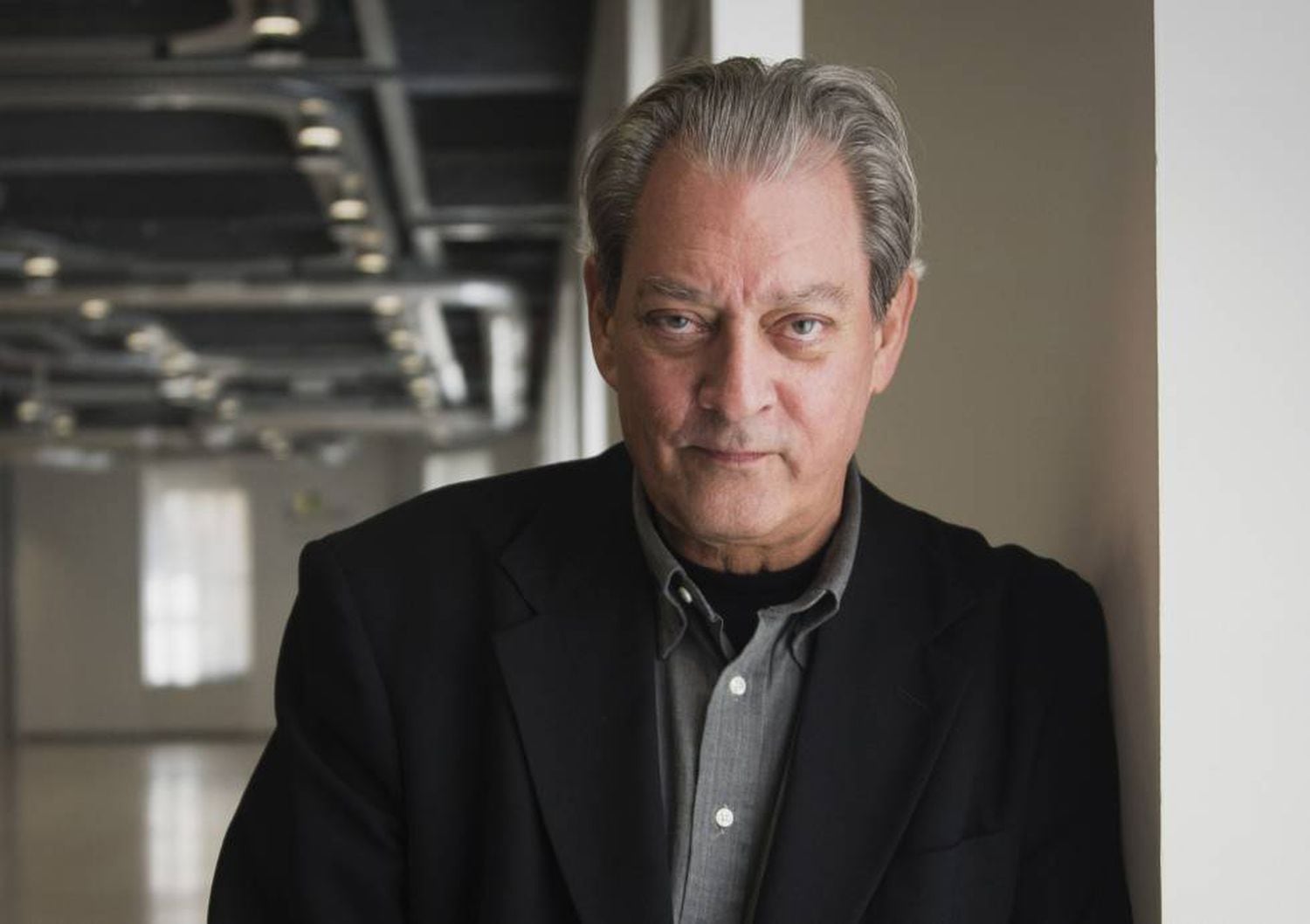
Paul Auster during a promotional photo session in Venice, Italy on September 2, 1996.
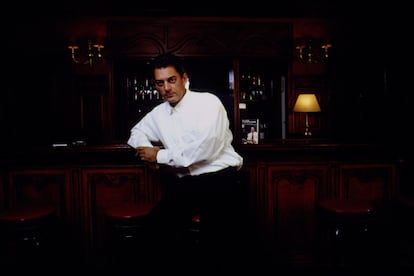
LEONARDO CENDAMO (LEONARDO CENDAMO)

Paul Auster 

(1947-2024)


Paul Auster


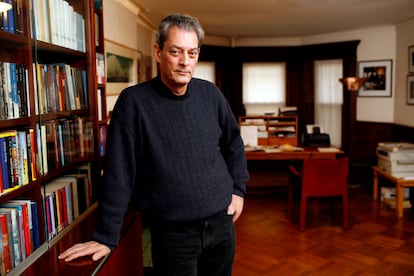
The novelist and film director Paul Auster at his home in Brooklyn, New York.TIMOTHY FADEK

Friday, May 3, 2024

‘I remember Paul Auster’/ A tribute by Jonathan Lethem to his friend


Paul Auster


The author of Motherless Brooklyn recalls his deepening relationship with the late author - from a chance book signing to becoming a confidant during tough times


Jonathan Lethem

Thursday 2 May 2024


remember the first time I approached Paul Auster. This would have been in 1987. I was an aspiring writer working at a bookstore in Berkeley and Paul appeared at another bookstore nearby, to read from In the Country of Last Things. It seems likely to me now that this was the first time a “major” publisher had sent him on a US book tour. The New York Trilogy was published in hardcover by a small publisher called Sun & Moon Press; up to that point he’d been a poet and translator. Paul signed a book for me. I never told him about this.
Saturday, October 31, 2020

Paul Auster / Time is running out, but I'm happy

TAGS:


Paul Auster

"Time is running out, but I’m happy"


SAKIS IOANNIDIS
30 JUNE, 2018

Paul Auster wrote his first poem on a sunny spring day in 1956, when he was 9 years old. Happy to see the back of winter, he came up with a few verses while walking through a small park in his native South Orange, New Jersey. It was the worst poem ever written, the American writer says today, but it wasn’t the words on the paper that mattered.

“I remember feeling connected to everything around me,” he says, describing a feeling he still gets when putting words down on paper. “I feel connected to the world and other people. And things around me, just everything that is not me becomes part of me too. I’ve only just thought about it recently. I think that’s why writers do it. Because it creates a feeling you can’t get anywhere else,” says one of the greatest living American writers today.

Paul Auster / “I wrote the book blindly, not knowing what was going to happen next”


Paul Auster


Paul Auster: “I wrote the book blindly, not knowing what was going to happen next”

US writer discusses ‘4321’, his first novel in seven years, ahead of translation into Spanish


English version by Debora Almeida
Maribel Marín Yarza
11 September 2017

Paul Auster makes no bones about playing God with the lives of his characters; he has created and destroyed lives at will; altering existences with his games of chance. And in recent years, he has done it with greater intensity than ever. In 4321, his first novel in seven years, which is made up of four stories about the four possible lives he imagines for his protagonist, Archibald Isaac Ferguson, who was born, like him, in 1947 in Newark, New Jersey, and comes from a family of Central European Jewish immigrants. “I’m not Archie, this is not an autobiographical novel,” insists the writer. “He just shares my timeline and geography, but he’s not me.”


US author Paul Auster, in Madrid.
US author Paul Auster, in Madrid.INMA FLORES
Greeted with star status by Spanish journalists, who are as interested in his work as his views on Donald Trump’s presidency, Auster arrived in Madrid on the European leg of a book tour that began in early August. Critics have praised 4321 as the best of his 17 novels. It is certainly his most ambitious work, thanks to its unique structure. “I always try to forget what I have done previously, to rethink it, to reexamine my thoughts about what is writing and its function, and to challenge myself with new approaches to novels, biographical works, or even an essay,” says Auster.

Paul Auster / ‘I'm going to speak out as often as I can, otherwise I can't live with myself'

Paul Auster


Interview

Paul Auster: ‘I'm going to speak out as often as I can, otherwise I can't live with myself'

The novelist on Trump’s America and publishing the book of his life at 70

Paul Laity
Friday 20 January 2017

‘I started the book at 66, which is the year my father died. Once I passed that boundary, I began to live in a very creepy world’ … Paul Auster Photograph: Tim Knox for the Guardian


When Paul Auster was 14, a boy just inches away from him was struck by lightning and killed. “It’s something I’ve never got over,” he tells me. He was at summer camp: “there we were, nearly 20 of us caught in an electric storm in the woods. Someone said we should get to a clearing, and we had to crawl, single file, under a barbed wire fence. As the boy immediately in front of me was going under, lightning struck the fence. I was closer to him than you are to me now; my head was right near his feet.”

Auster didn’t realise the boy had died instantly. “So I dragged him into the clearing. And for an hour, as we were pounded by intense rain, and attacked by lightning spears, I was holding on to the boy’s tongue so he didn’t swallow it”. Two or three other kids nearby had also been struck and were moaning; “it was like a war scene. Little by little, the boy’s face was turning blue; his eyes were half open, half shut, the whites were showing.” It took Auster a little while to absorb that, had the strike occurred just a few seconds later, it would have been him. “I’ve always been haunted by what happened, the utter randomness of it,” he says. “I think it was the most important day of my life.”A similar incident occurs in Auster’s new novel, 4321. Archie Ferguson, a 13-year-old full of promise, enthralled by The Catcher in the Rye and his first kisses, runs under a tree during a storm at summer camp. When lightning strikes, he is killed by a falling branch: “as his inert body lay on the water-soaked ground … thunder continued to crack, and from one end of the earth to the other, the gods were silent”.

An Interview with Paul Auster

Paul Auster


An Interview with Paul Auster


Nathalie Cochoy et Sophie Vallas
New York, March 2014

Paul Auster: OK, fire away!

Nathalie Cochoy: One of my fields of interest is New York, and the representation of walking in New York. When thinking about the art of walking, I often think of Thoreau and his concept of “sauntering.” In “Walking,” Thoreau simultaneously associates the French etymology of the word “sauntering” with a loss—être sans terre—and a form of pilgrimage—aller à sainte terre. You also seem to consider getting lost as a means of finding yourself. In The Invention of Solitude, you recall your enjoyment at being lost in the maze of AmsterdamI also remember these ambivalent lines in one of your poems: “A footstep / gives ground,” evoking a form of relinquishment and a form of birth. Is this something you often experience? Is walking a means of returning to the origins of your art?

Monday, October 16, 2017

What makes a Man Booker novel? Paul Auster on 4321


What makes a Man Booker novel? 

Paul Auster on 4321


Ahead of the announcement of the 2017 prize next week, the stories behind the stories


Saturday 14 October 2017 08.00 BST

Usually the material of a novel comes to me before I have a form in mind. But with 4321, for the first time in my writing life, the idea of the form came first – the idea that I could write about someone’s life, splintered into four versions. This notion was so compelling to me that I immediately started thinking how I might go about it. The story thrust itself on me. This boy, this Archie Ferguson – each of whose four incarnations follows a different path within the book – seemed there already, waiting to be found. Every day I would go to my work table and the story would be there for me, as if it were hovering just above my desk. All I had to do was reach out and grab it, and put it on the page.
My first impulse was to tell Ferguson’s story all the way through his middle age and perhaps even old age. But then I started writing, and after I was 50 or 60 pages in, I understood that this was going to be a book about human development. Surely the most intense period of our life is the beginning, the first 20 years, when we go from helpless infants to nearly formed adults. Something new is happening to us every day during those years, and as the story began to impose itself on me I began to understand the scope of the novel.
4321 is different from all the other books I’ve written in that it is enormously detailed and goes into subjects I haven’t usually covered. It gives a portrait of a time and place – America in the 1950s and 1960s – as well as telling the story of the main characters’ lives. For the first time in my fiction, historical events are in the forefront, and there’s a tonality that is different as well. At the same time, I think any reader familiar with my earlier work would recognise 4321 as a book written by me. I’ve always tried to challenge myself to take new approaches to the business of telling stories, and I felt all along that I had this big book inside me.
Ferguson’s life overlaps with my life in many ways. He is born in the same year I was, 1947, and he lives in all the places where I’ve lived, so we share chronology and geography. And there are certain elements of the book that are taken from my own life. But there’s no easy correlation of one to the other. There has been no Amy Schneiderman in my life, for example and after Ferguson, she is the most important character. Nor have I have had the homosexual experiences Ferguson 3 has. But desire is desire, and the imagination is a potent force, and even though these passages were a challenge to write, they were not the most difficult elements of the book.
It has been called a novel about chance, but I prefer to use the idea of “the unexpected”. “Accident” is another word that could apply. In philosophical terms, an accident is something that need not occur, a contingent fact, and yet of course we are all involved in accidents of one kind or another and continually meet up with the unexpected throughout our lives. You walk down the street, slip on a patch of ice, and break your leg, and for the next 50 years your leg will continue to cause you pain. The accident needn’t have occurred but its effects become a central part of who you are.
One thing that has taken me by surprise in responses to the book is that no one has asked me about the question of black-white race relations in America as presented in 4321. This may not be foregrounded in the novel but it is present throughout: for instance, in the depiction of the civil rights movement; the 1967 riots in Newark, New Jersey, which I saw in person; the relationship between Amy and her black boyfriend; and the massacre at Attica prison, which comes at the end of the book. I am still trying to figure out why no one has mentioned this. If I ever do, perhaps I will be able to understand my own country better.
4321 is published by Faber.

Thursday, September 14, 2017

Surprised by the Booker shortlist? Don't judge the books, study the judges


The judges for the 2017 Man Booker prize (from left): Sarah Hall, Lila Azam Zanganeh, Baroness Lola Young, Tom Phillips and Colin Thubron. Photograph: A Davidson/SHM/Rex/Shutterstock


Surprised by the Booker shortlist? Don't judge the books, study the judges


As a former judge, I sometimes joke that the only year I correctly picked the Man Booker winner was when I was on the panel – it’s too unpredictable

Stuart Kelly
Thursday 14 September 2017 15.32 BST


T
his week the email from the Man Booker’s publicity team arrived, with its announcement of the shortlist: three Americans; two debuts; two formerly shortlisted authors; one winner of a major prize set up in opposition to the Man Booker; and one grand old man. Curious indeed, I thought, and then, as my more reptilian brain kicked in, I started playing the odds. Horse-trading? Who pushed for what? Why were names such as Zadie Smith, Sebastian Barry and Arundhati Roy whittled off the longlist?

As a literary editor for many years, and a former judge, I have sometimes joked with friends that the year that I correctly predicted the Man Booker result was the year I judged it. It is, delightfully, unpredictable. The longlist did seem like a mix-tape of greatest hits (thankfully nobody put on the Rushdie) – and yet the only two surprise tracks are on the shortlist.

With a different set of judges each year, it is a fool’s errand to try to guess the eventual winner. So I have always had a simple formula: never judge the books – study the judges.
In the infamous year of having a former spook looking at literature, the prize nearly collapsed under the banalities, until a tried-and-tested victor was put in place (Julian Barnes, with The Sense of an Ending). This year’s judges are a curious mixture. Having been in this game for so long, I can say without hesitation that I respect the opinions of Sarah Hall and Lila Azam Zanganeh, both of whom I have chaired at literary festivals, and have long admired Colin Thubron and Tom Philips, whose work I used to push on creative writing students. I have not had the pleasure of meeting the chair, Baronness Lola Young. But these are people I take seriously, and their decisions should be taken seriously.
But seriously: Paul Auster? The new book strikes me as bloated Borges. What he managed in “The Garden of Forking Paths” it takes Auster a book longer than Ulysses to play around in. It’s a very macho book, not in content, but in form. After years of slender novels and slim pickings we get the huge work, and it is huge work to finish it.
Another Booker koan: the front-runner never wins. I quite liked George Saunders’s Lincoln in the Bardo, but it had a musty air of nostalgic experimentation. Ali Smith (Autumn) appears to be always the bridesmaid, and seems content with that – as she observed, Angela Carter never won the Booker. The debuts, History of Wolves by Emily Fridlund and Elmet by Fiona Mozley, which I read yesterday, are good; at points very good indeed. Mohsin Hamid (Exit West), like Auster, attempts alternative realities but has the upper hand in politics.
If you want to win at the Man Booker – as a punter – then here’s the strategy: find five friends and each of you place a bet on one of the books. One of you will win and you can divide the dividends sixfold. That’s the only way to win.