The novelist William Boyd tells us about the authors, from Chekhov to Heller, who most influenced his own development as a writer – and reveals the secret to a well-crafted sex scene
After writing 17 novels, do you feel as inspired now as you did 20 or 30 years ago?
Yes, I do actually. Funnily enough, I feel in the last three of four years a new surge of energy. I don’t know whether it’s because I’m getting older, but I actually feel I’m working harder than I’ve worked ever before in my life. I seem to have so many things on. It’s not by any great intent, it’s just the way things have panned out. I can’t write for as long as I used to. I used to write for five hours a day and now I’m down to about three. But I do feel very creatively energised as I approach my 60th birthday, which is reassuring. It’s strange how these things happen. It’s not just new novels, I’m also writing short stories and for film and television. I feel very busy and I enjoy that. I don’t feel under any pressure so obviously the brain is still working well.
Do you have to be cruel to be comedic? It often helps, says bestselling humour writer, Andy Borowitz. He picks his favourite comic novels.
Interview by Eve Gerber Marc 16, 2012
You’ve just turned the tale of a brush with death into a bestselling ebook that is by turns tragic, romantic, profound and just plain gross. Tell us about An Unexpected Twist and how you twist everything into comedy.
Because a lot can be learnt from this modern classic, for writers and aspiring journalists alike
Violet Daniels January 27, 2021
Scoop is known as the great satire of Fleet Street, written in the 1930s. Evelyn Waugh was a writer, journalist and book reviewer, known for his comedic tone and other novels such as Brideshead Revisited. Despite all his literary success, fellow writer, James Lees-Milne, called him, “the nastiest tempered man in England.”
From Tom Wolfe’s ‘master of the universe’ to George Eliot’s vengeful pedant, these are some of the hardest characters in literature to love
Louise Candlish
Wed 30 December 2020
A
t reader events to promote my novels, I find that one question crops up more often than any other: ‘Why do you write such dislikable characters?’ Well, I usually reply, swallowing my defensiveness, don’t all novelists write characters who are dislikable tosomeone, given that likability is entirely subjective? If niceness is a spectrum, then we’re all on it, for better or worse.
"It's not a bad camp, Sir," said Hooper. "A big, private house with two or three lakes. You never saw such a thing."
"Yes I did," I replied world-wearily. "I've been here before."
I had been there; first with Sebastian more than 20 years before on a cloudless day in June, when the ditches were creamy with meadowsweet and the sentences heavy with nostalgia. We had met several months earlier when he had been amusingly sick in my Oxford rooms. He had begged my forgiveness and thereafter allowed me to be his friend.
Ian Sansom on a family of writers who admired and disliked each other
Ian Sansom Saturday 5 February 2011
Y
ou might know the banana story. During the second world war, Evelyn Waugh's wife managed to procure three bananas for their children. When she brought the fruit home, Evelyn sat down in front of the children, peeled the bananas, poured on cream and sugar, and ate them all. "It would be absurd to say that I never forgave him," wrote Waugh's son Auberon many years later, in his autobiography, Will This Do? (1991), "but he was permanently marked down in my estimation from that moment."
1. Ulysses by James Joyce (1922). Filled with convoluted plotting, scrambled syntax, puns, neologisms, and arcane mythological allusions, Ulysses recounts the misadventures of schlubby Dublin advertising salesman Leopold Bloom on a single day, June 16, 1904. As Everyman Bloom and a host of other characters act out, on a banal and quotidian scale, the major episodes of Homer’s Odyssey—including encounters with modern-day sirens and a Cyclops—Joyce’s bawdy mock-epic suggests the improbability, perhaps even the pointlessness, of heroism in the modern age.
2. Underworld by Don DeLillo (1997). A finalist for the National Book Award, this literary page-turner is about the second half of the twentieth century in America and about two people, an artist and an executive, whose lives intertwine in New York in the fifties and again in the nineties. With cameo appearances by Lenny Bruce, J. Edgar Hoover, Bobby Thompson, Frank Sinatra, Jackie Gleason and Toots Shor, it has been called a “dazzling, phosphorescent work of art.”
3. Blood Meridian: Or the Evening Redness in the West by Cormac McCarthy (1985). D. H. Lawrence famously remarked that the archetypal American hero was a stoic, a loner, and a killer. Cormac McCarthy’s tale of the formation and dissolution of a band of scalp hunters in northern Mexico in the late 1840s embodies that dire maxim. Led by a soldier named Glanton and a mysterious, hairless, moral monstrosity known as the “Judge,” these freebooters wipe out Indians, Mexicans, and each other amidst a landscape of such sublime desolation one feels it leaching into their very souls.
4. Cities of the Red Night by William S. Burroughs (1981). This novel follows various plot strands – including 18th century pirates seeking to live lives of freedom according to articles written by Captain James Mission; a present-day detective, “Clem Snide, Private Asshole,” investigating the ritual sex murder of young boys, and the rise of a radioactive virus that may involve the CIA. An opium-infused apocalyptic vision from the legendary author of Naked Lunch, it is the first of the trilogy with The Places of the Dead Roads and his final novel, The Western Lands.
5. A Disaffection by James Kelman (1989). Patrick Doyle is a 29 year old Glasgow teacher in an ordinary school. Disaffected, frustrated and increasingly bitter at the system he is employed to maintain, Patrick begins his rebellion, fuelled by drink and his passionate, unrequited love for a fellow teacher.
6. The Brothers Karamazov by Fyodor Dostoevsky (1880). In perhaps the consummate Russian novel, Dostoevsky dramatizes the spiritual conundrums of nineteenth-century Russia through the story of three brothers and their father’s murder. Hedonistic Dmitri, tortured intellectual Ivan, and saintly Alyosha embody distinct philosophical positions, while remaining full-fledged human beings. Issues such as free will, secularism, and Russia’s unique destiny are argued not through authorial polemic, but through the confessions, diatribes, and nightmares of the characters themselves. An unsparing portrayal of human vice and weakness, the novel ultimately imparts a vision of redemption. Dostoevsky’s passion, doubt, and imaginative power compel even the secular West he scorned.
7. Men at Arms by Evelyn Waugh (1952). Meet Guy Crouchback, a 35-year-old divorced Catholic. Though the armed services really don't want him, he manfully succeeds in joining the Royal Corps of Halberdiers during World War II. There he meets Apthorpe, an eccentric African who is devoted to his “thunderbox” (aka chemical closet). Together they make quite a team. This is the first book in Waugh’s “Swords of Honour” trilogy which explores war, religion and politics. It is followed by Officers and Gentlemen (1955) and Unconditional Surrender(1961).
8. Lanark: A Life in Four Books by Alasdair Gray (1981). In the maverick Scottish author’s testy allegory, four (eccentrically illustrated) “books,” which are presented nonsequentially, trace the lives of two protagonists who are a single frustrated artist. Grim naturalism depicts Glaswegian painter Duncan Thaw’s losing battles with public indifference and chronic illness. Blakean fantasy traces the parallel sufferings of Thaw’s eponymous alter ego, whose misadventures in the dystopian city of Unthank represent Thaw’s continuing miseries in the hereafter he inhabits following his suicide. Accusatory, opaque, redundant—the novel is also, oddly enough, compulsively readable and perversely memorable.
9. Tender Is the Night by F. Scott Fitzgerald (1934). The heartbreaking, semiautobiographical story of two expatriate Americans living in France during the 1920s: a gifted young psychiatrist, Dick Diver, and the wealthy, troubled patient who becomes his wife. In this tragic tale of romance and character, her lush lifestyle soon begins to destroy Diver, as alcohol, infidelities, and mental illness claim his hopes. Of the book, Fitzgerald wrote, “Gatsby was a tour de force, but this is a confession of faith.”
10. The Strange Case of Dr. Jekyll and Mr. Hyde by Robert Louis Stevenson (1886). This novel might easily have become a victim of its own surpassing fame, which has removed all suspense from its central riddle: What is the relationship between Dr. Jekyll and Mr. Hyde? Yet as our narrator plumbs Dr. Jekyll’s descent into drug-addled, alter-ego madness, we are riveted by Stevenson’s portrait of the good and evil that lurks in one man’s heart. “This, too, was myself,” Jekyll says of Hyde. Somehow we suspect it’s us, too.
’Tis a strange serpent – 10 of the most entertaining drinking bouts in literature
From Viking magical mead poetry to Evelyn Waugh’s Decline and Fall, here’s how writers have encapsulated an eternal boozy truth
Mark Forsyth
Friday 1 December 2017
T
here have been drunken poets and poetic drunkards ever since the dawn of time, or, to put it more properly, since the sun first rose over the yardarm of history. The Vikings believed that all poetry came from some magical mead that Odin had stolen from a giant, downed, and then regurgitated in Asgard. They even believed this of bad poetry because, according to them, Odin had regurgitated most of it, but, in the heat of the moment, some of it had leaked out of his arse.
That is the reason that some great literary drinking bouts are better than others. Some stories sum up an eternal boozy truth, some pinpoint perfectly how one particular culture saw their alcohol. Here are 10 of the best.
The Epic of Gilgamesh
The first ever work of literature is about Gilgamesh and Enkidu. Gilgamesh is the musclebound king of Uruk and Enkidu is a musclebound wild man who lives happily among the animals. Enkidu is completely at one with nature until a beautiful woman offers him beer.
Enkidu eats food till he was satiated. Ale he drinks, seven goblets. His spirit is loosened, he becomes hilarious. His heart becomes glad and his face shines. The barber removes the hair on his body. He is anointed with oil. He becomes manlike. He puts on a garment, and he is like a man.
And after that he can never go back to the animals. They shun him now. Alcoholhas made him a human. That’s exactly the same thing that happens at the end of Animal Farm (written a mere 4,000 years later). The animals peek in the window to see pigs drinking with the humans and “the creatures outside looked from pig to man, and from man to pig, and from pig to man again: but already it was impossible to say which was which”. It’s alcohol that divides us from the animals.
That’s not scientifically true, by the way. Most of the higher apes love to get drunk, providing that they can get their opposable thumbs on the stuff. Darwin recorded that the best way to catch a baboon was to offer it beer and then grab it when it was hungover.
Letters, Lord Byron
When not shagging his way across Europe or swimming his way across the Hellespont, Byron liked a drink. It’s not that he was a better drinker than anybody else, but he was much better at describing it. It’s probably best to simply let him speak for himself. This is from a letter to Thomas Moore dated 31 October 1815:
“Yesterday, I dined out with a largeish party, where were Sheridan and Colman, Harry Harris of Covent Garden and his brother, Sir Gilbert Heathcote, Ds. Kinnaird, and others, of note and notoriety. Like other parties of the kind, it was first silent, then talky, then argumentative, then disputatious, then unintelligible, then altogethery, then inarticulate, and then drunk. When we had reached the last step of this glorious ladder, it was difficult to get down again without stumbling;—and, to crown all, Kinnaird and I had to conduct Sheridan down a damned corkscrew staircase, which had certainly been constructed before the discovery of fermented liquors, and to which no legs, however crooked, could possibly accommodate themselves. We deposited him safe at home, where his man, evidently used to the business, waited to receive him in the hall.
Both he and Colman were, as usual, very good; but I carried away much wine, and the wine had previously carried away my memory; so that all was hiccup and happiness for the last hour or so, and I am not impregnated with any of the conversation.”
‘Experimental literary chaos …’ An illustration by Gustave Doré from the novel Gargantua by François Rabelais. Photograph: Corbis via Getty Images
Antony and Cleopatra, William Shakespeare
Advertisement
Shakespeare always gets things right. Though Falstaff is his most famous drunk, there’s one aspect of the business that the Bard nailed in Antony and Cleopatra.The three rulers of the known world – Antony, Octavius and Lepidus – are drinking together and Lepidus is very, very drunk. He’s so drunk that he doesn’t just say things, he insists on them.
“Nay, certainly, I have heard the Ptolemies’ pyramids are very goodly things; without contradiction, I have heard that.”
As though some invisible figure keeps contradicting him – something that I (and you) do after a few glasses. They’re so smashed that, when Lepidus asks Antony what Egyptian crocodiles are like, Antony replies: “It is shaped, sir, like itself; and it is as broad as it hath breadth: it is just so high as it is, and moves with its own organs: it lives by that which nourisheth it.”
And Lepidus is just about capable of considering this answer, nodding like he understands and saying, after some thought: “Tis a strange serpent.”
Right Ho, Jeeves, PG Wodehouse
For the pure unadulterated joy of drinking, you can’t really beat Wodehouse. Indeed it’s hard to beat him for pure unadulterated joy full stop. He had wonderful phrases for it – “tanked to the uvula” or “oiled, boiled, fried, plastered, whiffled, sozzled and blotto”. He also has the wonderful story of Gussie Finknottle’s first encounter with alcohol. Gussie is a shy man who is shyly in love with Madeline Bassett. But he doesn’t have the nerve to propose to her. Bertie tries to persuade him that a stiff drink will give him the requisite Dutch courage. Gussie refuses and Bertie decides to spike Gussie’s orange juice. Unfortunately Jeeves also decides to spike Gussie’s orange juice, and Gussie himself then decides that he’ll do as Bertie suggested and downs half a decanter of whisky, which he washes down with the doubly-spiked orange juice. The result is a new Gussie Finknottle, who acts as though he could bite a tiger. “Make it two tigers. I could chew holes in a steel door.”
He proposes to Bassett, who joyously accepts. But he then has to give a speech at the school prize-giving in Market Snodsbury, and his drunkenness, now begun, must run its course through the classic stages of jocose, bellicose and morose, before finally arriving at comatose, by which time Bassett has called off the engagement.
The King in Yellow, Robert W Chambers
The story of an American in Paris in the 1880s who falls in love with a Parisian girl, but is too prim, proper and embarrassed to even introduce himself. So far, so Henry James. But this hero differs from James’s, because after a few bottles of wine, and a brief attempt to start a fight with the Arc de Triomphe (“Its size annoyed him”), he realises that it would be a fantastic idea to visit her street, and, once there, that it would be a fantastic idea to climb up to her window, and a simply superb idea to break in. Finally, they come face to face, but he still hasn’t the courage to speak, and, in a beautiful tragicomic ending, he retreats, wordless, with a rose.
Gargantua, François Rabelais
Long before there was James Joyce, there was the experimental literary chaos of Rabelais. The Discourse of the Drinkers is a crazy dialogue where you can’t work out who’s saying what or why, but everybody wants to drink. “The concavities of my body are like another hell for their capacity … There is not a corner, nor cunniborow in all my body where this wine doth not ferret out my thirst.” NB: a cunniborow is a rabbit-hole.
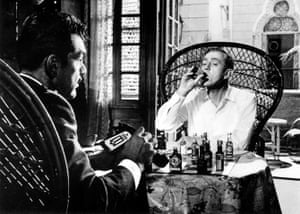
‘Bite-of-the-nail suspense …’ Alec Guinness (right) and Ernie Kovacs in Our Man in Havana (1959). Photograph: Ronald Grant
Decline and Fall, Evelyn Waugh
Decline and Fall starts with the famous drunk scene where Paul Pennyfeather is debagged by the Bollinger Club, but it ends with a better one. Waugh not only captures perfectly the ability of a drunkard to repeat himself ad nauseam, but he also uses those repetitions to make the final conversation of the book into a literary symphony of theme, repetition, variation and motif. And when the drunkard is told he drinks too much, he replies: “Oh, damn, what else is there to do?”
Our Man in Havana, Graham Greene
This is the only drunk scene I can think of that has edge-of-the-seat bite-of-the-nail suspense. The main character, Wormold, has to render the head of Cuba’s secret police unconscious. So he challenges him to a game of draughts played with whisky miniatures. When you take a piece, you have to drink it, thus handicapping yourself. The police chief begins to realise what’s happening and is caught in a battle between the desire to win, the desire to keep his head and the alcohol. A board game, some drinks, and the casual question: “Do you keep your gun loaded?”
The Prose Edda, Snorri Sturluson
The Vikings believed that all poetry came from alcohol, specifically from the magical Óthrerir, the Mead of Poetry. This was guarded by a giant in the middle of a mountain, but Odin managed to break in, down it in one and then fly back to Asgard in the form of an eagle and regurgitate into a cauldron. Unfortunately, he was being chased by the giant and he was in such a hurry that, though most of it came out of his mouth, some sprayed out of his godly arse. All good poetry, believed the Vikings, came from the former; all bad poetry from the latter.
Lucky Jim, Kingsley Amis
Let us end with a hangover, as these things usually do. There have been some great descriptions, but this is the greatest. Dixon finds himself “too wicked to move, spewed up like a broken spider-crab on the tarry shingle of the morning”. But the line that clinches it is: “His mouth had been used as a latrine by some small creature of the night, and then as its mausoleum.”
•A Short History of Drunkenness is published by Viking.