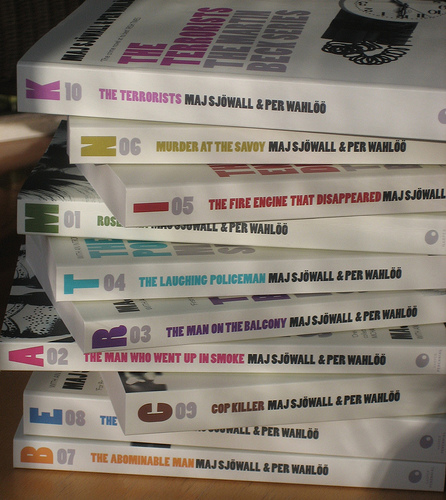
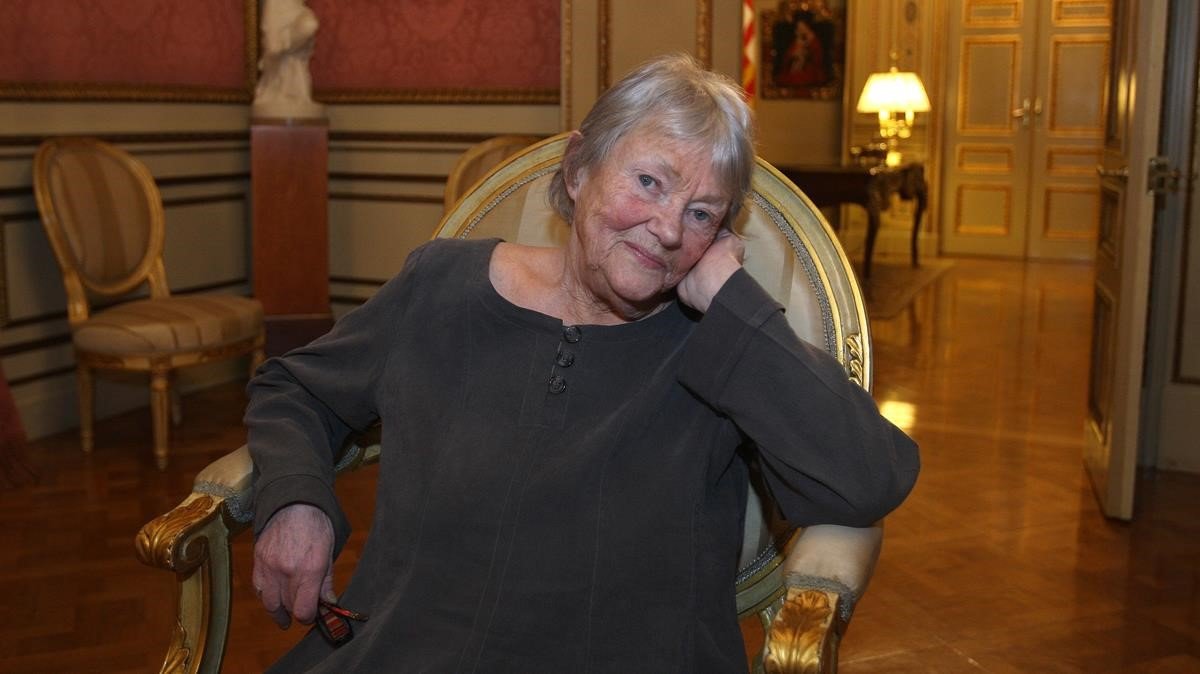
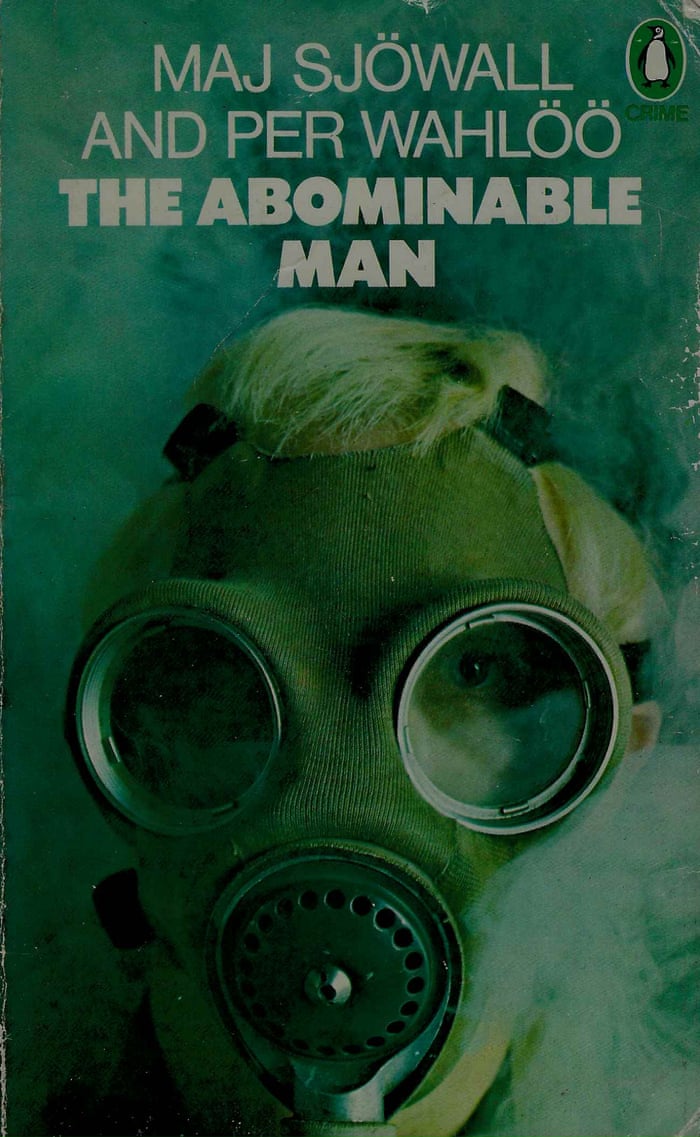
Fans of Scandinavian crime fans were hit with some very sad news yesterday upon learning of the death, at 84, of Maj Sjöwall, coauthor with Per Wahlöö, of the vastly influential Martin Beck series of police procedurals. Set in Stockholm from 1965 through 1975, the series is widely regarded as the progenitor of what we now call Scandinavian noir. Before Henning Mankell, before Stieg Larsson, before Jo Nesbø, there were Sjöwall and Wahlöö. Back in 2007, I wrote a column called “It Began with Beck.” The following draws from what I said then.
The husband-and-wife team of Maj Sjöwall and Per Wahlöö were on the case 30 years before Henning Mankell, and the hero of their groundbreaking 10-novel police procedural series, Detective Inspector Martin Beck, is unquestionably godfather to Mankell’s Kurt Wallander and all the other twenty-first-century Scandinavian sleuths. Both committed to radical politics, Sjöwall and Wahlöö set out “to use the crime novel as a scalpel cutting open the belly of an ideologically pauperized and morally debatable so-called welfare state of the bourgeois type.” The 10-novel sequence began in 1965 with Roseanna and continued through 1975, when the finale, The Terrorists, was published shortly after Wahlöö’s death. Unlike most European crime fiction of the time, the series was immediately translated into English and met with widespread critical acclaim in the U.S.—surprising given the political emphasis (the last word in the series is, symbolically, “Marx”).
I first read the Martin Beck books in the late 1970s and found them unlike any other crime fiction of the time, with the exception of Ed McBain’s 87th Precinct series, to which the Beck novels, also in the “station house” tradition and portraying the lives and careers of a squad of homicide detectives, are clearly indebted. But Sjöwall and Wahlöö are more interested in the inner lives of their characters than McBain, and Beck is a far more vulnerable figure than McBain’s Steve Carella or any of the other hard-boiled heroes of that era. And, of course, the overtly left-wing point of view set the Beck series apart while giving it something in common with the similarly inclined younger readers of the sixties generation.
“The world we live in today is simply Martin Beck’s world writ large.”
Per Wahlöö
But how does Martin Beck hold up today, when vulnerability has become a common character trait among European detectives and when the idea of communism as a solution to society’s ills seems naive at best? I decided to find out and reread three Beck novels, The Laughing Policeman, The Fire Engine That Disappeared, and The Terrorists. Not only do they hold up just fine, they also seem remarkably contemporary. In The Laughing Policeman, about the seemingly motiveless mass murder of the riders on a Stockholm bus, one of Beck’s detectives exclaims, “Are there no limits?” The same scene is replayed throughout Mankell’s Faceless Killers, after the murder of an elderly farm couple in remote Ystad unleashes an ugly wave of racist hate. The contemporary Scandinavian crime novel is defined by this sense that the old rules no longer apply, and while good cops might “solve” an individual crime, they are powerless to stop the slide of society into hate-fueled chaos. These are familiar ideas today, of course, and have worked their way into all aspects of popular culture. But the theme has even greater resonance in Scandinavian fiction because it plays against our image of the region as somehow beyond all that—neutral in war, liberal in sex, tolerant in society. Henning Mankell burst that bubble once and for all in the nineties, but Sjöwall and Wahlöö were posting Danger! signs before many of today’s Mankell fans even knew how to read.
But what of the politics? Shouldn’t a pair of committed socialists railing against capitalist injustice seem, well . . . quaint today? Sjöwall and Wahlöö might seem exactly that if they were sitting in your living room and espousing a Communist agenda. But in their Martin Beck novels, they show rather than tell, and what they show seems like everyday life to today’s reader. We might not draw the conclusions the authors drew about how to fix the problems of society, but we certainly recognize those problems in all their prickly detail. Bureaucracy run amok, for example. It hardly sounds like Communist propaganda to describe a world where most institutions are mired in their own rule-making and incompetence and where government leaders are, well . . . shall we just say not very bright. The world we live in today is simply Martin Beck’s world writ large.
It’s no wonder that when Mankell’s Faceless Killers appeared in 1997, it came with a blurb from Maj Sjöwall.
This is how the authors and friends remember Maj Sjöwall
Maj Sjöwall has passed away at the age of 84. The colleagues remember her as indispensable for the Swedish decker genre.
29/4/2020 11:17:47
- It is hardly possible to describe her significance for the cover genre in Sweden, says author Mari Jungstedt to the Culture News.
May Sjöwall and Per Wahlöö wrote ten novels about Martin Beck that made the police novel more political and the romance suite a huge success.
- They have inspired all of us who write crime novels and have had a huge significance with their international success as they did early on. They paved the way for us to come, says Mari Jungstedt.
Per Wahlöö and Maj Sjöwall
"Brilliant translator and mentor"
Author David Lagercrantz also emphasizes Sjöwall / Wahlöö's significance for the cover genre but also highlights Sjöwall's significance after Per Wahlöö's death in 1975.
- May also continued to work. She has been a brilliant translator and a mentor for Swedish writers. It is an incredibly big loss, he says.
Lagercrantz, who among other things wrote She Who Must Die - the continuation of Stieg Larsson's Millennium books, says that his writing was inspired by Sjöwall / Wahlöö.
- That's where I got the idea that criminal literature can do something - can change and have a political message.
This is a digitized version of an article from The Times’s print archive, before the start of online publication in 1996. To preserve these articles as they originally appeared, The Times does not alter, edit or update them.
Occasionally the digitization process introduces transcription errors or other problems; we are continuing to work to improve these archived versions.
Per Wahlöö, who achieved worldwide recognition for the detective novels that he and his wife, Maj Sjöwall, created while their children slept, has died. His death, at the age of 48, was announced yesterday in Malmo, Sweden, where he lived.
Although Mr. Wahlöö won favorable comment as the author of Kafkaesque allegories set in police‐procedurai novels, he was perhaps best known—and most popular—for the collaboration with his wife that introduced Detective Martin Beck of the Stockholm police force to mystery fans.
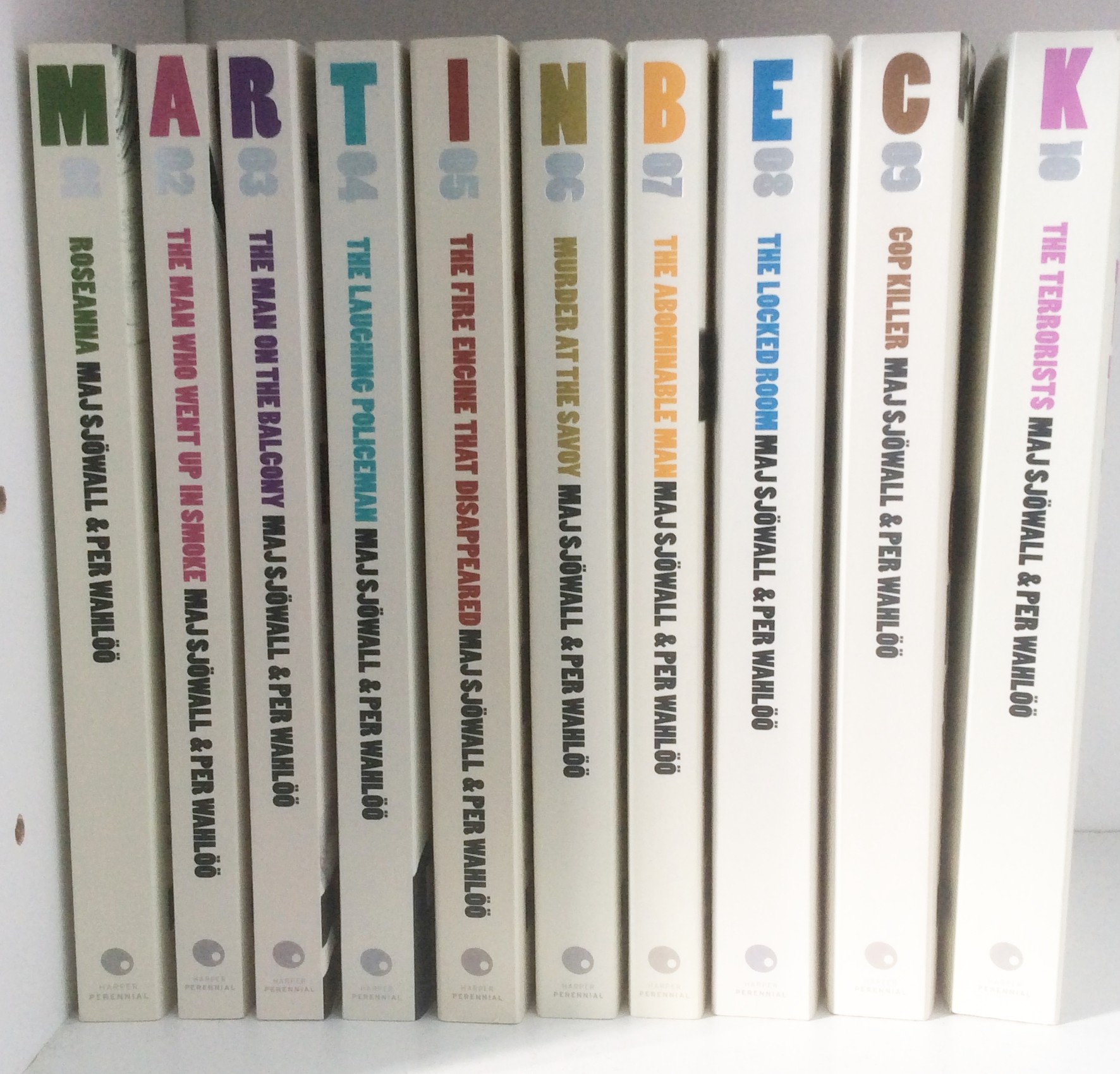
I ended my last full post (September 4, 2013) saying I’d finally begun reading Maj Sjöwall and Per Wahlöö’s Martin Beck novels, though I don’t rightly know how I managed to cultivate such a passion for ‘moody sleuths’ without coming across Martin Beck much sooner, especially since so many crime fiction writers count this ten book series as being ‘the’ most influential in shaping the modern mystery novel, particularly the police procedural.
I should be red-faced, I know… but in the past month I trust I’ve made amends; I’ve read all ten, and will undoubtedly read them again in the future. They’re that good!
As I said in my earlier post, Swedish journalists, Maj Sjöwall and Per Wahlöö, co-wrote the Martin Beck series, first published between 1965 and 1975. The couple set out to use the police procedural to carry a penetrating critique of Sweden’s social and political conditions at the time.
Sean & Nicci French, in their introduction to the fourth Martin Beck novel, The Laughing Policeman (Harper Perennial edition), remind us once again that Martin Beck was “the prototype of the brilliant tormented detective.”
Many other moody sleuths such as fellow Swede Kurt Wallander, Norwegians Konrad Sejer and Harry Hole, and Icelander Erlendur Sveinsson owe their existence to Martin Beck. Sean and Nicci French extend Sjöwall and Wahlöö’s influence to include the likes of Ian Rankin’s John Rebus and Thomas Harris’s Will Graham.
Sweden's crime writers too interested in love, says Maj Sjöwall
Too much romance and too little police work in today's thrillers, says architect of modern Scandinavian crime thrillers
Charlotte Higgins, chief arts writer
Wed 14 Aug 2013
The grandmother of Scandinavian crime writing has said her counterparts today are too concerned with screen adaptations of their work and "are not about police work and crime, but very much about love and relationships – like girls' books".
Swedish crime novelist Maj Sjöwall was often called the godmother of the literary genre dubbed “Nordic noir,” later also known as Scandi-noir. Her best-known creation was Martin Beck, the subject of a massively popular series about a Swedish homicide detective in mournful middle age, lugubrious and ill-tempered.
Her fiction — bleak but often humorous — grew out of the work of crime writers such as Ed McBain (the 87th Precinct series), Dashiell Hammett (with his private detective Sam Spade) and Georges Simenon (French police inspector Jules Maigret).
But Ms. Sjöwall’s Beck series — widely translated and published to rave reviews and tens of millions of copies — helped inspire a popular subgenre of problem-laden rather than heroic policemen. One of her Beck novels was turned into an acclaimed 1973 film, “The Laughing Policeman,” a crime thriller starring Walter Matthau, with the gory action transposed to San Francisco from the original Stockholm setting.
Sometime in the early eighties, I began reading a series of mysteries that featured a Swedish homicide detective named Martin Beck. I was living in Berkeley at the time, studying for a Ph.D. in English literature as I worked a variety of part-time jobs, and I knew a lot of people both inside and outside the academy. Being a talkative sort, I started telling everyone around me about this incredible Scandinavian cop series. Soon we were all reading it.
Maj Sjöwall and Per Wahlöö
What I knew at the time was that it was written by a couple, Maj Sjöwall and Per Wahlöö, who had from the very beginning envisioned it as a sequence of ten books that would portray Swedish society from a distinctly Marxist perspective. Published between 1965 and 1975, the Martin Beck series grew noticeably darker as it moved toward its end—though whether this was because Sweden itself (not to speak of the world beyond it) had worsened during that decade, or because Per Wahlöö had learned in the early seventies that he was dying of cancer, was something no one could answer. Wahlöö died, I later learned, on the exact day in June of 1975 when the tenth volume was published in Sweden, having worked like a maniac to finish it on time. (Sjöwall, who was his equal partner in many ways—they would write their alternating chapters at night, so as not to be interrupted by their small children, and would then exchange chapters for editing—has said that at the very end Wahlöö was pretty much writing everything himself.) At any rate, he left behind exactly what he had intended to produce: ten books containing thirty chapters each, which, taken together, constitute a single continuous social narrative comparable in some ways to a Balzac, Zola, or Dickens project, though clothed in the garments of a police procedural.
It would be a melodramatic exaggeration to say that the Martin Beck series changed my life, but like all such exaggerations, this one would be built on a nugget of truth. Both my idea of Scandinavia and my sense of what a mystery could do were shaped by those books. If I later became a veritable addict of the form, gobbling up hundreds if not thousands of dollars a year in Kindle purchases of Swedish, Danish, and Norwegian mysteries, that habit could no doubt be attributed to many things besides the Martin Becks: the invention of digital books, for instance, which allowed for impulse buying and virtually infinite storage; the massive and surprising success of Stieg Larsson’s Millennium series, which encouraged American publishers to bring out any and every available Scandinavian thriller; the introduction of the long-cycle police procedural on American television, including such gems as Hill Street Blues, NYPD Blue, and ultimately The Wire, all of which cemented my fascination with the form; not to mention dozens if not hundreds of similar behavior-shaping factors that remain, for me, at an unconscious level. We never know for sure why we read what we read. I cannot, at the moment, even call to mind who first recommended the Martin Becks to me (though I know it was a person and not, say, a bookstore display or a newspaper review). Whoever it was, in any case, deserves my eternal gratitude.
When Maj Sjöwall and her partner Per Wahlöö started writing the Martin Beck detective series in Sweden in the 60s, they little realised that it would change the way we think about policemen for ever Louise France Sunday 22 November 2009
I
t might count as one of the most remarkable writing collaborations in the history of publishing. A man and a woman, a couple, sit down every evening to write. Dinner is over, their children are in bed. She’s never written a book before. He’s a published author, but not with anything like this. They write in long hand, through the night if necessary. One chapter each. The following evening they swap chapters and type them up, editing each other as they go along. They don’t argue, at least not about the words. These seem to flow naturally.
This article appeared in the 2004 Supplement, which Ross Shideler guest edited.
Having been a dominant figure in Swedish literary and cultural life since the 1960s, one would think that Per Olov Enquist might sit back and rest in the glow of renown that his novels, short stories, journalism, essays, and plays have won for him. However, as he told me in a recent phone conversation, he gets restless when he is not writing. So this long-time columnist for the Swedish Expressen and the Danish Politiken, this author who has become one of Sweden’s most celebrated dramatists, continues to write novels that have won him acclaim throughout Europe and the United States. He doesn’t like to talk about them, but the awards for novels and dramas that he has won in Scandinavia include the Nordic Book prize (1969), The Aniara Prize (1976), The Dablovsky Prize from the Swedish Academy (1991), the H. C. Andersen Prize (1992), The Eyvind Johnson Prize (1994), The Ivar Lo Prize (1995), and The August Prize (1999) among others. In Europe he has received the Prix du Meilleur Livre Étranger (2001), the Deutsche Bücherpreis (2002), the Premio Flaiano and Super Flaiano (2002) the Premio Mondello (2002), and in England he won The Independent Foreign Fiction Prize (2002). As this remarkable list suggests, Enquist’s works have been translated into more than twenty different languages. Given his international standing and his unique position in Swedish literary and cultural life, we devote this Supplement of Swedish Book Review to Per Olov Enquist; we want to recognize, first, the range and depth of his contribution to modern Swedish literature, and, second, to celebrate this acclaimed author’s 70th birthday.
Per Olov Enquist has been a great writer for so long in his native Sweden that, at this stage, he can write what he likes. He brings a sense of freedom, and intellectual relish, to The Story of Blanche and Marie, which is not so much the story of two famous women as an interrogation of their story. Enquist likes asking questions of history: this is perhaps a more honest way of proceeding than merely stating the facts.
The facts are amazing - but in a funny sort of way. By the time Marie Curie received her second Nobel prize, in 1911, one of her lab assistants, Blanche Wittman, was a triple amputee, having lost her left arm and both her legs as a result of working with radioactive materials. Blanche had come to Curie from the x-ray department of Salpêtrière, the great female lunatic asylum, where she had once been a star patient - quite literally. Blanche was the "Queen of the Hysterics", one of the women exhibited by Dr Charcot to the good people of Paris, every Wednesday afternoon, for free. A convulsive attack would be provoked by pressing very particular points on their bodies - for which Charcot had the diagram, of course. The need to squeeze, for example, their ovaries also explained the women's state of undress. Everyone took these hysterical displays, which were both violent and swooningly creative, very seriously, including Charcot's one-time assistant, the young Sigmund Freud.
This is very rich stuff; you might think it would be enough for one book at least - but Enquist keeps going. It is what Blanche, as a sublime victim, takes to the story of Marie Curie that interests him most.
Per Olov Enquist
Curie's astonishing achievement - she was the first person to be awarded the Nobel twice - was not reported by the French press. They were too busy publishing her love letters, hounding her as a foreigner - possibly a Jewish foreigner - and the seductress of a married man. Blanche was living in Curie's house at the time, propelling herself about in a little wheeled wooden box. She is, as Enquist tells it, a torso who can write, and it is to her that Marie turns when she needs to talk about the baying crowd, and about love.
This is a book of intersections. Enquist puts the facts down on the page, then he questions, repeats and rearranges them. He nudges and dunts the historical moment, in the hope that it will yield its sweetness. Blanche sees her role as "explaining the connection between radium, death, art and love". The essence the writer extracts is a poetic truth about love, but it is also the story - which is to say the fiction - of the novel itself. Some things, finally, he can simply make up: Blanche, while hypnotised, has a vision of kissing a boy by a river bank; Charcot, her hypnotist, is not only in thrall to her, but actually in love; she spends her last days in Curie's house not bombed out on laudanum, but writing a "book of questions" in three notebooks that have covers of yellow, black and red.
The beautiful, deadly blue light of radium illuminates the novel. This was a time when science and mysticism were still close. Charcot was a believer and Curie was a lover. Enquist admires their wrongheadedness, somehow, as much as, or more than, he admires their work.
The Story of Blanche and Marie is written with the same poetic vigour and eye for the moment as Enquist's last, much acclaimed novel, The Visit of the Royal Physician. It is dizzy with associations and questions, full of interest and appetite and the satisfactions of a good mind. It is a strongly feminist piece of work, and often funny. The aftertaste it leaves, however, is a little strange. Blanche's career as a beautiful hysteric is, quite rightly, suffused with a sense of the ecstatic, but it is odd to see a multiple amputee in the same glowing light. Blanche Wittman was used and then destroyed - what's so attractive about that? Is this what we have to endure, in order finally to understand what love is?
Olov Enquist was born in 1934 in a small village in Norrland, the northern part of Sweden. After studies at the university of Uppsala he received his MA in 1960. Since the early sixties Enquist has worked as literary and theatre critic for several newspapers and magazines. He is one of Sweden's leading contemporary novelists as well as a playwright. He has been a member of the Swedish Cultural Council, a member of the Board of the Swedish Radio between 1969 and 1973 and of the Board of the Swedish Writers' Association.
Enquist made his literary debut in 1961 with the novel The Crystal Eye, and since then he has published many novels, an essay and short stories which have all brought him international fame and readers in 30 countries.
WithThe Royal Physician's Visit, P O Enquist achieved an international breakthrough with the critics as well as with a large audience. It was awarded the August Prize in 1999. The memoir Another Kind of Life was also awarded the August Prize 2008, making Enquist one of only two writers ever to have received the prestigious August Prize for fiction twice.
Enquist has also written screenplays for TV and film and several plays, including The Night of the Tribades, a play about August Strindberg and his relationship to the women around him. This play made Enquist into one of the most performed Scandinavian playwrights and has enjoyed about 200 productions around the world including a critical success on Broadway.
PO Enquist: ‘An upbringing like mine marks you like a branding iron’
Swedish author Per Olov Enquist talks about his pious childhood near the Arctic Circle and his latest novel, shaped by his early life Andrew Brown Saturday 30 July 2016
T
here have been a number of books in recent years in which old men look back from literary eminence to the sexual excitements of their youth – Gabriel García Márquez with Memories of my Melancholy Whores, Philip Roth with just about everything – but the 81-year old Swedish writer Per Olov Enquist’s most recent novel The Parable Book, translated by Deborah Bragan-Turner, is about love rather than sex, and death rather than regret. It is also in passages blindingly funny.
Enquist is seen as one of Sweden’s greatest living authors: he has won the Nordic Council’s literary prize and the the Swedish Academy’s Nordic prize, among others, and his work has been tranlsated into more than 20 languages. He has lived in Germany, Denmark and the US, but has since returned to Stockholm, where we meet at his publisher’s office, a glorious stone building in the old town. He still reads four Swedish newspapers a day, the London and New York Reviews of books, British and German papers on the web and watches CNN. He has been greatly concerned about the EU referendum. “Sweden has always been Anglophile. There is a very strong feeling of bonds with England. Our welfare states are built up on the same lines even if they differ in execution. That’s not sentimentality: there is a very strong sense of interconnection with you.”
Hermes watches over the Gulf of Bothnia from the cliffs of Kokar in Aland, Finland. Photograph: Berit Berg/AP
None the less, his two most recent books deal with an upbringing very remote indeed from English concerns. In part this is a matter of geography. He was born and brought up in a scattered settlement near the coast of the Gulf of Bothnia, a couple of hundred miles south of the Arctic Circle. The piss bucket in the hallway froze to a solid lump of ice on winter nights, and his mother, a teacher, would ski the 3km to her school every day. His father, a lumberjack, had died when he was six months old so he was raised in fervent piety and profound isolation from anything that might be ungodly.
“The Bible is a very strange and repellent text when you read it as an adult. Then you have to find the passages which point inwards, not forwards. But if you have had an upbringing like mine you never get away from it. You get to be 80 and read the Bible again. It’s an upbringing that marks you like a branding iron, but I wouldn’t want to change it if I could. The children who were raised in secular families could go to the theatre or the cinema. I couldn’t.”
Enquist has an extraordinarily direct and persistent gaze of the kind you never meet in cities, even Swedish ones, where anyone who looked at you that long would be suspected of some predatory act. He did not, he says, even know what a cinema was until he was 16; the books he read were almost all religious: his mother removed Rudyard Kipling’s Kim from the bookshelf once she had established that it had a Buddhist as a hero. Yet she loved him deeply and he loved her and writes about her with great respect. It was, he says, a very fine upbringing if you were going to become a writer, because it saved you from distractions and taught close attention to the world. In fact one of the village children he knew grew up to become the father of Stieg Larsson, who wrote the Millennium trilogy, so perhaps there is something in the water of Hjoggböle lake.
Some of the family stories read like Stella Gibbons’s Cold Comfort Farm – when one of his relatives wanted to kill himself in winter he had to spend hours whacking the ice of the lake with a crowbar in the dark until he had made a hole big enough to admit him along with the rucksack full of potatoes he’d strapped on to weigh himself down.
But there is also a current of humour in Enquist’s books that is part of the northern character. “Martin Luther was a great comic,” he says. “Rude, funny and crude. There’s lots of that still in the evangelical revival movement. It’s effective, and very practical, but never entirely serious.”
Although many of his works have been fictional, or at least reworkings of known history, such as The Book About Blanche and Marie and The Visit of the Royal Physician, the two most recent are reworkings of his own life. The spine of his latest, The Parable Book, is the story of his encounter, at 15, with a 51-year-old woman visiting from a suburb of Stockholm, identified for the most part simply as “the woman on the smooth pine floor”. It’s an extraordinary piece of writing, perfectly paced and anatomically precise without being embarrassing or pornographic. When it is over, she says they must never meet again, but this is not to heighten the mystery. It is simply that in her life in the south she is a virtuous woman, active in her parish council. It would disrupt her life to continue.
The two of them, however ill matched, manage to recognise one another’s dignity despite being drawn together only by lust. Of course, this leads them both to long for more. Eventually he does see her again, once, on a platform at the station in her home town. By this time he has moved south himself, to study at university. He was the first boy in the village to do that, and indeed the first to continue school after the age of 15. She tells him they can’t meet again. She quotes to him a fragment of the poem “Autumn Song” by Tove Jansson:
Now the storm is blowing out there and shuts the summer’s door;
It’s too late to wander and to search. Perhaps I love you less than I did before,
But more than you will ever know.
Many years later, he is sent, through his publisher, a notice of her funeral. Sixteen people attend in a Stockholm graveyard. A teenage girl sings a cappella the whole of the Jansson poem the dead woman had quoted at him, a song in which transience and longing thicken together to something that bites the throat like smoke.
Afterwards the girl approaches him: “I recognised you from the TV,” she says. She is the woman’s niece. She is 15 herself now, as he had been when he met her aunt. The woman on the smooth pine floor had had two requests for her funeral: to ask Enquist to attend and that her neice should sing the song she had quoted to him. She had also, says the niece, kept a number of his books.
Remembering this scene now, he says with sudden heat that if the woman had liked his books, “she could have bloody well said so earlier”.
This is authorial vanity, of course, but it is also a pressing sense of all that is lost with a death. The Parable Book is told in parable partly because death can only be approached through parable and simile. It can’t be grasped. In this book and its immediate predecessor, published in English as The Wandering Pine and also translated byBragan-Turner, Enquist turns his own life into a parable – a story whose moral eludes us, even while it is obviously there.
His literary success in Sweden came fairly early and overwhelmed him. He had plays produced in numerous European countries and even, briefly, on Broadway. His account of the progress of a Broadway flop is a deadly funny section of The Wandering Pine. By the mid-70s he was a colossus of Swedish literature, a friend of Ingmar Bergman and of the Social Democratic leadership, whose party had run the country for 40 years of peace and increasing prosperity.
But since everything in Sweden was settled, it was necessary to have opinions about south-east Asia if you wanted arguments. It was obligatory for Swedish intellectuals to be on the side of the Viet Cong and opposed to American power if they wanted to be regarded as morally serious, a process that reached its culmination when the Khmer Rouge captured Phnom Penh and drove out all the inhabitants they did not kill. Enquist wrote a column defending their actions. At the time he had never even heard the name Pol Pot, but in the context of Swedish debate that was a mere detail. What mattered was to be righteous rather than factually right.
Enquist left his first wife and family for a Danish theatre director, and when he got a job as a cultural ambassador in Paris, lived with her in a seven-room flat on the Champs-Élysées. There he wrote just one play, after, he says, a conversation with his cat.
“The cat said to me, ‘You have to start writing now,’ but I couldn’t. So the cat finally said to me, ‘What was your first telephone number?’ And I wrote my first phone number: Sjön 3, Hjoggböle. And then I went on and wrote the play. That was the real beginning. I have written a lot about my upbringing since.”
Otherwise he did almost nothing in Paris except try to drink himself to death. He very nearly succeeded. He brings to his account in The Wandering Pine of the humiliations of alcoholism the same precision of observation and of language that he deploys in the account of his first love. In both cases, he is striving for redemption without understanding what it is or even why.
He writes he says, quite freely: not without a plan, but allowing the text to develop as he types, confident that he can always throw it away in the morning. “No one can read it, and that’s a good feeling.” So one morning he found in the previous day’s pages the sentence, “When he wrote he was never afraid, but only when he wrote.” This was all he kept from those pages, but he couldn’t explain why. “I understood that I had written it, but I didn’t understand it.”
He describes his wandering technique of writing as being like entering a forest. “For the first month you don’t know where the paths go, but after three months you realise that you can’t get lost. That’s the feeling: that the forest has many alternatives, but you can’t take the wrong path.”
At least he is still writing, he says. “I spend half my life bouncing around between hospitals or measuring the decay within me. I had a little problem last spring: the tips of my fingers grew too big. I hit two keys at once. It took me about a month to get over it. There was nothing wrong with the words I wrote, but I was terrified.” Otherwise, he says, he’s in pretty good shape. “Considering my health problems, I feel young. I have retired from all cares, you might say.”


 Is Martin Beck the original moody sleuth?