Showing posts with label Coetzee. Show all posts

Sunday, October 1, 2023

Coetzee / ‘After many years of practice, I write good English sentences’


The South African writer J. M. Coetzee, photographed in Madrid in 2018.VÍCTOR SAINZ


J. M. Coetzee: ‘After many years of practice, I write good English sentences’

The South African Nobel laureate, a great connoisseur of Latin American literature, published the Spanish translation of his latest novel before releasing it in English. He says it is his way of counteracting Anglo cultural hegemony


Berna González Harbour
September 13, 2022


Dante Alighieri defined falling in love in his first known work, The New Life (1294) in such a lyrical and simple way that, centuries later, it continues to hold value.

“She appeared [to me]... I say truly that the vital spirit, which lives in the most secret chamber of the heart, began to tremble so violently that I felt it fiercely… from then on I say that [love] governed my soul.”


This is just the appetizer of a text about Dante’s love for Beatrice. She accompanied the Italian poet to all the purgatories and paradises that he described.

J. M. Coetzee – who was awarded the Nobel Prize for Literature in 2003 – has recreated and updated Dante’s passion for Beatrice, in the form of a relationship between a Polish pianist in his seventies and a forty-something woman from Barcelona. His latest novel is titled The Pole, published first in Spanish as El polaco by the Argentinian publishing house El Hilo de Ariadna.

“I have specifically published my three most recent novels in the Southern Hemisphere,” he explained to EL PAÍS via email. “They have appeared in Argentina and Australia before [being published] in Great Britain or the United States.”

- ”Are you happy with this decision?”

- ”I’m not sure that following this procedure has had any practical consequences. But the symbolism of publishing in the South before the North is important to me.”

The author, who was born in Cape Town in 1940, has never conformed or limited himself to the South African reality, whose description earned him the Nobel Prize. He has lived and been trained in multiple places and disciplines: he studied English Literature, but also mathematics and computing. He has lived in the United Kingdom, the United States and, currently, he resides in Australia. His work has travelled even farther, from those early novels depicting the narrow-mindedness and breadth of racism and apartheid to his latest story set in Spain.

In The Pole, the main character, Beatrice, has asked the pianist to give a concert in Barcelona. Later, as a courtesy – and without much enthusiasm – she takes him out to dinner. An older couple joins them, serving as a mirror for the reader to get to know the protagonists more deeply. For Beatrice, the relationship ends there – she hasn’t enjoyed the concert and doesn’t connect with the pianist’s supposed talent for playing Chopin’s oeuvre. For him, however, everything has just begun.

The Pole’s infatuation – his return to Catalonia to see her and the visit he makes to the island of Mallorca – gives the novel an inexhaustible palette of sensations, from blind love to compassion, from mistrust to loyalty. Coetzee’s many layers are tidily included in a trim work of 138 pages.

- In your novel, you talk about love, peace and compassion. It also describes good ways to love and bad ways to love, while recreating the myth of Dante and Beatrice. Do you believe in these forms of love?

- The type of love that is celebrated in Dante’s New Life – strongly influenced by the cult of courtly love, which in turn derived from the cult of the Virgin Mary – is already so distant in our present, [because of] its fusion between the erotic and the religious, [which] is practically incomprehensible. However, it is Beatrice who leads the poet Dante through Purgatory and Paradise towards his vision of the divine.

When asked about his experience of Spain, Coetzee recalls: “I’ve spent some time in Barcelona and Girona, but I can’t say I know them well.” And Mallorca? “Everything I know about the island comes from my reading. I have never been there.”

The core of the novel, he says, “comes from the time [that] the novelist George Sand and Frédéric Chopin spent together in Mallorca, where [Chopin] composed most of his preludes.” He is referring to 1838 and 1839, when the lovers spent a few months on the island. This episode is described in Sand’s autobiographical novel, A winter in Majorca, which gave Coetzee one of the main settings for The Pole. In one of the many layers of this book, there is even a debate about how to interpret Chopin.

“I hold Chopin in the highest regard as a composer. He strikes me as the strongest and most original talent of the post-Beethoven generation and has had a lasting influence on keyboard technique.”

Coetzee uses his protagonists to offer up – what we sense – are his own thoughts on music and poetry: “Why is it important?” the pianist asks. “Because it tells us about us. Of our wishes. That which is beyond us.” And Beatrice also reflects: “Music is good in and of itself, just as love is good, or charity, or beauty… [it’s] good for making people better people.”

- What is your experience with the Spanish language as a reader and as a writer?

- At high school, and then later at the University of Cape Town, I studied Latin. In class one day, someone asked our professor what was the point of learning Latin, since it was a dead language. He replied: “If you can master Latin grammar, you will find it easy to master the grammar of any of the modern Romance languages.” He also suggested that we use the Christian Gospels as our basic text, since the language was simple and we would all be familiar with the content (this was true back in the 1950s, maybe it is not so true any more). So I began to read the Gospels in Spanish, and indeed I did not find the language difficult. In the years that followed, I read a lot of Spanish-language poetry (I fell deeply under the spell of Pablo Neruda, as many young poets did in those days). As is my habit, I acquired a reading knowledge of the language without being able to speak it. I was already a middle-aged man when I visited a Spanish-speaking country for the first time. So the answer to your question is that I have a fairly wide-ranging (though somewhat out-of-date) acquaintance with Spanish-language literature, particularly of Latin America, but absolutely no competence as a writer.

- Why do you write?

- Ever since childhood I have had facility with the English language. This is somewhat strange, even to me, since I don’t come from British ancestry and received all my instruction at school from teachers to whom English was a second language. In my teenage years I began writing poems, mainly imitations of the English Romantic poets, and continued to write poetry through my twenties. It was only at the age of thirty that I recognized that I had no future as a poet, and switched to prose, which seemed to me then, and still seems now, second best.

- And how would you define your literature?

- After many years of practice I believe I write good, simple, economical English sentences, with sufficient syntactical flexibility to make them attractive enough, from a musical point of view, to hold the reader’s attention.


EL PAÍS


Tuesday, November 15, 2022

Book Review 099 / Man Booker Prize 1999 / Disgrace by JM Coetzee


MAN BOOKER PRIZE
BOOKER CLUB: Disgrace

Looking back at the Booker: JM Coetzee


People will have you believe it's a masterpiece, but I found Disgrace didactic, thinly characterised and melodramatic

Sam Jordison
Tue 24 Jun 2008

The book that won JM Coetzee his second Booker prize is, according to Time magazine: "A subtly brilliant commentary on the nature and balance of power in his homeland...Disgrace is a mini-opera without music by a writer at the top of his form." OK - if you think about it too hard, that last sentence doesn't make all that much sense, but you know what they're getting at. And hell, it's Time magazine! I could list any number of similar eulogies from similarly august publications. There's also the small matter of the Nobel prize for literature Coetzee received in 2003, not to mention the Booker. Disgrace is a book that most cultural arbiters want us to take extremely seriously.

Wednesday, July 13, 2022

The Death of Jesus by JM Coetzee review / A boy who challenges the world


BOOKS OF THE YEAR

The Death of Jesus by JM Coetzee review – a boy who challenges the world


The final book of Coetzee’s Jesus trilogy is also its darkest, keeping the mystery at the books’ heart intact to the end


Steven Poole
Sat 4 Jan 2020 07.30 GMT


Martin Amis once complained that JM Coetzee had “got no talent”, showing perhaps that obsessive ranking of talent (here used in a far more debased sense than TS Eliot’s) is a pastime favoured by those who are not, like Coetzee, writers of genius. Even more improbably, Amis claimed that Coetzee was not funny, which bespeaks a cloth ear for the more sophisticated kind of irony. It would certainly surprise readers of the hilarious Slow Man, or indeed the first two novels in this sequence, The Childhood of Jesus and The Schooldays of Jesus, in which a dreamlike mode of nowhere and no-when reminiscent of Kafka (and Coetzee’s own early Waiting for the Barbarians) is illuminated by sparks of sardonic humour or sheer childlike silliness. The final book of the trilogy, however, as one might with trepidation expect from its title, is a far darker affair.

Tuesday, July 12, 2022

The Death of Jesus by JM Coetzee review / A barren end to a bizarre trilogy


The Death of Jesus by JM Coetzee review – a barren end to a bizarre trilogy


This empty-hearted conclusion to Coetzee’s allegorical saga feels like an elaborate joke at the reader’s expense

Alex Preston
Tue 31 Dec 2019 07.00 GMT

The Death of Jesus is the final book in the bizarre allegorical trilogy that Nobel laureate and two-time Booker-winner JM Coetzee has been working on for most of the past decade. The stories tell of a precocious orphan boy, David, who is taken into the care of a fellow refugee, Simón, and, eventually, a woman, Inés.

Friday, January 15, 2021

Temporal lines / An interview with Pedro Mairal, Samanta Schweblin, Fabian Martinez


Samanta Schweblin


Temporal lines: An interview with Pedro Mairal, Samanta Schweblin, Fabian Martinez

Fabian Martinez Siccardi (born Patagonia 1964) is an award-winning writer of fiction. Pedro Mairal (born Buenos Aires 1970) is the author of Savatierra (2008), translated into English as The Missing Year of Juan Salvatierra. Samanta Schweblin (born Buenos Aires 1978) is the author of Distancia de rescate (2014), translated into English as Fever Dream. All three writers have visited Australia recently. The interview was conducted by John Coetzee.

JM Coetze
October 16, 2018

J.M. Coetzee: Balzac famously wrote that behind every great fortune lies a crime. One might similarly claim that behind every successful colonial venture lies a crime, a crime of dispossession. Just as in the dynastic novels of the nineteenth century the heirs of great fortunes are haunted by the crimes on which their fortunes were founded, a successful colony like Australia seems to be haunted by a history that will not go away. The question of what to say or do about dispossession of Indigenous Australians is as alive in the Australian imagination as it has ever been.

Could the same be said about Argentina, which has a comparably bloody history behind it?

Fabian Martinez Siccardi: The bloody history and the dispossession of indigenous peoples in Argentina, which is not only an issue from the past but also a current one, given the conflicts occurring all over the country over land and other rights, does not seem to be at the centre of discussion in Argentina, not even among the politically progressive and socially sensitive sectors of society. And this is due, in my opinion, to a profound ignorance of history. The massacres, the concentration camps and all of the past and current abuses against indigenous peoples have never made it into the textbooks, and at the same time, the main media outlets are hermetically sealed against indigenous voices, which they normally accuse of being ‘terrorists’.

Wednesday, September 16, 2020

Disgrace by JM Coetzee / Sex and other problems

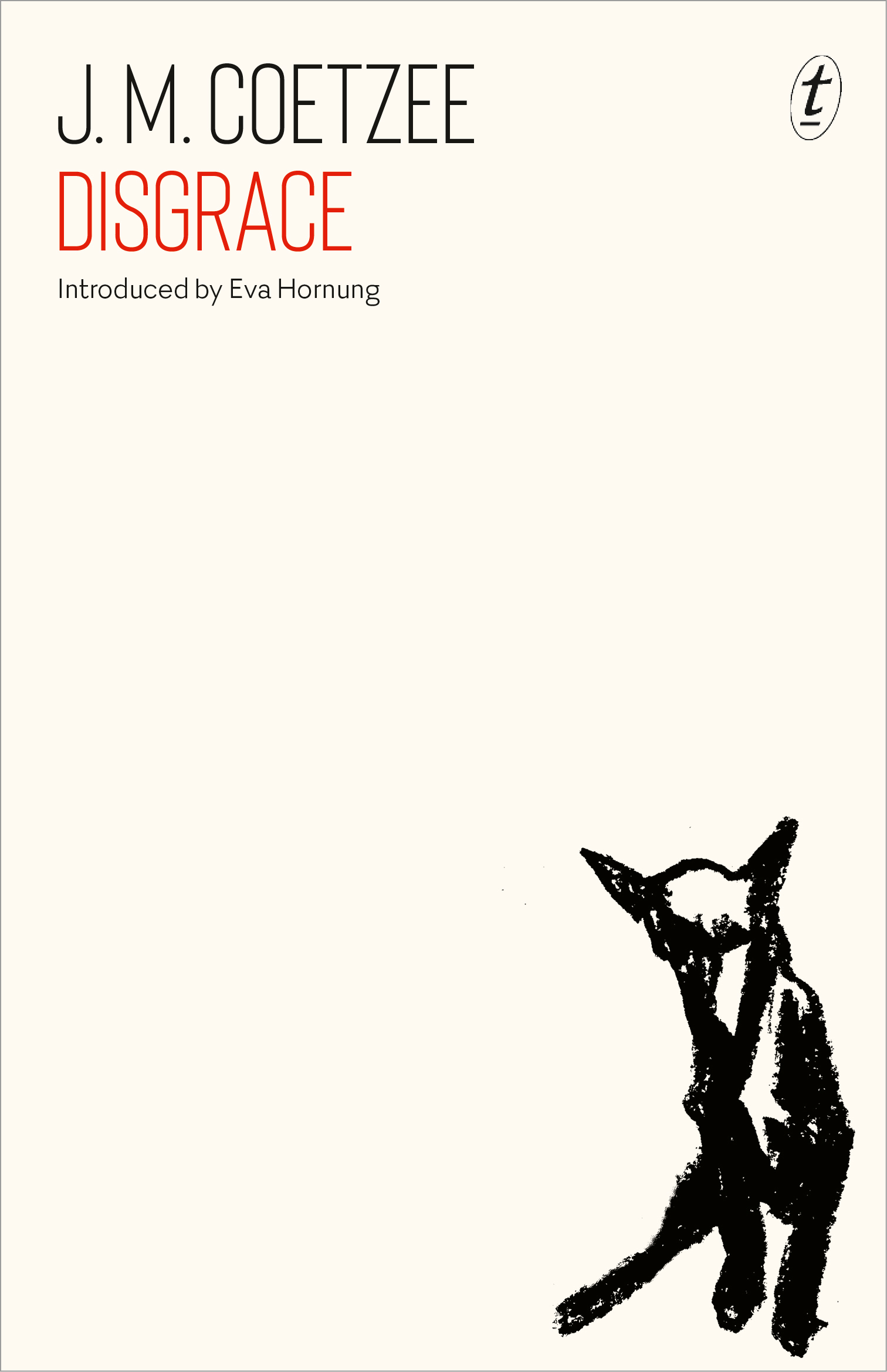
Text Publishing — Disgrace, book by J. M. Coetzee

Disgrace
Sex and other problems

Beyond shame and tragedy, a damaged survivor edges towards hope in the new South Africa. Paul Bailey praises a novel of quiet distinction


Paul Bailey
Saturday 3 July 1999 00:00
AT THE beginning of this painful novel, Professor David Lurie prides himself on having "solved the problem of sex rather well". He is 52, twice divorced, and no longer capable of, or willing to sustain, a deep emotional relationship. Each Thursday afternoon, he visits a woman who calls herself Soraya for professional purposes. They make love at a leisurely pace. He arrives at two pm and leaves 90 minutes later, having first paid her R400. He is content for another week. Next Thursday, he reflects, his problem will be solved again.

Film / Disgrace by JM Coetzee


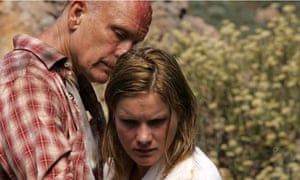
 John Malkovich and Jessica Haines in Disgrace.


Disgrace 

The 100 best novels / No 99 / Disgrace by JM Coetzee (1999)


Philip French
Sunday 6 December 2006


T
his decent, extremely faithful adaptation of Nobel laureate JM Coetzee's 1999 Booker-winning novel is the work of an Australian team led by director Steve Jacobs and screenwriter Anna Maria Monticelli. John Malkovich stars as the arrogant 52-year-old David Lurie, a lecturer in English literature at a Cape Town university, who loses his job after refusing to apologise sufficiently for an affair with a coloured student and then joins his lesbian daughter at a remote farm where she is raped by three young marauding black men. The contrasted ways father and daughter react to this terrible act define their responses to a radical social change.

Disgrace is both a compelling human fable and a complex, ambiguous allegory of post-apartheid South Africa, raising issues about white guilt, black vengeance, the shift in political power and the problems occasioned by the country's deeply divided past and problematically shared future. Malkovich invariably plays men apart and is here well cast as a fastidious intellectual, a Byronic authority on Byron, standing aloof equally from the unjust society in which he was raised and the new one in which he uncomfortably finds himself. His oddly strangulated accent contributes to a sense of alienation, though one doubts if this was the intention. This chilly film gets surprisingly close to the tone of Coetzee's precise prose.


Lesbians are like that because they're fat


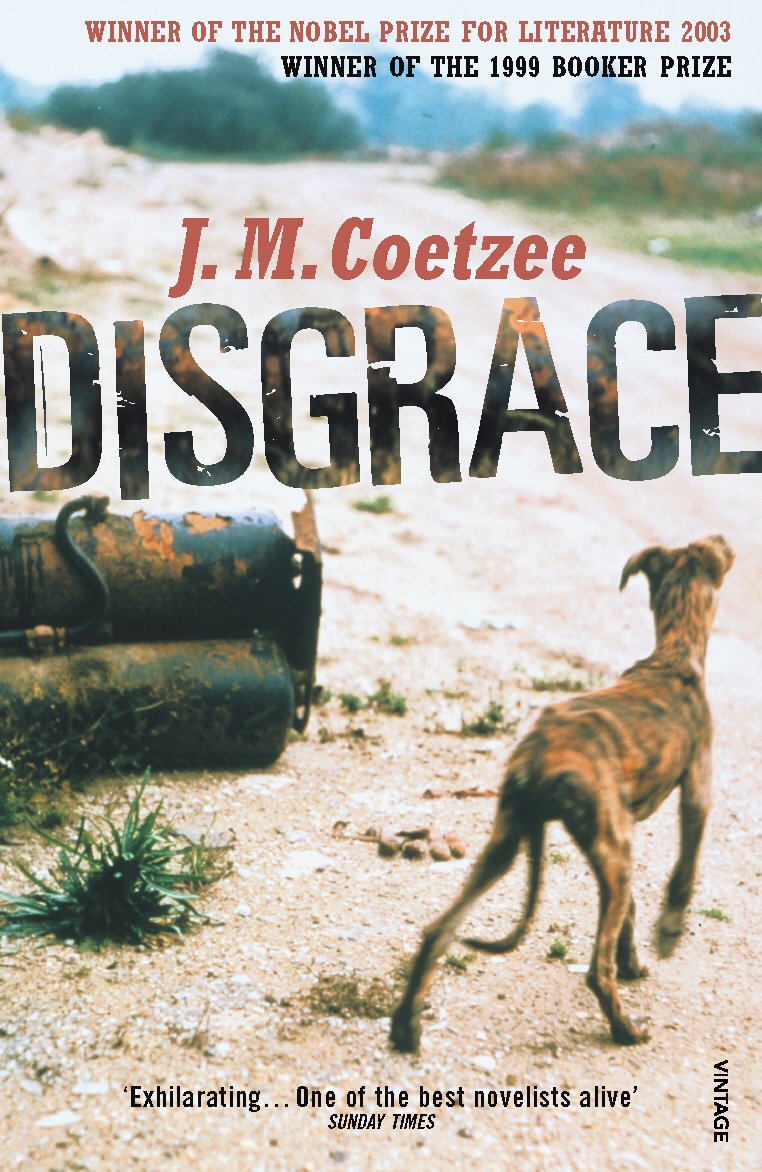
Disgrace: Amazon.es: Coetzee, J.M.: Libros en idiomas extranjeros

Lesbians are like that because they're fat

The 100 best novels / No 99 / Disgrace by JM Coetzee (1999)


Adam Mars-Jones


T
he novel may not inherently be a dialectical form, but readers are so used to a synthesising process that they may detect one without help from the author. JM Coetzee's quietly deceptive new novel exploits this reflex, with a narrative that belongs to two opposite types simultaneously, revealing its true allegiance only on the last page - in fact the last sentence.

Tuesday, September 15, 2020

Man Booker Prize 1983 / Life and Times de Michael K by JM Coetzee


MAN BOOKER PRIZE 1983

Booker club: Life and Times of Michael K

Sam Jordison
Tue 16 Jun 2009

JM Coetzee's first Booker winner about passive resistance in South Africa is elegantly crafted, but its protagonist is more clumsy plot device than character – I'm surprised it won

Thanks to the brief interruption of last year's Best of Booker Prize, the chronology of this trawl through past Booker winners has been warped. I reviewed JM Coetzee's second Booker winner, 1999's Disgrace before getting to this, his first, 1983's Life and Times of Michael K.
The reaction to that Disgrace blog made me nervous about this one. Especially since my negative opinions moved Canada's finest blogger, bookninja, to request that his followers kill me by slipping extra-strength ex-lax into my coffee. But even without that, criticising Coetzee is a dangerous game. He is a Nobel-winning sacred cow of contemporary literature, and any attempts to slaughter him must be made in the face of received and popular opinion.
At first, I thought I was going to escape such conflict. Like Disgrace, Life and Times of Michael K makes a good first impression. And who wouldn't be intrigued by a novel inspired by the moral rebellion of a giant panda?
JM Coetzee
Photograph: TIZIANA FABI

This animal, according to Coetzee, ate only young bamboo shoots when free and so refused all other food when captured. It died as a result. The titular Michael K, a borderline simpleton, "not right in the head" and burdened with a cleft lip, enacts a similar biological revolt.
Michael's journey to this ultimate form of passive resistance is well told. We first meet him in Cape Town, where things seem relatively normal – until in discomfitingly casual tones, Coetzee describes a jeep knocking a youth off a road, a crowd gathering, curfew sirens ignored, a man firing a revolver from a nearby building and the arrival of the military. Things are very wrong in this alternate South Africa.


Soon, Michael K decides he cannot stay where he is, especially since his sick mother is hankering for her rural birthplace. So he straps her to a makeshift trolley and heads for the hills. She dies on the way, but he continues with her ashes, to an abandoned farm where he begins to cut his remaining ties with the world; hiding himself away, in a self-made dugout, living off little more than water, light, a few gathered bugs and a crop of pumpkins.
Every so often Michael's quiet existence is disrupted by the war he feels he has no part in. He finds himself in and out of prison camps, forced to work, and to answer questions he does not understand. So he defies his captors by rejecting the food they give him.
All of this is told in fewer than 200 pages. But if it's a thin book, that's not because Coetzee doesn't have a lot to say, or doesn't paint a vivid picture. It's just that his prose is as lean and spare as Michael after months of bugs, pumpkins and sunlight. At its best his writing moves like a cracking whip.

But in spite of such pleasures, I have serious doubts. My main concern is Michael K himself. He's more of a plot device than a real man, and we are constantly reminded how simple Michael is, and how little he understands . Yet he is able frequently to outwit those who would capture him, to work irrigation systems and grow crops, build shelters and – most jarringly – speak eloquently and ask endless searching questions.
The way in which this "simple" man so often voices the central concerns of the book soon stops feeling uncanny and starts to feel clumsy. Perhaps it's intentional; perhaps Coetzee is making a point about how society disregards those who don't follow its absurd logic. But it's hard not to be cynical about such an obscure possibility when so much else in the book is so laboriously spelled out. Coetzee's habit of highlighting his didactic points, as if in red ink and underlined three times, aren't as pronounced as they are in Disgrace, but he still does it too often.

Michael K, for instance, is prone to reader-prodding reflections such as: "Is this my education? … Am I at last learning about life here in a camp?" While the doctor even ferments a desire to tell Michael that his stay in the camp was merely an allegory, and then expound several of the themes, ideas and potential meanings in the book, in case the reader missed them. Who needs York Notes?
Coetzee's lack of faith in his reader's ability to trace his meaning without such interjections becomes almost insulting. He also has an irritating fondness for gnomic utterances almost as annoying as the garden decorations themselves:
"Why does it matter where they are taking us?" he says. "There are only two places, up the line and down the line. That is the nature of trains."
Sounds good. Means nothing. Less than nothing if you consider the uses the Nazis had for their trains.
These are serious annoyances. Especially when so much of the book is so elegantly crafted. I was left with the feeling that this was a deeply flawed book. Much better than Disgrace, but not one I would be inclined to give a prize. Especially in a competition against Graham Swift's Waterland.


Thursday, December 5, 2019

Digested read / The Schooldays of Jesus by JM Coetzee

JM Coetzee
David Levine

DIGESTED READ

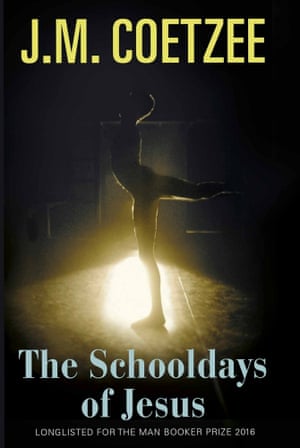
The Schooldays of Jesus by JM Coetzee

‘Is it possible that I am the Messiah?’ David asks. ‘No, you’re just a very naughty boy’

John Crace
Sunday 4 September 2016


“I was expecting Estrella to be bigger,” says he, Simon. “It looked much bigger on the map.”
“Where are we?” says Ines.
“I don’t know because we have forgotten everything except the bits we remember. All I know is that we are everywhere and nowhere,” says he, Simon.
“Why does your direct speech always end with ‘says he, Simon’ but mine always ends ‘says Ines’?” says Ines.
“Only Booker judges can truly know why this kind of nonsense ends up on their longlist,” says he, Simon.


The Schooldays of Jesus by JM Coetzee

They look at their six-year-old boy who is not their boy, the boy who is called David yet is not called David.
“Is it possible that I am the Messiah?” David asks.
“No, you’re just a very naughty boy.”
Simon and Ines find some work which they do to the best of their ability. Sometimes they fall asleep. It is hard to stay awake when every sentence has been crafted to be as dull as this. David sees some boys torturing a duck. Simon kills the duck because it has been fatally wounded.
“Are there burial rites for ducks?” David asks.
“That’s a fascinating question,” says he, Simon.
The owner of the place where Simon and Ines are working offers to pay to send David to one of Estrella’s two Academies.
“David seems to be a very intelligent little boy,” says the woman.
“That’s news to us,” say the readers, who remember him all too well from the first book, The Childhood of Jesus.
“There are two Academies in Estrella,” says the woman who has forgotten she has already mentioned this. “The Academy of Dancing and the Academy of Singing. There are also regular schools but I think David should go to the Academy of Dancing.”
“Very well,” says he, Simon.
The next day Simon takes David to meet the beautiful Ana Magdalena. “Ordinary sums like 9 x 7 are for the lesser mechanical mortals. Here I teach children how to get in touch with numbers through interpretative dance.” She shimmies across the room. “That was the true meaning of the number two. Only children can understand this because they are still in touch with their former cosmic lives.”
Simon wants to say this is the biggest load of bollocks he has ever heard and that JM Coetzee must be taking the piss out of his readers but he has forgotten what Ana Magdalena has said so he just nods.
“I want to dance the number eight,” says David.
Outside the Academy David meets an ugly, dishevelled man called Dmitri. “I work in the museum but as I don’t have any work to do I spend all my time hanging around the Academy,” says Dmitri.
“That’s fascinating,” says he, Simon.
At some point Simon and Ines separate but neither suffer any great distress as neither has any recollection of being together. Simon goes to watch Ana Magdalena swimming naked with the boys in the Academy and finds some pornography that Dmitri has been showing to the boys.


“Can I ask a load of second-rate philosophical questions that are usually found in the novels of Paulo Coelho?” asks David.
“That would be great,” says he, Simon. “I can’t wait.”
“Do you think I’m Jesus?”
“Well, you’re not David.”
Just then Simon hears a commotion. Ana Magdalena has been found strangled in the basement.
“I did it, I did it,” yells Dmitri. “Send me to the salt mines for ever. I deserve to be punished.”
“No,” says everyone. “You must go to a hospital for you are not well.”
The next 100 pages pass slowly for time is sometimes like that. The Academy of Dance closes, David is refused a place at the Academy of Singing and continues to be annoying.
“Psst, it’s me,” says Dmitri. “I’ve escaped from the hospital. Help me get to the salt mines. I was having a passionate affair with Ana Magdalena and I don’t know why I killed her. I need to atone for my sins.”
“OK,” says he, Simon. Simon doesn’t question this ludicrous turn of events as none dare challenge the plotting of a Nobel prize-winning novelist who has twice won the Booker.
David dances a perfect two. “That’s very good,” says he, Simon. “Now hide under the mattress so you don’t get counted in the census.”
“Is that because I am the Son of God? I can dance a perfect three if you like.”
“Save that for one of the next 20 books,” says he, Simon. “You’re still only seven and something tells me you are going to live to 33.”
Digested read, digested: Crucifiction
THE GUARDIAN


Tuesday, November 29, 2016

Tim Parks / Reality Fiction


Reality Fiction

Tim Parks
October 16, 2014, 4:30 pm

It has long been a commonplace that fiction provides a way to break taboos and talk about potentially embarrassing or even criminal personal experiences without bringing society’s censure on oneself. Put the other way round you could say that taboos and censorship encourage creativity, of a kind. But what happens if the main obstacles to free and direct expression fall away?

Monday, August 10, 2015

The 100 best novels / No 99 / Disgrace by JM Coetzee (1999)


The 100 best novels


writtein English

No 99

Disgrace 

by JM Coetzee(1999)


In his Booker-winning masterpiece, Coetzee’s intensely human vision infuses a fictional world that both invites and confounds political interpretation


Robert McCrum
Monday 10 August 2015 05.45 BST


Disgrace was a Booker prize winner in 1999, making JM Coetzee the first writer to win the trophy twice (first with Life & Times of Michael K). In 2003, he was also awarded the Nobel prize in literature. But beyond the awards, Coetzee is notable as a great South African writer who, together with Breyten Breytenbach and the late André Brink, grappled with the savage complexity of the apartheid and post-apartheid years. Coetzee also took the novel in English into new imaginative and moral territory. From his many outstanding works of fiction, Disgrace is unquestionably his masterpiece.

In an apt connection to the beginnings of the 100 best novels series nearly two years ago, Disgrace has been compared by some critics to the work of Daniel Defoe (No 2 in this series). David Lurie, on whom Coetzee visits a contemporary catalogue of humiliations, is a fairly average, twice-married, fiftysomething lecturer at a Capetown university who, accused of sexual misconduct with one of his students, chooses not to defend himself but rather to suffer his fate with a noble, slightly grumpy, stoicism. In his mind, Lurie has committed no offence; he prefers to get fired and suffer disgrace than endure a politically correct process of rehabilitation. He will not give his bien pensant academic tormentors the satisfaction they crave. “Pass sentence,” he says, “and let us get on with our lives.” He retires to the country to live with his daughter Lucy, and address the meaning of this self-inflicted injunction. It’s here that Disgrace, moving up a gear, begins seriously to engage with the aftermath of apartheid.
At first, there is hope. Country life in the eastern Cape, and Lucy’s company, seem to offer the prospect of sanity. But the conflicts of South Africa will never go away. The farm is attacked by a gang of black men, Lucy is raped, and Lurie beaten up. His daughter refuses to press charges, even though one of her assailants is a former “dog man” on the property. The novel ends on a note of utter bleakness. Lurie resolves to stay on the farm to protect his daughter, a domestic act of love by a broken man in search of redemption but almost too confused to know where to find it. Everyone, Coetzee seems to be saying, is a victim. Somewhere, the shade of Samuel Beckett must be smiling.

A note on the text

Coetzee is a writer whose scholarly literary interests can be detected, and followed, quite openly in his work. It is, indeed, instructive to see his creative journey refracted through the Anglo-American literary tradition. His first book,Dusklands (1970), is partly about Vietnam, partly a study of an Afrikaner ancestor written in the spirit of Hawthorne’s The House of Seven Gables. Later, he also studied Beckett, Ford Madox Ford and Jonathan Swift (6141, and 3 in this series).

Braided into this austere tapestry of influence is Coetzee’s political vision, his version of late 20th-century South Africa. Here, he is at pains to avoid the head-on political outrage of a writer such as Nadine Gordimer, a fellow Nobel laureate. Coetzee’s approach is unflinching and subtly fierce, but always much more oblique, avoiding specifics of location and landscape. First, in Waiting for the Barbarians and then in Life & Times of Michael K, he created a world that is simultaneously African but also universal. Coetzee’s vision made a sharp, original commentary on the South Africa of apartheid, but it also explored the human condition with a bleak, dispassionate sympathy that many readers have found unforgettable.
Disgrace, published on the eve of the millennium, is more apparently rooted in a southern African context of “truth and reconciliation”. On closer examination, however, its focus is almost exclusively on Lurie and his crisis, addressing the urgency of his sexual needs in an opening sentence of quasi-documentary simplicity: “For a man of his age, fifty-two, divorced, he has, to his mind, solved the problem of sex rather well.” For the next 218 pages (in the British edition) the reader never leaves Lurie’s head, any more than we leave Robinson Crusoe’s in Defoe’s masterpiece.
But Coetzee is a writer of his time, too. Later in Disgrace, echoing Beckett, Lurie will insist on his identity as a man in a world where even language, the tool of his trade, can no longer be trusted. “Only the monosyllables can still be relied on,” he declares at one point, “and not even all of them.” What is remarkable about Coetzee’s vision as a novelist is that it remains intensely human, rooted in common experience and replete with failure, doubt and frustration. As the critic Adam Mars-Jones wrote in his Guardian review of Disgrace on its publication in July 1999, “any novel set in post-apartheid South Africa is fated to be read as a political portrait, but the fascination of Disgrace is the way it both encourages and contests such a reading by holding extreme alternatives in tension. Salvation, ruin.”
This highly perceptive and specific judgment was echoed, more loosely, by other reviews. For the Times, Disgrace was “a great novel by one of the finest authors writing in the English language today”. For the Independent, “Coetzee’s prose is chaste and lyrical – it is a relief to encounter writing as quietly stylish as this.” TheSunday Telegraph, alluding to Conrad (32 in this series), declared rather loftily that “the journey to a heart of narrative darkness has become a safe literary destination, almost a cliché”. However, the review went on, “Disgrace goes beyond this to explore the furthest reaches of what it means to be human; it is at the frontier of world literature.”
When Coetzee became the first writer, later followed by Peter Carey (True History of the Kelly Gang) and Hilary Mantel (Wolf Hall), to win the Booker prize twice, he declined to attend the presentation dinner. He is, thankfully, too serious about his work to be bothered by such distractions.

Three more from JM Coetzee

Waiting for the Barbarians (1980); Life & Times of Michael K (1983); Elizabeth Costello (2003).

THE GUARDIAN


007 Emma by Jane Austen (1816)
014 Fair by William Thackeray (1848)  

031 Dracula by Bram Stoker  (1897)
035 The Call of the Wild by Jack London (1903)
036 The Golden Bowl by Henry James (1904)
039 The History of Mr Polly by HG Wells (1910)
040 Zuleika Dobson by Max Beerbohm (1915)

041 The Good Soldier by Ford Madox Ford (1915)

042 The Thirty-Nine Steps by John Buchan (1915)
043 The Rainbow by DH Lawrence (1915)
044 Of Human Bondage by W Somerset Waugham (1915)
045 The Age of Innocence by Edith Warthon (1920)
046 Ulysses by James Joyce (1922)
047 Babbitt by Sinclair Lewis (1922)
048 A Pasage to India by EM Forster (1922)
049 Gentlemen Prefer Blondes by Anita Loss ( 1925)
050 Mrs Dalloway by Virginia Woolf (1925)

051 The Great Gatsby by F Scott Fitzgerald (1925)

052 Lolly Willowes by Sylvia Townsend Warner (1926)