Showing posts with label Philip Roth. Show all posts

Saturday, October 5, 2024

Donald Margulies / Slights Unseen


Philip Roth


Slights Unseen

A dozen years ago, critics saw Donald Margulies bring a Philip Roth character to the stage. Some scenes have aged better than others.

BY
STEPHEN VIDER
JUNE 16, 2004

When Donald Margulies‘ Sight Unseen made its New York debut in 1992, it was advertised with a photograph showing Grete, a German journalist, interviewing artist Jonathan Waxman, in London for a major retrospective. Within minutes, Grete asks Jonathan, painter of the controversial Walpurgnisnacht, an image of interracial love (or maybe rape) in a desecrated Jewish cemetery, to “reconcile the success of your work with its rather bleak subject matter.” He manages to evade most of her questions, but in the second act, when Grete calls Jonathan’s representation of middle-class domesticity “obviously Jewish,” he gets defensive: “To say that the subjects of my painting are Jewish subjects, because a Jew happened to paint them, that’s totally absurd!”

Frank Rich, then the Times‘ theater critic, pointed out that the brilliance of this short scene lay in its carefully wrought ambiguity: “Is Grete in fact anti-Semitic? Or is Jonathan…just exploiting the charge of anti-Semitism to deflect this German journalist’s legitimate attacks on his work and integrity?” The question that effectively ends the interview, after all, concerns not Jonathan’s religion but his publicist.

When Sight Unseen returned to New York this spring, Rich’s successor, Ben Brantley, wrote that Jonathan’s confrontation with Grete is “what most people who saw the show then remember most vividly.” Yet in promoting the revival, the Manhattan Theater Club avoids the play’s overarching questions of Jewish cultural identity, focusing instead on Jonathan’s visit with his ex-girlfriend Patricia. Critics have also paid less heed to the Jewish dimension; in The New Yorker, John Lahr barely addressed the interview scenes, except to call them “well-written.”

To be fair, it’s possible that a mere mention of the Pulitzer-prize winning playwright is enough to suggest the play’s concerns. Margulies’ The Model Apartment is a dark comedy about two Holocaust survivors shadowed by their schizophrenic daughter and their past; Collected Stories follows an aging intellectual from the Delmore Schwartz era and a gentile protégée who argues for “the right to write about Jews;” and God of Vengeance resets Sholem Asch‘s Yiddish melodrama on the Lower East Side.

Yet the critical downplaying of Sight Unseen‘s Jewish themes also reflects an obvious imbalance in the revival. The action takes place within the walls of Patricia’s country home, as Jonathan discovers and then tries to steal an early nude he made of his former muse. The story unfolds out of sequence, darting back and forth over a 17-year span and ending with Jonathan and Patricia’s first meeting, when he painted the portrait. The Village Voice‘s Michael Feingold, who called Jonathan “a Philip Roth figure come to life” in 1992, still claims the question of cultural identity “runs parallel to the play’s more general questions about love, art, career, and the wrenched perspective time gives all three.” But as the love triangle gathers steam, the interview scenes—and the larger cultural questions they raise—feel more like a distraction.


This shift may be a deliberate choice by director Daniel Sullivan, or it may just be a function of the acting. Ben Brantley is perceptive in saying that Laura Linney, who played Grete in the original and now plays Patricia, “gives the one unconditionally authentic performance in this production.” It hardly helps that Ben Shenkman plays Jonathan fairly flat, or that Ana Reeder’s Grete sounds like a parody. Neither actor is self-aware enough to project the kind of ambiguity Frank Rich delighted in a dozen years ago.

But even with more parity among the actors, the interview scenes might still feel heavy-handed in 2004. In his notes to the published play, Margulies explains that Sight Unseengrew out of an abandoned 1988 project called Heartbreaker, following Jonathan from puberty through fatherhood. Margulies wove in the interview scenes after remaking Jonathan from an upstart into a celebrity.

Of all the scenes, these seem to have aged least well, and not just because the art world has changed (in 1992, critics frequently compared Jonathan to Eric Fischl). When Jonathan storms off the stage, Grete’s supposed anti-Semitism is less striking than his paranoia: “Wait a minute, wait a minute. What is this Jewish stuff creeping in here?”

Creeping is hardly the right word. Without the interview, Sight Unseen still has a slew of references to shtetls, shiva calls, bar mitzvahs—dialogue that’s become common on television shows from Will and Grace to The O.C. to South Park. Jewish identity has been so casually assimilated into contemporary culture that the play’s more serious debate about Jewish identity and Jewish art feels not only awkward but dated. Yet while the encounter with the German critic seems strangely contrived, the hostility from Patricia’s English husband, Nick—sexual jealousy with an undercurrent of anti-Semitism—sounds more familiar. “Circumcision isn’t common practice in the U.K., you know,” Nick says. “Jews still do it the world over, don’t they. On religious grounds. Here the risk is too great. Too many accidents. Too many boy sopranos.” It could be a harmless observation, but Byron Jennings delivers the line with menacing pleasure. Nick’s racism and Jonathan’s heritage are never the point of the scene, just another layer—and maybe that’s why this exchange seems so real.


TABLET


Philip Roth’s Afterlife


Philip Roth
by Kurt Hoffman


Philip Roth’s Afterlife

He was very sexual, deeply selfish, and content to be just that. It made for great writing, but at what cost? 

BY
ADAM KIRSCH
MARCH 31, 2021


Blake Bailey’s “Philip Roth: The Biography” is the rare book that genuinely deserves the tag “highly anticipated.” While this is partly owed to Bailey’s excellence as a literary biographer (of John Cheever and Richard Yates, among others), I think it has mainly been anticipated in the same way that spectators count down the seconds until a building implodes.

Monday, August 5, 2024

Philip Roth / A Conversation With Edna O’Brien


Edna O’Brien


A Conversation With Edna O'Brien

By PHILIP ROTH 
18 November 1984

The Irish writer Edna O'Brien, who has lived in London now for many years, moved recently to a wide boulevard of imposing 19th- century facades, a street that in the 1870's, when it was built, was renowned, she tells me, for its mistresses and kept women. The real estate agents have taken to calling this corner of the Maida Vale district ''the Belgravia of tomorrow''; at the moment it looks a little like a builder's yard because of all the renovation going on.
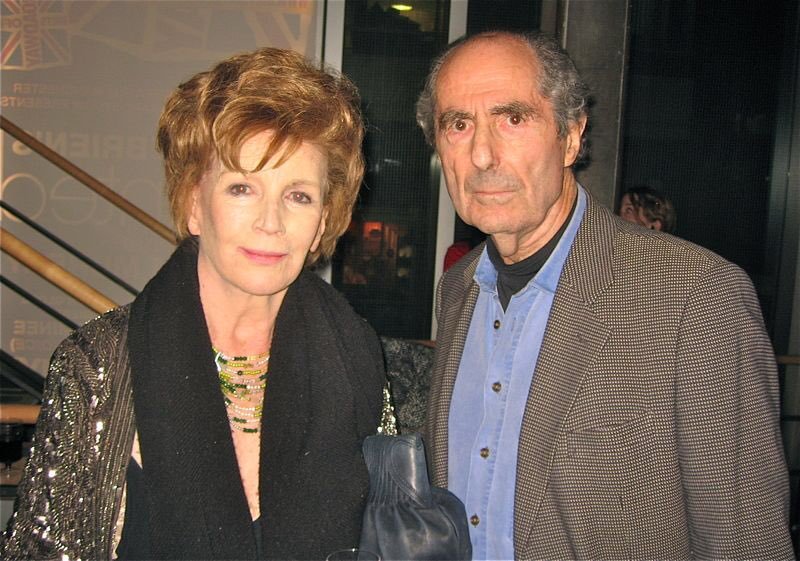
Wednesday, July 31, 2024

Edna O’Brien pays tribute to her friend and fellow writer Philip Roth.

Edna O'Brien
Edna O’Bruen and Philip Roth
The Great Comic Literary Conquistador: Edna O’Brien pays tribute to her friend and fellow writer Philip Roth.

In her poem, ‘One need not be a chamber to be haunted’, Emily Dickinson wrote of the mind’s many niches and the spectral encounters of night. I have been thinking of the forbidding rooms of Philip Roth, a man so studiously private in life, and as an author zanily, volubly confessional. He set forth his own manifesto in a few terse words: ‘Fiction is not a beauty contest and fiction is not autobiography.’ Were he to write an autobiography, he maintained, it would make Beckett’s The Unnamable read like one of the rich narratives of Charles Dickens.

Monday, March 6, 2023

Philip Roth Goes Home Again

philip roth bench
Steve Pyke

Philip Roth Goes Home Again

Philip Roth, a prize-winning novelist and frequent Esquire contributor, died Tuesday night at the age of 85. In 2010, on the occasion of his thirty-first book, Esquire's Scott Raab returned to the Newark of Roth's boyhood. And there, on Philip Roth Plaza, he couldn't stop laughing.


Scott Raab
May 22, 2018


This story first appeared in the October 2010 edition of Esquire.

There are worse places to be stuck in traffic than midtown Manhattan, worse people to be stuck with than Philip Roth. It's pretty nice, actually: Esquire hired a car to schlep us to New Jersey, Roth's old Jewing grounds, a jet-black SUV with a name — Tahoe? Denali? HinduKush? — and backseat as big as all outdoors, icy air-conditioning, and a small man at the steering wheel.

Thursday, November 17, 2022

Book Review 086 / Portnoy's Complaint by Philip Roth


PORTNOY'S COMPLAINT 

by Philip Roth


RELEASE DATE: FEB. 17, 1968

There are two voices in Portnoy's Complaint, Philip Roth's quasi-autobiographical tour de force, though both voices are the voices of the hero. The truer one is best represented by the remarkable section called "Jewish Blues." Here the theme is adolescent rage, middle class New Jersey misery, and filial ambivalence ("a Jewish man with parents alive is a 15-year-old boy, and will remain a 15-year-old boy till they die!"). The tone is at once nostalgic and embittered, rollicking and sad, and the juxtaposition of domestic conventions with the wild masturbatory fantasies of young Alex Portnoy, achingly accurate in every respect, including the highly colored one of the "castrating" Jewish mama, often equals the pathetic brilliance of some of the short stories of Gogol and Babel, besides being, in its rather idiosyncratic way, a closer look at the "generation gap" than anything that has yet appeared in print. The other voice, while rarely losing its original verve, (this is, without doubt, the most "inspired" of Roth's performances), is much less authentic or agreeable: thirty-three-year-old Alex, hot shot lawyer in the Lindsay administration, self-deprecating slob and non-stop lecher, seems not so much a Roth creation as another of those porno-kvetching heroes familiar to readers of Bruce Jay Friedman, replete with bargain-sale displays of fellatio and cunnilingus, as well as an uncomfortable succession of shikses headed by "the Monkey," a votary of East Side Kama Sutra. The affair with Mary Jane, which occupies more than half of the book, is hysterical yet mechanical, private yet desperately unaware, appropriately exhausted on a note of "poetic justice"—Alex becomes impotent, and in Israel. Masterful in parts, phony in others, but obviously a "hot" best-seller.

Saturday, April 24, 2021

Philip Roth and the Nobel Prize in Literature


Philip Roth

Philip Roth and the Nobel Prize in Literature

As he enters his eighties, could the man regarded as America’s greatest living novelist yet win the prize he really wants?


Jason Cowley
March 15, 2013

In 2011 Philip Roth was awarded the Man Booker International Prize for lifetime achievement. In the lead-up to an intimate celebratory dinner that he was due to attend with Roth in New York, Rick Gekoski, chairman of the judges, asked around to see if there was anything he shouldn’t raise in conversation with the thin-skinned and easily irritated novelist. The answer was the Nobel Prize in Literature. 

Philip Roth / The Great American Novelist


Philip Roth

The Great American Novelist
Philip Roth, a contender for the Great American Novelist, has written 27 novels. Here’s everything you need to know about all of them.

by Gabriel Roth

The career of Philip Roth, serious contender for America’s greatest novelist, has arrived at a charged juncture: the interval between Roth’s retirement in 2012, at the age of 79, and his death some time in the next quarter-century. (Is it rude to mention that he’s going to die? He’s been reminding us for more than a decade.) And that gives us an occasion to consider Roth’s entire corpus as the work of a living writer, before the books are moved into the separate stacks where we study or neglect the dead.¹

No other novelist has a narrative like Roth’s: the enfant terrible who settles into an engaged middle age making spiky satires and experiments... and who then, without warning, begins a hair-raising run of masterpieces that make everything up to that point look like a warm-up. In hindsight, Roth’s books organize themselves into four periods: a decade of finding his voice, two decades of trial and error, an imperial phase, and a dying fall.


The Beginning

To start at the beginning, though: Goodbye, Columbus has all the attributes of the classic American first novel. It’s a swift coming-of-age story about a young man in love with a woman he can’t see clearly, taking place over the course of an intense summer. It’s also about two different kinds of Jewish families that used to exist, the pushy strivers and the WASPily assimilated, and how they look down on each other. It’s a near-perfect example of the form—few mature novelists display the chops Roth had his first time out—but today the satirical elements seem foreign, almost anthropological.

Howard Jacobson / Is American Pastoral Philip Roth at his best?


Howard Jacobson: Is American Pastoral Philip Roth at his best?


Roth said Sabbath’s Theater was his best book, even though many hated it. Should we take notice of a writer’s evaluation of their own work?

Howard Jacobson
11 November 2016

P

hilip Roth has said that Sabbath’s Theater is his best, or at least his best-written, novel. One should take writers’ valuations of their own work with a pinch of salt: they are likely to rank them differently tomorrow. But this judgment is particularly interesting, regardless of whether one agrees with it – though I do – for the reason that Roth seems to take satisfaction in noting that many people “hated” the novel. As though “hating” is a precondition of understanding it. Roth, of course, has always been a novelist who gives his readers a wild ride. If you haven’t wrestled with the angel and the devil and lost to both, you can’t be said to have read him. The nakedness of the encounter is part of what makes him the greatest novelist alive.


If ever a writer put paid to the notion that the best books are those you can’t put down, it’s Roth. But is there an over-and-above provocation to readerly exhaustion and rage in Sabbath’s Theater of which Roth is especially proud and which in itself explains his preference for it? It’s a testament, not only to how much there is to think about in the book, but to its grand comic scandalousness, that you need to pause to catch your breath every dozen pages or so.

Monday, October 14, 2019

Philip Roth Interviews Primo Levi

Primo Levi and Philip Roth


Philip Roth Interviews Primo Levi

Marco Belpoliti

One of Phillip Roth’s best books is not a novel, nor even a collection of short stories; rather it is a book of interviews, entitled Shop Talk (in Italian Chiacchiere di bottega). Published in English in 2001, the volume contains a series of conversations with fellow writers. The interviews are preceded by vivid portraits of the people that Roth met, from Aharon Appelfeld to Ivan Klima, from Isaac Bashevis Singer to Milan Kundera; then there is a visit with Edna O’Brien and an exchange of letters with Mary McCarthy, a portrait of Philip Guston and a series of quick reviews of the books of Saul Bellow. These are wonderful pieces in which Roth displays not only that he is an excellent reader – and how could it be otherwise given that he is a writer? – but also that he is capable of stepping into the role of critic, a role not familiar to all authors, particularly if they are celebrities. A critic is someone who enters the depths of the books he reads, to travel through the fine web of their substance and from this travel glean general observations about literature, the world and himself. Roth demonstrates in his ‘shop talk’ that he is possessed of extraordinary humility. He never puts himself above the authors he meets and never looks down at their books: he asks questions, eye to eye. He does so as a friend, as well as an admirer, with an intensity of interest that is stunning in a writer who is so complex, rich and profound. His depth derives from his intelligence, for as sharp as he is Roth is never cynical or sentimental, and is always ready to understand.