Review
Five of the best science fiction and fantasy books of 2023
From the ocean bed to the stars and the multiverse, five novels to transport you
Adam Roberts
Wednesday 6 December 2023
Conquest
Nina Allan (Riverrun)
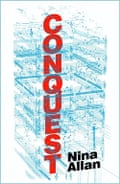
Frank sees patterns in everything. He loves the music of Bach and is exceptionally good at his work as a coder, but he gets drawn into an elaborate conspiracy theory about a secret alien invasion, the “conquest” of the book’s title, supposedly predicted by an obscure 1950s science fiction tale by John C Sylvester. When Frank disappears, his girlfriend hires a private investigator to find him. This absorbing detective story is interspersed with concert reviews, true crime, film criticism, biographical sketches and a healthy chunk of Sylvester’s text detailing the aftermath of an interstellar war and the building of a gigantic tower from living stone. The novel touches on David Bowie and Upstream Color, The X-Files and Stephen Hawking. Are these elements merely disparate, or do they add up to something bigger? Does connecting them, as the story increasingly does, induct us into a dangerous conspiratorial mindset, or do the distinct elements cohere, as individual notes come together into the gestalt of music? Allan’s story is as mellowly complex as the Bach variations its main character adores, and her best novel yet.
Him
Geoff Ryman (Angry Robot)
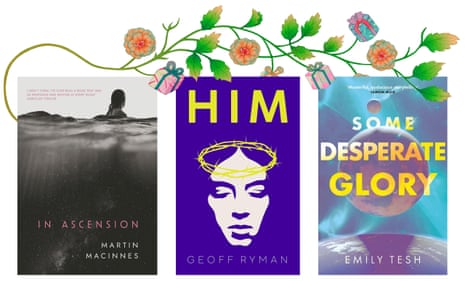
Him is a powerful piece of historical fiction, recreating ordinary life in first-century Judea with vivid immediacy; but it is also a science fiction novel about the multiverse, alienness and the possibilities of reality. The story is, in one sense, familiar: the childhood and ministry of Jesus – here “Yeshu”, born a girl called Avigayil but identifying from an early age as male (Ryman uses Aramaic names rather than the more familiar biblical ones for greater historical verisimilitude). The novel’s God presides over a multiverse, and into each proliferating reality he sends a slightly different iteration of redemption. This grand science-fictional conceit is grounded by Ryman’s superbly precise and evocative writing, his immersively believable world. The relationship between Yeshu and his mother Maryam is beautifully rendered and the ending, though it can’t be unfamiliar, is intensely moving. Ryman’s gospel achieves what SF does at its best: beautifully estranging our too-familiar world, and making us think and feel anew.

Some Desperate Glory
Emily Tesh (Orbit)
This sparky debut is a blend of space opera and military SF that refreshes both modes. Desperate Glory moves briskly, page-turningly, and provides all the satisfactions of widescreen galactic worldbuilding and adventure as it goes; but it never sacrifices complexity or trades in easy answers. Humanity is one of three galactic species to have independently discovered the “shadowspace” tech that powers starships, but we are regarded by the others as uncontrollably violent, having evolved “as apex predators in a hazardous biosphere” – the Earth. Now Earth has been destroyed, and the novel’s protagonist, Kyr, a genetically enhanced supersoldier, grows up in the military space station Gaea, unthinkingly embodying Gaea’s militaristic, fascistic ethos, focused on revenge. But as the story proceeds and she learns more about the universe, questioning her own assumptions, a richer, more complex sense of the nature of things grows in her. Kyr’s coming-of-age journey does not take the path plot-cliche leads you to expect, and the telling is bracingly twisty. An instant classic.

In Ascension
Martin MacInnes (Atlantic)
Longlisted for the Booker, MacInnes’s novel is both spacious and intimate. Two sisters take different paths through life: outgoing Leigh becomes a marine biologist and travels the world; quieter, smaller Helena stays home with their mother and becomes a financial lawyer. Leigh is part of a survey-ship team that discovers an impossibly deep fissure in the ocean bed. Later, she joins a space mission to investigate an anomalous object passing through the solar system: a kilometres-long, spirally decorated traveller from deep space. This object eludes the mission as they chase after it through the solar system, but something happens to the consciousnesses of the crew. What Leigh sees in outer space are “the planets, the sun, the moons as a single curved body drifting through space like the juvenile stage of an aquatic life form”. It’s a novel about big, complex ideas – our place in the cosmos, our interconnectedness with one another and with the natural world – that is also brilliantly readable, wide-ranging and thrilling.