Showing posts with label Viggo Mortensen. Show all posts

Wednesday, October 4, 2017

Viggo Mortensen / ‘Often people are desperate, so I do what needs to be done’


Viggo Mortensen


Viggo Mortensen: ‘Often people are desperate, so I do what needs to be done’


Viggo Mortensen is not a man to do things by halves: he’s been starved, beaten and frozen for the sake of his art. Now he’s got lost in the pampas of Patagonia. Alice Fisher hears why the actor makes life so hard for himself

Alice Fisher
Sunday 5 April 2015 08.30 BST


‘I just want to be in movies that I wouldn’t mind seeing 10 years from now’: Viggo Mortensen.
Photograph: Suki Dhanda for the Observer


Viggo Mortensen is in his socks – he likes to go shoeless whenever he can – and is making a cup of tea. If this does not seem a thing of note, you’ve never watched Viggo brew. He carefully portions out green leaves from his own pouch into his personal silver vessel – a modern version of the South American mate gourd – then decants the water into a silver Thermos, adding the leaves to brew. “I’m ready to go,” he says, pulling his vessel close.
I mean, obviously he’d have been ready to go five minutes ago if he’d just dunked a tea bag in a cup with a slosh of milk like most of us do, but it’s clear Viggo likes to do things on his own terms and to his own very precise standards. You just have to look at his CV to see that. Viggo became an internationally fancied and bankable star as Aragorn, king of men, in the Lord of the Rings trilogy starting back in 2001. It’s a reputation he’s cemented over the years, in large part with another trio of films – A History of Violence, Eastern Promises and A Dangerous Method – all directed by David Cronenberg. Though he received an Oscar nomination for Eastern Promises in 2007, Viggo never capitalised on the earning potential the LOTR franchise offered. In fact, that idea is baffling to him. He says he only took the role of Aragorn to please his son, Henry, who was around 10 years old at the time.
Given the choice, what Viggo wants above all else is to tell a story he thinks is interesting. “I don’t really look for movies based on the budget or the nationality or the language,” he has said. “I just want to be in movies that I wouldn’t mind seeing 10 years from now.” Looking at the films he has been in since he made his name, it’s fair to say his vision of enduring storytelling is not one seen in the romcoms and blockbusters that typically make for box-office hits.
Jauja, the film we have met to discuss, is possibly one of his least commercial yet. It’s an Argentinian-Danish movie directed by Lisandro Alonso, an award-winning young director, and co-written by Alonso with Fabian Casas, an Argentinian poet. “Jauja” is a Spanish word with Arabic origins which roughly translates to Neverland. After he’s patiently clarified the pronunciation (“How as in how you doing? And huh as in uh-huh,”) Viggo explains that the promise of Jauja was used as propaganda by the Spaniards who conquered South America in the 16th century.
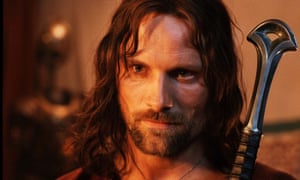

‘What else would I do?’: as Aragorn in Lord of the Rings: Two Towers. Photograph: AP
“It was hard to convince people to go there. You’d either die on the way or die when you got there. You never got to go home. So they tried to make it sound like the ideal place. Something you’d dream about seeing or achieving. But you never really get what you’re looking for, do you?”

The film is about a Danish captain stationed in a remote Patagonian army outpost. He’s travelling with his 15-year-old daughter and when she vanishes into the pampas, he goes on a desperate quest to find her. Viggo stumbles and sweats through the unforgiving landscape and a series of surreal encounters. At one point he follows a dog through the mountains – chasing not his own tail, but someone else’s.
Viggo’s lack of physical vanity has become a recurring theme in his work. On film he’s been beaten up (Eastern Promises), starved (The Road) and kicked in the balls (A History of Violence), but he can’t imagine work being any other way. “What else would I do?” snorts the 56-year-old. “Those films where I’m the hero with a 20-year-old girlfriend? I go for what needs to be there. Often people are desperate or ridiculous rather than heroic, so I do what needs to be done.”
Jauja is a beautiful film – lit like a Technicolor classic and surprisingly funny – but also baffling. I went to the loo during the screening and, when I returned, for a moment I thought I’d walked into the wrong auditorium because the film had changed so completely. “It’s nonlinear,” agrees Viggo. “But even people who resisted it and didn’t think they liked it find there’s a resonance on an intellectual level. You can get existential about it. What’s it about? Well, you keep thinking about it. Most movies don’t do that.”
Viggo’s animation and enthusiasm as he talks about the film are contagious. He’s very smart and articulate and his intensity is interestingly at odds with his laidback appearance – his scruffy jeans and faded San Lorenzo football shirt (Viggo is a huge football fan and the Buenos Aires team was his first love), and the ratty friendship bracelets that slither up and down his arm as he drinks his tea.
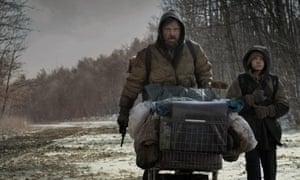

In The Road with Kodi Smit-McPhee. Photograph: Allstar
Jauja is also a personal project for Viggo. Though he was born in New York, he grew up in Argentina with his American mother Grace, Danish father Viggo Sr, and younger brothers Walter and Charles. His father worked as an agricultural manager and, though they mainly lived in Buenos Aires, they also spent time in Chaco in the rural north. “We’d go on camping holidays over the Christmas holidays in the area where Jauja was shot, just our sleeping bags in the car,” he says. “It made me really happy to be on a horse in that landscape again.”
Viggo left South America aged 11, when his parents divorced and he moved to upstate New York with his mother and siblings. The move was a shock: to lose that Spanish culture, the TV, the football. He and his brothers mainly spoke Spanish, but then they were living near Quebec. He adapted – learned some French, started supporting the Montreal Canadiens hockey team – but it seems unsurprising that he now mainly lives in Madrid with his girlfriend, actor Ariadna Gil (best known here for the film Pan’s Labyrinth).

Working on Jauja made him think about his father a lot. “In the film I speak Spanish with a thick Danish accent, copying my father. I was raised there so there were connections for me in terms of culture, language and landscape. I knew those things would be assets for me and for Lisandro.” Did it make him think about his parents’ split? “Maybe subconsciously. I certainly thought a lot about our life there.”
Even without the personal connection, Viggo approaches each film as a learning experience. “Making a movie for me is not always about being paid, but it is a new university course. There’s no limit to what you can learn. I mean, it’s perfectly fine for an actor to say I’m just going to learn the lines and get on the horse, but I happen to enjoy digging deeper. In this case, I already knew about 19th- century Danish history and the wars the captain would have fought, so I went to Denmark and met with antiquarians and military historians. I found the uniform he would have worn and also picked out a medal. It was only given to soldiers who served in 1848-64 against the Prussians.”
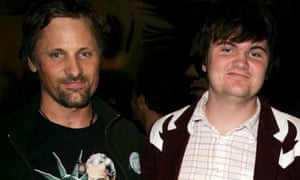
 With his son Henry. Mortensen says he only took the role of Aragorn to please Henry who was 10 at the time. Photograph: Matt Baron/Rex

For Viggo, this research is pretty superficial. He slept outside in his costume for the first few days of the LOTR shoot. For the big-screen adaptation of Cormac McCarthy’s The Road he went one further and slept outside in sub-zero temperatures wrapped in nothing but a tarpaulin and always made sure his shoes were soaking wet before filming, for added discomfort. While researching Good(2008), in which he plays a German professor working with the Nazis, he drove more than 1,000 miles around Germany and Poland visiting concentration camps. To get under Freud’s skin for A Dangerous Method, he not only learned to write like the psychoanalyst but also bought first editions of the books that the good doctor would have had on his study shelves.

“I just think,” explains Viggo, “that the more realistic and specific you are with the details, the more universal the story becomes.”
Much of Viggo’s LOTR money was sunk into Perceval Press, an independent publishing company (named after the knight who stars in his favourite part of the myth of the Holy Grail). Perceval produces albums, art books and poetry collections by obscure artists, and the company recently diversified into film withJauja, the second film it has been involved in.
Viggo’s own art books, poetry and albums are also available on Perceval. He was a published poet before he set up the imprint and his art had already been shown around LA (you can see his paintings in the 1998 film A Perfect Murder. He played an artist and, of course, created the work for the film). Perceval’s biggest profits come from Viggo’s own artistic output – though whether that’s because his fans really love his spoken-word albums or because they fancy him and would buy anything he released is hard to tell. His latest album, Under The Weather, came out last month, dedicated to feminist author Ti-Grace Atkinson and Albert Camus.
Perceval Press’s website is interesting even if you’re not in the mood for buying a book of paintings of endangered species by an Iranian artist. It’s a repository for Viggo’s political and world views, too. He regularly posts features, news stories and poems which he thinks will interest visitors. Currently the home page is a jumble of pieces about Israel, Benjamin Netanyahu’s re-election and climate change.
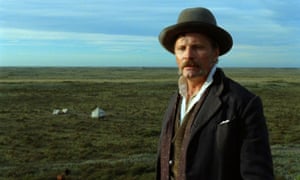

‘The more realistic and specific you are with the details, the more universal the story becomes’: in his latest film, Jauja. Photograph: Rex
“Putting that stuff up there makes me pay attention,” he says. “I concentrate when I’m reading the newspaper in case there’s something I can take from it. It’s like having a camera. I’ve carried a camera since I was a teenager and whether you’re using it or not, it means you look at composition, think about what around you would work well in the frame. The pieces on Perceval are just things I think are interesting to read. I’ll put up pieces I don’t agree with – conservative, right wing – if I think they’re well written. I’m not saying what I think, I’m asking questions and giving you the opportunity to ask yourself how you relate to this.”

This is a nice idea, but not strictly true. Viggo has always been fairly outspoken: no one would be in any doubt about his left-wing political affiliations. “Yeah, I’ve been called antisemitic and I got so much shit for speaking out against the Iraq invasion, but it was a huge waste of material resources and manpower.”

One of my favourite stories about Viggo comes from 2005. He heard that Californian mother Cindy Sheehan had driven her motorhome to Texas and parked outside George Bush’s family home in the hope of talking to the president about her son, who had been killed in Iraq. Viggo decided to show his support, so he flew out of LA and turned up unannounced at her motorhome with fresh vegetables, mineral water and a copy of George Orwell’s Animal Farm (to read, in case she had to wait around before meeting Bush). He only spoke to Sheehan for 20 minutes because he had to go back to LA to pick Henry up from school. Sheehan said she was a bit surprised when Aragorn turned up on her doorstep, but she appreciated the gesture. Viggo dedicated his next album, Intelligence Failure, to her.
You have to admire Viggo’s intentions, no matter what you think of the end results. Whether he’s stumbling through a desert looking for life’s answers, bringing his own tea set to an interview or flying across the country for a 20-minute chat, the man knows what he wants. As we finish, I tell him I think he has a pretty nice life – he basically gets to do all the things he enjoys. He shrugs: “Yeah, but if people weren’t interested in that stuff, I’d be doing it anyway. You just have to go ahead and do it, don’t you?”


Tuesday, October 3, 2017

Viggo Mortensen / 'My mother is very happy about it'

Viggo Mortensen

Viggo Mortensen

'My mother is very happy about it'

Viggo Mortensen has no illusions about his chances in the best actor race. No problem - it's all ridiculous anyway, he tells Harriet Lane

Harriet Lane
Friday 22 February 2008 12.10 GMT


It's fair to say that Viggo Mortensen has mixed feelings about his Oscar nomination, and the awards season in general. "I don't know why I was included this time. I certainly haven't gone out and done the campaign that one is supposed to do," he says, in so diffident a mumble I have to lean to catch his words. "If you're lucky, you get a lottery ticket, then you have to go find some nice clothes, wash up and go, and it's very flattering, and my mother is very happy about it. But like most people - unless they're very practised at it or have no warm blood at all in their veins - I feel a little apprehensive about the red carpet. It's always a bit bewildering when people are taking pictures and asking questions before the ceremony. I'm not very good at giving quick answers, and that's what they want. So I end up saying half a sentence, and then they go, 'OK, thank you!' and I'm thinking, 'WHAT did I just say?'"
The whole business, he supposes, is just a teensy bit ludicrous. Mortensen doesn't want to sound unappreciative about his inclusion on the best actor Oscar shortlist for his work in David Cronenberg's Eastern Promises, but a) he is indignant that his director has failed to score any nominations, and b) he is under no illusions about winning. Indeed, if ever there's a bad year to be up for best actor, this is it, with Daniel Day-Lewis inexorably locked on to target. "I'm realistic," Mortensen says. "I know I'm the odds-on favourite to remain seated throughout the ceremony."
Mortensen, 49, arrived in London from Washington state yesterday. He comes down from his room jetlagged, barefoot and wet-haired, smelling quite deliciously of soap, and makes short work of the two double espressos that have been cooling on the table waiting for him. A slight, thoughtful presence, he's bearded in preparation for his role in The Road, an adaptation of Cormac McCarthy's post-apocalyptic novel, co-starring Charlize Theron; he has just completed Ed Harris's western Appaloosa, and Good, from the CP Taylor play set in 1930s Germany.
Mortensen was 43 when he landed the role of Aragorn in The Lord of the Rings, ending a long stint on the supporting actors' bench (The Indian Runner, Carlito's Way, Portrait of a Lady), but his choices since then - including a previous film with Cronenberg, A History of Violence - have shown a taste for the unexpected and small-scale. He likes the freedom that comes with limited budgets, where the directors tend to be "left more in peace" by producers; he also likes scripts that take him somewhere new. "I don't have a set plan. I like to learn things. That's the main thing I like about my job."
Divorced and with a son at college, Mortensen is famous for immersing himself in his characters' lives long before he steps on set. This is along with an engaged political interest - he backed the shortlived presidential campaign of progressive Democrat Dennis Kucinich, and will now settle for Obama, though he sounds less than rapturous: "Both he and Clinton have so many corporate ties that are unsettling to me. Perhaps he has fewer. And the movement that's behind him may plague his conscience so much that I think he'll get us out of Iraq sooner than Hillary Clinton will. So, that's our best chance." It means that he's viewed by the industry with respect and bafflement; certainly his young LOTR colleagues talked about him as some sort of visionary or seer.
"This basic thing I always do: what happened between the character's birth, and page one of the script? Anything that's not in the story, I'll fill in the blanks." This has always been Mortensen's approach, even for rinky-dink starter roles such as his brief appearance in Witness, where he appears in straw hat and shirtsleeves for the famous barn-building scene. It made the long haul of fruitless auditioning particularly draining - he got this close to the Christopher Lambert role in Greystoke, to the Willem Dafoe role in Platoon - but at least he came away better informed. For Eastern Promises, in which he plays Nikolai, implacable fixer for a London-based family of Russian mobsters, his research informed not just his performance but the plot itself. The tattoos that play such a key role, for instance, only found their way into the script after he read a book on the subject. Just before shooting, he went backpacking, solo, around Moscow, St Petersburg and the Urals. (Languages are not a problem. Born to a Danish farmer father and an American mother, he grew up in Venezuela, Argentina, New York state and Denmark. There's a UN patch on his sweatshirt and if you ask him where he's based, he says, hippyishly, "Planet Earth, mostly.") The travelling, he says, informed more than his performance. "It changed the way I read Russian literature, poetry, history ... it changed the way I felt about things I'd read before. I like what I learn in preparation. That's the main thing."

His character in Good, a German professor, finds refuge in music, and while filming in Budapest, Mortensen started hankering after a piano, though he'd never played before. An old piano tuner loaned him an upright, "and I asked the hotel if we could bring it in the back door if I promised to put pieces of wood under it or something ... So we put it in the room and I started playing a little bit, and I played it more and more, to the point where every night, rather than looking at the script, I'd just play the piano while thinking about tomorrow's work, and it was really helpful." Nothing goes to waste. As we're finishing up, he hands over a CD, entitled Time Waits for Everyone. Composition, performance, production, cover photography: he did the lot, then released it via his own company, established with the LOTR cash dump. (It's minimalist, melancholy, entirely listenable and owes a certain debt to Satie.)
Mortensen, then, is a bit of a polymath. He paints, writes poetry and has exhibitions of his photographs lined up in Iceland and Denmark later this year. "I can remember being seven or eight and waking up in the morning and going, shit, I'm going to die. Not because I was afraid of dying, but there was this sense - I still have this once in a while - that there's so much to see and do. It made me want to seize the day, whatever you want to call it. Pay attention." He only began to think about acting after college (he studied government and Spanish and - a characteristic flourish - embarrassed his parents by boycotting graduation robes in protest about the manufacturers' poor labour practices) while living in Denmark, delivering flour to bakeries and selling flowers on street corners.
Growing up, he hadn't been exposed to much cinema, so he educated himself: "Older European movies, Japanese movies. In particular I remember Meryl Streep in The Deer Hunter. I saw a really poor print of Maria Falconetti in Carl Dreyer's The Passion of Joan of Arc: she's amazing. Bergman's movies, Autumn Sonata. Bresson. Jessica Lange in Frances. What I saw was a way of doing the job of make-believe that was more than just entertainment. And when it really was well done, as well as appreciating it as literature or art, something else happened, which was that I started wondering: what's the trick? I started being curious about how it worked, how I was moved to really believe what I was seeing, if it was done well." In New York, he joined a drama workshop, was picked up by an agent and began the long slog. "I started getting close to getting jobs - repeatedly. The first couple of years I did screen-tests like Greystoke maybe twentysomething times. I'd do my best, but never got one."
So why did he stick with the acting? "On balance, even though it was mostly disappointments and frustrations and embarrassments, there was something about it that I liked, and still like." Film reconciles the sprawl of his interests: philosophy, history, psychology, photography, music. Sure, it's an odd business, with plenty of pitfalls, but he thinks he has a pretty healthy take on it. "But then," he says, "if I had a really healthy attitude, I wouldn't be in the industry at all. So I must be somewhat contaminated."


Saturday, January 2, 2010

Life and style / Viggo Mortensen / This world, the love of my life


LIFE AND SYTLE

Q&A: Viggo Mortensen


'If I could go back in time, I'd go to the first Viking ship to land in America'
"This world, the love of my life" 

Rosanna Greenstreet
Saturday 2 January 2010 00.10 GMT

Viggo Mortensen, 51, was born in New York to an American mother and a Danish father. He made his feature film debut in Peter Weir's Witness and went on to appear in Carlito's Way, The Lord Of The Rings trilogy, A History Of Violence and Eastern Promises, for which he was Oscar-nominated in 2008. His latest film, The Road, an adaptation of the Cormac McCarthy book, opens on Friday. He is divorced with one son, and lives in Idaho.
When were you happiest?

Right now. The past has gone.

What is your greatest fear?

The next thing I ought to do. With few exceptions, one ought always do what one is afraid of.

What is your earliest memory? 

Lying in my mother's lap and looking up at her face. I think we were in a car. I was one and a half, two, maybe. My next memory is also in a car, and I was standing behind my dad. I remember getting sick and throwing up down the back of my dad's shirt. He remembers it well.

Which living person do you most admire, and why? 

My son, Henry, because he is kind, which I think is the highest wisdom.

What is the trait you most deplore in yourself? 

Occasionally being mistrustful of others.

What is your most unappealing habit? 

It's hard to pick one!

What is your favourite smell? 

To truthfully answer at this time, I'd have to reveal something that is too intimate to reveal.

What is your guiltiest pleasure? 

Sleeping.

What is the worst job you've done? 

In a factory in Denmark when I was 20. All day long I had to punch a single hole in the centre of a square piece of metal.

To whom would you most like to say sorry, and why? 

My body – we all do things we shouldn't.

What is the love of your life? 

This world.

Which living person do you most despise? 

I don't think it solves anything to despise.

Which phrases do you most overuse? 

"Let me think about it."

What has been your biggest disappointment? 

That Barack Obama seems to be more concerned with becoming re-elected than with doing his very best to fulfil the promise of his candidacy.

If you could go back in time, where would you go? 

To the first Viking ship to land in North America.

When did you last cry, and why? 

Last night, because of a beautiful thing someone told me on the phone.

How do you relax? 

I go for a walk, play the piano or take a long bath.

What is the closest you've come to death? 

Quite a few times in cars, in water, on horseback and on motorcycles.

What single thing would improve the quality of your life? 
Not dying.


What do you consider your greatest achievement? 

Understanding that my parents are not gods, and that I'm not one, either.

What keeps you awake at night? 

Yesterday and tomorrow, but I eventually fall asleep because neither exists.

What song would you like played at your funeral? 

It doesn't really matter.

How would you like to be remembered? 

That doesn't really matter, either.