Showing posts with label Salman Rushdie. Show all posts

Wednesday, June 10, 2026

My top 10 by Salman Rushdie


Headshot of Salman Rushdie

My top 10
Salman Rushdie
Author


Ulysses (#3)
by James Joyce
In Search of Lost Time (#5)
by Marcel Proust
The Trial (#27)
by Franz Kafka
One Hundred Years of Solitude (#17)
by Gabriel García Márquez
The Tin Drum
by Günter Grass
Beloved (#2)
by Toni Morrison
Don Quixote (#26)
by Miguel de Cervantes
Great Expectations (#35)
by Charles Dickens
The Master and Margarita (#66)
by Mikhail Bulgakov
10 The Age of Innocence (#38)
by Edith Wharton

THE GUARDIAN


Tuesday, January 9, 2024

Nonfiction to look out for in 2024


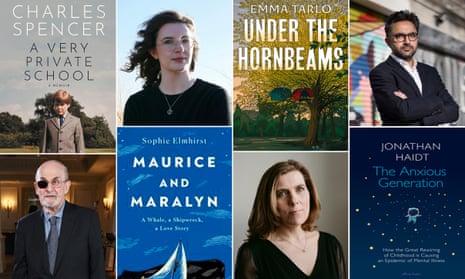
Clockwise from top left: A Very Private School by Charles Spencer; Lauren Oyler; Under the Hornbeams by Emma Tarlo; Sathnam Sanghera; The Anxious Generation by Jonathan Haidt; Rose Boyt; Maurice and Maralyn by Sophie Elmhirst; and Salman Rushdie.


Nonfiction to look out for in 2024

From Salman Rushdie’s account of the attempt on his life to Sathnam Sanghera’s thoughts on imperialism via the story of the Tory party’s decline, here are the big hitters coming your way next year


Rachel Cooke
1 January 2024


What are the trends in new nonfiction? From where I’m sitting, nature writing and major biography appear to be on their way down, history and health are still rising, and every other publisher’s list is littered, somewhat dispiritingly, with what they call genre-defying but I think of as bitty, not-one-thing-or-the-other kinds of books: group biographies of people about whom tons has already been written; collections of essays with no unifying theme; texts that combine fact with a certain kind of fiction in a sometimes rather desperate bid to make the austere and the arcane seem newly “relevant”.

Wednesday, November 16, 2022

Book Review 091 / Midnight’s Children by Salman Rushdie


BOOKER CLUB
Midnight's Children is the right winner

Salman Rushdie's madcap characters splash gleefully in the novel's serious historical tide. A tough book, but a rare treat


Sam Jordison
Thursday 10 July 2008

Plenty to smile about ... Salman Rushdie. Photograph: Felix Clay

It's only minutes since I reached the final, typically long and rich sentence of Midnight's Children and closed the covers. It feels like shutting the lid on a magic box. A swirling, overloaded mass of words, colours, smells, allusions and illusions has suddenly been contained. A portal to a fantastical, vital dimension has been sealed off.

Thursday, August 18, 2022

Hundreds of authors to read from Salman Rushdie’s works in show of solidarity


Salman Rushdie


Hundreds of authors to read from Salman Rushdie’s works in show of solidarity

The ‘Stand with Salman’ event in New York mirrors a public reading of The Satanic Verses that took place after the fatwa was issued in 1989


Sarah Shaffi
Wednesday 17 August 2022


Hundreds of writers are to gather in New York this week to read from Salman Rushdie’s works, in a recreation of an event first held after the fatwa on the author was issued in 1989.

Authors including Paul Auster, Tina Brown, Kiran Desai, Amanda Foreman, AM Homes, Siri Hustvedt, Hari Kunzru and Gay Talese will be among those taking part in the “Stand with Salman” event.

The writers will gather on the steps of the New York Public Library on Friday morning, exactly a week after 75-year-old Rushdie was stabbed during an event at the Chautauqua Institution in upstate New York.

The Indian-born British author is currently recovering in hospital. His injuries are “severe”, said his agent Andrew Wylie; he had 10 knife injuries and emerged with a damaged liver and severed nerves in an arm and an eye. In a separate statement, Rushdie’s son Zafar said the novelist was able to talk and that “his usual feisty and defiant sense of humour remains intact”

Friday’s event is being organised by PEN America, the New York Public Library, Rushdie’s publisher Penguin Random House, and House of SpeakEasy. PEN America said those gathering would “read from selected texts from Rushdie’s body of work”.

The event will be live streamed, and PEN America is asking those unable to attend to show their support by hosting a public reading of Rushdie’s work in their own community. Social media users are encouraged to post videos reading passages of Rushdie’s work using the hashtag #StandWithSalman.

The event is modelled on a public reading of The Satanic Verses held a few days after the fatwa against Rushdie was announced in 1989, which was attended by more than 3,000 people.

The fatwa was issued by the late Iranian leader Ayatollah Ruhollah Khomeini, in response to the publication of The Satanic Verses. Although the Iranian regime has since sought to distance itself from the fatwa, the price on Rushdie’s head was increased in recent years to more than $3m.

Rushdie recently said he believed his life was “very normal again”. He was at the Chautauqua Institution to speak about the importance of America giving asylum to exiled writers, and he had also recently signed a letter expressing “grave concerns about the rapidly worsening situation for human rights in India”.

The man accused of attacking Rushdie, Hadi Matar, has pleaded not guilty to charges of attempted murder and assault.

THE GUARDIAN


Friday, January 31, 2020

"Don't Want To Hide," Says Author Salman Rushdie, 30 Years After Fatwa


Salman Rushdie

"Don't Want To Hide,"


 Says Author Salman Rushdie, 


30 Years After Fatwa

Salman Rushdie's life changed forever on February 14, 1989, when Iran's spiritual leader ordered the novelist's execution after branding his novel "The Satanic Verses" blasphemous.


Agence France-Presse
February 11, 2019 10:42 am IST


Paris: 
After decades spent in the shadow of a death sentence pronounced by Ayatollah Ruhollah Khomeini, Salman Rushdie is quietly defiant.

"I don't want to live hidden away," he told AFP during a visit to Paris.
The novelist's life changed forever on February 14, 1989, when Iran's spiritual leader ordered Rushdie's execution after branding his novel "The Satanic Verses" blasphemous.

Salman Rushdie's 'Midnight's Children' to be adapted in a series on Netflix


Salman Rushdie's 'Midnight's Children' to be adapted in a series on Netflix


June 29, 2018

On Thursday, Netflix announced a new original series based on Midnight’s Children, Sir Salman Rushdie’s seminal work of fiction.
Midnight’s Children (1981) is a literary tour de force that has won multiple accolades, including the 1981 Booker Prize, the Best of the Booker twice - both in 1993 and 2008, and the James Tait Memorial Prize. The critically acclaimed and hugely successful novel is considered by some to be amongst the 100 best novels of all time by the Modern Library. It is considered a groundbreaking example of postcolonial, postmodern and magic realist literature.

Sunday, October 6, 2019

Margaret Atwood, Salman Rushdie, Chigozie Obioma / How to write a Booker contender

Margaret Atwood

Brooke Prize 2019

How to write a Booker contender – by Margaret Atwood, Salman Rushdie and others

Where do Booker-prize authors find their inspiration? The authors on the 2019 shortlist reveal the secrets behind their novels

Margaret Atwood
In The Handmaid’s Tale, we left Offred here: “The van waits in the driveway, its double doors stand open. The two of them, one on either side now, take me by the elbows to help me in. Whether this is my end or a new beginning I have no way of knowing: I have given myself over into the hands of strangers, because it can’t be helped. And so I step up, into the darkness within; or else the light.” When readers were asking for a sequel, So The Testaments is a sequel, but not the kind that was once expected – even by me. That was the narrative thread they wanted me to pick up. But it would have been impossible for me to recreate that voice, so I kept saying no. Then I saw that another approach to the world of Gilead might be possible: a later time, different voices.

The Booker prize shortlist resists easy reading


Presenting the competition … the six novels shortlisted for the Booker Prize 2019.
 Presenting the competition … the six novels shortlisted for the Booker Prize 2019. Photograph: The Booker Prize/PA

The Booker prize shortlist resists easy reading


From the detonation of the domestic in Ducks, Newburyport to Don Quixote’s reincarnation in Quichotte, this year’s finalists revealed today challenge our assumptions

Alex Clark
Tuesday 3 September 2019


I
n an accelerated age, the best response is to take your time. There is no choice with Ducks, Newburyport, Lucy Ellmann’s 1,000-page plus novel, shortlisted on Tuesday for the 2019 Booker prize. A bewildering feat of simultaneous compression and expansion, it takes us into the mind of an Ohio housewife as her thoughts run wild – from the state of the nation to the minutiae of daily life. Its narrative occupies a mere eight sentences. Among many other things, it is a rebuke to the consistent downgrading of the “domestic” in literature, so frequently ascribed to female writers, because it insists that our consciousness does not exist in neat compartments marked personal, social, familial, political. Our heads, instead, are a riot.

What does the inclusion of Ducks, Newburyport tell us about the judges’ tastes, judgments and priorities in assembling this year’s shortlist? Perhaps foremost, that they are unafraid of issuing a challenge to readers not to make assumptions about novels based on thumbnail sketches like the one above (Ducks is a hoot, as it were, not a slog.) That they are concerned with writers concerned with foregrounding women’s voices: joining Ellmann on the list are Margaret Atwood’s The Testaments, her reprise of the world of The Handmaid’s Tale; Bernardine Evaristo’s Girl, Woman, Other, the story of 12 black British women, told in Evaristo’s trademark multi-vocal, poetic style; and Elif Shafak’s 10 Minutes 38 Seconds in This Strange World, whose title refers to the final moments of brain activity experienced by an Istanbul sex worker after a fatal assault.
Completing the half dozen are Chigozie Obioma, whose second novel, An Orchestra of Minorities, brings him his second Booker shortlisting; and Salman Rushdie’s Quichotte, which transplants the kernel of Cervantes’s Don Quixote into the world of a travelling salesman on a US road trip. In common with other novels on the shortlist (and indeed longlist: Lost Children Archive by Valeria Luiselli and John Lanchester’s The Wall spring to mind), Obioma and Rushdie’s books invoke older traditions and instances of storytelling and recast them in a contemporary world, bringing to the fore the experiences and pressures of movement and migration.
Which of these six will triumph on 14 October? (And will the ceremony have to compete with a general election?) Given the thematic unity of this year’s prize – from long- to shortlist, there has been an emphasis on experimentation and engagement with the present day – it’s not immediately obvious where divergence of opinions will begin; as ever, it’s a pin in a donkey’s tail. Perhaps out of sheer fun, my money’s on those Ducks.