Showing posts with label Al Pacino. Show all posts

Sunday, May 3, 2026

Say hello to my little compendium! Al Pacino films – ranked


Say hello to my little compendium! Al Pacino films – ranked

As the actor turns 86, we rate his greatest screen performances and ask which Godfather was the best of the trilogy


Ryan Gilbert

Thursday 30 April 2026


20. Manglehorn (2014)

With greased-back hair, dainty spectacles and bristly chops, Pacino is a former Little League baseball coach turned locksmith. But – symbolism alert! – who holds the key to his clenched heart? One scene gives good cringe: over a would-be romantic dinner with a bank teller (Holly Hunter), he starts reminiscing about his great lost love, oblivious to his date’s escalating indignation.

Feline good … Pacino in Manglehorn. Photograph: Cinematic/Alamy

19. Any Given Sunday (1999)

No surprise that Oliver Stone’s football drama is frenzied, overloaded and unsubtle. At least it has at its centre a performance of style and grace by Pacino. He plays the idealistic coach of the fictional Miami Sharks, who sees the game as a test of character. “On any given Sunday, you’re gonna win or you’re gonna lose,” he says. “The point is – can you win or lose like a man?”

Sunday, October 12, 2025

Diane Keaton, Oscar-winning star of Annie Hall and The Godfather, dies aged 79


Diane Keaton, 2018

Diane Keaton, Oscar-winning star of Annie Hall and The Godfather, dies aged 79

The legendary actor best known for her many collaborations with Woody Allen, as well as films including Reds, The First Wives Club and Book Club, has died


Catherine Shoard
Saturday 11 Octobet 2025


Diane Keaton, one of the best-loved film stars of the past 50 years, has died at the age of 79 in California.

Wednesday, July 16, 2025

The Secret Lives of Brando, Pacino, Dolly Parton, and More


Left: Brando, in a candid shot that Lawrence Grobel took during their days together on the actor’s island not far north of Tahiti. Right: Grobel and a mournful Pacino confer at the actor’s home in Sneden’s Landing, New York, which was sometimes referred to as Hollywood on the Hudson.
BRANDO: LAWRENCE GROBEL. GROBEL AND PACINO: HARVEY WANG.


The Secret Lives of Brando, Pacino, Dolly Parton, and More

For decades, celebrity interviewer Lawrence Grobel has kept a meticulous diary, chronicling his surprising and sometimes maddening experiences with legends of the screen. He’s never published it—until now.

1977: Dreaming of Brando

NOVEMBER 3

First contact with Brando. At least, close. Got his secretary/assistant’s number. So, I called. She said that Marlon would do this, and that it should be about the Indians. He was back East but back next week. She would give him my number and he’d get back to me. I said, or else I’ll call him.

Al Pacino on how he got his Modigliani film off the ground after 30 years


Al Pacino plays an art collector in the film.
Photograph: Sam Sarkar


Al Pacino on how he got his Modigliani film off the ground after 30 years

Exclusive: Actor talks of difficulties of getting ‘art film’ made about tortured artist, played by Riccardo Scamarcio


Dalya Alberge
 26 Jun 2025


He is one of Hollywood’s biggest stars, having made his name in the 1970s gangster classic The Godfather. Yet, despite his fame and Oscars recognition, Al Pacino struggled for 30 years to make a movie about one of the 20th century’s greatest artists because “art films” are “always difficult to get off the ground”.

Monday, April 8, 2024

Al Pacino / The Playboy Inteview


  • AL PACINO: THE PLAYBOY INTERVIEW 

(1979)

by Lawrence Grobel
A candid—and very rare—conversation with the enigmatic actor and superstar.
Al Pacino is pacing in his camper, parked on Waverly Place in Greenwich Village, the location for the day’s shooting of his latest and most controversial picture, Cruising. While waiting for director William Freidkin to set up the next shot, he tries to relax by reading aloud all the parts from Bertolt Brecht’s The Resistable Rise of Arturo Ui to his hair stylist , secretary and make-up man. Down the street, behind a police barricade, he can hear faint shouts and the shrill whistles of the gay activists who have gathered to protest the making of this picture, which deals with homosexual murders.“There they go,” Pacino says, interrupting his reading. “Sounds like day crickets.” The people in the camper smile, but no one is laughing, especially Pacino, who has found himself in the midst of a controversy he doesn’t understand. All his life he has shied away from social movements, political issues, marches, protests. Then, last summer, he did Richard III on Broadway—the first “Richard” done on Broadway in 30 years—and many of the critics attacked him so fiercely it seemed vindicative. No sooner did that play complete its run than Cruising began. And, once again, the press was provoked. For an actor who considers himself removed from such furor, and a man who has passionately avoided the press, the spotlight has suddenly been turned strongly his way—and this is the only major interview he has ever granted.Alfredo James Pacino has traveled a great distance from the South Bronx of his childhood to the Upper East Side of Manhattan, where he lives today. He was born April 25, 1940; his father left his mother when he was two, and he was raised by a protective mother and grandparents.Nicknamed Sonny, his friends often called him The Actor, and though a prankster throughout his school years, in junior high he was voted most likely to succeed, mainly in recognition of his acting abilities. But what he really wanted to be was a baseball player. When they started teaching Stanislavsky’s acting principles (the Method) at the High School of Performing Arts, which he attended, he thought nothing could be more boring. He made it only through his sophomore year before the money ran out and the pressure to get a job surpassed the need to continue his education.The succession of jobs brought him in contact with all kinds of characters. He was a messenger, shoe salesman, supermarket checker, shoe shiner, furniture mover, office boy, fresh-fruit polisher, newsboy. But he also sensed that he could be more, so he auditioned for Lee Strasberg’s Actors Studio, while a teenager. Rejected but undeterred, he enrolled in another actor’s studio, Herbert Berghof Studios, where he met the man who would become his mentor and closest friend, Charlie Laughton. Laughton not only taught acting and directed him in his first public play (William Saroyan’s “Hello Out There”) but also wrote poetry and introduced him to poets and writers. Pacino was accepted by the Strasberg studio four years later.In the mid-sixties, he and a friend started writing comedy revues, which they performed in coffeehouses in Greenwich Village. He was also acting in plays in warehouses and basements. He appeared in numerous plays, including “Awake and Sing!” and “America, Hurrah”. In 1966, he received his first recognition in an off-off-Broadway production of “Why Is A Crooked Letter”. Two years later, he won an Obie for Best Actor in an off-Broadway production of “The Indian Wants the Bronx.” The following year, 1969, he was awarded his first Tony—the legitimate theater’s Oscar—for his Broadway performance in “Does A Tiger Wear a Necktie?”Like Marlon Brando after his major stage debut in “A Streetcar Named Desire,” Pacino was lured by Hollywood. He was offered about a dozen pictures before he and his then manager, Marty Bregman, decided to choose The Panic in Needle Park (though he did appear in a bit part in a Patty Duke movie called, Me, Natalie). Panic was a strange and disturbing film about a New York drug addict, and has only now picked up a cult following.There was something, however, about Pacino that made another newcomer in Hollywood, Francis Ford Coppola, choose him for a film he was about to do on the Mafia. Coppola had big ideas. He wanted not only this relatively unknown actor to play a major role in his film but also another actor not considered bankable at the time: Marlon Brando. The studio balked twice, but Coppola insisted. The result was The Godfather, a film that reversed the downward trend of Brando’s career and that shot Al Pacino into the ranks of stardom.Nominated for an Academy Award for Best Supporting Actor, Pacino was insulted (he was onscreen longer than Brando, who won—and refused—the Oscar that year) and boycotted the awards ceremony. For his third movie, Scarecrow, he chose a freewheeling rover on the road with an ex-con, played by Gene Hackman. An unsuccessful picture, it became Pacino’s most upsetting experience with the movie industry.Still, he responded with another recognized performance in Serpico, the New York cop who exposed the New York police force for taking bribes and almost lost his life for it. This time he was nominated for an Oscar for Best Actor. His third Oscar nomination came after his strongest performance to date, as Michael Corleone in Godfather II. This was the movie that proved that Pacino was among the rare breed of actors who would leave their mark in American cinema history.It was a controlled and troubling performance, which put him in the hospital for exhaustion halfway through the production. But when it was completed, he signed to do another controversial and memorable film, Dog Day Afternoon, in which he played a bisexual bank robber. For the fourth time, he was nominated for an Oscar.Hollywood continued to recognize his enormous talent, but he was still an outsider. He refused to move to California, preferring to live in a small, unpretentious apartment in Manhattan; and he refused to consider himself solely a movie actor. Pacino feels his roots are in the theater, and he returns whenever the pressure of being a movie “star” become too great.His next movie was Bobby Deerfield, the story of a superstar race-car driver going through and identity crisis. It was also the story of Pacino and his co-star, Marthe Keller, who became an item when they decided to extend their relationship offscreen as she moved in with him. But the film didn’t work for Pacino or the public. He decided to return to Broadway to do “Richard III.”But before he did, he completed one more picture, …And Justice for All, directed by Norman Jewison. Just released , it tells the story of an ethical lawyer fighting corruption in the judicial system. Once again, Pacino displays a wide range of acting ability that will almost certainly earn him his fifth Oscar nomination.While his professional life has turned him into a superstar and a wealthy man (he received over $1,000,000 for …And Justice for All), his private life remains somewhat in turmoil. When he was still in his teens, he lived with a woman for a number of years. When the broke up, he lived for short periods with other women, until he met Jill Clayburgh. They lived together for five years. When that broke up (she married playwriter David Rabe), he had a relationship with Tuesday Weld, and then with Marthe Keller. That too, ended about a year and a half ago, and Pacino, who will soon turn 40, remains, like so many of the characters he plays, alone. But his attitude toward relationships and what he wants out of life is changing, as Lawrence Grobel (whose last “Playboy Interview” was with Godfather One, Marlon Brando) discovered. His report:“My first impression of Pacino’s lifestyle brought to mind a line from “Hamlet”: “I could be bound in a nutshell and count myself a king of infinite space.” His three-room apartment consists of a small kitchen with worn appliances whose toilet is always running, and a living room that is furnished like a set for a way-off-off-Broadway production of some down-and-out city dweller. I know poor people who live in more luxury than this, I thought. Which made me instantly like this man, whose material needs are obviously slight. All around the living room, were dog-eared paperback copies of Shakespeare’s plays and stacks of scripts, including one that Costa-Garvas had recently given him based on Andre Malraux’s “Man’s Fate.”“For the next two weeks, I saw Pacino every evening and some afternoons, our talks often continuing into the early hours of the morning. For an hour or two, he would sit or lie on the couch, then jump up and go into the kitchen to light a cigarette from the stove, check the time, walk around a bit. One night I smelled something burning and we ran into the kitchen to see a potholder in flames on the stove. Pacino picked up the teakettle and calmly, as if such things happened all the time, put out the fire. On another night, I arrived to find him downstairs in the hall, picking up the pieces of a broken Perrier bottle that he had dropped on his way to the elevator. “People wouldn’t believe I do this, but I do,” he said.During our first few meetings, Pacino had trouble completing his thoughts—his mind jumped, his sentences dangled, he spoke in dashes and ellipses. But as we got to know each other, his sentences and thoughts became complete. He was fascinated with the actual process of being interviewed. “Nobody ever asked me for opinions,” he said.We finished the interview on a Saturday and I was scheduled to fly back to L.A the next evening. Sunday morning, Pacino called, wanting to know when my plane was leaving. When I told him, he said, “Well, that gives us enough time for one more talk.” I put the batteries back into my tape recorders and grabbed a taxi to his place.“Finally, it was time to say good-bye. I had 40 hours of talk on tape and close to 2000 pages of transcription to reduce. “I feel like I have played ball with you,” Pacino said as I left. “Like we know the same candy store or we remember that time when we opened a hydrant or something. It is a good feeling”. I smiled and nodded. That was exactly how I felt about him. And I think some of that good feeling comes through in the interview. Along with the doubts and hesitations, which he continued to express over the phone after I arrived in Los Angeles. He may never do another interview, but for this one, Al Pacino definitely was talking.”

Monday, August 8, 2022

Scarface / Review by Pauline Kael


    SCARFACE (1983) 

    Review by Pauline Kael

    A DE PALMA MOVIE FOR PEOPLE WHO DON’T LIKE DE PALMA MOVIES

    by Pauline Kael
    Al Pacino’s Tony Montana is small and mean. The slash of a scar that runs through one eyebrow and down across the cheekbone seems to go right to his soul; there’s something dead in his face—as if ordinary human emotions had rotted away, leaving nothing but greed and a scummy shrewdness. As the central character in the new Scarface, directed by Brian De Palma from a script by Oliver Stone, he scrambles up the rungs of the Miami drug world the way that Paul Muni, as an Italian immigrant, climbed to the top of the Chicago bootlegging business in the 1932 Scarface. Modelled on the career of Al Capone, the 1932 film, like the other prototypical gangster pictures—Little Caesar and The Public Enemy, both of 1931—was set during Prohibition. The basic story fits right into the early eighties: the new Scarface is a Cuban, one of an estimated ten thousand inmates of jails and mental institutions whom Castro, having his little joke, deported to the United States in 1980, when President Carter (briefly) opened the doors to Cuban refugees. Tony Montana boils with resentment because other people have a soft life, and more money than he has. “Me, I want what’s coming to me,” he says—”the world and everything in it.’’ He’s an angry, vindictive killer, and he sees America as the land of opportunity.

    For the first three-quarters of an hour, the film is garish and intense. With Giorgio Moroder’s synthesizer music pulsating and with shots of the arrival of the “Marielitos” (the Cubans who set out from Mariel Harbor), it feels like the beginning of a new-style, post -Godfather gangster epic—hot and raw, like a spaghetti Western. The swaying movements of music and image suggest a developing delirium. In these lushly ominous early sequences, the-American immigration officers spot Tony for what he is, and they put him and his pal Manolo (Steven Bauer) in a detention camp. We see the sadistic murder that the two of them carry out in order to buy their freedom, and then the first drug deal that Tony handles, which turns into a bloody massacre. These two sequences are planned and edited with staccato, brutal efficiency; De Palma seems to be adapting his techniques to naked melodrama, chain saw and all. (The massacre is awesome—a slapstick comedy of horrors which just goes streaking by.) And our first encounters with the other characters raise our expectations. Frank Lopez, the Hispanic-Jewish kingpin of the Miami drug trade, who takes a fancy to Tony, is like any number of movie producers: as played by Robert Loggia, he’s a big, beefy windbag who enjoys being expansive and handing out paternal advice. Frank’s bored girlfriend, Elvira, a Wasp junkie with silken blond hair and a mannequin’s cool, is played by Michelle Pfeiffer, a funny, sexy beauty who slinks across the screen—she’s the Platonic ideal of classy hooker. And Frank’s henchman, Omar, an anxious pockmarked creep who has a big laugh for his boss’s jokes, is played by the whirlwind F. Murray Abraham; he manages to look like a shark here, and every time he appears in a scene, its energy level jumps.

    Thursday, November 28, 2019

    Martin Scorsese / Digital de-ageing could replace make-up


    Martin Scorsese: digital de-ageing could replace make-up


    Martin Scorsese
    In our November 2019 issue, Martin Scorsese discusses the new work in digitally ‘youthifying’ Robert De Niro for his new film The Irishman – and speculates that it could become a more significant tool of illusionism than traditional tricks of hairdressing and make-up.
    The Irishman sees Martin Scorsese re-uniting with his old star Robert De Niro to tell the story of Frank Sheeran, a World War II soldier turned mafia fixer who was assigned to handle relations with the powerful union boss Jimmy Hoffa (played by Al Pacino) and later claimed responsibility for Hoffa’s disappearance and death. 
    For our November 2019 issue, Scorsese sat down with Philip Horne for a generous three-and-a-half-hour interview covering mob culture, power and politics, his history with Al Pacino, why he made the film for Netflix, what he learned from his Bob Dylan documentaries and much more. One revelatory topic was the filmmakers’ groundbreaking work with digital ‘youthification’ technology to allow De Niro and his fellow septuagenarians to play their characters across 50 years of American history.

    Robert De Niro, Martin Scorsese and Al Pacino

    In the section of the interview excerpted below, Scorsese explains the fine details of facial analysis and animation that he, his editor Thelma Schoonmaker and the visual effects team led by Industrial Light & Magic’s Pablo Helman found was required to preserve the actors’ performances and emotions as the de-ageing technology rolled back the years from their faces. Given more practice and perfection, could this – rather than “prosthetics and that sort of thing” – become the standard for telling film stories that cross the decades? 
     
    Robert De Niro, Joe Pesci and Al Pacino

    Philip Horne: About the use of ‘youthification’ in the film. You were quoted as saying at an earlier stage, when I think you weren’t happy with the first version, “Does it change the eyes at all?”
    Martin Scorsese: That’s the second time I’ve heard that as if it was a negative thing. Actually not.
    What I was saying was: “That’s the job, that’s what we have to do.” In other words, you keep the eyes, but even if you keep the eyes, there’s much more to that: there’s the crow’s feet, there’s the bags under the eyes, there’s the eyebrow. There’s the way the light hit. So every frame you see, there’s infinitesimal work that’s been done. Ultimately, it’s about the performance and about the character.
    I knew the sort of picture it has to be. I said, “I can’t have the actors, these actors, with mechanical objects on their heads” because they’re not going to do it, it gets in the way.
    But then Pablo came back to me and said, “I think I’ve figured a way.” And he made the… I guess they’re called contacts; little pieces of fabric or something that really were invisible. And you know, you could be wearing it like, round here [indicates his face], and at a certain point you’re talking to a person, you’re not talking to a machine.
    The challenge, as they say these days, was to take those elements and keep the person, not lose them in something that is cleaned up. It’s really about keeping that character, keeping those emotions and their faces alive.
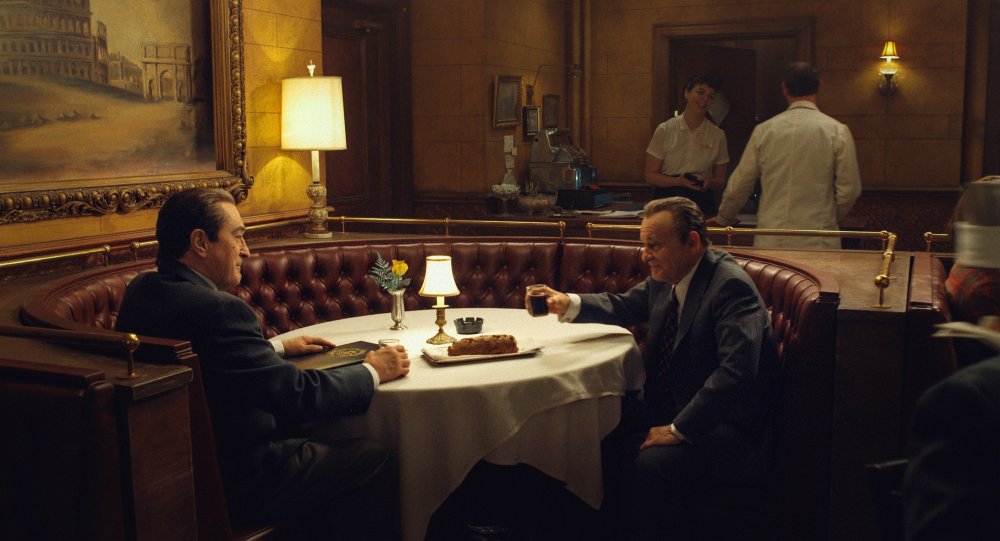
    The Irishman (2019)
    In one scene where De Niro’s younger, for example, and he’s talking to some people and he has to convey a kind of vulnerability and a haplessness – making him younger, a couple of times we noticed, made him look like he was threatening them.
    Now why’s that? The line around the mouth. So, let’s go into the mouth, work on that.
    A week later they bring it back. “No, it still looks like he’s threatening.” Well, maybe the eyes have to be fixed – around the eyes.
    I’m going for what the performance is. Ultimately, we felt that we regained through the youthification process the vulnerability in that moment.
    Martin Scorsese, Robert De Niro, Joe Pesci and Al Pacino

    So it makes you look very closely at the actual way that facial expressions work?
    Yes, at every aspect of the face. And then of course as the actor moves in the frame, the light changes. So a few frames this way – you’ve got to put some texture here… and so you’re really creating, recreating, the performance, in a way, with the basic truthful elements of the actor, and protecting those.
    We stumbled through that. We said, “What about trying this? What about that?” It would come back a week later, we would say, “It looks a bit funny here, or there.” And so we’d go back. We did that with every shot, with Joe Pesci and with Al too. It’s a learning experience.
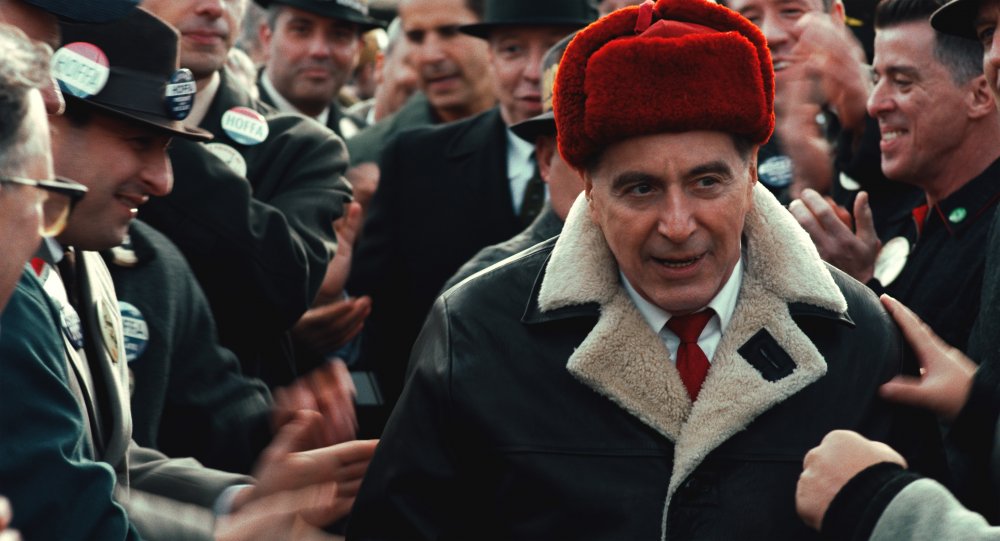
    Al Pacino as Jimmy Hoffa
    Al Pacino as Jimmy Hoffa
    In a way, I look at it as… well, there’s the convention in cinema of the use of make-up. If you look at an older film, there was an acceptance by the audience where the hair is powdered, or you know that that’s make-up and that the moustache is fake. But you went with the illusion.
    I always remember the great Dick Smith, and the old-age make-up he made for [Dustin Hoffman’s 121-year-old character in] Little Big Man [1970]. Or the make-up in The Elephant Man [1980]. Where’s the heart? Where’s the performance? It’s there, because John Hurt was great. But I know that’s make-up, so as a viewer I go with the illusion. I give you something back so I can get something from the world that you’re trying to depict for me and the characters.
    It’s another level of that, I think. And ultimately, it might be superior in the long run, to creating an illusion. Rather than having to apply prosthetics and that sort of thing. Mind you, we did a great deal of make-up on the film too.


    Do you think this system will have an effect on other films that are made?
    I think so. Obviously, it may have an effect on films that are trying to create more of a futuristic world. But it’s as good as the people doing it, really. Pablo and his group and ILM were amazing; and we were – myself and Thelma – on them to work in the slightest, the most scrupulous way.
    One of the key things was, I didn’t want to make a film dealing with this subject-matter, and this character – and where we were taking him, to the very end – and have half the film working with younger actors that were supposed to be Bob, supposed to be Joe, and supposed to be Al. I just didn’t.
    And so you may find that now that’s something that is doable: actors playing themselves younger – or older. This is a first time and there is an element of cost. But I think the more it’s used, the more the cost will become reasonable.