Showing posts with label Bruno Schulz. Show all posts

Friday, September 27, 2024

The Odd Knight of the Cinnamon Shops


The Odd Knight of the Cinnamon Shops

A new book explores the life and tragic death of Bruno Schulz, the great Polish Jewish magical realist writer and artist murdered by the Nazis

BY
DAVID MIKICS
APRIL 09, 2023

On Nov. 19, 1942, at the age of 50, Bruno Schulz, writer, artist, and idiosyncratic dreamer, was murdered in the ghetto of Drohobycz, Galicia. Earlier that month, Felix Landau, the SS officer who forced Schulz to produce works of art for him, had shot a Jewish barber enslaved by Karl Günther, another SS man. “You killed my Jew, I killed yours,” Günther said to Landau after murdering Schulz. At least, that’s the version of Schulz’s death that David Grossman recounts in his virtuosic novel See Under: Love.

Tuesday, October 6, 2020

Bruno Schulz (1892-1942)

Bruno Schulz


Bruno Schulz

12.07.1892—19.11.1942

Writer painter, illustrator and graphic artist known for short story collections that bring back the magical reality of Poland's pre-war shtetl's.


Born 12.07.1892 in Drohobych (present Ukraine), died there 19.11.1942 in tragic circumstances.

Bruno Schulz was born in Drohobych, a town of modest size located in western Ukraine, not far from the city of Lvov. He spent nearly his entire life there and was generally unwilling to travel. His voyages outside of his native city were sporadic and brief. He viewed Drohobych to be the center of the world and was a acute observer of life there, proving himself an excellent "chronicler." His writings and his art are both saturated with the realities of Drohobych. His stories are replete with descriptions of the town's main streets and landmarks, as well as with portraits of its inhabitants.

20 Things You Didn't Know about Bruno Schulz


20 Things You Didn't Know about Bruno Schulz


Twenty-five years after UNESCO announced that 1992 was to be the year of Bruno Schulz, interest in the writer is still constantly growing. New letters of his being uncovered, his work is continually being reinterpreted and more biographical information being unearthed – all of these factors have led to the creation of a discipline dedicated specifically to the prominent writer’s life and work: Schulzology. 


ALEXIS ANGULO

Mars 1, 2017


While you may think you know a lot about Bruno Schulz, we have found some facts about him that you may have missed. He was really quite an extraordinary person – and these tidbits will make you want to find out more about him:

1. He was obsessed with horses

In his early school days, he had a homework assignment – he was supposed to write a story on a topic of his choice. He ended up filling a whole notebook with a tale about a horse. His Polish teacher was so proud of him that he even showed the homework to the director of the secondary school: Józef Staromiejski. The director kept it and showed it to his colleagues. He became very well known… at school. He was also known to help others with their homework and make drawings for his classmates.  When he became a teacher, he would often sit on his chair backwards – as if riding a horse and would begin to tell stories to his class.

Tuesday, August 7, 2018

Bruno Schulz / August


BRUNO SCHULZ

AUGUST


Translated by John Curran Davis

1

In July, my father left to take the waters; he left me with my mother and older brother at the mercy of the summer days, white from the heat and stunning. Stupefied by the light, we leafed through that great book of the holiday, in which the pages were ablaze with splendour, their sickly sweet pulp, deep within, made from golden pears.

Monday, August 6, 2018

The Age of Genius / The legend of Bruno Schulz


Schulz in 1935: He rarely left his home town,
but his works contain an entire universe.

The Age of Genius

The legend of Bruno Schulz


By David Grossman
June 8, 2009


An afternoon in spring, Easter Sunday, 1933. Behind the reception desk of a small hotel in Warsaw stands Magdalena Gross. Gross is a sculptor, and her modest family hotel serves as a meeting place for writers and intellectuals. In the hotel lobby sits a Jewish girl of about twelve, a native of Lodz. Her parents have sent her to Warsaw for a school holiday. A small man, thin and pale, enters the hotel, carrying a suitcase. He is a bit stooped, and to the girl—her name is Jakarda Goldblum—he seems frightened. Gross asks him who he is. “Schulz,” he says, adding, “I am a teacher, I wrote a book and I—”

Tree of Codes by Jonathan Safran Foer / Review


Tree of Codes by Jonathan Safran Foer – review

Michel Faber considers Jonathan Safran Foer's cut-up of Bruno Schulz

Michel Faber
Saturday 18 December 2018
J
onathan Safran Foer's all-time favourite book is Bruno Schulz'sCinnamon Shops, retitled The Street Of Crocodiles when it was translated into English 47 years ago. "Some things you love passively,"Foer told Vanity Fair, "some you love actively. In this case, I felt the compulsion to do something with it." How might this active love manifest itself? A foreword to a new edition of Schulz's masterwork? No, Foer had already done that, for the Penguin Classics reissue published in 2008 in the US (but sadly not here). So, might Foer do something to bring Schulz's book back into print in the UK? Or might he commission a fresh translation? (Celina Wieniewska's 1963 version still reads like a dream to me, but there have been mutterings about its faithfulness for decades.) Might he script or bankroll a movie adaptation?

Bruno Schulz’s The Street of Crocodiles


Bruno Schulz’s The Street of Crocodiles

bruno-schulz-2
Self-Portrait, Bruno Schulz
I came to this book through Jonathan Safran Foer’s Tree of Codes, which is an excised novel of Schulz’s The Street of Crocodiles. Foer explains at the end of his book that he had always wanted to create an excised book but couldn’t decide which book to use– a dictionary, an encyclopedia, a phone book. But all these choices seemed to be more about the process and less connected to content and meaning. It was then he thought of excising his favorite book, his favorite author, The Street of Crocodiles by Bruno Schulz. Born in 1892 in Drohobycz, Poland, Schulz was a quiet, unassuming man who taught art in the local high school. He was a loner. In his free time, he wrote and made drawings.

Wednesday, August 1, 2018

From Frankenstein to Pinocchio / Top 10 artificial humans in fiction


Illustration by Triunfo Arciniegas


From Frankenstein to Pinocchio: top 10 artificial humans in fiction

Golems, clones, cyborgs and dolls ... these are some of the most urgent cautionary tales ever told

Sjón
Wed 1 August 2018


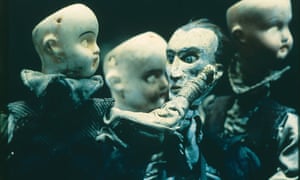
a still from the Brothers Quays’ film Street of Crocodiles.
 Everything infused with life … a still from the Brothers Quays’ film Street of Crocodiles.

T
he story of man trying to compete with the gods in creating a living being is one of the earliest tales. These narratives about effigies brought to life, homunculi, golems, reanimated corpses and sentient robots invariably end in death and disaster. Still, they profess our sincere hope that if we can invent the formula for life, we might also cheat death. It might even be argued that in the end this is really the only story there is to tell of our species. If only there will be someone left to tell it. 

No one grows up without being exposed to this story in one form or another. So when I set out to write CoDex 1962, a novel about a dying man trying to find a place for himself within the grand narrative of human history, I immediately thought of the treasure trove of these tales. His need to be something new leads him to the story of the golem and the rabbi who created him, and even to the brink of awareness of the real author of the book he thinks he is creating. For, after all, a novel is made of ink-and-paper automatons.
Here are some of the other great stories that we will never learn from.

The poet/warrior Thorleif and his dealings with the evil Earl Hakon is the subject of this short Icelandic saga – which boasts of one of literature’s nastiest artificial hitmen. After Hakon has robbed Thorleif and burned his ship, the poet takes revenge by composing a curse so powerful it makes the earl lose his hair. In turn, the miserable earl enlists two witches to help him fashion a man’s likeness out of driftwood and bring it to life by putting a fresh human heart in its breast. Then they send it off to Iceland where the wooden killer hunts Thorleif down and cuts his stomach open with a halberd. The poet recites a poem about his own killing before he literally spills his guts.


2. The Street of Crocodiles by Bruno Schulz, translated by Madeline G Levine One of the 20th century’s true masterpieces. Originally named The Cinnamon Shops, it is a string of stories taking place in the Jewish community of Drohobych in what was then Polish Galicia. It is a magical text where everything is infused with life. Things, creatures and natural phenomena constantly blend as they are used as metaphors for each other. At the book’s heart is the narrator’s father, Josef, slowly retreating into a world of his own within the large family house. He becomes the spokesman of tailors’ dummies and mounts a passionate defence of these silent, still beings. The book ends with a mysterious image of a giant homunculus merging with the universe and the index cards it is written on.


With this novel, the mythic tale of man’s limited authority in creation becomes a modern story. Like all the best stories, it makes us face the failure of our ambition and the damage we can do. Claimed by each new age as the perfect mirror, Frankenstein has been rewritten, retold and reinterpreted in every narrative medium, just like the antique Greek myth of Prometheus that inspired Shelley in the first place.


Collodi’s tale about the rascally boy marionette has it all and all too much of it: loneliness, the fear of dying, treachery, the corruption of youth, violence towards the weak, devious humans and talking animals, sexy spirits, ominous landscapes, man-to-beast metamorphosis, hopes fulfilled and quashed, humanity gained through trial and error, and a strangely elastic nose. It is a children’s book of the best and darkest kind. Most of us get to know the Disney film at an age when we are still raw material like the wooden boy. To read the book as an adult is even scarier.


a still from James Whale’s 1931 film of Frankenstein.
Pinterest
 A mirror for every age … a still from James Whale’s 1931 film of Frankenstein. Photograph: Universal/Sportsphoto/Allstar


“The cyborg would not recognise the Garden of Eden; it is not made of mud and cannot dream of returning to dust.” Animal, human, cyborg; Haraway put humans in their place with her 1984 manifesto, arguing for a post-humanist stance based on affinity and kindness. Her thinking is challenging and in dialogue with radical feminist body and identity theory. It is not an easy text to decipher but it has brought me much inspiration over the years and I think it contains a seed for our survival.


Ozick gives us a female golem in the second “paper” in her book of Ruth Puttermesser, a busy feminist lawyer in mid-20th century New York. What Puttermesser needs is a helper (a wife, really) and one night while sleeping she makes a golem from the earth in her apartment’s flower pots. This creature grows so powerful that Puttermesser is able to become city mayor. She uses her golem to clean up the city, but as in every well-told automaton tale, the creature gains dangerous independence.


Gross brings together in one beautiful volume key texts about the uncanny world of inanimate beings, by authors including Walter Benjamin, Marina Warner, Sigmund Freud (on ETA Hoffman’s The Sandman) and Heinrich Von Kleist. The latter’s On the Marionette Theatre makes the unsettling case that the marionettes’ experience is superior to man’s bondage in living flesh.


In 2059, Shira Shipman is living in a changed North America. Her young son has been taken from her by the “multi” that runs her zone, so she returns to Tikva, the Jewish “free town” where she grew up. Here, she meets an extraordinary cyborg, imbued with intelligence, feeling and the ability to kill.


Told in the past, the present and possible futures, Cloud Atlas’s most tragic and human character is Sonmi–451, a future clone designed to have no self-awareness – and thereby no survival instinct – so she can be worked to death in a diner only to end up reprocessed as food. As her name implies, she finds her strength through reading and her own story becomes a cornerstone of a civilisation even farther in the future.


When I was 17 and had just met my mentor in all things strange and marvellous, the Icelandic surrealist artist Alfreð Flóki, he gave me a copy of this novel and told me we could have no further conversation before I had read it. It is a fever dream of a book. The protagonist’s mind melds with the legend of the Golem of Prague, the original artificial man of clay created by rabbi Judah Loew ben Bezalel in the 16th-century ghetto. And my mind melded so thoroughly with the novel that 13 years later I decided to bring the golem story into the folds of Icelandic literature by any narrative means neccesary.

THE GUARDIAN


Friday, April 15, 2016

Bruno Schulz / A brief survey of the short story

Bruno Schulz

A brief survey of the short story part 30: 

Bruno Schulz

A writer who redraws the boundaries between fact and imagination, Schulz is a master of what he called 'the mythicisation of reality'


The Guardian, Friday 3 December 2010 10.09 GMT
Bruno Schulz
At once direct and arcane ... a self-portrait drawing by Bruno Schulz
The Polish Jewish writer Bruno Schulz described Sanatorium Under the Sign of the Hourglass (1937), the second of his two surviving collections of stories, as "eliciting the history of a certain family, a certain house in a provincial city – not from documents, events, a study of character or people's destinies – but by a search for the mythical sense, the essential core of that history ... These mythical elements are inherent in the region of early childhood fantasies, intuitions, fears and anticipations characteristic of the dawn of life."
Schulz's first book, The Street of Crocodiles (Cinnamon Shops in the Polish original), pursues the same aim, which he called "the mythicisation of reality". Its publication in December 1933 saw Schulz – a shy, rather awkward schoolteacher – join Stanislaw Witkiewicz and Witold Gombrowicz in the front rank of Polish modernists. Rarely does such a strange work win immediate recognition, but Schulz's writing pulls off the neat trick of being at once direct and arcane. Instantly striking for its beauty and peculiarity of vision ("sides of meat with their keyboard of ribs swollen with energy"; beds "disordered from the weight of dreams", standing "like deep boats waiting to sail into the dank and confusing labyrinths of some dark starless Venice"), its narrative paths are conversely crooked and confounding, leading the reader into neighbourhoods of paradox and uncertainty. Most of his stories involve the narrator, at once a child and a man remembering his childhood, describing the eccentric projects of his father, the merchant Jacob, whose personality cycles through biblical patriarchs (Noah, Moses, Joshua), who regularly dies and matter-of-factly returns, and who metamorphoses into a succession of beasts and insects.
This last aspect in particular draws comparisons with Kafka, and the two writers share many biographical similarities (not least a father obsession). But while both described worlds stuttering between the real and unreal, their purposes and methods are quite distinct. Neither is Schulz a surrealist: bizarre occurrences flood his fiction (people transformed into bundles of rubber tubing; a man engineered into a doorbell; Hades relocated to provincial Poland), but his project prizes rather than disdains logic, and he doesn't seek to shock.
Schulz referred to childhood and its boundless imaginings as the "age of genius", and its memories and impressions, crossbred with fragments of Greek and Hebrew myth, Polish and German folktales and quite probably Hasidic literature, became the "iron capital of the spirit" from which his art was manufactured. The "provincial city" he writes about is Drohobycz, where he spent most of his life. In 1892, when Schulz was born, it lay within the Austro-Hungarian Empire's borders. After the first world war it was Polish. By the time he died, in 1942, following a brief Soviet occupation, the town was part of the Nazis' Greater Germany. It's now Ukrainian.
Schulz, a secular Jew, was shot dead by the SS in the Drohobycz ghetto on 19 November 1942. I won't expand on the tragic and chilling nature of his murder because doing so, as the academic David A Goldfarb notes in a 1994 study, "projects a teleology backward onto the artist's work". Schulz's fantastical, elaborately interpretable stories, mostly written in the late 1920s and early 1930s, freely intermingle the past and present, but the future, as Jerzy Ficowski notes in his invaluable monograph, Regions of the Great Heresy, is "a nonexistent category" to him. His stories don't presage the Holocaust; to read them as if they do distorts both them and him.
Distortion is germane to a discussion of Schulz. Because of how he died, because much of his work – including the tantalisingly rumoured novel, The Messiah – is lost, and because of his talent, he has proved magnetic to other authors, whose work by turns uncovers and occludes his own. Isaac Bashevis Singer, John Updike and JM Coetzee have critiqued him; he features in novels by Philip Roth, Cynthia Ozick and David Grossman; Salman Rushdie's The Moor's Last Sigh recreates the Street of Crocodiles in Andalucia; Jonathan Safran Foer has recently released Tree of Codes, a story die-cut from The Street of Crocodiles. More has been written about him than he ever wrote himself.
It's fitting that Schulz, who believed so much in the living, interpolating qualities of texts, should cross-pollinate like this. David Goldfarb writes, "There are no boundaries between books and the world for Schulz ... Following the cycle of 'the mythicisation of reality', a book becomes a reality, which becomes another book." Stepping in and out of myth, in and out of literature, in and out of the fantastical and the everyday, and using the material gathered from each region to make something new and unrepeatable, Schulz redrafts the lines between fantasy and reality following an obscure but apparently robust logic, the precise architecture of which is still being fathomed.
His fictions contain vivid precincts to explore, constructed by an artist who understood –in fact worshipped – the powerful connections that lie, waiting to be made, between the covers of a book. In a letter of 1936 Schulz wrote: "Outside it is a cold day, hard and unyielding, full of prose and harshness. But good spirits have gathered around my bed, beside me are two volumes of Rilke that I have borrowed. From time to time I enter his difficult and intense world for a moment, beneath his many-arched skies, and again I come to myself."


A brief survey of the short story