Showing posts with label Flaubert. Show all posts

Saturday, June 20, 2026

010 Madame Bovary by Gustave Flaubert 1856

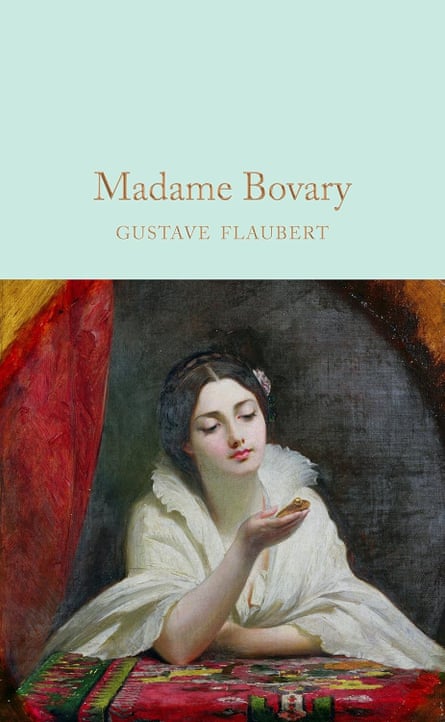
Cover of the book Madame Bovary by Gustave Flaubert


010
Madame Bovary
by Gustave Flaubert
1856


A devastating cautionary tale about the dangers of fantasy, snobbery and romantic yearning, the story of frustrated doctor’s wife Emma Bovary transformed the novel with its meticulous rendering of small-town life in mid-19th-century France. Scholars note that there is no record of Flaubert ever saying “Madame Bovary, c’est moi”, the quote often attributed to him as evidence for the ultimately autobiographical nature of all fiction.

First sentence

“We were in class when the head-master came in, followed by a ‘new fellow,’ not wearing the school uniform, and a school servant carrying a large desk.”


Total votes 19


  • Freya Johnston
    ,
  • Kit de Waal
    ,
  • Juan Gabriel Vasquez
    ,
  • Yan Lianke
    ,
  • Anne Enright
    ,
  • John Mullan
    ,
  • Kevin Power
    ,
  • Melissa Broder
    ,
  • Elif Shafak
    ,
  • Rebecca Liu
    ,
  • Laura Wilson
    ,
  • Claire Messud
    ,
  • Tessa Hadley
    ,
  • Houman Barekat
    ,
  • Stephen King
    ,
  • Ian McEwan
    ,
  • Marcel Theroux
    ,
  • Clare Clark
    ,
  • Michael Donkor

THE GUARDIAN


Thursday, February 24, 2022

Flaubert and Madame Bovary by Somerset Maugham


Flaubert and Madame Bovary
by William Somerset Maugham


(1)

If, as I believe, the sort of books an author writes depends on the sort of man he is, and so it is well to know what is relevant in his personal history, this, as will presently appear, in the case of Flaubert is essential. He was a very unusual man. No writer that we know of devoted himself with such a fierce and indomitable industry to the art of literature. It was not with him, as it is with most authors, an activity of paramount importance but one that allows for other activities which rest the mind, refresh the body or enrich experience. He did not think that to live was the object of life; for him the object of life was to write: no monk in his cell more resolutely sacrificed the pleasures of the world to the love of God than Flaubert sacrificed the fullness and variety of life to his ambition to create a work of art. He was at once a romantic and a realist. Now, at the bottom of romanticism, as I said in speaking of Balzac, is a hatred of reality and a passionate desire to escape from it. Like the rest of the romantics, Flaubert sought refuge in the extraordinary and the fantastic, in the Orient and in antiquity; and yet, for all his hatred of reality, for all his loathing for the meanness, the platitude, the imbecility of the bourgeois, he was fascinated by it; for there was something in his nature that horribly attracted him to what he most detested. Human stupidity had a revolting charm for him, and he took a morbid delight in exhibiting it in all its odiousness. It got on his nerves with the force of any obsession; it was like a sore on the body that is pain to touch and that yet you can’t help touching. The realist in him pored over human nature as though it were a pile of garbage, not to find something he could value, but to show to all and sundry how base, for all their outward seeming, were human beings.


Ilustration by Fernando Vicente


(2)

Gustave Flaubert was born at Rouen in 1821. His father, a doctor, was head of the hospital and lived there with his wife and children. It was a happy, highly respected and affluent family. Flaubert was brought up like any other French boy of his class; he went to school, made friends with other boys, worked little but read much. He was emotional and imaginative, and, like many another child and boy, was troubled by that sense of inner loneliness which the sensitive carry with them all their lives. ‘I went to school when I was only ten,’ he wrote, ‘and I very soon contracted a profound aversion to the human race.’ This is not just a quip; he meant it. He was a pessimist from his youth up. It is true that then romanticism was in full flower and pessimism the fashion: one of the boys at Flaubert’s school blew his brains out, another hanged himself with his necktie; but one cannot quite see why Flaubert, with a comfortable home, affectionate and indulgent parents, a doting sister and friends to whom he was devoted, should have really found life intolerable and his fellow-creatures hateful. He was well-grown and to all appearance healthy.


When he was fifteen, he fell in love. His family went in summer to Trouville, then a modest village by the sea with one hotel; and there, that year, they found staying Maurice Schlesinger, a music publisher and something of an adventurer, with his wife and child. It is worth while to transcribe the portrait Flaubert drew of her later: ‘She was tall, a brunette with magnificent black hair that fell in tresses to her shoulders; her nose was Greek, her eyes burning, her eyebrows high and admirably arched, her skin was glowing and as if it were misty with gold; she was slender and exquisite, one saw the blue veins meandering on her brown and purple throat. Add to that a fine down that darkened her upper lip and gave her face a masculine and energetic expression such as to throw blonde beauties into the shade. She spoke slowly, her voice was modulated, musical and soft.’ I hesitate to translate pourpré with purple, which does not sound alluring, but that is the translation, and I can only suppose that Flaubert used the word as a synonym for bright-hued.

Wednesday, September 8, 2021

Ten of the best / Cathedrals in literature


Ten of the best
Cathedrals in literature
John Mullan
Monday 7 November 2011 

Salisbury resident Golding imagined the building of the cathedral whose spire towers over the city. Ignoring the warnings of others, the obsessive Dean Jocelin drives the work on, convinced that an angel is prompting him. As he becomes madder, the miraculous building takes shape out of the dust and chaos.
The Mystery of Edwin Drood by Charles Dickens
Dickens's last novel is set in the precincts of the cathedral of Cloisterham. "… a city of another and a bygone time is Cloisterham, with its hoarse Cathedral bell, its hoarse rooks hovering about the Cathedral tower, its hoarser and less distinct rooks in the stalls far beneath." Murderous passions are nursed in the shadow of the great cathedral.

Notre Dame de Paris by Victor Hugo
The cathedral is the central character in Hugo's huge historical novel. All his characters gravitate to it. Quasimodo is the bell-ringer and swings down on a rope from the towers of the Cathedral to rescue the Gypsy girl Esmerelda from the gallows. They seek sanctuary in the great church, but violence and death pursue them there.


Madame Bovary by Gustave Flaubert
Housewife Emma Bovary has an assignation with student Léon Dupuis in Rouen cathedral. "In the choir a silver lamp was burning, and from the side chapels and dark places of the church sometimes rose sounds like sighs, with the clang of a closing grating …" For Léon, the religious solemnity is fitting: he is a devotee of love. Emma arrives, tries to pray, but is overwhelmed by "the tumult of her heart".
The Warden by Anthony Trollope
The clergymen of Barchester find the pursuit of God's purposes is an often ignoble business. The unworldly Septimus Harding, precentor at the great cathedral, is drawn into a furious dispute about church corruption, his only solace being the sublime sound of the cathedral choir as its songs ascend to heaven.
Old St Paul's by Harrison Ainsworth
Ainsworth's best-selling Victorian romance is set in the 1660s. During the great plague, the old cathedral becomes a hospital. At the climax, the great, dilapidated old building burns down, trapping two of the novel's villains in its vaults where they are drowned in molten lead.
The Choir by Joanna Trollope
Trollope's tale of submerged provincial passions is set in the cathedral city of Aldminster, where the cathedral itself is falling down and the costs of repairs seem likely to be met by abolishing the costly boys' choir. From the worldly dean to the idealistic choirmaster, everybody wants the best for the cathedral, the good of which becomes the justification for whatever they want to do.
"The Cathedral" by Rainer Maria Rilke
Rilke wrote a sequence of six poems inspired by a visit to Chartres cathedral with the sculptor Rodin. In the second, the poet muses on what the influence is of this huge tracery of stone, overwhelming rather than elevating. "And in the towers' quelled ascent, / and sudden spurn of skies, sat Death".
"A Cathedral Facade at Midnight" by Thomas Hardy
The poem recalls a night walk in the cathedral close at Salisbury, where Hardy took the movement of light across the building as a metaphor of ancient belief in the light of modern unbelief. The facade is thick with "the pious figures" of saints and clerics, holy men and women seen "Under the sure, unhasting, steady stress / Of Reason's movement, making meaningless".
The Cathedral by Joris-Karl Huysmans
Huysmans has his alter ego, Durtal, who has converted to Catholicism, explore the elaborate symbolism he discovers in stone in the great gothic edifice of Chartres cathedral. An apparent rejection of modernity, it was a bestseller.