For human beings, the years pass like the petals of a flower fall: it seems as though they fall more quickly when the end is near. Death will reach us all, without a doubt. For some people, knowing “the moment” is a privilege, and for others to have it surprise us in our sleep is the best option. In the end, who really knows how much time we have left in this world?
Continuing our series revisiting childhood movie passions, we look at a romance that could’ve been schlock, if not for Rachel McAdams and Ryan Gosling’s chemistry
F
lash back to the summer of 2007: Spider-Man 3 was in theatres. Two of the top five most viewed YouTube videos were by the band My Chemical Romance. And The Notebook, a movie starring Rachel McAdams and Ryan Gosling as star-crossed teenage lovers who reconnect as adults, was three years old. The famous re-enactment of the film’s climactic lift-and-kiss at the MTV movie awards by its stars, then a real-life couple, was two years old. I was 13 years old and, true to sheltered oldest child form, didn’t know about any of this. And so one sleepover night in my friend’s basement, I faced at least three aghast faces: “You haven’t seen The Notebook?!?”
The Notebook probably has fans outside my demographic – it’s an adaptation of a Nicholas Sparks romance novel, a book/author/genre marketed to middle-aged women – but for girls in middle school (or, at least, my middle school in suburban Ohio) between 2004 and 2008 or so, it was a foundational text. It was the romantic movie of choice, a portal into couple-shipping YouTube and, later, Tumblr holes, a benchmark for years of unrealistic dating expectations. You wanted to know what sex was “supposed” to look and sound like AND tell everyone you bawled at the profound idea of love transcending old age? You watched The Notebook.
For those who haven’t seen it, The Notebook follows 17-year-old Allie (McAdams) as she moves to a small South Carolina town for the summer and meets Noah (Gosling), a construction worker fond of Walt Whitman and bold gestures, such as threatening to jump off a ferris wheel to get Allie to go out with him. They fall in love, then break up (she’s rich, he’s not; her parents disapprove) and, separately, serve in the second world war . He pines for her; she gets engaged to handsome, preternaturally forgiving solider played by James Marsden. They reconnect, and things are complicated. The story is narrated by the older Noah, who reads from a notebook composed by Allie as a totem to bring her back from the dementia eclipsing her memories.
This twist – Noah and Allie have together composed an epic love story that she mostly can’t remember – landed like a gut punch for us as emotionally chaotic seventh-graders who had imagined our sunset years approximately zero times. All of us watching that summer night ended the movie in tears, which was a cathartic bonding experience on its own. But at 13, on the cusp of high school but seemingly, for me, light-years away from sneaking out with a boy, the main draw was the heat between McAdams and Gosling. Their chemistry was palpable and hungry with a sharp, heady sting. (It is transparent they were falling in love off-screen.) These two were brain-meltingly hot, an unknowing factory of aspirational summer love gifs. Importantly for me then, the film hinges on one pivotal, rain-soaked scene in which Allie asks Noah why he never wrote her when they broke up. (Actually, he wrote her 365 letters! He wrote her every day for a year!). He proclaims, famously: “It wasn’t over … it STILL isn’t over.” At the time, I had no older friends or siblings, no health class, just the steamy handprint from Titanic, so I was thrilled when they kiss, and he pushes her against a wall, and carries her up the stairs, and strips off her soaked clothes … and the camera keeps rolling. As far as movies go, The Notebook has a rather tame sex scene – all soft lighting, swelling music, delicate shots that don’t reveal much, nudity-wise. The camera mostly lingers on McAdams’ face as she has a transcendent time (again, disappointingly high expectations were set by this movie). The whole scene is only about 4.5 minutes long, but at 13 this felt like an eternity, and a guidebook. Oh, adulthood has this? You lose your senses and can’t take your hands off someone? Good to know!
Rewatching The Notebook for the first time in years, it’s clear, of course, how silly it was to base my idea of maturity on this movie, and also how stellar McAdams and Gosling’s performances remain. The Notebook could have been a solid B-movie romance (see: every other Nicholas Sparks adaptation), but the lead performances power it far higher than its melodramatic parts. It is almost thrilling – and the main draw for me now – to watch two ascendant, now-acclaimed actors make the hairpin turns of its dialogue somewhat convincing. The idea of actually fighting this way? Laughable. But that look Noah gives Allie when he asks: “Goddammit, what do you WANT?” Yeah, that still hits.
A couple of weeks ago, before this series assignment, I rewatched The Notebook on instinct. It felt good during, you know, ALL THIS, to return to an old favourite, to slip along the slick grooves of worn emotions. To retrace the lines of this familiar ride, even if I now find many of them horribly cheesy, and my feelings cringingly earnest. How to think of it now? I defer to Gosling, who said in that fateful year, 2007: “God bless The Notebook. It introduced me to one of the great loves of my life.” I would not classify The Notebook as one of my great loves, but still: god bless this movie, flawed textbook that it was, for introducing me to a new vision of the adult future, and for saying: Hang on. It’s a bumpy ride of feelings ahead but one day, you’ll appreciate them.
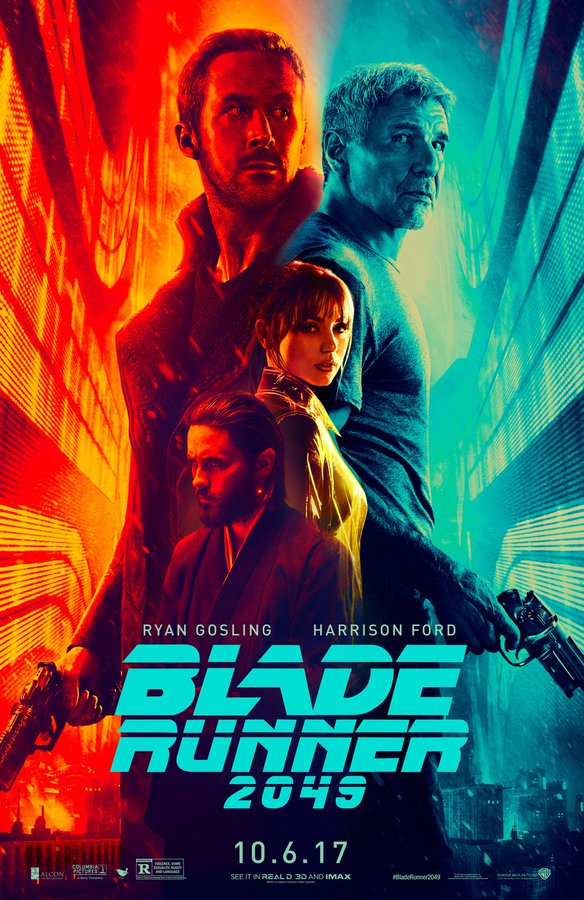
Let’s catch up: the highly anticipated and/or contentious sequel Blade Runner 2049 releases October 6th, now with a brand new poster to show for it!
Burgeoning director du jour Denis Villeneuve helms this sequel, which counts a number of co-conspirators in its ranks, including original director Ridley Scott as executive producer, as well as screenwriter Hampton FancheI have an intensely personal relationship to, and fondness for, the original Blade Runner, from its smoky, neon-blasted-noir backdrop, to its sparse but ruminative plot workings, to the weird intimacy of its performances. It’s a storied, iconic, evergreen film, dignified in its art design, and loaded with dark mysteries on both sides of the screen. As a kid, it was one of the first open-ended films I’d ever seen, and I’d be confident enough to say that I know the entire script by heart; to be fair, this is not a tremendous ask, as it runs significantly less than 6,000 words.
At least, in this generation of obligatory remakes, Blade Runner 2049 is a specifically stated sequel, with a story occurring 30 years after the original. Although he first emerged as a surprise inclusion in early trailers, Harrison Ford reprising his role of Rick Deckard is now positioned neck-and-neck with lead actor Ryan Gosling (keep in mind that this might be a mislead, as earlier reports indicated Ford’s screen-time as minimal). In addition, the colors in the poster—a sort of dusky amber and an icy teal—distinguish the four actors, almost color-coding them: Gosling, Jared Leto, and Ana de Armas are saturated in the former, Ford alone in the latter. Interestingly, this is in contrast to the posters released in May, which swapped these identifying colors for the two leads.
I’m tremendously excited for this film, though I expect a lot out of it. Villeneuve has had an incredible run as a director, and trailers imply that the crucial aesthetic qualities of the sci-fi classic have been effectively attempted, which speaks highly of Roger Deakins’ return as Villeneuve’s cinematographer. The question remains of how much of the film will take place in the steamy, buzzy streets and locked-down ziggurats of 2049 LA versus the wasteland-like environs where Deckard has apparently sequestered himself.
In a month and a half, most of our questions will be answered. For now, take another look at the most recent trailer:
————-
Production Details below:
In 3D and 2D in select theaters and IMAX on October 6th
(Warner Bros/ Alcon Entertainment)
Director: Denis Villeneuve
Writer: Screenplay by Hampton Fancher and Michael Green, Story by Hampton Fancher,
based on characters from the novel Do Androids Dream of Electric Sheep? by Philip K. Dick,
Producers: Andrew A. Kosove, Broderick Johnson, Bud Yorkin, Cynthia Yorkin
Executive Producers: Ridley Scott, Tim Gamble, Frank Giustra, Yale Badick, Val Hill, Bill Carraro
Cast: Ryan Gosling, Harrison Ford, Ana de Armas, Sylvia Hoeks, Robin Wright, Mackenzie Davis, Carla Juri, Lennie James, with Dave Bautista and Jared Leto
Sci Fi Thriller: Thirty years after the events of the first film, a new blade runner, LAPD Officer K (Ryan Gosling), unearths a long-buried secret that has the potential to plunge what’s left of society into chaos. K’s discovery leads him on a quest to find Rick Deckard (Harrison Ford), a former LAPD blade runner who has been missing for 30 years.
Damien Chazelle’s drama about Neil Armstrong and the 1969 Apollo 11 moon landing is a moving tale of loss and peril
Mark Kermode
Saturday 14 October 2018
I
n William Peter Blatty’s underrated 1980 mystery-thriller The Ninth Configuration, a grounded lunar astronaut played by Scott Wilson (who sadly died last week) delivers a heartbreaking soliloquy that perfectly encapsulates the existential crisis at the centre of much space-travel cinema. “See the stars, so cold, so far and so very lonely,” he says, plaintively. “What if I got there, got to the moon and couldn’t get back… I’m afraid to die alone, so far from home. And if there’s no God, then that’s really, reallyalone.”
That sense of cosmic isolation reverberates throughout a range of space movies, from Andrei Tarkovsky’s Solaris to Douglas Trumbull’s Silent Running (dubbed “the loneliest adventure of all”) and, more recently, Alfonso Cuarón’s Gravity. Now it resurfaces in powerful form in First Man, Damien Chazelle’s sombre, real-life account of the 1969 moon landing, which turns a spectacular space-race adventure into a low-key study of grief.
Adapted from James R Hansen’s book by Spotlight screenwriter Josh Singer, First Man’s 60s-set narrative essentially picks up from Philip Kaufman’s 1983 adaptation of Tom Wolfe’s The Right Stuff. Indeed, there’s at least one shot that seems very deliberately to quote from Kaufman’s sprawling masterpiece. But Whiplash director Chazelle’s sights are set on something more explicitly allegorical, as the insular Neil Armstrong finds himself caught between inner and outer space.Chazelle’s La La Land star Ryan Gosling is the titular explorer whom we first meet almost skipping an experimental plane off into space. His superiors think he’s a danger to himself, and the film suggests a connection between his desire to slip the surly bonds of Earth and his bereavement at the loss of his young daughter, Karen. When Nasa puts out the call for trainee astronauts, his successful application seems to offer a new start. Yet it’s Karen’s memory that haunts Armstrong throughout training and into his Apollo 11 mission – a vision of her hair running through his fingers recurring at key moments of crisis.
Significantly, Gosling’s outwardly emotionless antihero seems to be lost in space even when down on Earth. Time and again, cinematographer Linus Sandgren frames him alone amid the darkened spaces of the Armstrong home – the camera gazing through doors, halls and hatchways that paint a black shroud around his softly illuminated figure. Brilliantly, Sandgren uses handheld 16mm for the up-close-and-personal scenes and 35mm for the industrial Nasa sequences, shifting to the stark Imax clarity of 65mm for the expansive silence of the moonscapes where Armstrong can finally confront his awful loss. While “space force” cheerleader Donald Trump may have declared (sight unseen) that the absence of an American flag-planting scene in First Man is “a terrible thing”, anyone with a pulse will recognise that there is more at stake here than some empty gesture of faux patriotism. In space, Donald, no one can hear you whine.
Chazelle describes this tale as existing “between the moon and the kitchen sink”, and, like Ron Howard’s Apollo 13, he juxtaposes convincingly evoked Nasa sequences with back-garden scenes of beers and barbecues in which the moon glimmers distantly through the trees. Claire Foy’s Janet Armstrong proves adept at keeping the connection between these two worlds open, even when the live feed from her husband’s spacecraft is cut. While Gosling plays everything close to his chest, it’s Foy who invites us into the unfolding drama with her wonderfully empathetic performance.
Like the Armstrongs’ under-stress marriage, the space vessels themselves are in constant danger of falling apart, accurately portrayed as an alarming collection of screws and rivets that Janet dismisses as “balsa wood” boys’ toys. It’s no surprise when someone asks for a Swiss army knife to do some last-minute adjustments. Rather than revelling in the majesty of space travel, First Man puts its audience inside a tin can as it shakes and rattles its claustrophobic way into the sky. Like The Right Stuff, there’s no sugar-coating the spectre of death that haunts even training missions. The horrors of fiery catastrophe hang heavy over the proceedings, with the shocking loss of friends and colleagues amplified through well-judged dramatic understatement. Taking a lead from Lunar Rhapsody (a tune that Armstrong famously loved), Justin Hurwitz’s melancholy score incorporates the eerie, mournful wail of a theremin, once a staple of the sci-fi genre and most famously deployed by Bernard Herrmann in The Day the Earth Stood Still. Here, it adds yet another note of longing and loss to a film that I found both powerfully moving and quietly profound.
School’s back in, so sharpen your pencils and study our list of eminent educators, from the inspirational to the irredeemable. No sniggering at the back
One of the late Robin Williams’s most affecting and less mawkish studies in child-men (of which Patch Adams remains the acknowledged nadir), John Keating is the quintessential inspirational English teacher who shakes up his charges at a buttoned-up late-50s Ivy League-style academy by having them rip out the introductions to their poetry primers and clamber on their desks to “sing the body electric”, while he exhorts them to “seize the day boys, carpe diem, make your lives extraordinary”. “Middlebrow high-mindedness,” harrumphed Pauline Kael, but it left a generation of men unable to hear the words “O captain, my captain” without finding that they had, you know, something in their eye.
Continuing our countdown of the best movies of the past year, Peter Bradshaw celebrates a brilliant and brutal anti-revenge film
Peter Bradshaw Wednesday 11 December 2013 09.40 GMT
Nicolas Winding Refn's brilliant, bizarre and ultraviolent anti-revenge movie Only God Forgives is his most interesting work since the Pusher trilogy in the Mads Mikkelsen era. It is put together with lethal strangeness: there are bad-dream setpieces of sentimentality and nauseous black comedy. The film takes place in a universe of fear, a place of deepsea-unreality in which you need to breathe through special gills. It is a tragi-exploitation shocker, an enriched uranium-cake of pulp.
Ryan Gosling is the expatriate American gangster Julian, lying low in Bangkok and running a drug business under the cover of a Muay Thai boxing club, co-managed with his psychotic brother, Billy. Billy's horrible fate is to involve Julian in a metaphysical duel with enigmatic local cop Chang, played with eerie poise by Vithaya Pansringarm.
Chang dispenses his own justice with a samurai sword, and Julian – paralysed with some kind of guilt or suppressed qualm of conscience – is mesmerised by the mere rumour of Chang's avenging presence. The situation is complicated by the arrival in Thailand of Julian's formidable mother, uproariously played by Kristin Scott Thomas. Her imperious demands bring a horrible new Freudian dimension to the drama.
Like Julian, like Chang, the film swims through the hostile streets, along corridors, into alleys, round corners, waiting for some terrible, nameless, violent destiny, and yet it entirely upends what you might expect from a revenge movie. This is a very brutal film, and enclosed in a kind of carapace of neon, a strange otherworld. Faces appear to glow in the artificial light, partly illuminated from within by their own madness.
Only God Forgives has something of Scorsese's Taxi Driver and Noé's Enter the Void, granting access to a private hell. On its first appearance, it was excitably denounced and mocked by some critics. But with such a provocative film, some misjudgment is forgivable.