Showing posts with label Jon Lee Anderson. Show all posts

Monday, December 30, 2024

Jon Lee Anderson, journalist / ‘I can’t rule out a civil war in the United States’


Jon Lee Anderson

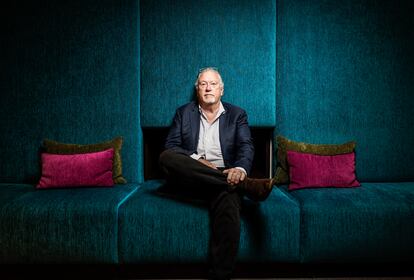
Journalist Jon Lee Anderson at Madrid’s Hotel Hospes Puerta de Acalá in November.ÁLVARO GARCÍA


Jon Lee Anderson, journalist: ‘I can’t rule out a civil war in the United States’

‘The New Yorker’ reporter is publishing a Spanish-language compilation of his articles. After abandoning X, he says, ‘Social media is a toxic swamp’


Guillermo Altares

Madrid, 27 December 2024

Jon Lee Anderson, reporter for The New Yorker, author of numerous books, biographer of Che Guevara and Fidel Castro, speaks a Spanish as entertaining as it is colorful. He’s one of the journalists who best knows Latin America and maintains ties, both familiar and sentimental, with Granada, Spain, where he lived for many years. His history of coming and going across the Atlantic and the Andes has left its mark on the way he speaks the language, with a blend of sayings and accents from many countries.

Saturday, April 5, 2014

Jon Lee Anderson / Ernesto "Che" Guevara

Ernesto "Che" Guevara

Jon Lee Anderson
ERNESTO "CHE" GUEVARA

For nearly 30 years now, Ernesto “Che” Guevara has been a figure of myth. Although his name remains celebrated, and the image of his bearded, haunting face continues to resonate from beneath its ubiquitous beret, little is known about his life. According to his biographer Jon Lee Anderson, “Che was this glaring omission. He was not only a ‘60s figure, but he had a full effect on our time. His life had really never been looked at. It was cloaked in mysteries and legends. I realized the only way I could seriously propose to do a proper life’s biography was to unearth the secrets that had lain dormant all that time.”
In Che Guevara: A Revolutionary Life (Grove Press), Anderson attempts to do just that, looking beyond the myth and resurrecting Che Guevara the human being. Che was the essence of the self-made man. A middle-class Argentine who became one of the heroes of the Cuban revolution; an unrelenting Marxist who loved his family but refused them the privileges of leadership—even when it meant his wife taking one of their children to the hospital by bus. In his early twenties, Che gave in to youthful wanderlust and traveled throughout Latin America by motorcycle. The Motorcycle Diaries, published in 1995, is the account of one such journey. Later, having passed his medical degree and resolved to work with lepers, he then discovered the draw of political insurgency. After meeting Fidel Castro in Mexico City in 1955, Che became part of the small revolutionary force that invaded Cuba in late 1956 and fought the army of President Fulgencio Batista. Upon liberation, he took the post of Minister of Industry, but his heart was on the battlefield, and in 1965 Che left Cuba to foment revolution in the Congo and Bolivia. These latter campaigns were less than successful, and on October 8, 1967 Che was captured by the Bolivian Army. He was executed the next day.

Saturday, March 15, 2014

Jon Lee Anderson / The Power of Gabriel García Márquez

Gabriel García Márquez
Poster by T.A.

The Power of Gabriel García Márquez

Everyone from Clinton to Castro listens to him. But can he help rescue Colombia from left-wing guerrillas and right-wing death squads?

By Jon Lee Anderson
The New Yorker 
September 27, 1999
WHEN Gabriel García Márquez leaves his apartment in Bogotá, he travels in a customized metallic-gray 1992 Lancia Thema Turbo, a midsize sedan with bulletproof windows and a bombproof chassis. It is driven by Don Chepe, a stocky former guerrilla fighter who has worked for García Márquez for more than twenty years. Several secret-service agents, some times as many as six, follow them in an other vehicle. A nondescript bombproof sedan with a big engine is a reassuring car to have in a country where nearly two hundred people are kidnapped every month, and more than two thousand are murdered. In mid-August, Jaime Garzón, a popular political satirist, was assassinated as he drove to work. A man got off a motorcycle and shot him in the head while he was waiting at a red light. Garzón, like García Márquez, had acted as an intermediary between leftist guerrillas and the government, and he had received death threats from members of right-wing paramilitary organizations who don't want people negotiating with their enemies.