Eddie Redmayne wins best actor Oscar for portrayal of Stephen Hawking in The Theory of Everything
British actor wins first Oscar, beating a field including Birdman star Michael Keaton
Henry Barnes Monday 23 February 2015 16.57 GMT
Eddie Redmayne has won the best actor Oscar for his performance as Professor Stephen Hawking in The Theory of Everything.
The British actor came to the Oscars the favourite after claiming the Screen Actors’ Guild’s best actor award last month. The winner of that award has gone on to pick up the best actor Oscar every year since 2003.
There’s nowhere to hide in The Reach – even for the west coast Gordon Gekko, says the veteran actor
Henry Barnes
Thu 18 September 2014
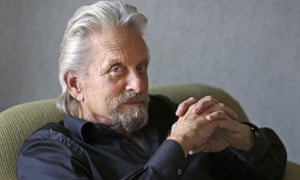
Michael Douglas … ‘You’ve gotta be a hunk!’ Photograph: Richard Lautens/Getty Images
You star in The Reach. It’s a cat-and-mouse thriller with you as an evil businessman hunting Jeremy Irvine’s trail guide across the Mojave desert. Where does the story come from?
It comes from a book called Deathwatch by Robb White (1). He was a young-adult novelist. I wanted to do something for a younger audience. So here was an opportunity for me to be involved with this co-star that might attract a young adult audience.
The book was written in 1972. Was it tricky to adapt for 2014?
The desert doesn’t change. The hardest thing translating it as a thriller was to visualise it in hot sunlight. There’s not a lot of things to hide behind in the desert (2). You worry, well, can we sustain suspense for an hour and a half?
Your character’s a bad guy who wants to export American jobs to China. Is the movie trying to shore up traditional American values?
Yeah. There’s certainly that message going on. Patriotism isn’t the first thing that jumps out at you from my character. This was old-fashioned good guys and bad guys. I looked at Jeremy as a 19-year-old John Wayne. He represents the best of what America has to offer. I looked to the worst it has to offer.
Michael Douglas
Is it more fun to play the villain?
Oh yeah. Much more fun. You get to be bad. B-b-b-b-b-b-bad to the bone! (3) My father was the sensitive young man for seven pictures until The Champion (4). He played a prick and was nominated for an Oscar. Most everyone’s careers, their biggest successes have been through playing villains. Nice guys are more and more difficult to play in terms of getting the edges. I enjoy the challenge of winning an audience over. The audience hate you at the beginning of the picture, and by the end they’re going, “Welllllll. He’s not so bad.”
You’ve described this role as “the Gordon Gekko of the west coast”. Are all bad guys the same? Is the nature of evil universal?
No. There are subtleties. In this film, it’s more polarised (5), in the format of the original book. Young adults have good guys and bad guys, and it looks like the world’s come back around that way again: there are good guys and there are bad guys now.
Irvine spends most of the film topless. He went from playing a malnourished prisoner of war in The Railway Man to this. He was asked to put on 20lb of muscle …
We worked him over pretty good about it: “You’ve gotta be a hunk!”
Is there a double standard here? He had to buff up but it might be seen as sexist for a women to be asked to slim down. Should actors have to be eye candy?
It’s not acceptable for women to be eye candy?! If your role in that picture is to be eye candy and the director looks at you and says: “You’re going to be in your bra and panties and you’re looking pretty soft around the middle.” Absolutely you’d tell that person to kick ass. This guy is search and rescue. He’s a mountaineer. He’s in physical shape. Ignoring the fact that he happens to be a decent-looking guy, it would be wrong for him not to be in shape. If you wanted Seth Rogen running through the desert (6), that’s a different movie.
Foot notes
(1) White also colonised a tiny Atlantic island with his wife. They protected it from typhoons, an amorous Nazi ship captain and White’s mother-in law. He was a doer.
(2) Things Irvine hides behind in the desert: outcrops, hillocks, dunes, a delectably coiffed fringe.
(3) Douglas is rocking a villainous Van Dyke beard. It looks wicked.
(4) 1949 drama starring Kirk Douglas as a devious boxer.
(5) Key line for Douglas’s character: “Ah ha ha ha ha! Why won’t you die?!!
(6) We do. Kickstarter?
The Reach premiered at the Toronto film festival and is scheduled for release in 2015.
Our rundown of the top 10 films of 2013 continues with Quentin Tarantino's "southern", the hip, flashy revenge fantasy that dared to tackle slavery Henry Barnes Monday 16 December 2013 16.17 GMT
When Django Unchained was released back in January, Spike Lee did what he does best: took umbrage. "American Slavery Was Not A Sergio Leone Spaghetti Western," the director tweeted. "It Was A Holocaust".
Lee hadn't seen the film, but he had a point. Django Unchained, Quentin Tarantino's action fantasy about a freed slave (Jamie Foxx) enacting bloody revenge on plantation owners across the southern states, does make pre-civil war America look cool. It's loaded with style, plugged into a killer soundtrack, shot with a confidence that we hadn't seen from Tarantino since Jackie Brown. The script – for which Tarantino won an Oscar – is funny, the story is exciting, the performances – particularly Christoph Waltz's turn as the dentist-cum-bounty-hunter Dr King Schultz (another Oscar) – are vital. And then, in among all the crash zooms and gunplay and snappy rejoinders, there's the devastating brutality of the slave trade.
Django Unchained is a hip, flashy film that dares to tackle the slave trade. It takes the cartoonish stereotypes of the martial arts, western and blaxploitation genres and uses them to confront a modern audience with the grey areas of contemporary racial politics. Schultz hates the slave trade, but he bought Django, and he is – make no mistake – using him. He's both emancipator and captor. He's also a wealthy, white gun-for-hire who risks his life for the cause of a former slave (for free). In that he's more unrealistic than Calvin Candie, the moustache-twirling villain (played by Leonardo DiCaprio), or Stephen (Samuel L Jackson), the "house slave" overseer at Candie's ranch. Schultz is the moral centre of the film. And he is absolute fantasy. A stab at crude fictional reparation. A symbol for a much more modern sense of white guilt.
And yet, by presenting a rare and meaningful analysis of a period that many are still too wary of talking about, Tarantino compels us to take Django Unchained seriously. The slaves wearing branks in the trader town in Mississippi, the introduction of Django's wife Broomhilda – whipped first, dragged naked from a sweatbox later: these practices happened, the images are horrifically real. And still you watch them recognising that you are experiencing an entertainment product (as all films, even Steve McQueen's sombre analysis of the same subject, 12 Years a Slave, are in part). It's this quandary that makes Django powerful: the same quandary that has made most of Tarantino's films, from the depiction of extreme violence in Reservoir Dogs to the crass racial epithets of Pulp Fiction and Jackie Brown, so startling.
A film set to a backdrop of the most inhuman of human behaviour shouldn't be fun. But Django is. It's also shocking and horrible and unwatchably grim. Tarantino makes no apologies for tackling this period of American history in his own indomitable style. In doing so he presents one way – not the wrong way – of reflecting on an atrocity that's almost incomprehensible.
We kick off our list of the top 10 films of 2013 with Wadjda - a funny, romantic drama based on a Riyadh girl's quest to buy a bike that's Saudi Arabia's first film directed by a woman. We'll be launching the remainder of our top 10 daily over the next two weeks
Henry Barnes Monday 9 December 2013 11.57 GMT
Wadjda is the first Saudi Arabian feature to be directed by a woman. Shot in the suburbs of Riyadh, Haifaa Al-Mansour's film tells the story of an 10-year-old who wants to buy a green bicycle to race against her friend Abdullah.
Wadjda (Waad Mohammed) shouldn't want a bike (her mum's worried – it could ruin her virginity), she shouldn't – as a girl on the edge of puberty – really be playing with Abdullah. But she does, cheerfully and with cursory regard for mum's fretting or the disapproval of her staunchly traditionalist teacher. She wears Converse under her traditional garb – a handy visual metaphor for the film itself.
Because Wadjda is a funny, romantic story hiding its political edge. It subverts the western fallacy that womanhood in traditionalist Islamic countries must always be miserable, while never soft-pedalling in its push for reform. Religion is part and parcel of the restrictions on Wadjda's daily life, but she's learned to use the system to get what she wants. A Qur'an reading competition at school offers her the chance to win the money for the bike. So she acts the model student and gets her head in the book. The real reason for her new-found interest in devout study is kept secret.
Wadjda is a film about working for change under the radar, with small victories. Al-Mansour had to a make sacrifices to get the film made. In the more conservative neighbourhoods of Riyadh she directed scenes from inside a van, for fear of sparking protests. Some have questioned how restrictions like this can provoke anything but fury. But this film shows that there are subtle ways to attack injustice. Wadjda's response when faced with the outrage of her teacher is to sigh. The older woman is enforcing men's rules, which – for Wadjda – are to be shouldered only if they can't be shrugged off. There's no out-and-out polemic against Saudi society. It's the everyday nature of Wadjda's frustration that gets to you.
Al-Mansour has described Saudi Arabia as a "moving society" – a male-dominated country that is slowing coming around to the need for change. She is necessarily idealistic – her criticism of her country is delivered inside a love letter to her people and to custom. And her method seems to work. The film's nomination as Saudi Arabia's Oscar contender is an implicit nod of approval from the country's mainstream. Al-Mansour, like Wadjda, walks the line between what she wants and what she can get away with.