WHEN I BECAME Thomas Mann’s secretary in the summer of 1941 he was working on the last volume of his great Joseph tetralogy. He wrote this book as he had most of his other books—every day of the week, between nine and twelve in the morning, he wrote with pen and ink, on plain white sheets, covering never less than two and never more than three pages in a day. So great was the force of his self-conditioning, attained through an awesome discipline, that he kept writing even when he was not at home, in hotel rooms, Pullman cars, steamship cabins.
ES DIEUX S’EN VONT.The gods pass. With George Bernard Shaw another of Europe’s Old Guard has departed—the Nestor of that great-statured generation, gifted with enduring vitality, unwinded, productive to the last—leaving behind what must be called, in comparison, a race not without interest, but frail, somber, endangered, and withered before its time. He was preceded in death by Gerhart Hauptmann, of whom G.B.S. scarcely took notice, though plays like “The Weavers” and “The Rats” should have greatly pleased him, and by Richard Strauss, whom he knew quite well and in whom he admired the great tradition as well as the brash revolutionary efficiency of a man born under a lucky star. Still among us are the octogenarian André Gide, Shaw’s kinsman in capricious genius and Protestant morality, and the aged Knut Hamsun, now merely vegetating, a man broken by politics, though the quondam creator of highly discriminate narrative works that yield nothing in richness and charm to Shaw’s dramatic works. Shaw, judging by his writings, was sublimely unconcerned with this compeer; and it is true that in many respects the two of them were counterpoles, especially in the matter of socialism. The bond between them in the personal sphere was a sense of obligation towards Germany, well-founded in either case, though it spelled Hamsun’s political doom, while in the more intelligent Shaw it maintained the character of a well-tempered gratitude which, for the rest, laid little claim to any very extensive intimacy.
“Who yearns for the impossible I love” —FAUST. “He could not walk, and he walked; he could not stand upright, and he stood.”
THUS THOMAS MANN in April 1945 in a speech of homage to Franklin Roosevelt, so recently dead. Of course there is no doubt that he meant these words deeply; though Mann was never given to uncritical hero worship, he did admire, this side of idolatry, the great President, the “politician of the good.” Roosevelt had contributed, Mann thought, more than anyone else to the defeat of Hitler. Yet we also know that Mann generally included an element of self-portraiture in his essays on figures which especially interested him. In Goethe he stressed the burgher element, in Schiller the heroically determined artist who pushed his world to conclusion at any cost, in Lessing the man of prose whose works rank with those of the highest poets. To the dismay of some readers, he even wrote of “Brother Hitler,” seeing in the Führer a Bohemian; a miserable artist but still one of the guild. Is there any sense in which we can take statements like “He could not walk, and he walked” as referring to Mann as well as to Roosevelt? I am convinced that there is, though such self-reference may well be involuntary.
AS A YOUNG MAN, I thought and said that, once having been born into the world, it was a good and honorable thing to persevere a long time, to live a full, canonical life, and, as an artist, to be characteristically fruitful in all its stages. But I had very little confidence in my own biological qualification and soundness, and the endurance that I have, nevertheless, demonstrated appears to me less a proof of my own vital patience than proof of the patience of the genius of life towards me—something unmerited, an act of grace. And grace is always astonishing and unexpected. He who experiences it thinks he is dreaming.
I CONFESS THAT THE REMARKS of the singular gentleman I met in Venice that evening thoroughly mystified me, and I fear I shall not be able, even now, to repeat them so that they will affect others as they did me at the time. Perhaps the effect of his words was due merely to this amazing frankness, coming from a total stranger.
FOR THIS ESSAY ON GOETHE, a task of which I feel so unworthy, I shall fall back upon a memory, a personal experience, to hearten myself for the venture and give it the stamp of authenticity, which is best and final in all things. I recall the emotions that crowded in upon me years ago when I found myself for the first time in Goethe’s childhood home on the Hirschgraben in Frankfurt. Those rooms and stairs I knew perfectly, in style and tone and atmosphere. Here was “ancestry,” as it is recorded in the book of my life, and the beginning, likewise, of something gigantic. I was at home and at the same time I was a late and shy guest in the realm of genius. The homelike and the grand rubbed shoulders. This bourgeois-patrician mansion, now become a museum, where reverence treads softly as at the cradle of a demi-god; this dignified and decorous setting, treasured and held sacred because of the son who left it behind—how far behind!—to grow to austere world stature—I gazed on all this, I breathed it in; and the discord between familiarity and awe in my breast was resolved into that feeling in which humility and self-assertion are one, into smiling love.
In his historical novel The Magician, Colm Tóibín presents an intimate portrait of Thomas Mann, the great German novelist and foe of the Nazi regime. Good biographies of Mann exist, but Tóibín uses a novelist’s tools to present a picture of Mann as a full human figure with darkness and depth.
The Magician by Colm Tóibín review – inside the mind of Thomas Mann
This compelling fictionalised biography explores the life and times of the exiled German Nobel winner, exquisitely balancing the intimate and momentous
In August 1939 Thomas Mann was in Sweden, staying in a seaside hotel. The mornings, as always, were devoted to his writing. After lunch with his family, he would take his afternoon walk on the beach.
Before anyone gets carried away with Valentine’s Day fantasies, these books give a genuine sense of how passion is lived and often lost in the real world
When people recommend love stories to girls, more often than not, they’re cosy, undemanding books, so transparent you can see the outline of the plot just by flicking through the pages. These are books you could never lose yourself in, which never really get under your skin and instead just leave you feeling sluggish. Limp, sparkly books with sparkly covers. Mills and Baloney. Their love stories have nothing to do with the ones we actually live. They tell of affairs that begin badly, end well, and last forever. But the memory of the book, once the final page is turned, fizzles out more quickly than the briefest of passions.
In writing Trysting, I wanted to bring together fragments of love stories that would feel familiar, to record awe, desire, surges of tenderness, rituals, ludicrous obsessions that become necessary crutches, creeping feelings of routine and boredom, suspicion, jealousy, attrition, moments of intense shared loneliness, simple joys, breakups, wrong turnings, beginnings, brief love, everlasting love, and most of all, everyday love. I wanted to write a book about all those moments. I wanted my words to preserve them, keep them from slipping away, and let them surface in my readers’ memories, to help them remember their own past loves, help them love and be loved.
Here are 10 books that give superb accounts of authentic romance – in brief encounters, and also in shared lives. They may be the subject of the whole book or story, or perhaps they are just a moment in the narrative. These encounters are sometimes extraordinary, sometimes ordinary, but never bland: they’re anti-baloney.
Death in Venice
by Thomas Mann
1913
1. Death in Venice by Thomas Mann (translated by Joachim Neugroschel)In search of beauty, an ageing writer falls in love with a teenage boy. As he tracks the boy’s movements through the streets of Venice, the writer is only extrapolating his artistic research. But his goal is as ineffable as it is ephemeral and only death will be there to greet him when he reaches it. When I read this beautiful text for the first time I too was a teenager, but the book’s spell remains just as powerful now.
2. Be Mine by Laura KasischkeSherry, married and in her 40s, receives an anonymous Valentine’s Day card with the message “Be Mine”. Kasischke gives us a minute portrayal of an American reality in which everything, including desire, seems perfectly ordered. She pushes her characters, ordinary people, to the point where their destiny is overturned. We watch as the superficial order is stripped away and they lose control of their lives.
3. The Wake of Forgiveness by Bruce MachartBetween 1895 and 1924, somewhere in the vast expanses of Texas, Machart draws us into a family saga in which four boys confront their father’s coldness and violence. In the midst of these harsh, wonderfully described lives, an all-consuming love is born during a horse race: in the driving rain, the meeting of bodies between horse and rider is echoed in the meeting of bodies between a man and a woman.
4. Sounds by Vladimir Nabokov (translated by Dimitri Nabokov)In this brief story – one of Nabokov’s first published pieces – the narrator describes the end of a love affair in poignant and delicate detail. Yet the story is also, and fundamentally, about the author’s sensuous relationship with nature, which he identifies with Russia and therefore also with his childhood.
5. Where the Sea Used to Be by Rick BassIn a tiny Montana village, life revolves around the bar and the general store. Mel is the daughter of Dudley, a rich, tyrannical geologist. Wallis arrives at the beginning of winter. Bass weaves a many-faceted narrative in which Mel and Wallis’s relationship takes root, grows, and blossoms in a wonderful nocturnal scene in which Mel, on skis, carries Wallis on her back through the snowy forest.
6. Hotel Iris by Yoko Ogawa (translated by Stephen Snyder)In spare and finely nuanced writing, Ogawa describes the unexpected relationship between a rather ordinary young girl and an elegant older man, a solitary and wayward intellectual who will lead his young protege into a highly unusual sexual initiation, pushing her to the very limits of what she can bear. Switching skilfully between scenes of S&M sex and everyday routine, Ogawa engages her readers in a novel that’s both clever and disturbing.
7. A Balcony in the Forest by Julien Gracq (translated by Richard Howard)Deep in the Ardennes at the beginning of the second world war, before any fighting has started, Lieutenant Grange takes up his position at a solitary outpost: a little, tumbledown house in the immense forest. One night he meets Mona: there follows a brief, timeless, sensual happiness, quickly crushed by history. Mona is constantly changing: child-fairy, unicorn, sprite, witch, meadow, stream, rock, rain, waterfall, melting ice, ray of light. In Grange’s imagination, she merges with the forest itself.
8. The Possession by Annie Ernaux (translated by Anna Moschovakis)Having walked away from a man, then learned that he walked straight into another woman’s bed, the narrator is overtaken by a devastating fit of jealousy. Beginning with the most ordinary event, Ernaux plots the incursion of the strange, absurd and consuming sentiment that is jealousy. For it is jealousy that drives the narrator into ever more undignified and ridiculous reactions, all minutely described, as if this machine once set in motion can never be stopped again.
9. Beware of Pity by Stefan Zweig (translated by Anthea Bell)On the eve of the first world war, a poor young officer garrisoned in a small Austrian village is filled with pity for a rich young invalid who misinterprets his attentions. This misunderstanding sucks her into an unrequited passion, before she who began as victim turns into tormentor and manipulator. Years later, the officer tells the story of the trap into which his irreconcilable feelings led him, giving us a novel that’s subtly disturbing.
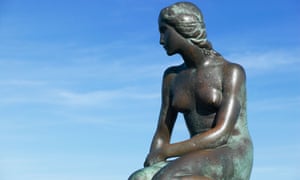
Edward Eriksen’s sculpture of The Little Mermaid in Copenhagen
There’s no right or wrong age to read – and relive – the most beautiful and appalling love stories. During her brief sojourn on solid ground, the day of her 15th birthday, the little mermaid meets a man. Out of love for him, she agrees to give up her tongue to a witch and to have her tail split in two and transformed into a pair of legs. This causes her dreadful pain, “as if she were stepping on sharp knives”. Agonised anew with every step she takes, the mermaid’s pain feels all the crueller when her beloved, charmed by the mute little mermaid for a while, decides ultimately to marry someone else.
The end of coronavirus: what plague literature tells us about our future
From Thucydides to Camus, there are plenty of hopeful reminders that there’s nothing unprecedented about the coronavirus lockdown - and that pandemics do end
Marcel Theroux
Friday 1 May 2020
Shortly before the London lockdown, at an eerily quiet branch of Waterstones, I managed to get my hands on The Decameron, by Boccaccio,and Daniel Defoe’s A Journal of the Plague Year. But Camus’s The Plague had gone the way of dried pasta and toilet roll; there was just a desolate gap on the shelves where the copies had once been.
The primary lesson of plague literature, from Thucydides onwards, is how predictably humans respond to such crises. Over millennia, there has been a consistent pattern to behaviour during epidemics: the hoarding, the panicking, the fear, the blaming, the superstition, the selfishness, the surprising heroism, the fixation with the numbers of the reported dead, the boredom during quarantine.
Defoe would have recognised the impulses behind the strange tableaux of life interrupted in central London: piles of ice melting outside abruptly closed bars; a truck unloading gym equipment at an oligarch’s house in Mayfair; jittery shoppers with overloaded trolleys. “Many families,” he writes, “foreseeing the approach of the distemper laid up stores of provisions sufficient for their whole families, and shut themselves up, and that so entirely, that they were neither seen or heard of till the infection was quite ceased.”
The sudden, powerful need to know what’s coming is predictable, too. We turn to historical witnesses who can explain what it’s like. Defoe’s motive for writing A Journal of the Plague Year was an outbreak of bubonic plague in Marseille in 1720. Anticipating its spread, readers wanted to know what it had been like in 1665. Defoe, responding to demand, provided them with an instant book, fashioned out of statistics, reminiscences, gossip, anecdote and blood-curdling dramatic detail. “Passing through Token-House Yard in Lothbury, of a sudden a casement violently opened just over my head, and a woman gave three frightful screeches, and then cried, “O death, death, death!”
Bring out your dead ... a depiction of the Great Plague in London, 1665.
Defoe almost certainly didn’t witness this – he would have been about five. Novelistic moments such as these would make the book compelling at any time, but right now it has a painful relevance. Defoe is particularly strong on the unpreparedness and prevarication that made the impact of the plague more severe. Or, as he puts it: “I often reflected upon the unprovided condition that the whole body of the people were in at the first coming of this calamity upon them; and how it was for want of timely entering into measures and managements, as well public as private, that all the confusions that followed were brought upon us, and that such a prodigious number of people sunk in that disaster which, if proper steps had been taken, might, Providence concurring, have been avoided.”
Bracingly vivid ... Daniel Defoe’s religious fanatic Solomon Eagle from A Journal of the Plague Year. Photograph: Colin Waters/Alamy
Defoe is sometimes dismissed as a hack, but his lack of vanity about his prose is one of the things that gives the book its power. There’s something amazingly bracing about his vividness and curiosity – the bills of mortality, quoted in full; minor characters such as the religious fanatic Solomon Eagle who walks around naked with a pan of burning charcoal on his head; and the imprudent John Cock, a barber who is so relieved by the apparent retreat of the epidemic that he returns to normal life too soon and pays the penalty. Moral: don’t be a John Cock.
So much of the behaviour of our 17th-century forebears is uncomfortably familiar. The citizens of east London watch complacently as the plague tears through the West End, and assume they will be fine. They’re proved terrifyingly wrong. Defoe adds in a chilling parenthesis: “For indeed it came upon them like an armed man when it did come.”
Even before germ theory, Defoe’s common sense and perceptiveness lead him to conclusions of which our chief medical officer would approve. He gives a prescient warning about the danger of asymptomatic carriers: “The plague is not to be avoided by those that converse promiscuously in a town infected, and people have it when they know it not, and that they likewise give it to others when they know not that they have it themselves.”
If human behaviour remains dismayingly constant, one thing that has changed for the better is science and our understanding of it. Seven hundred years on, there’s something deeply poignant about Boccaccio’s pre-scientific description of the spread of the Black Death in his native Florence. “What was particularly virulent about this plague was that it would leap from the sick to the healthy whenever they were together, much as fire catches hold of dry or oily material that’s brought close to it. And that was not all. Not only did speaking with the sick and spending time with them infect the healthy or kill them off, but touching the clothes of the sick or handling anything they had touched seemed to pass on the infection.” You feel like the audience in a pantomime, wanting to shout across the centuries and tell him who the villain is and how he operates.
‘There was particularly high mortality among doctors,’ Thucydides tells of the plague in fifth-century Athens. Photograph: Science History
Not everyone responds to plague by immersing themselves in data about epidemics. The escapist response to disaster is another predictable move and The Decameron epitomises it. After his short but terrifying description of the Florentine plague, Boccaccio sends his troupe of young characters into quarantine, where they spend the remainder of the book, swapping funny, ribald stories: the plague doesn’t feature again. It’s a welcome relief to lose yourself in a world of cuckolds and randy nuns. And once more, plus ça change. The gilded Florentine youths are doing the 14th-century equivalent of binge-watching Sex Education on Netflix.
Thomas Mann and Camus are less interested in plague itself than in using it to make existential points. The plague in Death in Venice is an avatar of death in general, the terrible mystery, the pale horse; it is something that strips away vanity and reveals unpalatable truths. In Mann’s novella, it is the catalyst for Von Aschenbach’s humiliating descent into clownish self-destruction. At the same time, the pages dealing with the cholera epidemic are vigorous and apposite. The hotels in Venice empty swiftly, despite official protestations that there is nothing to worry about. It’s a young English travel agent who finally cuts through the official flannel. The doubts he raises about administrative competence and probity are ones that in due course we’ll all be obliged to consider. “‘That is,’ he continued in an undertone and with some feeling, ‘the official explanation, which the authorities here have seen fit to stick to.’”
FacebookTwitterPinterestExistential epidemic ... a scene from Neil Bartlett’s adaptation of Camus’ The Plague at the Arcola theatre, London, in 2017. Photograph: Jane Hobson/Rex/Shutterstock
Camus is the real odd one out. The Plague is often read as an allegory of the French experience under occupation, but right now there seems nothing allegorical about it: the hero, Dr Rieux, seems like a naturalistic depiction of a frontline care-worker forced into impossible decisions over who gets a ventilator. At other historical moments, the constant reflection on the meaning of the plague could seem heavy-handed – Gallic, not in a good way – but in 2020 it’s like reading The Cruciblewhile your elderly parent is on trial for witchcraft. For long stretches, you forget any notion of allegory and simply wonder how Camus could have got it so right: from the panic buying of peppermints that people think will be a prophylactic, to the high mortality rate in the municipal jail, to the exhausted healthcare workers, and the terrible monotony of quarantine, something with which we are only just beginning to get acquainted.
And then, of course, the plague ends. That’s the actual good news that these books bring. The epidemic always passes. The majority of people survive. Thucydides himself had it and recovered. “I shall simply tell it as it happened,” he promises of the plague that ravaged fifth-century Athens, “and describe the features of the disease which will give anyone who studies them some prior knowledge to enable recognition should it ever strike again.”
Should it ever strike again is the phrase that awakens our sense of hubris. For all the talk of an unprecedented crisis, we are living through something with many precedents. “There was particularly high mortality among doctors because of their particular exposure,” Thucydides wrote 2,500 years ago in a sentence that could appear in tomorrow’s paper. We have assumed that deadly epidemics belonged to a phase of history that was behind us, as quaint and irrelevant as candlelight and milking your own cows.
When the number of fatalities finally peaks and dwindles, Defoe’s citizens pull up their windows and shout to each other to share the news. Camus’s Oran is liberated; its citizens struggle to make sense of what has happened to them. Back in fifth-century Athens, the Peloponnesian war continues. Whether society changes for the better or worse, or simply stays the same, is what we will find out.