Lost Federico García Lorca verse discovered 93 years after it was written
Eight-line poem found on the back of a manuscript sheds light on Spanish poet’s preoccupation with time
Sam Jones in Madrid
Sat 18 Apr 2026 05.00 BST
A previously unknown verse attributed to Federico García Lorca has been discovered 93 years after the celebrated Spanish poet and playwright is believed to have jotted it on the back of one of his manuscripts.
‘Difficult love’: Spanish publisher reprints groundbreaking book of Lorca’s homoerotic sonnets
This article is more than 9 months old
Federico García Lorca’s poems were printed anonymously in 1983 after being hidden away by family for 50 years
Sam Jones in Madrid Friday 13 June 2025
In the autumn of 1983, dozens of carefully chosen readers received an envelope containing a slim, red booklet of sonnets that had been locked away since they were written almost 50 years earlier by the most famous Spanish poet of the 20th century.
Name of Federico García Lorca's lover emerges after 70 years
This article is more than 13 years old
Box of mementoes reveals that young art critic Juan Ramírez de Lucas had brief affair with Spanish poet
Giles Tremlette in Madrid
10 May 2012
The identity of the lover to whom Federico García Lorca wrote passionate verse in his final year has been a mystery ever since the poet's assassination during the Spanish civil war. But now, more than 70 years later, his name has finally emerged.
Irish-born scholar’s work on writer to be reprinted to mark 80th anniversary of his death
English version bySusana Urra Jesús Ruiz Mantilla 25 January, 2016
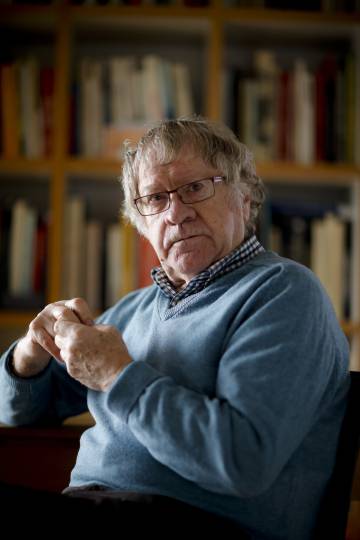
Ian Gibson inside his Madrid home.BERNARDO PÉREZ
Life with Federico García Lorca is a pilgrimage that involves carrying the load of injustice on your back.
It has its moments of satisfaction, says scholar Ian Gibson, but also its sorrows – such as realizing that some people in Spain still prefer ignorance over knowledge of what happened on the day a firing squad ended the writer’s life at the onset of the Spanish Civil War.Ever since he was a young 18-year-old student in Dublin, Gibson has spent most of his time unraveling the mysteries that surround the Spanish author ofBlood WeddingandPoet in New York. His complete works on the subject are to be reprinted this year, to coincide with the 80thanniversary of Lorca’s murder on August 19, 1936.
“He is the most famous missing person in the world,” says Gibson, alluding to the fact that Lorca’s body has still not been found despite several high-profile attempts.
Sitting inside a bar in Lavapiés, the Madrid neighborhood where he lives, Gibson explains how Lorca became the focal point of his career. “It could have been Baudelaire,” he admits. “But it was Federico who dazzled me.”
At age 76, he still doesn’t quite know why. “It was a very intimate, very profound thing that his poetry revealed to me. It had to do with the atavistic, with something primitive and instinctive. He was an eminently telluric poet.”
“It could have been Baudelaire. But it was Federico who dazzled me”
His first reading of El romancero gitano(translated as Gypsy Ballads) left a mark for life. Later, piqued by clues offered by Gerald Brenan in his 1950 book The Face of Spain, Gibson decided to investigate Lorca’s killing.
The result was his book The Death of Lorca, which addressed a taboo subject in 1970s Spain, then still under the yoke of Francoism.
Later came his main work, the 1998 biography Vida, pasión y muerte deFederico García Lorca, and offshoots such as 2009’s Lorca y el mundo gay and the more recent Poeta en Granada (2015).
“People think I’m obsessed,” he says, before admitting that maybe it is no wonder. “He is everything to me.”
Whether he likes it or not, Lorca is the central element that has enabled Gibson to approach other areas of research. It was Lorca who led him to Salvador Dalí, Antonio Machado and Rubén Darío, whose biographies he ended up writing as well.
Federico García Lorca in a picture taken by French writer Marcelle Auclair.MARCELLE AUCLAIR
Gibson also played a role in the efforts to exhume Lorca’s body after putting forward a possible location of the mass grave in which he is thought to lie, together with a schoolmaster and two bullfighter assistants. That attempt proved fruitless, as did the others.
“I have gone over the notes, the recordings. I still think he is buried very near the memorial park in Alfacar, but I have no problem with people investigating other possibilities, like the researchers Miguel Caballero, Javier Navarro and their people are doing,” he says. “All leads must be followed, no doubt. All I am interested in are the scientific results.”
But Gibson is not just attracted to the shadows surrounding the writer’s death. He is also intrigued and moved by certain episodes in his life.
“He had this sense of abandonment during his childhood years. Perhaps there was a wet nurse. His love trauma must have come from some very deep place. Like he used to say: every abandoned child is a story that got erased.”
But there was a lot of light in his life as well: there was joy, there was music, and a passionate determination to follow up on what he called his inclinations. Nobody can be left indifferent after getting to know Federico. To study Lorca is to study inner prisons and how to escape from them.
Gibson had found a soulmate. “He taught me both to detect and to wish to free myself of the puritanical environment I experienced as a child in a Protestant family surrounded by a Catholic country,” he notes.
“If I live in Lavapiés, it’s because of him, because this is where I came searching for his trail,” he adds. “I never dreamed I would end up living here.”
Ultimately, he even applied for dual citizenship. This has been a source of joy and sadness, as Gibson cannot understand why his adoptive country sometimes seems unwilling to get to the bottom of the Lorca issue.
Not that he hadn’t been forewarned “by a great observer of this country, Richard Ford,” he says about the 19th-century travel writer who wrote the influential A Handbook for Travellers in Spain.
“In one of the passages he comes up with a dazzling definition of this country,” says Gibson: “Unamalgamating Spain.”