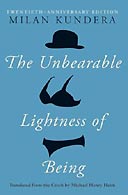
Refusing to talk about himself was not a moral attitude, nor a posture of proud withdrawal, but a novelistic rejection of the despotism of the media
CHRISTIAN SALMON
JUL 13, 2023 - 10:37 COT
The success of a writer is often accompanied by increasingly numerous misunderstandings about him. After the worldwide success of The Unbearable Lightness of Being, misunderstandings kept arising. Interview requests came in from all over the world and his words were often misrepresented. The legend of the Prague dissident threatened to overshadow his work, which he had tried to protect from biographers with his constant translation and editing work. His seminar at EHESS, the School of Advanced Studies in Social Sciences in Paris, was always full of journalists and intellectuals in need of a master thinker. One of them said to me as he left a seminar: “He could be the new Sartre!”
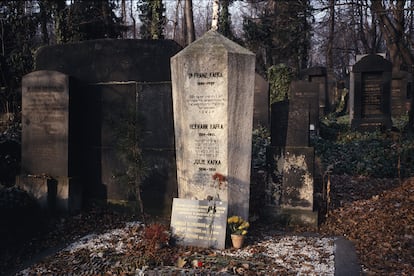
Franz Kafka’s grave in the Prague cemetery.JNS (GAMMA-RAPHO / GETTY IMAGES)
Is there a European literature?
The narrative of the continent continues to be burdened by the absence of a common strategy in a space of miscegenation with no shared language
ANTONIO MONEGAL
NOV 17, 2023 - 19:01 COT
The question posed by the headline is one that inevitably excites the experts in comparative literature, those of us who study literary phenomena beyond national and linguistic borders, from a supranational perspective, if only to delve into the implications of the matter without the need to reach a definitive answer. Like so many other, very relevant questions, this one is not answered with a yes or a no, but with “it depends.”
It is clear that there is a literature produced within the diffuse, ever-changing margins of that territory we call Europe, and if this were the meaning of the question, the answer would be a simple “yes” and this article would end here with nothing more to say. An obvious answer to an uninteresting question. Such European literature would be nothing more than the sum of the literary productions of a group of countries endowed with the status of “European,” either due to their membership in the EU or to broader, more inclusive criteria.
I understand that the ambition of the question is different; that it alludes to a notion of Europe that is more than a territory or a sum of nations. Is there such a thing as a European identity that unites a literary system, a series of shared traits that define a group of works or writers, a lowest common denominator? This immediately leads us to question whether it is possible to develop a canon of European literature, especially one that differs from Harold Bloom’s Western canon or what was previously known as world literature, in a comprehensive ethnocentric projection. Are we referring to a set of values? It is not even easy to reach a consensus on who Europeans are and which writers to include, because today Europe is a space of miscegenation, hybridization and diversity.
The answers to these questions are far from obvious, and require questioning some labels that we take for granted. There is nothing natural about the national and linguistic categories that we use to classify literature. However, nation and language are identifiable elements; possible instruments of convergence that help build community. Europe lacks these basic resources, a common language and a hegemonic cultural identity.
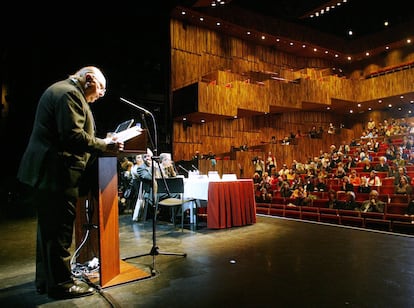
Hungarian Nobel Prize winner Imre Kertész at a conference held in 2005.FERENC ISZA (AFP / GETTY IMAGES)
The title of this article coincides with that of a short essay by Richard Miller, Existe-t-il une littérature européenne?, published — not coincidentally — in Brussels in 2017. In his exploration of the topic, Miller notes some evidence. There is a European literary tradition, dating back to Homer, made up of borrowings, influences, reception and circulation of literature, since the Romans read the Greeks, a powerful circuit of exchanges that characterizes the Middle Ages and the Renaissance, when the common poetics outweighed territorial and linguistic differences.
The circulation of literature does not slow down when national distinctions gain strength and political centrality, and comparative literature emerges as a discipline to deal with this international trade of literatures, already understood in the plural, with an essentially European approach because, in that early period, the requirement was that relationships between traditions and authors who had not been in contact should not be studied, which largely left out the non-Western literatures, where, on the contrary, the discipline is now fully rooted.
European literature was thus understood as a set of national literatures in a close relationship that grows when the works enter what Emily Apter refers to as “the translation zone.” This phenomenon today has been facilitated, extended and multiplied, but it can no longer be said that it is limited to European literatures: there is a global circulation of literature.
European leaders have disregarded culture as an instrument of cohesion
Perhaps the most interesting thing about Miller’s diagnosis is his assertion – or complaint – that there is no EU literature (which would certainly not coincide with a European literature) because European leaders have disregarded culture as an instrument of cohesion, delegating any cultural strategic planning and goal setting to the member states. He cites Renaud Denuit’s study on European cultural policy, which shows that the 2007-2013 budget allocated €400 million to culture for seven years; less than €1 per inhabitant for the entire period. This neglect is particularly serious if we consider, as Miller says, what the European ideal owes to the literature that founds and substantiates it.
Where does the idea of Europe come from if not from that shared tradition? For Milan Kundera, the modern novel, since Cervantes, is the research instrument through which Europe is built. That is a theme that is also explored, invoking Homer, by the Albanian Ismail Kadare.
Miller’s reflection forces us to acknowledge the absence of what would be a European literary system, that framework of institutions, resources and tools with which nations are equipped to protect and promote activities related to literary production and reading, the translation of works and their circulation. There is a lack of a European policy for the development of common institutional platforms, support for culture in the media, promotion of transnational initiatives in the publishing industry and distribution, and even literary awards.
Literature is not only authors and texts in a sort of cumulative chain, as literary history used to be taught, and perhaps still is; but rather a set of practices and the experience of a relationship with and for the readers that depends on a complex network of factors. Without the social structure that surrounds it, literature can hardly fulfill its purpose and have an impact. Hence, it is difficult to identify a properly European literature in a context in which the various European national literatures, with internal support, move and compete in a global literary system, because the old limitations to the dialogue and exchange with non-European traditions have been overcome. Miller concludes that it is not literature that needs the EU; it is the EU that needs a literature, it needs the Europe of literature, the source of its fundamental principles.
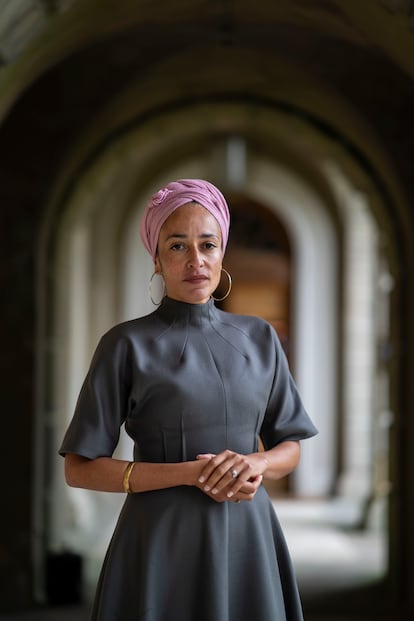
Writer Zadie Smith, pictured in September 2023.DAVID LEVENSON (GETTY IMAGES)
Perhaps it is Stefan Zweig who most consistently embodies and turns these principles and the consciousness of being European into literature, in the midst of the threats that loomed over that dream, humanist and cosmopolitan, of freedom. His contemporary, Franz Kafka, a writer who belongs to everyone and to no one, appeals to another eminently European tradition, one that describes the disturbing, hopeless side of the human condition. Two subjects of the Austro-Hungarian Empire, Zweig and Kafka, who anticipate the horror of the Holocaust, the transnational tragedy that defines European history.
A hypothetical European canon must include those who went through that experience and were affected by it, leaving us their testimony, such as Primo Levi, Charlotte Delbo, Imre Kertész or Victor Klemperer, who defended a moral idea of Europe. If identity consists of a collective memory, what other memory do Europeans share? And the literature of those survivors has contributed to building it. Jorge Semprún was that kind of European whose multilingual literature cannot be appropriated by a single nation and who struggled to translate his concentration camp experience into writing and political practice, both expressions of an ethical commitment and a vision of Europe.
Others who moved between languages and cultures are also essential references, like Vladimir Nabokov and Samuel Beckett, to whom George Steiner, another polyglot European, dedicated his essay Extraterritorial. Or James Joyce, an Irishman who belongs to English literature, publishes in Paris, lives in Trieste and dies in Zurich, and whose English contains a multitude of languages. His secretary, Beckett, can be read as an heir of Kafka’s desolation, although the languages among which they move are different: English and French one, German, Czech and Yiddish the other.
For Milan Kundera, the modern novel, since Cervantes, is the research instrument through which Europe is built
Another way of being between cultures and languages, one that is subject to more friction than that of these established authors, is that of writers like Sema Kiliçkaya, Najat El Hachmi or Zadie Smith, women who make us aware of the experience of migration, an inherent part of the European reality today. The question is not who is and who is not on an exclusive list, but rather on the selection criteria that make up a repertoire that we recognize as European, beyond the sum of its parts.
The literature that fulfills this purpose cannot be, at this moment, the representation of an identity, but that of a tense, dynamic and conflictive plurality, defined by displacements, crossings between languages and cultures and the mediation that expresses the perspective of the other. A literature that could be described as extraterritorial.
Claudio Guillén said in Múltiples moradas(Multiple dwellings) that “Europe is a moving whole, with a changing profile, but which nevertheless recognizes itself, physically and historically. It recognizes itself, but it does not know itself? Let us say for now that its demarcation is problematic, mobile, and often indefinite.” From this approach, we can think of Europe and its literature not as an identity, but as a changing process, the evolution of a project. More than a tangible, definable reality, it would be a historical construction and a utopian horizon to aspire to, if the goal is a Europe that is capable of combining union and differences.
Antonio Monegal teaches literary theory and comparative literature at the Pompeu Fabra University. He won the 2023 National Essay Prize for ‘Como el aire que respiramos: el sentido de la cultura’ (Like the air we breathe: The meaning of culture).
Milan Kundera: The Unbearable Lightness of Being author dies aged 94
The Czech novelist found himself silenced by the communist regime at home, but achieved international fame with playfully philosophical fiction
Richard Lea and Sian Cain
Wednesday 12 July 2023
Czech writer Milan Kundera, who explored being and betrayal over half a century in poems, plays, essays and novels including The Unbearable Lightness of Being, has died aged 94 after a prolonged illness, Anna Mrazova, spokesperson for the Milan Kundera Library, has confirmed.
Famously exiled from cold war Czechoslovakia by the Russian invasion, the novelist used his exclusion to find new ways to live and write
Adam Thirlwell
Wednesday 12 July 2023
In many ways Milan Kundera formed how I think about novels. I first discovered him at about 17, when I read his essay The Art of the Novel followed by his novel Slowness, which had just come out. (A book I ended up stealing from a friend’s apartment, I loved it so much.) He had been dramatically famous in the 1980s, so I associated him with the bookshelves of my parents’ generation, but these two almost miniature books were so funny and lucid and experimental and worldly that they seduced me entirely. This sensation of excitement and the contemporary never left me.
‘A melancholy duet about the schism between body and soul’ (Milan Kundera in the Introduction)
Czech history – a postwar snapshot
Kundera was born in 1929 in Brno, Czechoslovakia. When he was ten the Nazis annexed his country and imposed Nazi rule, when he was 16 the Russians liberated his homeland, and when he was 19 the Russians supported the February 1948 coup which brought a communist government to power. Initially, many of the brightest and best in the country celebrated a new era which promised to deliver a new world of freedom and justice and equality for all. Soon enough the government showed its Stalinist colours, rounding up not only conservatives and capitalists, big landowners, bankers and so on, but also socialist and liberal writers and critics. Hundreds of thousands were sacked from their jobs, around a hundred thousand were imprisoned and tens of thousands executed as spies and traitors and saboteurs, including friends and colleagues of Kundera’s.
In 1979 the Czech novelist Milan Kundera published a short essay about the works of fellow Czech and Prague inhabitant, Franz Kafka. The essay was titled Somewhere behind.
Throughout it Kundera uses the adjective ‘Kafkan’, which seems perverse of either him or the translator, because everyone else in the English-speaking world talks about the ‘Kafkaesque’.
20 years on, John Banville returns to the Czech Republic's most famous fictional export, The Unbearable Lightness of Being by Milan Kundera
by John Banville The Guardian, Saturday 1 May 2004
The Unbearable Lightness of Being by Milan Kundera, translated by Michael Henry Heim 314 pp, Faber.
Returning after 20 years to what is acknowledged as a modern classic, I was struck by how little I remembered. As I began re-reading The Unbearable Lightness of Being, Milan Kundera's novel of love and politics in communist-run Czechoslovakia between 1968 and the early 1980s, I realised that, true to its title, the book had floated out of my mind like a hot-air balloon come adrift from its tethers. I managed to retrieve a few fragments - the naked woman in the bowler hat whom we all remember, the death of a pet dog, a lavatory seat compared to a white water lily rising out of the bathroom floor, and the fact that Nietzsche's name appears in the first line on the first page - but of the characters I retained nothing at all, not even their names.
The Paris-based author Milan Kundera has finally got over a fit of pique and published his novel, L'Ignorance, in France, a work he wrote in French three years ago. The Czech-born author, at odds with the critics, refused to release the book here until translations had triumphed in bestseller lists in 26 countries, although Czechoslavakia has also been deprived of his insight into the problems of expatriation because of resentment over the way he is treated in his homeland.
Kundera, who emigrated from Prague aged 36 in 1975, spent the better part of 20 years perfecting his written French before publishing his two previous books, La Lenteur - slowness - and L'Identité here. Miffed by lack of overwhelming praise, after ecstatic reviews for works translated from Czech, he still won't speak to French critics and literary interviewers, not even the best known of them, Bernard Pivot, whose TV debates on L'Apostrophe sealed Kundera's reputation when he arrived virtually unknown in France.
This interview is a product of several encounters with Milan Kundera in Paris in the fall of 1983. Our meetings took place in his attic apartment near Montparnasse. We worked in the small room that Kundera uses as his office. With its shelves full of books on philosophy and musicology, an old-fashioned typewriter and a table, it looks more like a student’s room than like the study of a world-famous author. On one of the walls, two photographs hang side by side: one of his father, a pianist, the other of Leoš Janácek, a Czech composer whom he greatly admires.