It has been said that you can’t know what the story is until you come to its end, until the final scene or line casts its retrospective light and illuminates everything that came before. In writing History of Wolves, I thought I was done many times. The first of these endings was a paragraph that came to me like a dream late at night, a set of sentences in the second person that concluded a short story I’d drafted while living in Los Angeles. That short story was chilly and spare, everything LA and my life at the time were not. Its final paragraph offered a hopscotch through time and place as its ferocious protagonist, a 14-year-old girl for most of the story, grew up unable to leave the past behind.
The second time I finished was a couple of years later. By then, I’d added about 150 pages to the story of Linda (or Mattie or Madeline) in a three-month dash of notes that I scribbled in a notebook each morning, then typed up each afternoon. I’d recently left behind my beloved community in LA so my husband could complete graduate work in New Jersey. I was feeling unmoored, lonely, and Linda’s stark Northwoods home provided a familiar place for me to live each day. I pencilled a little map of the lakes and roads, researched species of fish and types of ice. But it was Linda’s unusual voice that compelled me most. As I followed her beyond the first ending I’d written, I found myself increasingly interested in how her peculiar combination of canniness and naivety allowed her simultaneous insight and blindness. At a crisis point in the new manuscript, I wrote a drawn-out scene showing Linda wandering through her hometown and looking for help. When I showed it to the marvellous writer Aimee Bender, she said it felt like the ending. I resisted the idea for a long time, but her comment plucked open the deeper logic of the book, helped me see why the point where a story stops might not be its chronological end.
And so this second ending, as I considered it, paved the way for a third. I’d begun thinking of memory, and especially memory of trauma, as roving and recursive. Increasingly the book seemed less about its events and more about how Linda thinks about them. As the novel evolved in these new directions, I was drifting between cities myself, living first in suburban Philadelphia and then in upstate New York. At some point around this time I began to feel that the scene showing Linda walking through town might be close to, but not quite, the end of the novel. Though I’d resolved the novel’s main events by then, I felt there was some residual anger, some lingering hunger, in Linda that demanded outlet. So I wrote yet another ending, the final, final chapter of the book, as a way of acknowledging how events in one part of a life ineluctably affect experiences in another.
But that wasn’t the end of the story of this book, either. What followed were a flurry of smaller revisions when the manuscript made its way to a publisher. In the spring of 2016, I found myself poring over copy edits in a dark Airbnb in New York City. Is it relevant to say that I was in NYC that spring for fertility treatments? I think it is. I was struggling to make my deadlines while injecting myself with drugs and commuting across town to the clinic. Childless, hormonal, I could not help but consider with fresh urgency the death that opens History of Wolves – not the death of the teacher that inspired the original short story, but the death of the little boy, Paul, whose parents fail him so profoundly. At that point I’d been trying to become a mother for five years. This period coincided almost exactly with the long process it took to write and revise and edit my book. I could not have known that this second round of IVF would fail days before I turned in the copy-edited manuscript, just as I could not have known that a last-ditch effort the following fall would lead to the birth of my son, Eliot. To base your understanding of a story on the ending suggests a system of belief that sees that conclusion as the necessary outcome of unfolding events. But at no point was the writing and finishing of History of Wolves inevitable. At any point along the way it could have fallen apart or changed course or simply gone unwritten, just as any part of a life might have been different – until at last, due to bad luck or malevolence or terrible human folly, we are all, like Paul, no longer granted that exquisite gift of an open ending.
History of Wolves is published by Weidenfeld & Nicolson.
The judges for the 2017 Man Booker prize (from left): Sarah Hall, Lila Azam Zanganeh, Baroness Lola Young, Tom Phillips and Colin Thubron. Photograph: A Davidson/SHM/Rex/Shutterstock
Surprised by the Booker shortlist? Don't judge the books, study the judges
As a former judge, I sometimes joke that the only year I correctly picked the Man Booker winner was when I was on the panel – it’s too unpredictable
Stuart Kelly
Thursday 14 September 2017 15.32 BST
T
his week the email from the Man Booker’s publicity team arrived, with its announcement of the shortlist: three Americans; two debuts; two formerly shortlisted authors; one winner of a major prize set up in opposition to the Man Booker; and one grand old man. Curious indeed, I thought, and then, as my more reptilian brain kicked in, I started playing the odds. Horse-trading? Who pushed for what? Why were names such as Zadie Smith, Sebastian Barry and Arundhati Roy whittled off the longlist?
As a literary editor for many years, and a former judge, I have sometimes joked with friends that the year that I correctly predicted the Man Booker result was the year I judged it. It is, delightfully, unpredictable. The longlist did seem like a mix-tape of greatest hits (thankfully nobody put on the Rushdie) – and yet the only two surprise tracks are on the shortlist.
With a different set of judges each year, it is a fool’s errand to try to guess the eventual winner. So I have always had a simple formula: never judge the books – study the judges.
In the infamous year of having a former spook looking at literature, the prize nearly collapsed under the banalities, until a tried-and-tested victor was put in place (Julian Barnes, with The Sense of an Ending). This year’s judges are a curious mixture. Having been in this game for so long, I can say without hesitation that I respect the opinions of Sarah Hall and Lila Azam Zanganeh, both of whom I have chaired at literary festivals, and have long admired Colin Thubron and Tom Philips, whose work I used to push on creative writing students. I have not had the pleasure of meeting the chair, Baronness Lola Young. But these are people I take seriously, and their decisions should be taken seriously.
But seriously: Paul Auster? The new book strikes me as bloated Borges. What he managed in “The Garden of Forking Paths” it takes Auster a book longer than Ulysses to play around in. It’s a very macho book, not in content, but in form. After years of slender novels and slim pickings we get the huge work, and it is huge work to finish it.
If you want to win at the Man Booker – as a punter – then here’s the strategy: find five friends and each of you place a bet on one of the books. One of you will win and you can divide the dividends sixfold. That’s the only way to win.
The 2017 Man Booker Shortlist Is Heavy on Americans and Debut Novelists
By SARAH BEGLEY
September 13, 2017
The 2017 Man Booker Prize shortlist was announced on Wednesday, and the final six books are heavy on American authors and debut novelists.
Until 2014, the prize was only open to writers from the U.K. and Commonwealth, Ireland and Zimbabwe. It has since been opened up to any author writing in English and published in the U.K. Last year, Paul Beatty became the first American novelist to win the award for The Sellout.
This year’s list is half American — Paul Auster, Emily Fridlund and George Saunders all made the cut — and, depending on how you count it, half of the nominees are debut novelists. Fridlund and Fiona Mozley were both recognized for their first books, and though Saunders already had a well-established career as a short story writer before publishing Lincoln in theBardo, it is technically his first full-length novel.
Here is the complete list of finalists for the 2017 Man Booker Prize. The winner will be announced in a ceremony on Oct. 17.
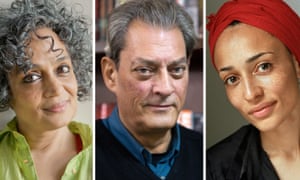
International range … longlisted authors (from left) Arundhati Roy, Paul Auster and Zadie Smith. Composite: Chandni Ghosh / Getty / Dominique Nabokov
Man Booker prize 2017 longlist led by Arundhati Roy's return to fiction
Twenty years after her first novel took the same award, The Ministry of Utmost Happiness leads a field of 13, ranging from established stars to newcomers
Alison Flood
Thu 27 July 2017
Twenty years after Arundhati Roy won the Man Booker prize for her debut novel The God of Small Things, the Indian author has been longlisted for the £50,000 award for her second, The Ministry of Utmost Happiness.
On a longlist thronged with literary titans, whose combined trophy cabinet would include the Pulitzer, the Costa, the Baileys, the Folio, the Impac and the Goldsmiths prizes, Roy – the only author to have won the Booker before – is listed for her novel about an Indian transgender woman, which judges called a “rich and vital book”. Speaking about why it took her two decades to produce a second novel, Roy told the Guardian earlier this year that “fiction just takes its time. It’s no hurry. I can’t write it faster or slower than I have; it’s like you’re a sedimentary rock that’s just gathering all these layers, and swimming around.”
The Man Booker judging panel, picking from more than 150 titles, also went for four writers who have been shortlisted for the UK’s most prestigious literary prize before but not won it. Ali Smith was chosen for the “humane, zany, delightful, optimistic” post-EU referendum novel Autumn; Zadie Smith was picked for her story of the friendship and rivalry between two London girls who meet at a dance class, Swing Time; Sebastian Barry is in the running with Days Without End, about an Irish man who migrates to the US in the lead-up to the civil war; and Mohsin Hamid for Exit West, a love story set in a world where refugees use wormholes to travel from city to city.
The Booker was opened up to US authors in 2014, with Paul Beatty the first American author to win, for The Sellout last year. This year, three of the biggest names in US letters are competing for the prize: Paul Auster with 4321, which explores one man’s four simultaneous lives and was deemed “magisterial” by the judges; George Saunders, a short-story writer whose first novel Lincoln in the Bardo follows Abraham Lincoln’s visits to the graveyard where his 11-year-old son has been laid to rest in a crypt; and Colson Whitehead for his fantastical novel The Underground Railroad, about a female slave escaping from a Georgia cotton plantation, which has already won the Pulitzer and the National Book Award for fiction in the US.
Yet another accolade ... Colson Whitehead. Photograph: Dorothy Hong/Koboy
“Obviously it has been very controversial, opening it up to the US,” said chair of judges Baroness Lola Young. “Before the Americans were included, I personally felt it did seem quite strange, to say it was for any book written in English from the UK, or the Commonwealth, and Ireland, and Zimbabwe – it was a slightly odd configuration. So [including America] seemed like a logical step and I don’t think readers, writers and publishers should feel too nervous.” This year, added Young, around a third of submissions were by American writers – slightly down on last year.
Saunders, Whitehead and Auster will be competing with two new names: 29-year-old Fiona Mozley, from the UK, and 38-year-old American Emily Fridlund, both picked for their debut novels, Elmet and History of Wolves respectively. They are joined by the Impac Dublin award-winning author Jon McGregor and his novel Reservoir 13, about the life of a Peak District village after a 13-year-old girl goes missing on holiday, and Kamila Shamsie’s Home Fire, a modern retelling of Sophocles’s tragedyAntigone that opens in an interrogation room in Heathrow airport.
The longlist is completed with Irish writer Mike McCormack’s Solar Bones, a single-sentence novel that won him the Goldsmiths prize last year. First published in 2016 by tiny Irish publisher Tramp Press, McCormack’s novel was ineligible for last year’s Booker because Tramp is not based in the UK. After being picked up by Canongate, Solar Bones was made eligible for the award.
With a split of four UK, four US, two Irish, two UK-Pakistani and one Indian writer; seven men to six women; three debuts; and three novels from independent presses, chair of judges Baroness Lola Young insisted that only when the judges surveyed the 13 remaining contenders that they realised the diversity of their list.
“The longlist showcases a diverse spectrum – not only of voices and literary styles but of protagonists too, in their culture, age and gender. Nevertheless we found there was a spirit common to all these novels: though their subject matter might be turbulent, their power and range were life-affirming – a tonic for our times,” said Young. “Together their authors – both recognised and new – explore an array of literary forms and techniques, from those working in a traditional vein to those who aim to move the walls of fiction.”
With 144 novels submitted for the prize, and 10 books called in by the judges, the selection of Young and her fellow judges literary critic Lila Azam Zanganeh, author Sarah Hall, artist Tom Phillips and travel writer Colin Thubron overlooked new novels by names including former Booker winners Salman Rushdie and Roddy Doyle.
“It’s always a struggle [rejecting titles] because one is very aware of the energy and commitment it takes to produce something. You have to bear that in mind,” said Young. “Having said that, I wouldn’t say we found it incredibly difficult, in terms of having lots of arguments – there was a fair amount of consensus.”
Young and her fellow judges will now reread the longlist of 13 titles to come up with a shortlist of six, which will be announced on 13 September. The winner will be unveiled on 17 October, to join a roster of winners dating back to 1969, including Hilary Mantel, Iris Murdoch and Ian McEwan. Last year’s winner, The Sellout, has now sold more than 360,000 physical copies, with sales in the week after the prize announcement jumping by 658%.