Diane von Furstenberg Tells the Story Behind Her Iconic Andy Warhol Paintings
Diane con Furstenberg 6 August 2026
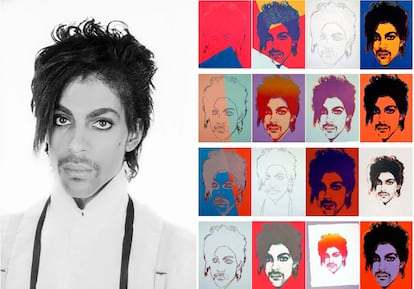
Happy Birthday, Andy! Today marks what would have been 98 years of Interview renowned founder. To celebrate, one of Warhol’s closest friends and muse, Dian von Furstenberg,wrote him a birthday note reminiscing on the fateful night these Polaroids were captured and how they went on to become some of the most well-known works in Warhol’s oeuvre. The following letter provides a snapshot of the artist at work, as well as a taste of the bustling social scene of ’70s New York City. More of Warhol’s Polaroids are currently on display as part of the Andy Warhol Family Album exhibition at the Whitney Museum running now through October 19. —BRENDAN KENNEDY
Valentino with Marisa Berenson at the opening of his boutique in Paris.
When Valentino Garavani Took Andy Warhol Shopping on Fifth Avenue
By Andy Warhol and Bob Colacello
January 20, 2026
For our December 1975 issue, Valentino Garavani spent the day with Andy Warhol and Bob Colacello to ring in the opening of his boutique on Fifth Avenue. Between playing dress-up and spontaneous encounters with legends like Liza Minelli, Shirley Goldfarb, and Marisa Berenson, it was a day of culture, opulence, and gossip on Billionaire’s Row. Following the announcement of Valentino’s passing this week at the age of 93, we took a dip into the Interview archives to bring this iconic conversation between two titans of art and fashion to light.
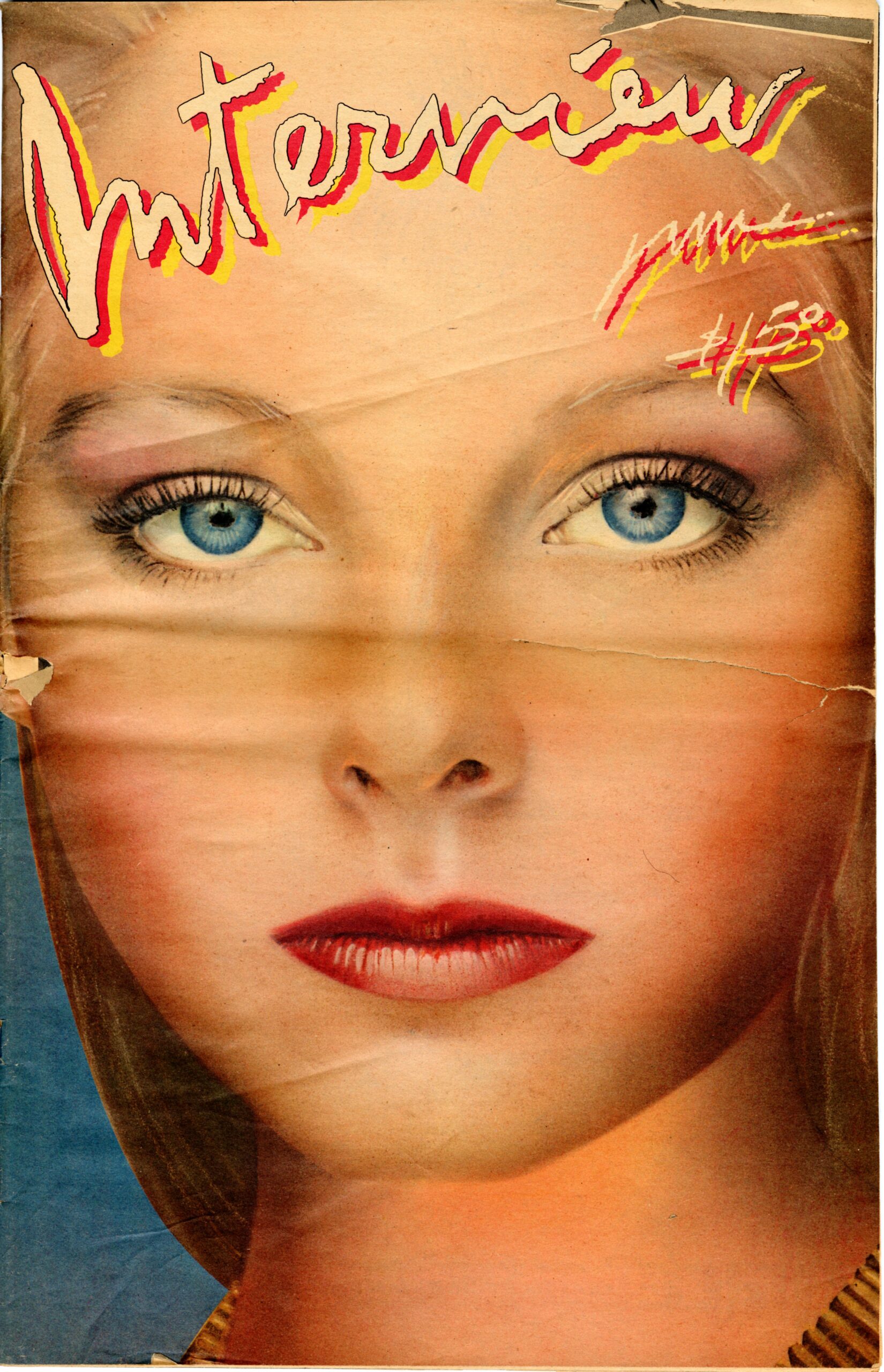
Jodie Foster on the cover of June 1980 issue of Interview.
A Young Jodie Foster Visits Andy Warhol at The Factory
By Andy Warhol
Photographed by Bob Kiss
February 27, 2024
After the twisted ending of Issa Lopez’s True Detective: Night Country, we decided to recirculate a conversation between Andy Warhol and the show’s star, Jodie Foster, who skillfully embodied the energy of a moody and complex female anti-hero, alongside her costar Kali Reis. Today, we revisit the June 1980 issue, in which a teenage Jodie Foster, just before her senior prom, joined Warhol at The Factory to discuss her burgeoning stardom and college acceptances, all while managing to dodge questions about her romantic life with humor and poise.
Top 21 Most Expensive Paintings Ever Sold (2025 Updated)
Paying enormous sums for a painting might seem silly to a commoner, but it’s a serious hobby for many rich people and art enthusiasts! Classic artworks by world-famous painters like Da Vinci, Monet, Rembrandt, and Picasso are usually stored securely in museums.
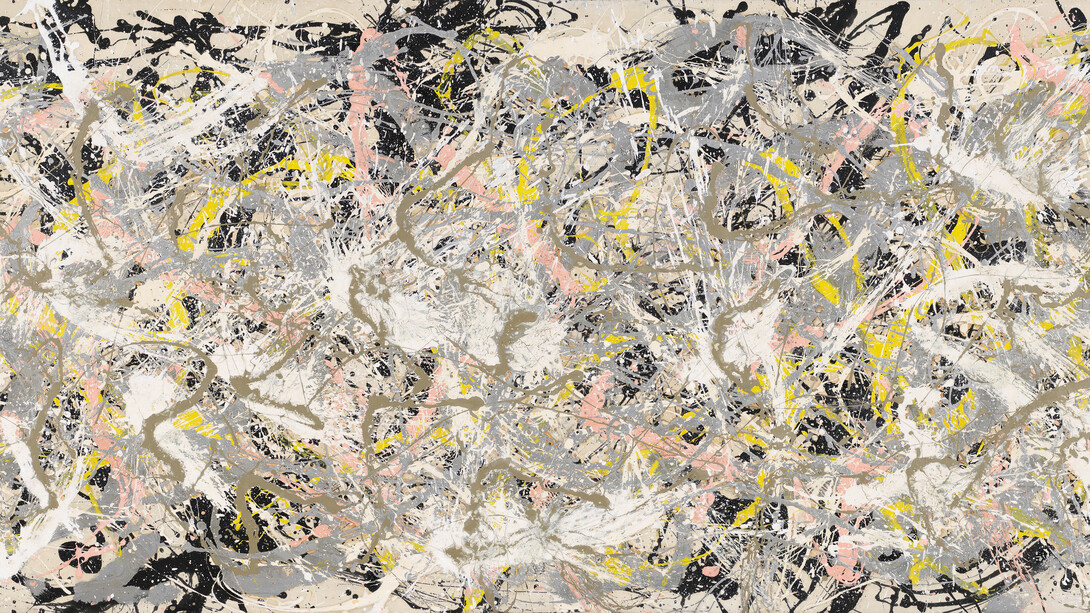
Jackson Pollock, Number 27 (detail), 1950. Courtesy of Museo Nacional Thyssen-Bornemisza
Warhol, Pollock and other American spaces
21 Oct 2025 — 25 Jan 2026 at the Museo Thyssen-Bornemisza in Madrid, Spain
24 OCTOBER 2025
The Museo Nacional Thyssen-Bornemisza is organising an exhibition that brings together the work of Andy Warhol and Jackson Pollock, two key figures in 20th-century art who focused on issues relating to new spatial strategies. Like other artists of that generation also present in the exhibition, they were united by their interest in changes in the pictorial tradition, spatiality and, in some cases, the use of large formats.
The works featured in the exhibition reveal how Jackson Pollock (1912–1956) was not always an “abstract master”, while also presenting a more complex Andy Warhol (1928–1987) than the artist of dispassionately depicted, banal themes from popular culture. Midway between the abstract and the figurative, in their own way both set out to reassess the concept of space and its use as a place of concealment; a space revisited through repetition and seriality. Pollock and Warhol disrupted the notion of background and figure and developed a project which, through its very pictorial strategies, had something of camouflage about it. Frequently present in the works of both artists are traces and vestiges that refer to certain autobiographical aspects.
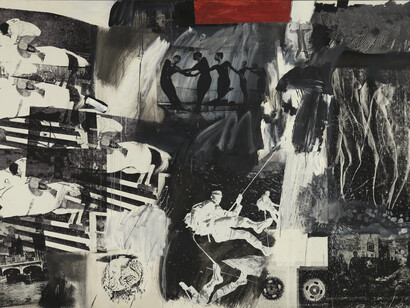
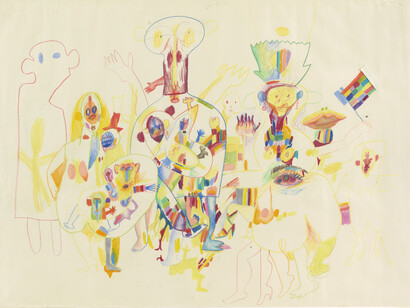
The exhibition, which has benefited from the collaboration of the Comunidad de Madrid and the Department of Culture, Tourism and Sports of the City Council of Madrid, features more than one hundred works, many of which have never previously been seen in Spain. Loaned from around thirty institutions in the United States and Europe, they include works by Warhol and Pollock as well as other artists such as Lee Krasner, Helen Frankenthaler, Marisol Escobar, Sol LeWitt and Cy Twombly. Among them, Brown and silver I by Pollock, Express by Robert Rauschenberg and Untitled (Green on maroon) by Mark Rothko are all from the Thyssen collection.
Robert Rauschenberg, Express (detail), 1963. Courtesy of Museo Nacional Thyssen-Bornemisza
Marisol, Untitled, 1960. Courtesy of Museo Nacional Thyssen-Bornemisza
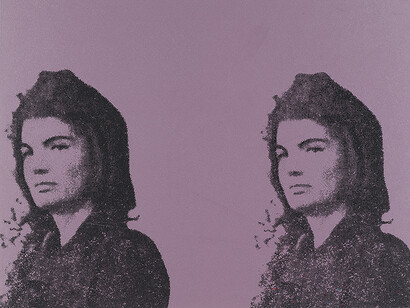
Andy Warhol, Jackie II (sheet 5 in: 11 Pop Artists II), 1966. Courtesy of Museo Nacional Thyssen-Bornemisza
Over its 258-year history, Hennessy has pioneered and elevated the art of cognac, a spirit fit for kings and queens. Interview hasn’t been around quite as long – just 54 years – but we like to think we, too, have curated conversations and photography that aspire to a similar level of elegance and sophistication. In honor of Hennessy’s storied Paradis marque, we poured through the Interview archives to recirculate conversations with personalities, entertainers, and icons who personify the brand’s spirit of refinement, grandeur, and artistry. Today, we revisit the June 1980 issue, in which a then-teenage Jodie Foster sat down with our founder Andy Warhol to discuss superstardom and going to college.
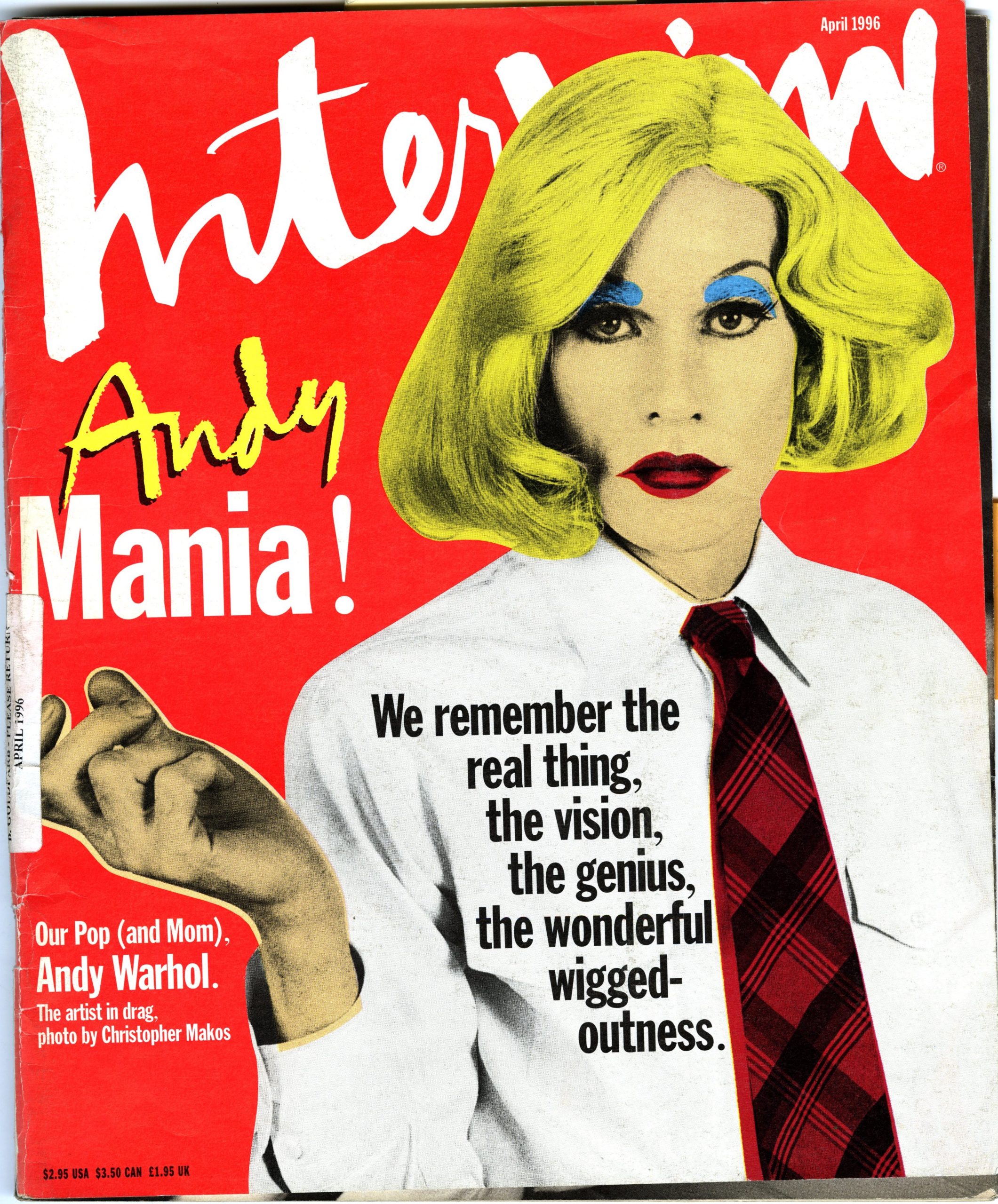
Welcome to Life Lessons. This week, we’re marking what would have been the 93rd birthday of our founder Andy Warhol with a journey into the archives. In our special April 1996 issue (aptly titled Andy Mania!), a few icons paid homage to our “wigged-out” patron saint in words and images. Among them are the likes of Richard Pandiscio, Candy Darling, Mary Harron, and our legendary former Editor-in-Chief Ingrid Sischy—whose most memorable reflections are found below. So sit down and grab a pen—you just might learn a thing or two.
Peter Beard and Lee Radziwill’s long-lost footage inserts Big and Little Edie into a wider cultural narrative about late 70s NYC.
Hannah Ongley 21 May, 2018
Grey Gardens superfans — in 2018, there are still many — tend to hold two theories about why Big and Little Edie Bouvier Beale are so eternally captivating. The eccentric former socialites’ story can be read as tragic, or triumphant, or both. Did the Beales shun society or did society shun them? Debating this requires you to look outside the crumbling walls of their Hamptons mansion, and towards an overlooked surrounding cast of characters. (Little Edie rejected marriages from both J. Paul Getty and Joe. Kennedy Jnr.)
A new, long-lost prequel to Grey Gardens now opens the circle up even wider, providing fascinating context to the iconic mother-daughter duo’s story, and introducing new narratives that are equally riveting. That Summer is a trove of fully restored archival footage previously believed to have been lost, shot a few years before Albert and David Maysles started filming Grey Gardens. The new documentary was commissioned by artist Peter Beard alongside Lee Radziwill, the glamorous younger sister of Jacqueline Kennedy Onassis, who originally hired the Mayles brothers to work on the now-iconic film about her reclusive relatives.
That Summer showcases a motley crew of creatives who shaped 70s NYC culture, from Radziwill and Beard to Andy Warhol and Bianca Jagger. (Warhol lent his own archival footage to the project.) The result blends the dilapidation of Grey Gardens with the glitter of Studio 54, blending the New Yorks into a languid summer dreamscape: encompassing glamor and dilapidation, nostalgia and foresight, ephemerality and eternal life. Peppering the archival footage and interviews are newly shot scenes of Beard creating a collage, blending scenes of Africa with 70s time capsules of Donyale outstretched on a rock. It’s a fitting metaphor for That Summer’s cinematic mélange of disparate communities. “At the time,” explains director Göran Hugo Olsson, “New York was far from paradise, with the drugs and all that, but to me, it was a dream that we should all be striving towards: tolerance and acceptance.”
How familiar were you with the original Grey Gardens documentary?Göran Hugo Olsson: I was familiar with it, and fascinated by it, like most other people I know. I viewed the film two times before making That Summer, to make sure that we could add something to it. I haven’t seen it since I made this film. I kind of disappeared every day, six hours a day, for a couple of years [laughs].
A incredible number of celebrities show up in the film, including Bianca Jagger, model Donyale, and Andy Warhol. It’s almost the Studio 54 of Long Island.The first time I became aware of the Beales was through a book by Andy Warhol. I actually think I became aware of Peter Beard though Andy Warhol, come to think of it.
Which book of Warhol’s was it?I think it was America, which has both Peter and the Beales in it.
LEE RADZIWILL, COURTESY JONAS MEKAS
You say the original footage was supposed to document the barometer of change in 70s East Hampton. Did you ever live in Montauk or the Hamptons yourself?No, not at all! I live in Stockholm, Sweden. The reason why I made the film, or was asked to come up with ideas of how to make the material into film, is that I was so into New York in the late 70s when I was a very young teenager. I was totally fascinated by the world around New York and Studio 54 and Warhol. At the end of the 70s I was very politically active in supporting the struggle against apartheid in South Africa. I remember biking from an ANC (African National Congress) meeting to the public library to read Interview magazine. It was a dream world for me. In South Africa, to be able to explore yourself and express yourself, that was a dream.
Obviously politics forms a facet of this documentary because of the Kennedy tie-in. But was politics a reason you became interested in the story?I think, not only me, but the entire team, we tried to make a film that exposes social or economic injustice. The film was about film itself. And I don’t see the difference between a political struggle and a struggle to present art as art. I was a hardcore leftist but I never saw any problems in loving mainstream pop stars.
Why do you think we are still so infatuated by Big and Little Edie today?The story or situation is about how you’re supposed to behave like a woman. They’re protected by their class or privilege up to a certain level. But when they break that level, their community or their surrounding world cracks down on them harder. I’m sure that if they were two eccentric professors in American literature, people would regard them more highly.
EDITH BOUVIER BEALE, COURTESY OF PETER BEARD
At one point, Big Edie says that “bringing up the past is the most awful thing you can do.” What do you think about that sentiment in the context of making this documentary?First, I think she’s right, and she saw it at that time. I kept that scene because I wanted to show that she was aware of what was going on, and how this could be perceived by others. We all should identify with that. It’s a key line.
What did you know of the Beales’s showbiz ambitions? The way Little Edie moves and speaks is so wonderfully theatrical.I think they both wanted to pursue singing careers. It was singing, drama, and music. Little Edie went to Harvard. I don’t know what she studied there. But in those days, it didn’t matter so much what you studied. It was a different system at that time.
At one point they’re talking about Lee’s father to a Hamptons local, who says he can’t tell any stories because they’re all too risqué. Did you get to hear any of them?I think the stories wouldn’t [be appropriate for] the time of the #MeToo movement! But it was a different time. He had a lot of stories! But when he was around, that was almost 100 years ago. What do you know? He was a character. What I heard was hearsay. What I do know, more than anyone because I’ve seen the footage so many times, and have been able to process it… we can all identify with having a family history which has to be re-written from time to time. 100 years ago, rich people didn’t pay much respect to women, even less than they do maybe today.
Little Edie applying makeup to never leave the house feels strangely modern. She’s not trying to impress men, but as she says at one point, she’s always looking for either her eyeliner or her pants.It’s very refreshing to hear Peter Beard talk about them. He said they were in a time capsule, and they were in a dream world, and it was okay. One of the things we wanted to communicate is that there was a tolerance at this particular time, in New York in the 70s, and I think we should all strive to be more tolerant. That was a key thing for Peter.
The scene where Big Edie is lying on the sofa surrounded by cake and ice-cream reminded me of Marie Antoinette .We all have that indulgent side, and they explore that side, and are unapologetic about it. It makes you really like them.
Hervé Gloaguen, 'Andy Warhol at the Factory,' NY 1966, 40 x 50 cm, C-print on argentic paper. Courtesy Galerie Arcturus and the artist
Andy Warhol in the Gaze of a 60s French Photographer
Full of bad haircuts, perfectly posed group shots, and unsentimental romanticism.
November 12, 2016
When Hervé Gloaguen arrived in New York City as a young Parisian photographer, he landed at the center of Andy Warhol’s inner circle, camera in hand. Gloaguen was in the US on assignment for popular French magazine Réalités, and his photos from 1965–1971 capture Warhol, his scene, and his city with endearing naiveté. Half a century after Gloaguen documented Warhol’s world, New York au Temps d’Andy Warhol puts the portraits on display once again at Galerie Arcturus, as part of the fifth-annual Photo Saint-Germain festival in Paris.
Gloaguen, unlike his star-struck contemporaries, dismantles Warhol’s invulnerability, producing photographs not of a celebrity, but of a friend. The images, like his metropolitan landscapes and portraits of other artists—take a young Yayoi Kusama and her clique, for example—are fun and indulgent. Full of bad haircuts, perfectly posed group shots, and unsentimental romanticism, the photos are nostalgia at its best.
Let Gloaguen’s portraits of 1960s New York wash away the woes of 2016, below:
Hervé Gloaguen, Saint Mark’s place, near the Dom (Third from the right is the artist Yayoi Kusama), NY 1967, 40 x 50 cm,Gelatin silver print on Baryta paper
Hervé Gloaguen, 'Andy Warhol with silver balloons at the roof of Chelsea Hotel,' NY 1966, 40 x 50 cm, C-print on argentic paper
Hervé Gloaguen, 'Skating in Central Park,' NY 1966, 40 x 50 cm, Gelatin silver print on Baryta paper, courtesy of Galerie Arcturus and the artist.
Hervé Gloaguen, 'Andy Warhol and Shirley Temple,' NY 1966, 50 x 40 cm, Gelatin silver print on Baryta paper
Hervé Gloaguen, 14th Street, NY 1967, 60 x 80 cm , C-print on argentic paper, courtesy of Galerie Arcturus and the artist
Jean-Michel Basquiat and Andy Warhol outside the Mary Boone Gallery, New York, 3 May 1984.
Photograph: The Andy Warhol Foundation
Andy Warhol's friendship with Jean-Michel Basquiat revealed in 400 unseen photos
Book offers ‘voyeuristic glimpse’ into the two artists’ lives with hundreds of Warhol’s images and diary entries
Dalya Alberge
Monday 20 May 2019
A“voyeuristic” glimpse into the world of two of the late 20th century’s greatest artists is to be revealed in a book that finally brings to light some of the 130,000 photographs that Andy Warholtook to document every aspect of his life.
More than 32 years after Warhol’s death, hundreds of his photographs are set to reveal the minutiae of his friendship with fellow artist Jean-Michel Basquiat, capturing many moments together – whether partying, getting their nails painted, or even, for Basquiat, while in the depths of depression facing suicidal thoughts.
Earlier this month, The New York Timesannounced that Graceland, Elvis Presley's estate that opened to the public in 1982, will establish a second location in Las Vegas. The announcement will be made official later this month, though the opening of this museum—set to include an exhibition space and live performances—is long overdue. Having played 837 performances in Sin City, there are few places more crucial to Elvis' career.
This week, we highlight an interview with his ex-wife, Priscilla Presley, from our December 1979 issue. Priscilla had been with Elvis since she was 14, and although she left him before his death in 1977, the actress would have known Graceland just as well as the King himself.
At the time of this conversation, Priscilla had fallen deeply in love with male model Michael Edwards. She resolved to not discuss Elvis during the interview, but it was impossible to ignore his legacy when speaking about topics like hair products, travel, and caviar.
Priscilla Presley
By Andy Warhol
Part I: Tuesday, October 16, 1979, 9:00 p.m., Quo Vadis.Andy Warhol, Bob Colacello, and actress/fashion-plate Janet Villella are dining with Priscilla Presley and her steady beau, Michael Edwards, a major male model. Priscilla, the ex-wife of the greatest legend in the history of rock-'n'-roll, is in town to promote Wella hair products, for which she has just become their million-dollar-a-year "spokesperson." She has let it be known in advance (through PR people) that the purpose of this interview is not to talk about Elvis. But whatever tension and restriction that has created is soon gone as Priscilla begins to speak in a voice as beautiful as her face.