One of the many reasons “Prometheus” was eagerly anticipated by so many was the director’s track record in the sci-fi genre. Ridley Scott had only made two science fiction pictures before this year’s blockbuster, and both are considered classics (and arguably his best two films). The first was 1979’s “Alien,” the direct inspiration for “Prometheus.” And the second? 1982’s “Blade Runner,” the noirish mystery adaptation of Philip K. Dick‘s novel “Do Androids Dream Of Electric Sheep,” which has been one of the most talked about and influential science fiction films of all time, particularly in terms of its grim look at Los Angeles in 2019.
The film, which follows Harrison Ford‘s “blade runner” Deckard as he’s tasked with tracking down four murderous “replicants” (life-like robots) who’ve escaped from an off-world colony and are hiding out on Earth, wasn’t a success when it first arrived, partly thanks to the tumultuous, compromised release, but the cult behind the picture has grown and grown over the years. And coincidentally, just as he gears up to work on the script with original scribe Hampton Fancher, we’ve hit the 30th anniversary of the film, which was released on June 25, 1982. To mark the occasion, we’ve pulled together five nuggets of information that you may not be aware of about Scott’s sci-fi classic — check them out below.
 1. “All those moments will be lost in time, like tears in rain”
We could have seen versions of the film directed by Martin Scorsese or “To Kill A Mockingbird” helmer Robert Mulligan
In another, parallel world, it’s possible that we might not know Martin Scorsese as a man who made his name with the gangster movie, but as a science fiction pioneer who reinvented the genre before “Alien” or “Star Wars” came along. According to Paul Sammon‘s seminal making-of book “Future Noir,” Scorsese and screenwriter friend Jay Cocks (who would go on to co-write “Gangs Of New York” and the “Blade Runner“-like “Strange Days“) met with Philip K. Dick in 1969, two years after Marty’s feature debut “Who’s That Knocking At My Door?” and a year after the publication of Dick’s “Do Androids Dream Of Electric Sheep?,” to talk turning the novel into a film. Discussions proved fruitful, but the book went into development elsewhere: producer Herb Jaffe (“Fright Night“) optioned it in the 1970s, and got his son Robert (“Demon Seed“) to write a script, one that Dick hated so much that he joked about beating up the screenwriter. But it was writer Hampton Fancher and producer Michael Deeley who were the ones to get over most of the hurdles, although the first director attached wasn’t Ridley Scott, but was in fact Robert Mulligan (“To Kill A Mockingbird,” “Same Time Next Year“). The veteran helmer worked with Fancher on a script for three months, before becoming frustrated and quitting. Michael Apted, Bruce Beresford and Adrian Lyne were all considered to replace him before Scott, who’d been approached early on, became free, frustrated with slow progress on his version of “Dune,” and unable to get a green light on the historical epic “Tristan & Isolde.”
 2. “More human than human is our motto”
A version of the film starring Dustin Hoffman, Barbara Hershey, Debbie Harry, Sterling Hayden and Joe Pantoliano? It might have happened.
When Fancher was writing his script, he envisioned it as a noirish tale with Robert Mitchum playing Deckard, and Sterling Hayden (who, as it turned out, made his last film with 1981’s “Venom“), but their age ultimately made this an unrealistic proposition. For Deckard, Scott spent months negotiating with Dustin Hoffman, but he the two couldn’t come to agreement on their approach for the character, so Hoffman left for new pastures (“Tootsie“). Beyond that, an extensive list of leading men were considered — “Future Noir” reveals that Tommy Lee Jones, Gene Hackman, Sean Connery, Jack Nicholson, Paul Newman, Clint Eastwood, Arnold Schwarzenegger, Al Pacino, Burt Reynolds, William Devane, Raul Julia, Scott Glenn, Frederic Forrest, Robert Duvall, Judd Hirsch, Cliff Gorman, Peter Falk and Nick Nolte were all possibilities, but it was early word on “Raiders Of The Lost Ark” that persuaded Scott that Harrison Ford was the best choice (actor Morgan Paull, who read the role of Deckard in screen tests, impressed Scott enough that he was cast as ill-fated blade runner Holden in the opening scenes).
Still, Scott might have come to regret the choice, as the two clashed on set. Scott was still nervous with actors, and left Ford out to dry a little, the actor later saying, in Tom Shone‘s “Blockbuster,” “There was nothing for me to do but stand around and give some vain attempt to give some focus to Ridley’s sets.” In producer Alan Ladd Jr’s words, “Harrison wouldn’t speak to Ridley and Ridley wouldn’t speak to Harrison and I was stuck in the middle, ‘Could you tell him to do this, or tell him to do that?’ It was difficult.” Scott acknowledged later, “Harrison and I are very similar. It can be perceived that we’re bad tempered and crotchety and actually we’re not. We’re actually relatively good fun, [but] if you have a discerning actor, who is smarter than most, he’s gonna ask questions, and you’d better have your answers. If you haven’t got your answers there’s likely to be a row. You have a row and your adrenaline flushes out all the other stuff you’ve got going through your mind and you suddenly come up with a very distilled answer…rage flushes it out. I get very articulate.” But the two have subsequently made up, with Ford contributing to interviews for the 2007 release of the Final Cut.
 Meanwhile, Dick had suggested “Dallas” star Victoria Principal to play Rachael, and was thankfully ignored, and testing came down to three contenders — Nina Axelrod (who can be seen on the “Dangerous Days” documentary on the Final Cut release, and went on to become a casting director), Barbara Hershey, and Sean Young. The latter got the part, but Hershey made her mark: the story of a spider being devoured by its young that Rachael tells was her suggestion. Rutger Hauer was always Scott’s first choice, thanks to his work with Paul Verhoeven, and the director was clearly a particular fan of the Dutch helmer’s 1973 picture “Turkish Delight,” as he wanted to cast Hauer’s co-star in that film, Monique van de Ven, as fellow replicant Pris, but she had a scheduling conflict. Blondie frontwoman Debbie Harry was discussed at one point, while Stacey Nelkin also tested for the part, before getting another role in the film (see below); her screen test is also in “Dangerous Days.” Finally, former NFLer Frank McRae (“1941,” “48 Hrs“) was cast as Leon, until Brion James freaked out Scott’s secretary to the degree that he thought he had to cast him, while future “The Matrix” star Joe Pantoliano was in the running for Sylvester.

3. “I’ve seen things you people wouldn’t believe”
The missing replicant that caused debate among fans for so long was actually a mistake, leftover from earlier drafts.
Given the substantial changes from the source material, and the many writers involved, it’s no surprise that things got a little confusing, and that’s particularly true when it comes to the fifth and sixth replicants — in all versions before the Final Cut, Bryant tells Deckard there were four on the loose, but seconds later, says that six escaped, with one killed by an “electronic gate.” The fifth was actually a character called Mary, who’d been present in many earlier drafts. Fancher’s original take was very different; the replicants are simply called “androids,” and the Voight-Kampff test can detect them after only six questions (although Rachael makes it to thirteen, rather than a hundred). At the end, Batty kills Tyrell’s entire family, as well as Sebastian, while Rachael kills herself, so Deckard doesn’t have to do it. Mary, the sixth replicant, a maternal, housewife-like character analogous to Irmgard Baty in the novel, is included in this take, and survived to Fancher’s next draft, completed on July 24th, 1980. It’s mostly closer to the finished version, although concludes with Deckard killing Rachael. The first draft by David Webb Peoples (dated December 15th, 1980), broke away a little; it opens with Batty pulling Mary and Leon from an Off-world Termination Dump, and includes at least two extra Replicants; a character called Roger, who attacks Deckard in Leon’s hotel room, and Tyrell himself — Roy kills his creator, only to discover that the real Tyrell was placed in hibernation after getting a terminal disease, but passed away during a power outage a year earlier. It was also darker in the conclusion; Deckard makes Gaff take the Voight-Kampff test, and kills him, and again shoots Rachael in the finale. Mary survived until very late on; Scott cast actress Stacey Nelkin, who’d also tested for Pris, in the part, but it was excised before filming. However, the script inconsistency involving six escaped replicants went unnoticed, and was only fixed in the 2006 Final Cut version. A note on the title; Fancher’s first draft used the novel’s, before it was changed to “Dangerous Days.” The name “Blade Runner” actually came from a William S. Burroughs screenplay, an adaptation of the Alan E. Nourse novel “The Bladerunner,” which Scott got producer Michael Deeley to buy the rights to, but at the last minute, tried to change it to “Gotham City.” Understandably, “Batman” creator Bob Kane and DC Comics were reluctant to sell the rights…
 |
| Harrinson Ford and Sean Young |
4. “Too bad she won’t live. But then again, who does?”
There have been three sequel novels, as well as David Webb People’s ‘sidequel’ “Soldier,” and a video game with a narrative that runs alongside the original, with a new protagonist.
Scott is finally getting moving on a sequel for “Blade Runner,” it would seem, but he’s far from the first to try. Soon after the release of the “Director’s Cut” helped to restore the reputation of the film, sci-fi author K.W. Jeter penned a novelistic sequel, “Blade Runner 2: The Edge Of Human,” published in 1995. Sticking mostly to the continuity of the film, it involves Sarah Tyrell, the human template for Rachael, hiring Deckard to hunt down the missing sixth replicant, even as the template for Roy Batty hires Holden (the blade runner in the opening scene, shot in the chest by Leon), to track down Deckard, who he thinks is the sixth replicant. Two further sequels follow: 1996’s “Blade Runner 3: Replicant Night,” which sees Deckard on Mars working as a consultant to a movie crew making a film based on his life (seriously…), and 2000’s “Blade Runner 4: Eye And Talon,” which follows Iris, another blade runner, on a quest to find Tyrell’s owl (again, we’re not making these plots up). The 1997 video game “Blade Runner” (there was an earlier 1985 game, based, confusingly, on Vangelis‘ score, rather than the film, which involves you hunting down “replidroids”) also builds out the universe, following blade runner Ray McCoy as he tries to hunt down more escaped replicants, taking place across the same timeline as the film. Deckard doesn’t appear, but Sean Young, Brion James, James Hong, Joe Turkel and William Sanderson all reprised their roles and lent their voices to the game (although Edward James Olmos refused to return as Gaff). Writer David Webb Peoples also penned a script called “Soldier,” which he considers to be a “sidequel” to “Blade Runner,” inspired by the deleted opening scene in an Off-world Termination Dump. The script included several references to “Blade Runner,” including a mention of the Tanhauser Gate and a glimpse of a spinner, but sadly, Paul W.S. Anderson was hired to direct, and turned it into a critically-reviled picture, and a box-office disaster. Other attempts were made at a sequel, however: Stuart Hazeldine (writer of Spielberg’s upcoming Moses movie and the aborted “Paradise Lost“) penned one on spec, entitled “Blade Runner Down,” in the late 1990s, and “Eagle Eye” writer Travis Wright and former partner John Glenn, worked on a potential sequel for producer Bud Yorkin in the 00s, which was said to explore questions like, in the writer’s own words “Is or isn’t Deckard a replicant? What happens to Rachel? What are the off world colonies like? What happens to replicants once Tyrell is killed by one of his creations?” More recently, Scott, his brother Tony and son Luke were said to be developing a web series called “Purefold,” inspired by the same themes as the film, but it never seemed to come to pass. Let’s hope the sequel is more successful.
 5. “Death. Ah, well that’s a little out of my jurisdiction”
The director’s cut was discovered entirely by accident.
Budget overruns and poor test-screenings meant that Scott was overruled on several key decisions on the film as it came close to completion, most famously the ending (partially achieved with unused footage from “The Shining“) and the narration. For many years, it was thought that Scott’s original version hadn’t survived, but in 1989, Warner Bros sound preservationist Michael Arick stumbled across a rare 70mm print in the archives while looking for footage from “Gypsy.” Arick didn’t watch it, but it was sent to the Fairfax on Beverly Boulevard in L.A. the following year when they were holding a special festival of 70mm films. They were as surprised as anyone to find that they were screening a never-before-seen version of the film, and word of mouth soon led to sell-outs at additional screenings, which led Warners to plan a release. It was labelled as the “Director’s Cut,” but against the objections of Ridley Scott, who wanted to make further changes, but wasn’t given the time or budget to do so. It was only with the 2006 Final Cut that he was able to do those last alterations. It wasn’t just the film that took some time to see the light properly; Vangelis‘ score only got a proper release after the Director’s Cut in 1992, although bootlegs circulated throughout the 1980s.


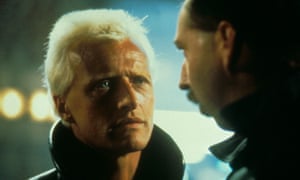 Rutger Hauer, left, with Brion James in Blade Runner.


