Showing posts with label Harvey Weinstein. Show all posts

Thursday, March 12, 2020

Harvey Weinstein / Rape and the City


Harvey Weinstein
RAPE AND THE CITY


Harvey Weinstein sentenced to 23 years in prison on rape conviction


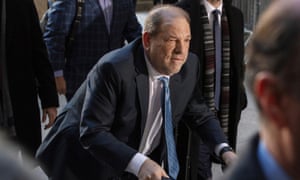
Harvey Weinstein was found guilty of raping a woman as well as forcing oral sex on a production assistant. Photograph: Lucas Jackson/Reuters


Harvey Weinstein sentenced to 23 years in prison on rape conviction

New York judge imposed 20 years for a first-degree criminal sex act and three years for third-degree rape, to run consecutively

Lauren Aratani and Ed Pilkington in New York
Wed 11 Mar 2020 15.37 GMT

Harvey Weinstein, the titan of Hollywood turned convicted rapist, has been sentenced to 23 years in prison today in New York.


The fallen mogul was handed down his punishment by Judge James Burke at the New York supreme court having been convicted of two counts of sexual assault. The judge imposed 20 years for a first-degree criminal sex act for forcing oral sex on a production assistant, Miriam Haley, in 2006.

Jennifer Aniston 'should be killed': Weinstein's rage laid bare in unsealed court documents


Jennifer Aniston

Jennifer Aniston 'should be killed': Weinstein's rage laid bare in unsealed court documents

The film producer also attempted to get support from Jeff Bezos and Tim Cook when he feared losing his job

Andrew Pulver
Wed 11 March 2020

Jennifer Aniston
Unsealed court papers have revealed that disgraced film producer Harvey Weinstein said that Jennifer Aniston “should be killed”. They also say he attempted to get help from billionaires Jeff Bezos and Michael Bloomberg to avoid being fired by the Weinstein Company.
Following Weinstein’s conviction for rape in the third degree and a criminal sex act in February, the New York City criminal courthouse has made public around a thousand pages of documents collected for Weinstein’s case. According to Variety, Weinstein was contacted in October 2017 by a reporter from the National Enquirer over a story that the magazine was planning to publish that alleged Aniston had claimed Weinstein had sexually assaulted her. Weinstein responded by email: “Jen Aniston should be killed.” Aniston’s representative has since told Variety that the Enquirer’s claims were false: “Jennifer has not been harassed or assaulted by Harvey.”

Sunday, February 3, 2019

John Malkovich to star in David Mamet play inspired by Harvey Weinstein

John Malkovich


John Malkovich to star in David Mamet play inspired by Harvey Weinstein

Bitter Wheat – ‘a black farce about a badly behaved movie mogul’ – to open at the Garrick theatre, London, on 7 June

Chris Wiegan
Tue 29 Jan 2019


John Malkovich is to star in a “farce” inspired by the Harvey Weinsteinscandal and written by David Mamet. The play, Bitter Wheat, will have its world premiere in London this summer.
Speaking on BBC Radio 4’s Today programme on Tuesday, Malkovich described the play as “a black farce about a very badly behaved movie mogul”. The actor said “a lot of people may not like” the play but that he felt it was “a terrific piece of writing”. Asked how comedy could be used to respond to the serious nature of the scandal – which includes allegations of rape, harassment and sexual assault, all of which Weinstein has denied – Malkovich said: “A lot of great plays elicit the question: do I laugh or do I cry? I think a lot of great comedy exists at the crossroads between pain and farce.”
In promotional material, Malkovich’s character, Barney Fein, is described as “a bloated monster – a studio head who, like his predecessor, the minotaur, devours the young he has lured into his cave”. Bitter Wheat is “written and directed by David Mamet in a good mood” and “rips the pashmina off the suppurating wound which is show business, and leaves us better human beings, and fitter to once more confront the horror of life”.
Malkovich, who worked with Weinstein on the film Rounders, said: “They say everyone in Hollywood knew [about Weinstein’s alleged behaviour] … That’s not true. It was never a topic of conversation any time the name Harvey Weinstein came around with me.”
Asked if Barney Fein is supposed to directly represent Weinstein, Malkovich said: “No, it’s not particularly Harvey Weinstein. It’s a great deal about that business and a great deal about about how people in that business in positions, say, as studio heads have behaved really for more or less a century now. If the idea maybe started as a reaction to all the news that came out in particular about Harvey Weinstein, I think David took the idea from there and went with it.”
Bitter Wheat is Mamet’s first new play since China Doll, which opened on Broadway in 2015 and starred Al Pacino. Malkovich will be joined on stage by Doon Mackichan, who will play Fein’s assistant, Sondra, and by Ioanna Kimbook in her debut theatre performance. The rest of the cast for the production, which Mamet will direct himself, has not yet been announced. The play will be at the Garrick theatre, London, from 7 June to 14 September.
Next month, Steven Berkoff will direct himself in Harvey, a one-man show he has written about Weinstein, at the Playground theatre, London.


Saturday, March 3, 2018

They know him as God, but you can call him Harvey Weinstein

Harvey Weinstein
by Kate Salley Palmer

They know him as God, but you can call him Harvey Weinstein


A living Hollywood legend is bouncing back from his troubles towards the Oscars, with an enhanced reputation for good taste

Thu 23 Feb 2018


O
n Sunday, one man's name will be invoked in Oscar acceptance speeches even more frequently than mom, America and the Almighty. Or at least, one of his monikers will be. At last month's Golden Globes, Meryl Streep referred to him as "God"; Madonna as "the punisher". For Thomas Langmann, the French producer of The Artist, he was simply "le boss".

Harvey Weinstein's producer credit on films such as The Iron Lady, My Week with Marilyn, and W.E. has earned him his 303rd Oscar nomination. Surely it's only a matter of time before the academy fires up the foundry and remodels the award itself in his generous image.
Forget an honorary gong – and word is Weinstein wouldn't mind an Irving G Thalberg memorial award, handed out periodically by the academy to outstanding producers – this would be the only truly fitting tribute.
Weinstein's top attack dog this year, with 10 Oscar nominations (and good odds on converting most of them to wins) is The Artist. A fan of French director Michel Hazanavicius's niche spy spoofs, Weinstein saw the film at a private screening in Paris last spring, then forked out for international distribution rights two days before its May premiere at Cannes. It went on to win best actor at that festival, and has hoovered up praise ever since; voracious, ferocious, unstoppable – a little like its master.
Its appeal is obvious for Weinstein whose involvement in a movie can range from buying the rights and masterminding release to overseeing the project from near inception. The Artist, an ode to the glory days of cinema, is smart enough to tickle academy voters and charming enough to woo punters. It also presents an irresistible challenge: the man who could secure a best picture Oscar for a silent black-and-white French film with no real stars is, surely, a man capable of anything.
Plus, the film's plot presents potent personal parallels. Three years ago, Weinstein was looking as washed up as George Valentin, The Artist's dashing hero flailing at the advent of the talkies.

For decades, he had been a living legend, one of the few producers with face as well as name recognition. In 1979 he and his younger brother, Bob, had dropped out of college and set up a distribution company in a one-bedroom Manhattan apartment, which eventually morphed into Miramax (named after their parents, Miriam and Max).
A decade in, they bought the rights to the Steven Soderbergh Sundance winner Sex, Lies and Videotape for $1m, and it took 20 times that. Weinstein discovered a gift for repackaging classy, yet cheap, European fare for the US market, scoring big with Cinema Paradiso, My Left Foot, The Crying Game, the Three Colours trilogy and The English Patient.
In 1993 Miramax was taken over by Disney for $60m. Initially, they were happy bedfellows. Profits rose from £5m to £75m in four years. Weinstein's short fuse (now ascribed to glucose overdose on account of a fondness for M&Ms) was indulged and found to be colourful, marketable even. He told the New York Observer he was "the fucking sheriff of this fucking lawless piece-of-shit town". To some extent, he was right.

His closeness to talent – he holidayed with Gwyneth Paltrow and Bill Clinton – wasn't just unctuousness. In March 2002, he reportedly took issue with director Julie Taymor's positive assessment of a test screening of her film, Frida. "You are the most arrogant person I have ever met," he apparently yelled. "Go market the fucking film yourself!" He then told Taymor's partner to "defend your wife, so I can beat the shit out of you", and fired half a dozen staff.
Such chutzpah went down less well once things started going awry. A venture into publishing, with Talk magazine, ended scrappily, ditto an experiment in the fashion market. Yet he remained defiant. Asked at the time if he was frightened, Weinstein said: "Yes, I am very frightened. I'm frightened I am going to have a better year than last."
Weinstein's health suffered; then in 2004, he separated from his wife of 17 years, Eve. The following year the brothers divorced from Disney to go it alone again, after an escalating conflict with Michael Eisner, then Disney's CEO-

But the Weinstein Company did not hit the ground running. "I think I took my eye off the ball," Weinstein has admitted. "I was out of it. I thought I could oversee movies and have it done for me."
The brothers bought too many titles, too fast – 70 between 2006 and 2009 – and few paid dividends. "Harvey felt if he sat out he would lose his edge," according to one unnamed former Miramax executive. "Well, the first movie was Derailed, with Jennifer Aniston and Clive Owen, which was pretty bad. Us Jews are superstitious. This was just bad karma."
Then the recession kicked in. "Bob and I had never done debt," Weinstein said. "The investment bankers would say to us, 'Debt is cheap money.' No, it's not. Debt can be the most addictive thing in the universe, and it can kill you. You get used to living high off the hog."
A best actress Oscar for Kate Winslet in 2008 for The Reader helped regain cash and composure. In 2009, they had a major success with Quentin Tarantino whose career they'd championed years before. Inglourious Basterds clocked up $321m worldwide, coffers swelled further in 2010 with The King's Speech ($414m worldwide, four key Oscars).
"You don't hear the horrific Harvey stories you used to," says Peter Biskind, whose book Down and Dirty Pictures traced Weinstein's story through to the Disney split. "He seems to be regaining his normal stature as a master at manipulating the academy audience.
"My guess is he's been a little bit chastened, that his experience post-Disney was a real struggle. He lost weight, he got a new wife. It might be an exaggeration to say he's a new Harvey but he went through some difficult times and I think it made an impression on him."
Everybody, including Oscar voters, loves a narrative arc of hubris and redemption. These days, Weinstein peppers his press with the word "blessed". "I didn't appreciate it in the first go-round, and boy do I appreciate it now."
How much salt should be swallowed with this? Murkier subplots certainly bubble; offstage whispers suggest ominous undercurrents (Weinstein is a man people are strikingly reluctant to discuss, even off the record). "He's still perceived as an absolute nightmare," says one industry insider. "He buys movies, changes them, buries them, fucks over young filmmakers, gets furious when he doesn't get the mention in the acceptance speech."
Even long-term cheerleaders, such as the British producer Stephen Woolley, seem sceptical about the scale of his overhaul. "He hasn't changed much. But it's the condition of the job; you have to have somebody who's fairly Machiavellian to compete against the studios."

Grisly litigation suits continue; most recently an ugly spat, settled last week, with Michael Moore over profits from Fahrenheit 9/11. Some of the talent Weinstein once fed has bitten back. Ten years ago, Clerks director Kevin Smith said of the brothers: "Those dudes have been my role models. Without Harvey and Bob, there's no Pulp Fiction. Quentin is still working in a video store."
These days, Smith trashes his former mentors, although Woolley ascribes much of this sort of behaviour to sour grapes. "Harvey is somebody everybody loves when they're releasing your films, and somebody they feel bitter about if they're not."
But the more pressing headache is financial. Last week, the Weinstein Company applied for a $150m (£95m) loan to – amongst other ventures – help settle debts. Earlier this week they announced a potentially lucrative partnership with Netflix, which might help address the home entertainment haemorrhage. Steven Gaydos, of Variety, says: "The victory that eludes [Harvey] is how to produce and release speciality films in the post-DVD revenue bonanza world in a way that creates stable sustainable profitability. That's the real gold."
And while The Artist is set to repeat the trick of The King's Speech in terms of an Oscars sweep, it has failed to set tills ringing to the same tune. At this stage last year, The King's Speech had made $114m in the US. The Artist has so far taken $28m.
The more wounding total may be that for My Week with Marilyn, which, despite its arguably more alluring premise, has taken just $13m. To some extent The Artist is an anomaly in Weinstein's catalogue: everything about it was fixed before he got his mitts on it. Marilyn he shepherded every step of the way, consciously trying to cook up a successor to The King's Speech. It may sting a bit that the film which has made the running this year for Harvey is the one other people have put together.
The critical success of The Artist is, nevertheless, a powerful acknowledgement of Weinstein's good taste. And 2012 is shaping up promisingly: at least three Weinstein titles – Tarantino's Django Unchained, The Wettest Country and Coogan's Trade – seem set for a bucketload of awards a year from now.
"I think if he can keep winning Oscars and put the company on a firm financial footing, he'll be a happy camper," says Biskind. "His achilles heel has always been his ambition, but I would hope he's learned his lessons." It's a cautionary note. A comeback is one thing. A second second-coming may be too much.

CV

Born Flushing, New York; March 19, 1952
Career to date Prolific and polarising. His genuine passion for cinema coupled with a straight-talking approach to making cash has inspired love, fear and loathing.
High point This Sunday. Weinstein already has already been a part of some 69 Oscar wins. The likes of The Artist and The Iron Lady may take him into the 80s.
Low point The mid-noughties. Divorced and out of his depth for the first time, with dwindling kudos and funds.
He says "Everything about it in my gut said, 'Do this'. "But my team said, 'No, we should focus on bigger movies'. I didn't listen to my very significant gut ... And that was a big bloody mistake." [On his failure to pick up US film rights to The Girl with the Dragon Tattoo]
They say "The truth is this time of year Harvey is all humble pie, he eats crow so he can win some awards … The day after the Oscars he will fall into his old bad habits again." [One anonymous source]
THE GUARDIAN


DE OTROS MUNDOS

DRAGON


Game of Thrones' Lena Headey claims she was harassed by Harvey Weinstein, accuses Terry Gilliam of 'bullying'
Matt Damon and Russell Crowe 'helped kill 2004 story' on Harvey Weinstein's misconduct
Paz de la Huerta / 'Boardwalk Empire' Actress Claims Harvey Weinstein Raped Her Twice
The Weinstein allegations
'I had to defend myself' / the night Harvey Weinstein jumped on Léa Seydoux
From Aggressive Overtures to Sexual Assault / Harvey Weinstein’s Accusers Tell Their Stories
What if only one woman had accused Harvey Weinstein?
Harvey Weinstein had secret hitlist of names to quash sex scandal
Salma Hayek / Harvey Weinstein Is My Monster Too
New Claims Against Harvey Weinstein Go Back to the 1970s
Mira Sorvino / Why I Spoke Out Against Harvey Weinstein
Rose McGowan's memoir Brave details alleged rape by Harvey Weinstein
In ‘Brave,’ Rose McGowan Exposes Hollywood ExploitationUma Thurman breaks silence on Harvey Weinstein
They know him as God, but you can call him Harvey Weinstein
John Malkovich to star in David Mamet play inspired by Harvey Weinstein


Monday, February 5, 2018

Uma Thurman breaks silence on Harvey Weinstein


Uma Thurman breaks silence on Harvey Weinstein

The Kill Bill actor told the New York Times of encounter in London: ‘He tried to shove himself on me. He tried to expose himself’

Edwar Elmore
Saturday e February 2018


Uma Thurman has broken her silence about her experiences with the disgraced film producer Harvey Weinstein. In an interview with the New York Times, the actor described an attempted sexual assault in Weinstein’s suite at the Savoy hotel in London in the mid-1990s.

Wednesday, January 31, 2018

In ‘Brave,’ Rose McGowan Exposes Hollywood Exploitation


Rose McGowan at the Women’s Convention in Detroit in October. CreditErin Kirkland for The New York Times

BRAVE
By Rose McGowan
251 pages. HarperOne/HarperCollins Publishers. $27.99.
If I had read Rose McGowan’s new memoir, “Brave,” in a vacuum, absent the feats of investigative reporting that took down the former Miramax head Harvey Weinstein, I would have thought it overwrought and paranoid. McGowan describes a life of almost ceaseless abuse, of falling into the clutches of one sadistic ogre after another as powerful forces conspired to crush her rogue spirit. “My life was infiltrated by Israeli spies and harassing lawyers, some of the most formidable on earth,” she writes on the first page. “These evil people hounded me at every turn while I went about resurrecting the ghosts that have made up my time on earth.” Come on — Israeli spies?


Of course, we now know: Yes, Israeli spies. In October 2016, McGowan posted three tweets accusing a “studio head” of rape, using the hashtag #WhyWomenDontReport. She was referring to Weinstein, who, it’s since been revealed, had paid her $100,000 for her silence about a 1997 encounter at the Sundance Film Festival in Utah. As Ronan Farrow reported in The New Yorker in November 2017, shortly after McGowan’s tweets Weinstein hired several private security agencies, one run largely by veterans of Israeli intelligence, to try to stop the story of his longtime sexual predation from coming out. Agents were explicitly directed to spy on and undermine McGowan. “It was like the movie ‘Gaslight,’ ” McGowan told Farrow. “Everyone lied to me all the time.”

One of the greatest tricks that the patriarchy plays on women is to deliberately destabilize them, then use their instability as a reason to disbelieve them. Much of “Brave” reads like the diary of a woman driven half-mad by abusive men who assume no one will listen to her. In this case, the truth was finally — and, for McGowan, triumphantly — exposed, but reading “Brave,” I kept thinking about how many more women must be written off as crazy and crushed under the weight of secrets no one wants to hear.


Even before she met Weinstein, McGowan had been through hell. She was raised in the polygamous Children of God cult, though her family fled when its leadership started encouraging sex with children. She then spent years bouncing back and forth between her cruel father and her unreliable mother, who for a time dated a vicious man who McGowan says was later charged with sexually abusing his own daughter. McGowan did a brief stint in rehab during junior high school and later lived as an itinerant street punk. Eventually she made her way to Hollywood and was emancipated from her parents before she was old enough to drive. 

This bitter history clearly left a mark, and her book is furious and profane, wild and a little unhinged. “Very few sex symbols escape Hollywood with their minds intact, if they manage to stay alive at all,” McGowan writes early on. There’s no glamour in “Brave,” and very little joy; I’ve never read anything that makes being a starlet sound so tedious and demeaning.


Photo


The book hinges on McGowan’s encounter with Weinstein, whom she refers to only as “the Monster.” Here, for the first time, she tells the story of what he did to her. It’s both disgusting and, if you’ve followed the Weinstein coverage, very familiar. She was summoned to a morning meeting in the restaurant of an exclusive hotel in Park City, Utah. When she arrived, the restaurant’s host directed her to Weinstein’s suite, saying he was stuck on a call. “I was certain we would be working together for many years to come, and we were here to plot out the grand arc of my career,” McGowan writes.

Instead, Weinstein pushed her into a room with a Jacuzzi and pulled off her clothes. “I freeze, like a statue,” she writes. As she describes it, he put her on the edge of the Jacuzzi, got in, and performed oral sex on her while masturbating. Her experience sounds similar to the one that the actress and director Asia Argento described to The New Yorker. Like Argento, McGowan says that she feigned pleasure in the hopes of bringing the event to a quicker conclusion. “He moans loudly; through my tears I see his semen floating on top of the bubbles,” she writes.

Afterward, McGowan writes, she was taken to a photo-op with Ben Affleck, her co-star in “Phantoms,” a movie she was promoting. Seeing her shaken and hearing where she came from, the actor said, “Goddamn it. I told him to stop doing that.” (It’s unclear what Affleck meant by that statement; he has never responded to the accusation that he knew about Weinstein’s abuse.) Others, McGowan writes, “counseled me to see it as something that would help my career in the long run.” Wanting to press charges, she spoke to a criminal attorney who told her she would never be believed.

Soon she heard that Weinstein was calling around town telling people not to hire her. “It seemed like every creep in Hollywood knew about my most vulnerable and violated moment,” she writes. “And I was the one who was punished for it.” Her film career was derailed.


McGowan would eventually find success playing one of a trio of witches on the TV show “Charmed.” She describes working on the show as a deadening experience, a “prison for my mind.” Her sense of martyrdom can be a bit much; she writes of feeling “robbed” by having to get married on TV before her real wedding. “Your entertainment comes at a cost to us performers,” McGowan writes. “You should know this and acknowledge.”

Yet it’s McGowan’s profound dissatisfaction with her profession — one she seems to have fallen into rather than pursued — that has given her the freedom to gleefully burn bridges. She loathes the entertainment business, describing Hollywood as a cult worse than the one she grew up in. Though she’s in her 40s, she sometimes writes with the grandiosity of an alienated adolescent whose mind was blown by “The Matrix.” “You may think that what happens in Hollywood doesn’t affect you,” she writes. “You’re wrong. My darlings, who do you think is curating your reality?”
For most adult readers, it won’t be much of a revelation that Hollywood trades in distortion and exploitation. But I hope “Brave” finds its way into the hands of teenage girls who may still look to actresses as they try to figure out how they’re supposed to be in the world, girls who aspire to the life McGowan once had. In the end, McGowan finds a measure of peace and redemption when she moves behind the camera, becoming a director and multimedia artist, subject rather than object. One of the lessons of her story is that being desired is no substitute for being powerful.


Michelle Goldberg is an Op-Ed columnist for The Times.

NYTIMES


DRAGON