Showing posts with label Kenneth Grahame. Show all posts

Wednesday, September 17, 2025

My hero / Mr Badger by Patrick Barkham


wind in the willows

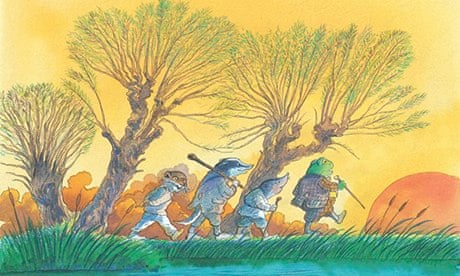
'The moral core of Grahame’s book' … Mr Badger and friends. Illustration by Michael Foreman.

My hero: Mr Badger by Patrick Barkham

The welcome arrival of Kenneth Grahame's Mr Badger marked a turning point in human relations with the brave and elusive creature

Patrick Barkham
Friday 6 December 2013

In 1908, Mole caught sight of Badger peering from a hedge. Badger trotted forward, grunted, "H'm! Company," and disappeared again. "Simply hates society!" explained the Water Rat. With that beautifully accurate cameo, Mr Badger stepped on to the pages of The Wind in the Willows – Will Tuckett's adaptation of which is at London's Duchess theatre this Christmas – and transformed our perception of Britain's largest carnivorous mammal.

Sunday, November 27, 2022

Book Review 038 / The Wind in the Willows by Kenneth Grahame


The Wind in the Willows Kenneth Grahame 

1908


The 100 best novels written in English / The full list

Book Review

The 100 best novels / No 38 / The Wind in the Willows by Kenneth Grahame (1908)


February 6, 2016


It is an incredibly long time since I last read ‘The Wind in the Willows’, and I returned to it with some nervousness – would it have retained its wit and charm? Unsurprisingly, it is one of those novels which contains depths unnoticed in earlier reads. It is simply wonderful, and if you have a couple of hours spare there are few ways of spending them that would be more rewarding than on the riverbank with Ratty, Mole, Toad, and Badger.
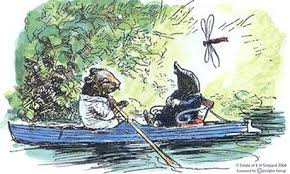
In an interesting article in the Guardian books column back in 2009, ‘Wild Waters are upon us’, Rosemary Hill observed that ‘The Wind in the Willows’ was written within a few years of Beatrix Potter’s ‘The Tale of Peter Rabbit’, E.Nesbit’s ‘The Railway Children’, and J.M.Barrie’s ‘Peter Pan’. Together she argues, very persuasively, these children’s stories came to define the Edwardian Era, “as an idyllic last summer bathed in golden sunshine“, in contrast to the developments in the real world, “a decade of social discontent and growing international tension, when the cracks in the British Empire began to show“. This novel captures brilliant a world of largely suburban contentment – the animals co-exist quite comfortably with the human world, all except perhaps Mr Toad, and their occupations – mainly messing about on boats – are those of middle class people with time on their hands. If ‘Willows’ creates a lost Edwardian idyll, rather than portraying it, the novel is however quite clear that this world is under threat, from development, urbanisation, and not least the dreaded car. The car must have been a rare and slightly frightening sight in 1908, but the way Graeme captures the petrol-head obsession of Toad has close parallels to the car worship of today.

Sunday, November 10, 2019

'Wind in the Willows' by Kenneth Grahame welcomes generations of readers to Toad Hall and the Wild Wood


'Wind in the Willows' by Kenneth Grahame welcomes generations of readers to Toad Hall and the Wild Wood

The 100 best novels / No 38 / The Wind in the Willows by Kenneth Grahame (1908) 

Karen R. Long
Updated Mar 28, 2019;Posted May 17, 2009


A century after it was first published, Kenneth Grahame's classic novel, "The Wind in the Willows," stands as a perfect example of how great children's literature always works on more than one level. On the surface, it's an adventure in which a mole, a water rat, a badger and a toad forge strong friendships as they -- especially Toad -- step in and out of trouble.
Grahame, a Scottish banker born 150 years ago, was informed by Greek tragedy, the industrial revolution and concerns about the natural world. So, then, was his story. Literature and politics infused his thoughts, and he brought all of this -- as well as a father's complicated love -- to "The Wind and the Willows," which he created for son Alastair, the virtually blind child known in letters as Dear Mouse.

Monday, June 9, 2014

The 100 best novels / No 38 / The Wind in the Willows by Kenneth Grahame (1908)


The 100 best novels

writtein English

No 38

 The Wind in the Willows 

by Kenneth Grahame (1908)


The evergreen tale from the riverbank and a powerful contribution to the mythology of Edwardian England

Monday 9 June 2014

The Wind in the Willows, known to many readers through theatrical adaptations such as Toad of Toad Hall, belongs to a select group of English classics whose characters (Rat, Mole, Badger and Mr Toad) and their catchphrases ("messing about in boats"; "poop, poop!") require no introduction. Endlessly recycled, in print, cartoon and cinema, the ideas and images of Kenneth Grahame's masterpiece recur in the most unlikely places. Chapter seven, "The Piper at the Gates of Dawn", is also the name of Pink Floyd's first album in 1967.

A sentimental British favourite, The Wind in the Willows is a far more interesting book than its popular and often juvenile audience might suggest. First, it is the work of a writer who had known considerable success in the 1890s as a young contemporary of Oscar Wilde, and who was also an admired contributor to the literary quarterly The Yellow Book. At that point, Grahame was employed by the Bank of England but, still in his 20s, was publishing stories in literary magazines, work that became collected in Dream Days (1895) and an even more successful publication, The Golden Age (1898).

The text of The Wind in the Willows also encrypts a family tragedy. In 1899, Grahame married and had one child, a boy named Alastair who was troubled with health problems and a difficult personality, culminating in the boy's eventual suicide, the cause of much parental anguish. When Grahame finally retired from the Bank (as secretary) in 1908, he could concentrate on the stories he had been telling his son, the stories of the Thames riverbank on which Grahame himself had grown up. So The Wind in the Willows is a tale steeped in nostalgia, and inspired by a father's obsessive love for his only son.
Within the text, the reader discovers two tales, interwoven. There are, famously, the adventures of Mole, Ratty, Badger and Toad with the canary-coloured caravan, the succession of motor cars, and the climactic battle for Toad Hall. At the same time, there are Grahame's lyrical explorations of home life ("Dulce Domum"), river life ("Wayfarers All") and childhood itself ("The Piper at the Gates of Dawn"). In most theatrical adaptations of Grahame's book, these lyrical elements are ruthlessly subordinated to the demands of the plot.


Above all, The Wind in the Willows makes a powerful contribution to the mythology of Edwardian England not only through its evocation of the turning seasons of the English countryside, from the riverbank in summer to the rolling open road, but also through its hints of an imminent class struggle from the inhabitants (stoats and weasels) of the Wild Wood.

Like the other books for children selected for this series – notably Alice's Adventures in Wonderland (no 18) and Kim (no 34)  The Wind in the Willows deserves recognition as a novel in which adult readers will find wisdom, humour, entertainment and meaning, as well as many passages of great literary power, together with characters who live on in the English literary unconscious.


A note on the text
The Wind in the Willows began as bedtime stories and letters addressed to Grahame's troubled son, a sickly boy known as "Mouse" who possibly inspired the wilful character of Mr Toad and who eventually committed suicide, aged 20, while at Oxford. Indeed, so personal were these stories that Grahame never intended to publish his material. The manuscript was first given to an American publisher, who rejected it. After the publication of The Wind in the Willows by Methuen in 1908, it found an unlikely transatlantic fan in US president Theodore Roosevelt who, in 1909, wrote to Grahame to tell him that he had "read it and reread it, and have come to accept the characters as old friends". Elsewhere, the critical response was more mixed, and it was not until AA Milne adapted parts of the book into a popular stage version, Toad of Toad Hall, in 1929, that it became established as the evergreen children's classic it is known as today.

Three more from Kenneth Grahame
Pagan Papers (1893); The Golden Age (1895); Dream Days (1898), a volume that includes another children's story, The Reluctant Dragon.
THE GUARDIAN


THE 100 BEST NOVELS WRITTEN IN ENGLISH
007 Emma by Jane Austen (1816)
014 Fair by William Thackeray (1848)  
031 Dracula by Bram Stoker  (1897)
035 The Call of the Wild by Jack London (1903)
036 The Golden Bowl by Henry James (1904)
039 The History of Mr Polly by HG Wells (1910)
040 Zuleika Dobson by Max Beerbohm (1915)
041 The Good Soldier by Ford Madox Ford (1915)
042 The Thirty-Nine Steps by John Buchan (1915)
043 The Rainbow by DH Lawrence (1915)
044 Of Human Bondage by W Somerset Waugham (1915)
045 The Age of Innocence by Edith Warthon (1920)
046 Ulysses by James Joyce (1922)
047 Babbitt by Sinclair Lewis (1922)
048 A Pasage to India by EM Forster (1922)
049 Gentlemen Prefer Blondes by Anita Loss ( 1925)
050 Mrs Dalloway by Virginia Woolf (1925)