Showing posts with label Japanese painters. Show all posts

Thursday, August 27, 2026

‘I fight pain and fear with art’: how Yayoi Kusama blazed a trail for neurodivergent artists


An enduring influence … Yayoi Kusama as a young woman.


‘I fight pain and fear with art’: how Yayoi Kusama blazed a trail for neurodivergent artists

The pioneering Japanese artist talked openly about how her mental health and neurodivergence informed her creativity, paving the way for the likes of Turner prize winner Nnena Kalu

BIOGRAPHY


Rhiannon Lucy Cosslett

Thrusday 27 August 2026


Yayoi Kusama – who has died at the age of 97 – was 10 when she first started experiencing vivid hallucinations consisting of visual and aural disturbances, which she described as “flashes of light, auras, or dense fields of dots”. A drawing from 1939, of a woman in a kimono assumed to be her mother, shows her obliterated by those dots; they would become Kusama’s artistic obsession. She hallucinated flowers, too. “I was looking at the red flower patterns of the tablecloth on a table, and when I looked up I saw the same pattern covering the ceiling, the windows and the walls, and finally all over the room, my body and the universe”, she once said, when asked about that recurring motif. “I felt as if I had begun to self-obliterate, to revolve in the infinity of endless time and the absoluteness of space, and be reduced to nothingness.”

Yayoi Kusama’s psychedelic art was at its best when taken in high doses


Yayoi Kusama’s psychedelic art was at its best when taken in high doses

With dots that dizzied the viewer, the giddy sensory overload of seeing the grandest installations of her octopuses and giant pumpkins was hard to resist

BIOGRAPHY

Jonathan Jones
Thrusday 27 August 2026

Ionce had an argument about Yayoi Kusama with Peter Gabriel. Not in person – I’ve never met the prog rock hero. But after I recorded some critical comments on her work for the BBC, I watched the segment only to see Gabriel passionately defending her. My onscreen cynicism seemed harsh indeed compared with his soulful appreciation of all those dots.


My scepticism about Kusama started the first time I saw her work at the Museum of Modern Art in New York. The context is significant because after a big dose of Jackson Pollock’s looping, tangled forests of colour and line (colour as line), Piet Mondrian’s pulsing Broadway Boogie Woogie and other great abstract art, Kusama’s dots appeared to me static, planned, predictable. I wasn’t excited or moved.

Obituaries / Yayoi Kusama


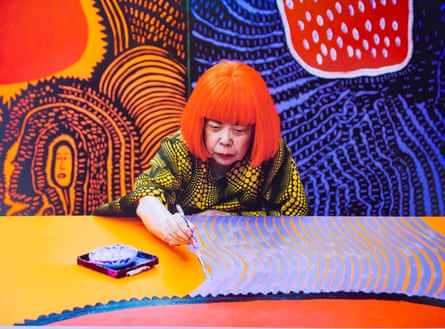
Yayoi Kusama creating a work from her My Eternal Soul series displayed in Cologne, Germany, 2026. Photograph: Sonja Blom/Alamy


Yayoi Kusama obituary

Artist known for her dazzling polka-dotted paintings and infinity mirror room installations

BIOGRAPHY

Christopher Masters
Thursday 27 August 2026


The Japanese artist Yayoi Kusama, who has died aged 97, created an exhilarating oeuvre of polka-dotted paintings, stuffed cloth phalloi and provocative happenings, films and installations, as well as a curate’s egg of novels and poetry. Kusama’s autobiography, Infinity Net (2002), relates her work directly to the obsessions and neuroses from which she suffered throughout her life: “From my very earliest memories, I have felt imprisoned by the walls of my eyes and ears and heart, upon which have been emblazoned all manner of things – nature, the universe, people and blood and flowers…. The only way for me to elude these furtive appearances is to recreate them visually with paint, pen or pencil in an attempt to decipher what they are.”

Friday, August 21, 2026

The Great Wave: why has this become the defining image of our era?


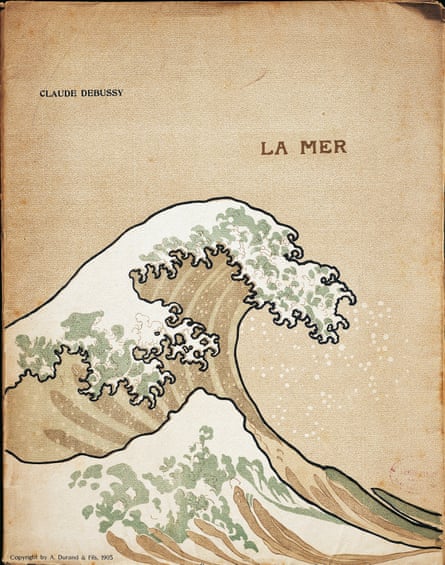
The cover of the sheet music for Debussy’s La Mer, 1905. Photograph: DEA/G Dagli Orti/De Agostini/Getty Images

The Great Wave: why has this become the defining image of our era?


Almost two centuries after its creation, Hokusai’s print is more popular than ever, featuring on everything from nail art to Lego to socks. What is its appeal?

Paula Cocozza
Tuesday 21 January 2025

Y


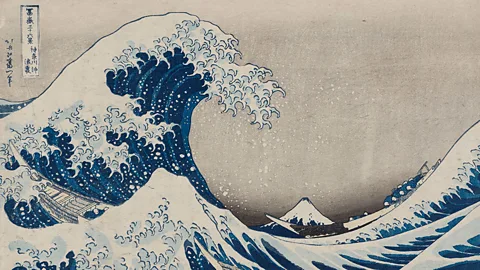
ou are never far from a great wave. Its foaming crest froths and sputters like ghostly fingers or monstrous claws raking over tote bags and journals. You can probably find it miniaturised in your emoji keyboard on your phone, and fading on a mouse mat or pair of socks somewhere nearby. The image – officially known as Under the Wave off Kanagawa, from Katsushika Hokusai’s series Thirty-six Views of Mount Fuji – depicts small boats facing down a large wave, and almost two centuries after its creation its appeal spans generations, continents, and socioeconomic bands.

Tuesday, June 23, 2026

Imamura Shiko / A revolutionary innovator


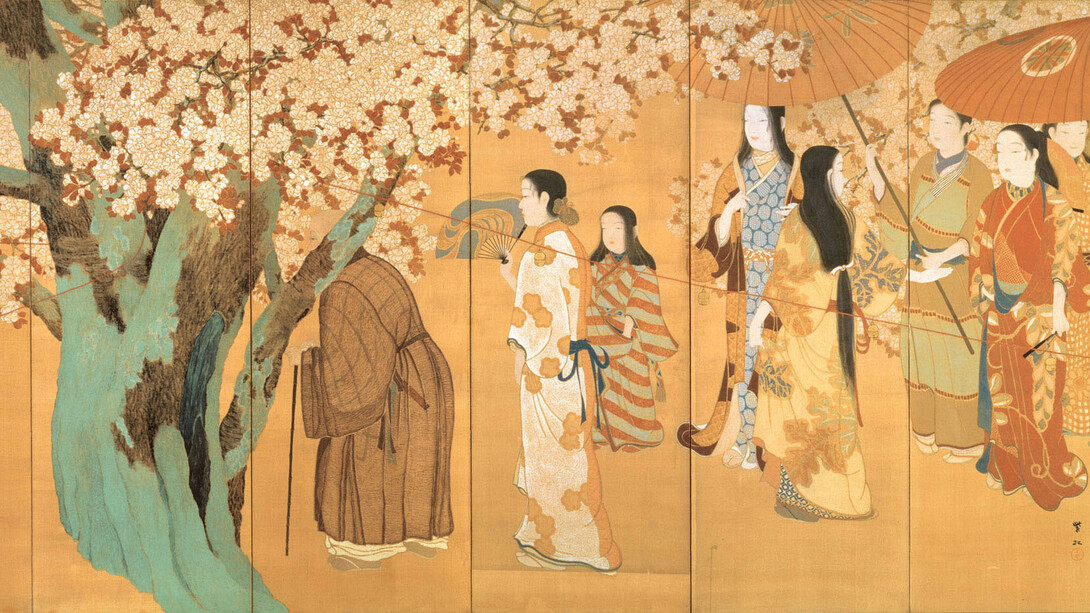
Imamura Shiko, Gokarei (Bird repelling bell) (detail). Courtesy of Yokohama Museum of Art


Imamura Shiko: a revolutionary innovator (...)

25 Apr — 28 Jun 2026 at the Yokohama Museum of Art in Kanagawa, Japan

15 MAY 2026

The painter Imamura Shiko (1880–1916) was active from the late Meiji era (1868–1912) through the early Taisho era (1912–1926). This is the first large-scale retrospective of his work in 42 years, and the first ever to be held at a public art museum. Shiko studied traditional Yamato-e, a Japanese painting style established during the Heian era (794–1185) and practiced continuously since, and at a young age demonstrated exceptional skill in history painting. 

Monday, April 13, 2026

Hokusai and the wave that swept the world


Katsushika Hokusai / Museum of Fine Arts, Boston (Credit: Katsushika Hokusai / Museum of Fine Arts, Boston)Katsushika Hokusai / Museum of Fine Arts, Boston
(Credit: Katsushika Hokusai / Museum of Fine Arts, Boston)

Hokusai and the wave that swept the world


Jason Farago
9 April 2015

Without the Japanese printmaker Hokusai, Impressionism might never have happened. Jason Farago examines the moment when European art started turning Japanese.

In the beginning was the wave. The blue and white tsunami, ascending from the left of the composition like a massive claw, descends pitilessly on Mount Fuji – the most august mountain in Japan, turned in Katsushika Hokusai’s vision into a small and vulnerable hillock. Under the Wave off Kanagawa, one of Hokusai’s Thirty-Six Views of Mount Fuji, has been an icon of Japan since the print was first struck in 1830–31, yet it forms part of a complex global network of art, commerce, and politics. Its intense blue comes from Hokusai’s pioneering use of Prussian Blue ink – a foreign pigment, imported, probably via China, from England or Germany. The wave, from the beginning, stretched beyond Japan. Soon, it would crash over Europe.

Tuesday, April 7, 2026

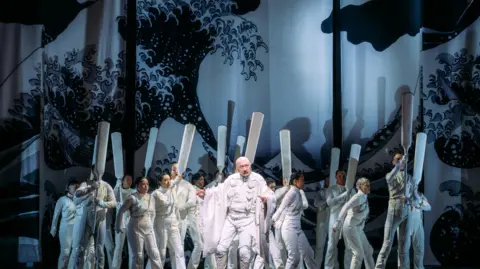
Japanese artist Hokusai inspires new work by Scottish Opera


Mihaela Bodlovic Performers on stage dressed in white with Hokusai's The Great Wave painting in the background.Mihaela Bodlovic
Japanese artist Katsushika Hokusai has inspired Scottish Opera's latest work


Japanese artist Hokusai inspires new work by Scottish Opera


Pauline McLean

14 February 2026


Japanese artist Katsushika Hokusai created more than 30,000 artworks during an extraordinary nine-decade career. 

One image in particular from two centuries ago - the picture The Great Wave off Kanagawa - has inspired countless works ranging from animations to T-shirts.

Thursday, November 13, 2025

The great wave off Kanagawa


The Great Wave at Kanagawa, designed by Katsushika Hokusai

The great wave off Kanagawa

A personal exploration of Japanese tradition and identity through the lens of Hokusai’s timeless print

12 NOVEMBER 2025, 

This exquisite print, a masterpiece of ukiyo-e, never fails to captivate with its vibrant hues and intricate details. The moment I first encountered it, I was swept away by the tumultuous roar of the ocean, a wave rising high above the distant Mount Fuji, creating a stark contrast that ignited a profound curiosity within me about the awe-inspiring world of Japanese culture, art, and cuisine. The energy of the wave, so alive and dynamic, seemed to speak to a deeper narrative of resilience and beauty amidst chaos, leaving me in a state of wonder and awe.

Monday, September 22, 2025

The magnificent world of Shiko Munakata


Shiko Munakata, Mt. Hakkoda, 1924, Aomori Museum of Art
Shiko Munakata, Mt. Hakkoda, 1924, Aomori Museum of Art 


The magnificent world of Shiko Munakata

The Van Gogh of Aomori, Japan

16 NOVEMBER 2023, 


"The woodcut, unconcerned with good and evil, with ideas, with differences, tells us that it consists of truth alone.”
(Shiko Munakata)