Murphy
by Samuel Beckett
1938
July 8, 2016
In a recent article about Beckett’s prose, the Guardian called him the “maestro of failure”, and described his work as being “a hypnotic flow of words, the meaning of which is initially utterly obscure…. but persevere and patterns emerge:” Or as one of his character says in this novel “It was like difficult music heard for the first time.” Indeed, the complexity of this novel is such that it is one of those rare works that sometimes requires reference to an annotated version giving a page by page guide.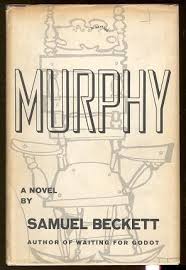
This understanding – that his work is complex but full of patterns and themes – is arguably the key to reading all Beckett, but applies particularly to his prose, including this relatively early novel. This is not difficulty for the sake of it, obscurantism, but complexity. In this novel Murphy, an Irishman of indeterminate profession, likely none, lives in exile in a condemned apartment in suburban London. He is an eccentric character – when the novel opens we find him naked in the dark, tied to a rocking chair. This appears to be more a form of meditation than sexual perversion! Murphy’s acquaintances are introduced as Beckett assembles his cast. Neary and Wylie, friends, Celia, Murphy’s lover and reluctant prostitute, and Cooper, Neary’s dull-witted assistant. Pressurised by Celia, Murphy finds a job as a nursing attendant at the Magdalen Mental Mercyseat in North London, a hospital for the insane, where he feels completely at home. The supporting cast attempt to track him down, but he eludes them by dying, apparently by suicide, caused by an opportune gas leak.


