Showing posts with label Short Stories by Alice Munro. Show all posts

Monday, December 30, 2019

Alice Munro / Chance / Short Story


Chance
By Alice Munro
DESTINO

Halfway through June of 1965, the term at Torrance House School for Girls is over. Juliet has not been offered a permanent job—the teacher she was replacing has recovered from a bout of depression—and she could now be on her way home. Instead, she is taking what she has described as a little detour. A little detour to see a friend who lives up the coast.

Friday, May 17, 2019

Alice Munro / Axis / Short Stories


Axis 

by Alice Munro


Fifty years ago, Grace and Avie were waiting at the university gates, in the freezing cold. A bus would come eventually, and take them north, through the dark, thinly populated countryside, to their homes. Forty miles to go for Avie, maybe twice that for Grace. They were carrying large books with solemn titles: “The Medieval World,” “Montcalm and Wolfe,” “The Jesuit Relations.”
This was mostly to establish themselves as serious students, which they were. But once they got home they would probably not have time for such things. They were both farm girls, who knew how to scrub floors and milk cows. Their labor as soon as they entered the house—or the barn—belonged to their families.

Thursday, May 9, 2019

Alice Munro / Corrie / Short Story

Corrie 

by Alice Munro


“It isn’t a good thing to have the money concentrated all in the one family, the way you do in a place like this,” Mr. Carlton said. “I mean, for a girl like my daughter Corrie here. For example, I mean, like her. It isn’t good. Nobody on the same level.”
Corrie was right across the table, looking their guest in the eye. She seemed to think this was funny.

Friday, July 13, 2018

Alice Munro / Leaving Maverley / Short Story


  Leaving Maverley 

by Alice Munro


In the old days when there was a movie theatre in every town there was one in this town, too, in Maverley, and it was called the Capital, as such theatres often were. Morgan Holly was the owner and the projectionist. He didn’t like dealing with the public—he preferred to sit in his upstairs cubbyhole managing the story on the screen—so naturally he was annoyed when the girl who took the tickets told him that she was going to have to quit, because she was having a baby. He might have expected this—she had been married for half a year, and in those days you were supposed to get out of the public eye before you began to show—but he so disliked change and the idea of people having private lives that he was taken by surprise.

Thursday, July 12, 2018

Alice Munro / Queenie / Short Story


QUEENIE

by Alice Munro


Queenie said, ‘Maybe you better stop calling me that,’ and I said, ‘What?’
‘Stan doesn’t like it,’ she said. ‘Queenie.’
It was a worse surprise to me to hear her say ‘Stan’ than to have her tell me to call her by her right name, which was Lena. But I could hardly expect her to go on calling him Mr Vorguilla, now that they were married, and had been for nearly two years. During that time I hadn’t seen her, and for a moment when I saw her in the group of people waiting for the train at Union Station, I hadn’t recognised her. Her hair was dyed black, and puffed up around her face in whatever style it was that in those days succeeded the beehive. Its beautiful corn-syrup colour – gold on top and dark underneath – as well as its silky length, was for ever lost. She wore a yellow print dress that skimmed her body and ended inches above her knees. The Cleopatra lines drawn heavily around her eyes, and the purply shadow, made her eyes seem smaller, not larger, as if they were deliberately hiding. She had pierced ears now, gold hoops swinging from them.

Wednesday, July 11, 2018

Alice Munro / Some Women / Short Story


SOME WOMEN

by Alice Munro


I am amazed sometimes to think how old I am. I can remember when the streets of the town I lived in were sprinkled with water to lay the dust in summer, and when girls wore waist cinchers and crinolines that could stand up by themselves, and when there was nothing much to be done about things like polio and leukemia. Some people who got polio got better, crippled or not, but people with leukemia went to bed, and, after some weeks’ or months’ decline in a tragic atmosphere, they died.

Tuesday, July 10, 2018

Alice Munro / What Is Remembered / Short Story


Eric Fischl “Reflection II (Who?), 1995

What Is Remembered

by Alice Munro
BIOGRAPHY


In a hotel room in Vancouver, Meriel as a young woman is putting on her short white summer gloves. She wears a beige linen dress and a flimsy white scarf over her hair. Dark hair, at that time. She smiles, because she has remembered something that Queen Sirikit of Thailand said, or was quoted as saying, in a magazine. A quote within a quote—something Queen Sirikit said that Balmain had said.
“Balmain taught me everything. He said, ‘Always wear white gloves. It’s best.’”
It’s best. Meriel smiles at that, not as you’d smile at a joke but as at an endearing absurdity. Her gloved hands look formal but helpless. A kitten’s paws.
Pierre asks why she’s smiling, and she says, “Nothing,” then tells him.
He says, “Who is Balmain?”

Monday, October 28, 2013

Alice Munro / The Bear Came Over the Mountain / Short Story


The Bear Came Over the Mountain
by  Alice Munro
Fiona lived in her parents’ house, in the town where she and Grant went to university. It was a big, bay-windowed house that seemed to Grant both luxurious and disorderly, with rugs crooked on the floors and cup rings bitten into the table varnish. Her mother was Icelandic—a powerful woman with a froth of white hair and indignant far-left politics. The father was an important cardiologist, revered around the hospital but happily subservient at home, where he would listen to his wife’s strange tirades with an absent-minded smile. Fiona had her own little car and a pile of cashmere sweaters, but she wasn’t in a sorority, and her mother’s political activity was probably the reason. Not that she cared. Sororities were a joke to her, and so was politics—though she liked to play “The Four Insurgent Generals” on the phonograph, and sometimes also the “Internationale,” very loud, if there was a guest she thought she could make nervous. A curly-haired gloomy-looking foreigner was courting her—she said he was a Visigoth—and so were two or three quite respectable and uneasy young interns. She made fun of them all and of Grant as well. She would drolly repeat some of his small-town phrases. He thought maybe she was joking when she proposed to him, on a cold bright day on the beach at Port Stanley. Sand was stinging their faces and the waves delivered crashing loads of gravel at their feet.
“Do you think it would be fun—” Fiona shouted. “Do you think it would be fun if we got married?”
He took her up on it, he shouted yes. He wanted never to be away from her. She had the spark of life.

Sunday, October 27, 2013

Alice Munro / Face / Short Story


Face
By Alice Munro
BIOGRAPHY

I am convinced that my father looked at me, really saw me, only once. After that, he knew what was there.
In those days, they didn’t let fathers into the glare of the theatre where babies were born, or into the room where the women about to give birth were stifling their cries or suffering aloud. Fathers laid eyes on the mothers only once they were cleaned up and conscious and tucked under pastel blankets in the ward or in semi-private or private rooms. My mother had a private room, as became her status in town, and it was just as well, actually, seeing the way things turned out.
I don’t know whether my father saw my mother before or after he stood outside the window of the nursery for his first glimpse of me. I rather think that it was after, and that when she heard his steps outside her door she felt the anger in them but did not yet know what had caused it. After all, she had borne him a son, which was, presumably, what all men wanted.
I know what he said. Or what she told me he said.
“What a chunk of chopped liver.”
Then, “You don’t need to think you’re going to bring that into the house.”
One side of my face was—is—normal. And my entire body was normal from toes to shoulders. Twenty-one inches was my length, eight pounds five ounces my weight. A strapping male infant, fair-skinned, though probably still red from my unremarkable recent journey.

Saturday, October 26, 2013

Alice Munro / Boys and Girls / Short Story


BOYS AND GIRLS
by Alice Munro
BIOGRAPHY
    
My father was a fox farmer. That is, he raised silver foxes, in pens; and in the fall and early winter, when their fur was prime, he killed them and skinned them and sold their pelts to the Hudson's Bay Company or the Montreal Fur Traders. These companies supplied us with heroic calendars to hang, one on each side of the kitchen door. Against a background of cold blue sky and black pine forests and treacherous northern rivers, plumed adventures planted the flags of England and or of France; magnificent savages bent their backs to the portage. 

    For several weeks before Christmas, my father worked after supper in the cellar of our house. the cellar was whitewashed , and lit by a hundred-watt bulb over the worktable. My brother Laird and I sat on the top step and watched. My father removed the pelt inside-out from the body of the fox, which looked surprisingly small, mean, and rat-like, deprived of its arrogant weight of fur. The naked, slippery bodies were collected in a sack and buried in the dump. One time the hired man, Henry Bailey, had taken a swipe at me with this sack, saying, "Christmas present!" My mother thought that was not funny. In fact she disliked the whole pelting operation--that was what the killing, skinning, and preparation of the furs was called – and wished it did not have to take place in the house. There was the smell. After the pelt had been stretched inside-out on a long board my father scraped away delicately, removing the little clotted webs of blood vessels, the bubbles of fat; the smell of blood and animal fat, which the strong primitive odor of the fox itself, penetrated all parts of the house. I found it reassuringly seasonal, like the smell of oranges and pine needles. 

    Henry Bailey suffered from bronchial troubles. He would cough and cough until his narrow face turned scarlet, and his light blue, derisive eyes filled up with tears; then he took the lid off the stove, and, standing well back, shot out a great clot of phlegm – hss – straight into the heart of the flames. We admired his for this performance and for his ability to make his stomach growl at will, and for his laughter, which was full of high whistlings and gurglings and involved the whole faulty machinery of his chest. It was sometimes hard to tell what he was laughing at, and always possible that it might be us. 

Friday, October 25, 2013

Alice Munro / Runaway / Short Story


Runaway
by  Alice Munro
BIOGRAPHY

Carla heard the car coming before it topped the little rise in the road that around here they called a hill. It’s her, she thought. Mrs. Jamieson—Sylvia—home from her holiday in Greece. From the barn door—but far enough inside that she could not easily be seen—she watched the road where Mrs. Jamieson would have to drive by, her place being half a mile farther along than Clark and Carla’s.
If it was somebody coming to see them, the car would be slowing down by now. But still Carla hoped. Let it not be her.
It was. Mrs. Jamieson turned her head once, quickly—she had all she could do to maneuver her car through the ruts and puddles the rain had made in the gravel—but she didn’t lift a hand off the wheel to wave, she didn’t spot Carla. Carla got a glimpse of a tanned arm bare to the shoulder, hair bleached a lighter color than it had been before, more white now than silver-blond, and an expression that was both exasperated and amused at her own exasperation—just the way Mrs. Jamieson would look negotiating this road. When she turned her head there was something like a bright flash—of inquiry, of hopefulness—that made Carla shrink back.
So.
Maybe Clark didn’t know yet. If he was sitting at the computer, he would have his back to the window and the road.

Thursday, October 24, 2013

Alice Munro / Passion / Short Story

Eleanor
Chicago, 1954
Photo by Harry Callahan
PASSION
by Alice Munro
BIOGRAPHY


When Grace goes looking for the Traverses’ summer house, in the Ottawa Valley, it has been many years since she was in that part of the country. And, of course, things have changed. Highway 7 now avoids towns that it used to go right through, and it goes straight in places where, as she remembers, there used to be curves. This part of the Canadian Shield has many small lakes, which most maps have no room to identify. Even when she locates Sabot Lake, or thinks she has, there seem to be too many roads leading into it from the county road, and then, when she chooses one, too many paved roads crossing it, all with names that she does not recall. In fact, there were no street names when she was here, more than forty years ago. There was no pavement, either—just one dirt road running toward the lake, then another running rather haphazardly along the lake’s edge.
Now there is a village. Or perhaps it’s a suburb, because she does not see a post office or even the most unpromising convenience store. The settlement lies four or five streets deep along the lake, with houses strung close together on small lots. Some of them are undoubtedly summer places—the windows already boarded up, as they always were for the winter. But many others show all the signs of year-round habitation—habitation, in many cases, by people who have filled the yards with plastic gym sets and outdoor grills and training bikes and motorcycles and picnic tables, where some of them sit now having lunch or beer on this warm September day. There are other people, not so visible—students, maybe, or old hippies living alone—who have put up flags or sheets of tinfoil for curtains. Small, mostly decent, cheap houses, some fixed to withstand the winter and some not.

Wednesday, October 23, 2013

Alice Munro / Train / Short Story

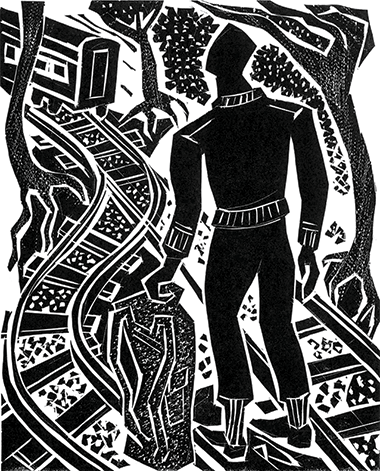
Man
by Triunfo Arciniegas
Train
By Alice Munro

BIOGRAPHY


This is a slow train anyway, and it has slowed some more for the curve. Jackson is the only passenger left, and the next stop is about twenty miles ahead. Then the stop at Ripley, then Kincardine and the lake. He is in luck and it’s not to be wasted. Already he has taken his ticket stub out of its overhead notch.
He heaves his bag, and sees it land just nicely, in between the rails. No choice now — the train’s not going to get any slower.
He takes his chance. A young man in good shape, agile as he’ll ever be. But the leap, the landing, disappoints him. He’s stiffer than he’d thought, the stillness pitches him forward, his palms come down hard on the gravel between the ties, he’s scraped the skin. Nerves.
Illustration by Raymond Verdaguer
The train is out of sight; he hears it putting on a bit of speed, clear of the curve. He spits on his hurting hands, getting the gravel out. Then picks up his bag and starts walking back in the direction he has just covered on the train. If he followed the train he would show up at the station there well after dark. He’d still be able to complain that he’d fallen asleep and wakened all mixed up, thinking he’d slept through his stop when he hadn’t, jumped off all confused.
He would have been believed. Coming home from so far away, from Germany and the war, he could have got mixed up in his head. It’s not too late, he would be where he was supposed to be before midnight. But all the time he’s thinking this he’s walking in the opposite direction. He doesn’t know many names of trees. Maples, that everybody knows. Pines. He’d thought that where he jumped was in some woods, but it wasn’t. The trees are just along the track, thick on the embankment, but he can see the flash of fields behind them. Fields green or rusty or yellow. Pasture, crops, stubble. He knows just that much. It’s still August.

Tuesday, October 22, 2013

Alice Munro / Gravel / Short Story

by Triunfo Arciniegas


GRAVEL
BY ALICE MUNRO
BIOGRAPHY


At that time we were living beside a gravel pit. Not a large one, hollowed out by monster machinery, just a minor pit that a farmer must have made some money from years before. In fact, the pit was shallow enough to lead you to think that there might have been some other intention for it—foundations for a house, maybe, that never made it any further.
My mother was the one who insisted on calling attention to it. “We live by the old gravel pit out the service-station road,” she’d tell people, and laugh, because she was so happy to have shed everything connected with the house, the street—the husband—with the life she’d had before.
I barely remember that life. That is, I remember some parts of it clearly, but without the links you need to form a proper picture. All that I retain in my head of the house in town is the wallpaper with Teddy bears in my old room. In this new house, which was really a trailer, my sister, Caro, and I had narrow cots, stacked one above the other. When we first moved there, Caro talked to me a lot about our old house, trying to get me to remember this or that. It was when we were in bed that she talked like this, and generally the conversation ended with me failing to remember and her getting cross. Sometimes I thought I did remember, but out of contrariness or fear of getting things wrong I pretended not to.

Monday, October 21, 2013

Alice Munro / Amundsen / Short Story


Alice Munro


AMUNDSEN
By Alice Munro
BIOGRAPHY


On the bench outside the station, I sat and waited. The station had been open when the train arrived, but now it was locked. Another woman sat at the end of the bench, holding between her knees a string bag full of parcels wrapped in oiled paper. Meat—raw meat. I could smell it.
Across the tracks was the electric train, empty, waiting.
No other passengers showed up, and after a while the stationmaster stuck his head out the station window and called, “San.” At first I thought he was calling a man’s name, Sam. And another man wearing some kind of official outfit did come around the end of the building. He crossed the tracks and boarded the electric car. The woman with the parcels stood up and followed him, so I did the same. There was a burst of shouting from across the street, and the doors of a dark-shingled flat-roofed building opened, letting loose several men, who were jamming caps on their heads and banging lunch buckets against their thighs. By the noise they were making, you’d have thought the car was going to run away from them at any minute. But when they settled on board nothing happened. The car sat while they counted one another and worked out who was missing and told the driver that he couldn’t go yet. Then somebody remembered that the missing man hadn’t been around all day. The car started, though I couldn’t tell if the driver had been listening to any of this, or cared.

Sunday, October 20, 2013

Alice Munro / The View from Castle Rock / Short Story


The View from Castle Rock
by Alice Munro
BIOGRAPHY

On a visit to Edinburgh with his father when he is nine or ten years old, Andrew finds himself climbing the damp, uneven stone steps of the Castle. His father is in front of him, some other men behind—it’s a wonder how many friends his father has found, standing in cubbyholes where there are bottles set on planks, in the High Street—until at last they crawl out on a shelf of rock, from which the land falls steeply away. It has just stopped raining, the sun is shining on a silvery stretch of water far ahead of them, and beyond that is a pale green and grayish-blue land, a land as light as mist, sucked into the sky.
“America,” his father tells them, and one of the men says that you would never have known it was so near.
“It is the effect of the height we are on,” another says.
“There is where every man is sitting in the midst of his own properties and even the beggars is riding around in carriages,” Andrew’s father says, paying no attention to them. “So there you are, my lad”—he turns to Andrew—“and God grant that one day you will see it closer, and I will myself, if I live.”
Andrew has an idea that there is something wrong with what his father is saying, but he is not well enough acquainted with geography to know that they are looking at Fife. He does not know if the men are mocking his father or if his father is playing a trick on them. Or if it is a trick at all.

Saturday, October 19, 2013

Alice Munro / Dimension / Short Story

by Kim Nesskain Hong
Dimension

Doree had to take three buses—one to Kincardine, where she waited for one to London, where she waited again, for the city bus out to the facility. She started the trip on a Sunday at nine in the morning. Because of the waiting times between buses, it took her until about two in the afternoon to travel the hundred-odd miles. All that sitting, either on buses or in the depots, was not a thing she should have minded. Her daily work was not of the sitting-down kind.
She was a chambermaid at the Comfort Inn. She scrubbed bathrooms and stripped and made beds and vacuumed rugs and wiped mirrors. She liked the work—it occupied her thoughts to a certain extent and tired her out so that she could sleep at night. She was seldom faced with a really bad mess, though some of the women she worked with could tell stories to make your hair curl. These women were older than her, and they all thought that she should try to work her way up. They told her that she should get trained for a job behind the desk, while she was still young and decent-looking. But she was content to do what she did. She didn’t want to have to talk to people.
None of the people she worked with knew what had happened. Or, if they did, they didn’t let on. Her picture had been in the paper—they’d used the photo he took of her with all three kids, the new baby, Dimitri, in her arms, and Barbara Ann and Sasha on either side, looking on. Her hair had been long and wavy and brown then, natural in curl and color, as he liked it, and her face bashful and soft—a reflection less of the way she was than of the way he wanted to see her.

Friday, October 18, 2013

Alice Munro / Free Radicals / Short Story


Free Radicals
by Alice Munro
BIOGRAPHY

At first, people kept phoning, to make sure that Nita was not too depressed, not too lonely, not eating too little or drinking too much. (She had been such a diligent wine drinker that many forgot that she was now forbidden to drink at all.) She held them off, without sounding nobly grief-stricken or unnaturally cheerful or absent-minded or confused. She said that she didn’t need groceries; she was working through what she had on hand. She had enough of her prescription pills and enough stamps for her thank-you notes.
Her closer friends probably suspected the truth—that she was not bothering to eat much and that she threw out any sympathy note she happened to get. She had not even informed the people who lived at a distance, to elicit such notes. Not Rich’s ex-wife in Arizona or his semi-estranged brother in Nova Scotia, though those two might have understood, perhaps better than the people near at hand, why she had proceeded with the non-funeral as she had done.
Rich had told her that he was going to the village, to the hardware store. It was around ten o’clock in the morning, and he had just started to paint the railing of the deck. That is, he’d been scraping it to prepare for the painting, and the old scraper had come apart in his hand.