Showing posts with label Lenín Moreno. Show all posts

Tuesday, October 8, 2019

Ecuador / Indigenous protesters paralyze roads in fifth day of anti-austerity unrest


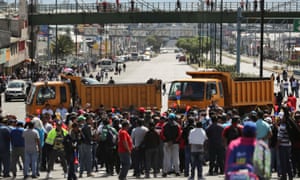
Trucks block main roads Monday during protests after Ecuador’s President Lenin Moreno’s government ended four-decade-old fuel subsidies.
 Trucks block main roads Monday during protests after Lenin Moreno’s government ended four-decade-old fuel subsidies. Photograph: Iván Alvarado/Reuters

Ecuador: indigenous protesters paralyze roads in fifth day of anti-austerity unrest
Measure to eliminate fuel subsidies sparks worst unrest in years, resulting in 477 arrests

REUTERS IN QUITO
Monday 7 October 2019
Indigenous protesters have paralyzed roads around Ecuador and blocked a main highway into the capital in a fifth day of action against government austerity measures that have sparked the worst unrest in years, resulting in 477 arrests.
The umbrella indigenous organization Conaie said demonstrations would continue until President Lenín Moreno withdraws last week’s measure to eliminate fuel subsidies.
“More than 20,000 of us will be arriving in Quito to demand that the government overturn the decree,” the Conaie president, Jaime Vargas, told a news conference, saying that mobilization would coincide with a national strike planned for Wednesday.
Moreno, 66, who has abandoned his predecessor and one-time mentor Rafael Correa’s leftist policies, says he will neither tolerate disorder nor overturn the fuel price hike that is part of a liberal economic reform package.
The interior minister, Paula Romo, told the local Radio Quito that detentions had risen to 477 since Thursday, mainly for vandalism, including the destruction of a dozen ambulances.
Indigenous and workers’ movements again blocked roads on Monday, from the Andean highlands to the Pacific coast, with stones, tires and burning branches.
The northern entry to Quito was paralyzed.
Police erected barricades around the presidential palace, closing off the downtown area while Moreno presided over a government security council meeting to assess the crisis.
The government says two dozen policemen have been injured in clashes with protesters, while a man died when he was hit by a car and an ambulance could not reach him through the barricades.
As well as the detainees for unrest, authorities have also rounded up about 20 shopkeepers for raising food prices illegally in a knock-on effect of higher fuel costs.
A state of emergency is in place.
Although he enjoys the support of business and the military, Moreno’s popularity has sunk to under 30%, compared with 70% after his 2017 election.
Indigenous-led protests brought down three presidents in the years before Correa’s rule.
In a national address on Sunday night, Moreno reiterated calls for dialogue. “I want to talk with the indigenous brothers, with whom we share causes,” he said, adding that resources would be set aside to help the poor and compensate for price rises.
The government is struggling with a large foreign debt and fiscal deficit and earlier this year reached a $4.2bn loan deal with the International Monetary Fund that hinges on belt-tightening reforms.
As well as ending fuel subsidies, the government is trimming the state workforce and planning some privatizations. Moreno says the fuel subsidies, in place for four decades, had distorted the economy and cost $60bn.


Ecuador declares state of emergency as protesters decry end to fuel subsidies

Quito, Ecuador


Ecuador declares state of emergency as protesters decry end to fuel subsidies

Fiscal reform package sends demonstrators to the streets: ‘We’re paralyzing the nation’
REUTERS IN QUITO
Thursday 3 October 2019
Ecuador’s president, Lenín Moreno, has declared a state of emergency amid nationwide protests over the end of decades-old fuel subsidies in a government fiscal reform package worth more than $2bn a year.
“Down with the package!” protesters shouted, referring to measures that Moreno enacted this week which also included tax reforms.
As the fuel measure came into effect on Thursday, taxi, bus and truck drivers blocked streets in the highland capital, Quito, and the second city, Guayaquil, on the Pacific coast, while bus stations were closed. Indigenous groups, students and unions joined the protest, blocking roads with rocks and burning tires.
In Quito, masked demonstrators threw stones at riot police who responded with tear gas and deployed armored vehicles.
“It’s an indefinite action until the government overturns the decree on subsidies. We’re paralyzing the nation,” one bus transport leader, Abel Gómez, told Reuters.
Officials say the elimination of fuel subsidies was necessary to lift the economy and stop smuggling.


Scenes in the capital, Quito, on Thursday. Photograph: José Jácome/EPA
Moreno, who won election in 2017 to replace Rafael Correa, told reporters the “perverse” fuel subsidy, in place for 40 years, had distorted the economy and protests would not be allowed to paralyze Ecuador.


“To ensure citizens’ security and avoid chaos, I have ordered a national state of emergency,” he said of the measure that suspends some rights and empowers the military to keep order.
Some groups of protesters trying to reach the government palace in downtown Quito scuffled with police.
The interior minister, María Romo, said 19 people had been arrested for blocking roads and other offences.
Ecuador has a long history of political instability. Street protests toppled three presidents during economic turmoil in the decade before Correa took office in 2007.


 A demonstrator is detained by the police in Quito. Photograph: Dolores Ochoa/AP

The economy minister, Richard Martínez, said on Wednesday that Ecuador hoped that eliminating fuel subsidies and tax reforms could save the country about $2.27 bn a year.
The government wants to reduce the fiscal deficit from an estimated $3.6bn this year to under $1bn in 2020.
Ecuador’s debt grew under Correa, who endorsed Moreno in the 2017 election but has since become a critic of his successor’s turn toward more market-friendly economic policies.
Moreno’s government reached a $4.2bn deal with the International Monetary Fund (IMF) in February. But skepticism of the IMF runs strong in Ecuador and throughout Latin America, where many blame austerity policies for economic hardship.
“We’ll close all the main roads,” said taxi driver Sergio Menoscal, 55, helping to block streets in Guayaquil.
“We’re tired of false promises ... we can’t be blind to a government that has done nothing for the people.”