Showing posts with label The long read. Show all posts

Sunday, May 3, 2026

Where Duolingo falls down / How I learned to speak Welsh with my mother


Where Duolingo falls

Dan Fox's taid, outside Tal-y-Braich Uchaf, Eryri (Snowdonia), c 1965. Photograph: Courtesy of Dewi Jones


Where Duolingo falls down: how I learned to speak Welsh with my mother

This article is more than 1 month old
Dan Fox's taid, outside Tal-y-Braich Uchaf, Eryri (Snowdonia), c 1965. Photograph: Courtesy of Dewi Jones

Once violently defended from extinction, Welsh is still a part of daily life. By learning my family’s language, I hoped to join their conversation


by Dan Fox

Thursday 12 Marc 2026


My maternal grandmother died 20 years ago. The funeral was held in a small Methodist chapel in the lush Conwy valley of north Wales. Her entire life – she had almost reached 100 – was spent in these hills. The drizzle that morning had slicked the trees and turned the slate of the chapel black. Our family, gathered under umbrellas, entered in order of seniority: Mum, now the family elder, with Dad on her arm, then my six aunts and uncles with their spouses, and finally the cousins, led by my brother Mark and me.

Tuesday, February 27, 2024

Simon Armitage / Making poetry pay


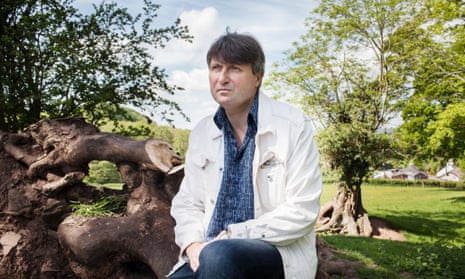
Simon Armitage. Photograph: Gareth Phillips for the Guardian

THE LONG READ

Simon Armitage: Making poetry pay


In a culture that has consigned poetry to the margins, Armitage has become something very rare: a genuinely popular British poet. Aida Edemariam hits the road with the busiest man in verse

Aida Edemarian
Tuesday 26 May 2015


One Indian summer evening last September, off a busy slip road not far from the Tower of London, Simon Armitage took to the stage of the world’s oldest surviving music hall and, after a short introduction from the broadcaster Melvyn Bragg, started to read. “It begins with a house, an end terrace / in this case …” The hall was full, generous with silence and later with laughter: young couples in careful retro outfits, men in suits dropping by after work, students, and older women; audience and performers held beneath a glowing tent of wobbly fairy lights that rose from the balconies to a bright apex in the roof. “But it will not stop there. Soon it is / an avenue / which cambers arrogantly past the Mechanics’ Institute …” Armitage’s reading voice is light; not exactly monotonal, but strung on a more delicate, questioning skein than his conversational voice. The poem, Zoom!, the title piece in his very first collection, in 1989, turns left at the main road, leads to a town, “city, nation, hemisphere, universe, … [is] bulleted into a neighbouring galaxy”, before finally coming to rest in the checkout queue at the local supermarket.

Wednesday, February 14, 2024

200 cats, 200 dogs, one lab: the secrets of the pet food industry


THE LONG READ

200 cats, 200 dogs, one lab: the secrets of the pet food industry


Pet food is a £120bn industry, with vast resources spent on working out how best to nourish and delight our beloved charges. But how do we know if we’re getting it right?


by Vivian Ho
Tus 13 February 2024

Florence Meowmalade came to me on a chilly winter’s night last year. A one-year-old orange tabby with a little pink nose, she arrived at my door in London after travelling for three days in a van with 30 dogs across continental Europe. She brought with her an EU pet passport, a soiled pink blanket and a penchant for snuggling into any available lap.

Tuesday, December 26, 2023

How Deborah Levy can change your life


La escritora Deborah Levy en febrero de 2017.Deborah Levy, 2017.

How Deborah Levy can change your life

From her shimmering novels to her ‘living autobiographies’, Deborah Levy’s work inspires a devotion few literary authors ever achieve

Charlotte Higgins
Tuesday 4 April 2023


Last August, the author Deborah Levy began to sit for her portrait. The starting point was a selfie – eyes penetrating, lips sensuous, head topped by a tower of chestnut hair. The artist, her friend Paul Heber-Percy, used Photoshop, then a pencil and tracing paper, to reverse and multiply the image of her face, until he had a drawing, neatly laid out on a grid, that satisfied him.

Tuesday, June 21, 2022

How Julia Donaldson conquered the world, one rhyme at a time


Julia Donaldson


How Julia Donaldson conquered the world, one rhyme at a time


She published her first book in her 40s and became the biggest selling author of the past decade in any genre – The Gruffalo alone has sold 13m copies. How did this former busker make it so big?


by Oliver Franklin-Wallis
Thursday 17 December 2020

The room where the children’s author Julia Donaldson writes – the heart of her vast picture book empire – is down a winding staircase, in the cellar of her grand white house in Steyning, West Sussex. Her desk looks out on the street at knee height. “I’m thinking of writing a book about legs,” Donaldson said, as she showed me around the house this summer. Children from the nearby school often wave in at her as they pass. Donaldson is well known in Steyning, due to her frequent signings at the local bookshop. She and her husband, Malcolm, a retired paediatrician, recently bought the local post office to save it from closure. But elsewhere she can walk the pavement without being recognised. “I got a letter the other day for Jacqueline Wilson,” Donaldson told me. “It said: ‘You’re my favourite author!’”

Friday, December 3, 2021

Cruel, paranoid, failing / Inside the Home Office


Illustration by Eleanor Shakespeare


Cruel, paranoid, failing: inside the Home Office

Something is badly wrong at the heart of one of Britain’s most important ministries. How did it become so broken?


by Daniel Trilling
Thursday 13 May 2021

For the thousands of people who end up on the wrong side of the Home Office each year, there is often a sudden moment of disbelief. This can’t be happening, people tell themselves. They can’t do this, can they?

For Ruhena Miah, a sales assistant born and raised in the West Midlands, this moment came when she received a letter saying that if she wanted to marry the man she loved, she would have to move to Bangladesh. For Tayjay Thompson, a young man convicted of a drugs offence when he was 17, it was when he was told he would be deported to Jamaica, a country he’d left as a toddler. For Monique Hawkins, a Dutch software engineer, it was when her application for a residency permit was rejected, despite the fact she had lived in the UK for 24 years. For Omar, a refugee from Afghanistan (who asked me not to use his real name), it was when he stepped off the plane at Heathrow and discovered that he was being taken to a building that looked to him very much like a prison.

'It’s a place where they try to destroy you' / Why concentration camps are still with us


A "political education" camp in China's Xinjing province
Photo by Greg Baker


'It’s a place where they try to destroy you': why concentration camps are still with us


Mass internment camps did not begin or end with the Nazis – today they are everywhere from China to Europe to the US. How can we stop their spread? 


by Daniel Trilling
Thursday 2 April 2020

At the start of the 21st century, the following things did not exist. In the US, a large network of purpose-built immigration prisons, some of which are run for profit. In western China, “political education” camps designed to hold hundreds of thousands of people, supported by a high-tech surveillance system. In Syria, a prison complex dedicated to the torture and mass execution of civilians. In north-east India, a detention centre capable of holding 3,000 people who may have lived in the country for decades but are unable to prove they are citizens. In Myanmar, rural encampments where thousands of people are being forced to live on the basis of their ethnicity. On small islands and in deserts at the edges of wealthy regions – Greece’s Aegean islands, the Negev Desert in Israel, the Pacific Ocean near Australia, the southern Mediterranean coastline – various types of large holding centres for would-be migrants.

The scale and purpose of these places vary considerably, as do the political regimes that have created them, but they share certain things in common. Most were established as temporary or “emergency” measures, but have outgrown their original stated purpose and become seemingly permanent. Most exist thanks to a mix of legal ambiguity – detention centres operating outside the regular prison system, for instance – and physical isolation. And most, if not all, have at times been described by their critics as concentration camps.

We tend to associate the idea of concentration camps with their most extreme instances – the Nazi Holocaust, and the Soviet Gulag system; genocide in Cambodia and Bosnia. But the disturbing truth is that concentration camps have been widespread throughout recent history, used to intern civilians that a state considers hostile, to control the movement of people in transit and to extract forced labour. The author Andrea Pitzer, in One Long Night, her recent history of concentration camps, estimates that at least one such camp has existed somewhere on Earth throughout the past 100 years.

Golden Dawn / The rise and fall of Greece’s neo-Nazis


A Golden Dawn rally in Athens in 2014
Photo by Yannis Kolesidis


Golden Dawn: the rise and fall of Greece’s neo-Nazis

A decade ago, violent racists exploited a national crisis and entered mainstream politics in Greece. The party has since been caught up in the biggest trial of Nazis since Nuremberg, and is now crumbling – but its success remains a warning. 


by Daniel Trilling
Tuesday 3 March 2020


After he stabbed Pavlos Fyssas in the chest, leaving him to bleed to death on the pavement, Giorgos Roupakias walked calmly back to his car and waited to be arrested. “Don’t give me away, I’m one of you,” he said, according to a police officer who arrived at the scene.

“What do you mean, are you police?” asked the officer.

“No, I am Golden Dawn.”