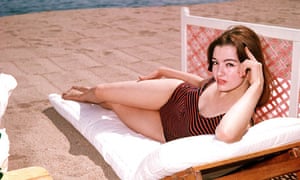
Christine Keeler, a key figure in the 1963 Profumo Scandal which rocked the government, was the subject of intimate sketches by the sculptor Alberto Giacometti. Photograph: Popperfoto/Popperfoto/Getty Images
How Christine Keeler provided inspiration for Giacometti
As the Profumo scandal raged, the artist Alberto Giacometti was fascinated by a French news report and dashed off some previously unknown sketches
Dalya Alberge
Sunday 14 November 2010
Dozens of previously unknown sketches by the artist and sculptor Alberto Giacometti have come to light, including impromptu drawings of Christine Keeler, the showgirl whose 1960s affair with Conservative minister John Profumo shook the British establishment.
Nine months ago, one of Giacometti's sculptures sold for £65m. Now the Swiss artist's family has allowed his biographer, the distinguished art historian Michael Peppiatt, access to the collection for a major new book and a loan exhibition. The unseen images reveal Giacometti at his most intimate and unselfconscious.
Giacometti seems to have taken his inspiration for the Keeler sketch from a 1963 French newspaper report. A series of nude female figures sketched across a page from France-Soir is thought to represent her. The collection also contains sculptures, paintings and drawings not seen since they left his dilapidated studio in Paris. Another find is an art book owned by Giacometti which he used to produce a striking drawing of Van Gogh's self-portrait.
 |
| CHRISTINE KEELER |
Another previously unknown sketch appears across a torn-out page of L'Express, a 1964 edition with a report on Lee Harvey Oswald, President John Kennedy's assassin. Giacometti scribbled over Oswald's photograph, giving him a beard and scrawling across the page the repeated word continuare ("to go on") and the phrase "the busts were made quickly, and a painting this evening, the drawings soon". The words seem to convey Giacometti's constant urge to push himself into yet more work. The artist, who died in 1966, obsessively scrutinised his work for hints of failure, always destroying works that did not match his vision. Peppiatt said that the newspaper sketches showed that drawing was fundamental for Giacometti. "Drawing was a form of instinctive thinking for him. He was never without a pencil in his hand or a fag in his mouth," he explained.
Peppiatt, an art critic for the Observer during the 1960s, recalled his excitement at being given access to the images, taken from a collection owned by the widow of Giacometti's nephew, Silvio Berthoud: "There is something very intimate about these works. I was allowed to choose from 300 drawings. I was deeply moved. I felt that Giacometti was almost there with me … as if his drawings were dropping from his hands. He had scribbled over the inside covers of books, doodled on bits of paper in cafes." Some of the unknown images are in Peppiatt's forthcoming book, In Giacometti's Studio, and a loan exhibition he has curated at the Eykyn Maclean gallery in New York.
Through newly published letters, Peppiatt offers new insight into Giacometti, the man and his art. He has delved into the artist's relationships, notably his doomed affair with Isabel Rawsthorne, a raucous, bohemian painter and model.
Peppiatt said: "Isabel was a terrifying animal, a man-eater. She was having affairs with both sexes and drinking everybody under the table. He was ambivalent towards women. What he liked were prostitutes. Giacometti was both attracted and repelled by Isabel." Feelings of despair emerge from their letters, Peppiatt said. In one, Giacometti wrote: "I didn't think your stay was a washout, Isabel, otherwise I wouldn't have felt so upset when you left. My throat was tight. I was sobbing inside."
Peppiatt also casts light on the artist's friendship with Samuel Beckett. Describing Giacometti's skeletal figures as a visual embodiment of the Irish writer's pared down prose, he said: "They had the same nocturnal habits. They'd bump into one another in Montparnasse around midnight, go to the same brothels together and walk home together." He tried to imagine their conversations as they strolled the deserted streets. "I researched and researched, following every line of inquiry, until I came to the truth," he recalled. These 20th-century geniuses would walk in "deep, utter, total silence", he said.
DRAGON


