Papers from May 1889 to April 1896 show the decision by trustees to exclude Oscar Wilde from the British Museum’s Reading Room.
Photograph: The Trustees of the British Museum
British Library to reinstate Oscar Wilde’s reader card 130 years after it was revoked
Dalya Alberge
Friday 13 June 2025
The British Libraryis to symbolically reinstate Oscar Wilde’s reader pass, 130 years after its trustees cancelled it following his conviction for gross indecency.
The young Oscar Wilde’s Russian revolutionary drama reveals a playwright divided
Vera; or, The Nihilists concerns a plot to kill a tsar but after Alexander II was assassinated, its London premiere was cancelled. Now receiving a rare production, it captures his conflict between ethics and aestheticsMichael Billington
The 100 best nonfiction books: No 52 – De Profundis by Oscar Wilde (1905)
There is a thrilling majesty to Oscar Wilde’s tormented tour de force written as he prepared for release from Reading jail
Robert McCrum
Monday 30 January 2017 05.45 GMT
I
n life and death, Oscar Wilde possessed a unique self-mythologising genius. Long before he secured his place in Britain’s pantheon of great dramatists, he had established himself as the witty icon of an aesthetic ideal. By the spring of 1882, when he went to America declaring his “genius”, he was doubly celebrated in both the United States and England (where Gilbert and Sullivan had just satirised Wilde’s aesthetic movement in the character of the poet Bunthorne in Patience), as much for himself as for his writing. For a tantalisingly brief period, until the summer of 1894, when he wrote The Importance of Being Earnest in three weeks, Wilde blazed like a meteor across Victorian London before crashing and burning at his Old Bailey trial (after the disaster of the Queensberry libel case) in May 1895. A lesser artist might have been broken by that fall, but Wilde was ultimately inspired by it.
In his cell, between January and March 1897, in preparation for his release from Reading jail in April, Oscar Wilde began to write an extraordinary letter. He wanted to address his notorious relationship with Lord Alfred Douglas, the fin-de-siècle romance that had swiftly become a fatal tragedy. “Bosie” had remained aloof from his former lover throughout the two years of Wilde’s sentence (“with hard labour”), and the 80 pages of manuscript written on 20 folios of thin blue prison paper became Wilde’s tormented bid for some kind of rapprochement. What began as an act of would-be reconciliation blossomed into an excruciating, and utterly compelling, chapter of autobiography, an aesthetic apologia (Epistola: In Carcere et Vinculis – “Letter: from Prison and in Chains”) , and finally a tour de force of prose by a late-Victorian writer of genius.
Oscar WiIde, photographed at the height of his success, five years before the trial that send him to prison in 1895.
Wilde was always a master of disguises and personas. The Importance of Being Earnest is all about double lives. In De Profundis (its title, “from the depths”, is taken from Psalm 130), he puts on the mask of the disgraced, and penitent, prisoner to review his affair with Bosie, to attempt a kind of confession and then, suitably purged, to assert “a fresh mode of self-realisation”. More than a century after its first appearance (Wilde’s friend Robert Ross both gave the manuscript its final title, and arranged for its publication), the ruthless and often self-lacerating candour with which Wilde lays himself bare is still shocking.
At first, he addresses the heyday of his affair, its carefree and irresponsible passion, and his reckless indulging of the younger man:
“From the very first there was too wide a gap between us. You had been idle at your school, worse than idle at your university. You did not realise that an artist requires for the development of his art the companionship of ideas, an intellectual atmosphere, quiet, peace and solitude.”
As Wilde’s realisation of his self-destruction sinks in, he rehearses the terrible sequence of events that would lead to his downfall, disgrace, and imprisonment: “Everything about my tragedy has been hideous. Our very dress [as convicts] makes us grotesques. We are the zanies of sorrow…”
A famous passage recalls the prisoner’s transfer from London to Reading, by train, on 13 November 1895:
“From two o’clock till half-past two on that day I had to stand on the centre platform of Clapham Junction, in convict dress and handcuffed, for the world to look at. Of all possible objects I was the most grotesque. When people saw me they laughed. Each train as it came up swelled the audience. For half an hour I stood there in the grey November rain surrounded by a jeering mob. For a year after that was done to me, I wept every day at the same hour and for the same space of time.”
This episode sees Wilde at one of his worst and lowest depths. Thereafter, De Profundis gains vigour and confidence as the prisoner charts his brilliant career as “a man who stood in symbolic relations to the art and culture of his age”. He contrasts the high moments of his art and its astonishing success with the humiliation of bankruptcy and jail. Somehow, he must come to terms with the great “Oscar” becoming a drab prison number “C.3.3.”, a cipher. Other parts of De Profundis hint at Wilde’s subsequent campaign for prison reform (“the prison system is absolutely and entirely wrong”), and the fate of the system’s inmates, an obsession that culminated in The Ballad of Reading Gaol, his lyrical masterpiece.
Thus emboldened, and with his artistic muscles recovering some of their old potency, Wilde begins to make a comparison between his life as an artist and the life of Christ, a theme that runs fitfully through his earlier prose writing, especially The Critic as Artist (1890) and The Soul of Man Under Socialism (1891). For Wilde, the noble artist, the figure of Christ is the supreme archetype of the suffering creator, as well as the ultimate individualist. In the degradation and shame of his 1895 trial, Wilde finds the glimmerings of his role as a martyr, a role he is happy to share with the son of God.
Never let it be said that Oscar Wilde was short of self-belief. “All of this”, he writes, “is foreshadowed and prefigured in my art… A great deal of it is hidden away in the note of Doom that like a purple thread runs through the gold cloth of Dorian Gray.”
“I now see that Sorrow is at once the type and test of all great Art. What the artist is always looking for is that mode of existence in which soul and body are one and indivisible: in which the outward is expressive of the inward: in which Form reveals…”
“To the artist, expression is the only mode under which he can conceive life at all. To him what is dumb is dead. But to Christ it was not so...
Having made this grandiose connection, the letter descends into a sustained rebuke of Bosie’s character and behaviour, in which his “horrible habit of writing offensive letters” comes across as perhaps the least troubling quality in a young man whose vanity, greed, treachery and vicious self-centredness dragged Wilde down.
And yet, remarkably, Wilde concludes with instructions for their joint future conduct once he has been released, and ends on a note of reconciliation:
“You came to me to learn the Pleasure of Life and the Pleasure of Art. Perhaps I am chosen to teach you something much more wonderful, the meaning of Sorrow, and its beauty. Your affectionate friend. Oscar Wilde.”
It’s hard not to conclude that the thrilling majesty of Wilde’s prose was wasted on Bosie. Within three and a half years of completing this extraordinary document, Wilde was dead. He was 46.
A Signature Sentence
“Our ill-fated and most lamentable friendship has ended in ruin and public infamy for me, yet the memory of our ancient affection is often with me, and the thought that loathing, bitterness and contempt should for ever take that place in my heart once held by love is very sad to me: and you yourself will, I think, feel in your heart that to write to me as I lie in the loneliness of prison-life is better than to publish my letters without my permission or to dedicate poems to me unasked, though the world will know nothing of whatever words of grief or passion, of remorse or indifference you may choose to send as your answer or your appeal.”
I know I don’t normally write about the publication history of the books I review, but the background to this one is more complex than usual, and quite relevant. It was published in full in Lippincott’s Monthly magazine in 1890 (in a significantly shorter version than the final novel). Wilde predicted “I think it will make a sensation” – which was a bit of an understatement. Prior to publication he made several edits to remove some of the more explicitly homo-erotic content, but he may as well not have bothered, because critics almost unanimously put two and two together, identified Wilde with his two main characters, and realised that some of the sins which they explore included gay sex. For the avoidance of any doubts Wilde drops clunking hints such as when he says “there are certain temperaments that marriage makes more complex…they are forced to have more than one life” (61) What can he mean? Later he refers to “such love as Michael Angelo had known, and Montaigne, and Winckelmann, and Shakespeare himself” (96). This was extraordinarily daring of Wilde – and his publishers – and he was of course to pay the price.
From Stephen King to Oscar Wilde and Tana French, novelist Gabriel Bergmoser chooses Halloween reading that does more than simply shock and scare
Gabriel Bergmoser Wed 28 Oct 2020 12.00 GMT
1. Red Dragon by Thomas Harris The Silence of the Lambs gets all the attention, but the best Hannibal Lecter novel is still the first; a book that suggests the most horrifying of evils can grow from an all too human place, and that even heroes can carry something monstrous inside them. Every Lecter story on some level features an implicit Faustian bargain and none is more tragic than FBI crimimal profiler Will Graham’s knowing choice to sacrifice his own fragile peace of mind to stop a killer he understands all too well.
2. The Picture of Dorian Gray by Oscar Wilde There are no real villains in Oscar Wilde’s first and only novel. The lurking danger of this book is our capacity for vanity and how it can literally and metaphorically disfigure us, how obsession with retaining beauty will inevitably lead to its destruction. Even Wilde’s central monster, Dorian himself, is more tragic idiot than conniving mastermind, a youthful dope consumed by a pathological belief that the only thing worth having is beauty at any cost. His descent would almost be funny if it wasn’t so chillingly believable.
3. Horns by Joe Hill Sometimes horror, even at its darkest, is the window dressing for something more tender. That’s the case with the unique and entirely enrapturing Horns, a book that starts out as a twisted revenge story before slowly becoming something more sprawling, knotty, and ultimately hopeful. Horns is by turns a gothic romance, a murder mystery, a supernatural thriller and a biting satire on how quick we can be to judge despite the darkness we all harbour.
4. The Exorcist by William Peter Blatty Often the best horror stories are the ones that believe, through all the death, jump-scares and creepiness, in the fundamental triumph of goodness. That The Exorcist was long considered one of the most terrifying novels ever is in large part is down to how deeply we are led to care about the desperate plight of its central characters, and how carefully detailed every one of them is. The evil they face is huge and incomprehensible, but not, in the end, insurmountable, and much of the book’s (and film’s) power comes from the ultimate hard-won victory of a small group who sacrifice everything for an innocent child.
5. Ring by Koji Suzuki, translated by Robert B Rohmer and Glynne Walley Successive film adaptations have not managed to capture the true power of this relatively demure tale of a cursed videotape, a chilling and all too human story of coming to understand your own insignificance in the face of forces beyond your comprehension. While Ring is a classic, it’s in its two sequels that Suzuki revealed the scope of his ambition, organically building on his horror fable to craft something far more epic and transcendent than any filmed version has yet realised.
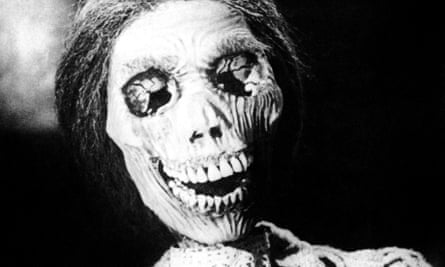
The subversion of convention began with the book … a still from Alfred Hitchcock’s film of Psycho. Photograph: Everett Collection/Rex
6. Psycho by Robert Bloch To be clear, like Jaws, the film is better; Hitchcock having made a series of clever tweaks to find new ways of manipulating the audience by making them care. But everything that turned Psycho into an enduring cultural lightning rod originated in Bloch’s novel; the shower scene, the house on the hill, the twist ending and the sense of gothic dread dripping from every moment. The gleeful subversion of conventions that Hitchcock gets all the credit for originated here, and without this book, horror – and cinema – wouldn’t be the same.
7. The Passage by Justin Cronin Justin Cronin’s epic vampire saga is a sprawling tale of love, loss and societies destroyed, rebuilt and destroyed again, centred not only on characters we could care deeply for, but a slowly growing sense of insidious evil whispering from the shadows, a terror so unknowable that it was always going to lose a little menace once it was explained. But like the best horror writers, Cronin uses that inevitability to make his point – that all too often evil grows from a place that is a little more understandable than we might care to confront. The whole trilogy is fantastic, but for its singular atmosphere of growing dread the first will always be the best.
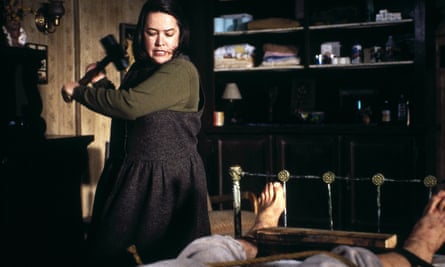
No escape from horror … Kathy Bates in the 1990 film adaptation of Misery. Photograph: Allstar/Castle Rock Entertainment
8. Misery by Stephen King There’s an intoxicating combination of anger, sadness and catharsis at the heart of Misery; a book written by an author trying to move away from horror only to find that his vast readership wouldn’t accept that. Cue the story of a writer literally held hostage by a fan torturing him into writing what she wants, facilitating the writer’s slow realisation that the genre he was so desperate to move on from may be the only one that’s right for him. It’s an intensely personal and ambivalent book, and one of the best explorations of the highs and lows of creativity ever written.
9. From Hell by Alan Moore and Eddie Campbell I don’t know whether it’s cheating to include a graphic novel on this list, but this is a horror masterpiece unlike anything else I’ve ever read, a sprawling, phonebook-heavy exploration of not just the Jack the Ripper murders, but the society that allowed them to happen. Unflinching and harsh, grim and deliberate, the book is an almost forensic dissection of Victorian England, suggesting that the motives for the murders, caused by a collision of dogma, classism and puritanical propriety, were the inevitable result of the true human horrors that made up a seemingly polite society.
10. In the Woods by Tana French I know; this is not horror, at least not insofar as where it sits in bookstores. But I would also argue it’s not a traditional crime novel or literary character study either. In the Woods uses the structure of a whodunnit to craft one of the most haunting explorations of fear I’ve ever read and, in doing so, includes the only written scene to ever make me jump, a scene so infused with the force of an unshakable nightmare that it transforms the book around it, leaving readers with the sense that some evils can never be truly understood and some trauma is too great to move on from. If that doesn’t encapsulate horror at its most evocative, I have no idea what does.
Patricia Highsmith at home in France in 1976 Photo by Derek Hudson
A half-shaven head? A handbag of snails at a cocktail party? I just adore a true eccentric
There is probably something in the idea that quirkiness or slightly odd behaviour might have a link with mental illness, neurodiversity or creative skill
Hannah Jane Parkinson Fri 21 May 2021 07.00 BST
D
on’t you just love an eccentric? Not the type of person who purposely cultivates an “I’m so wacky, me!” vibe, but the true, wonderful eccentrics of yesteryear. I love finding out about incidences of human behaviour that – how shall we say? – are somewhat out of the box.
I first came across The Picture of Dorian Gray when my mum took me to see a stage production of it at our local theatre, The Hexagon. I was absolutely captivated by the plot, the wit, and the climatic ending and soon sought out the book.
The Picture of Dorian Gray by Oscar Wilde - review
Although the mannered society of the late 1800s may seem far removed from that of today, I was struck by the similarities'
T
he saying "be careful what you wish for" has arguably never been more apt in literature than it is in this classic novel. When the young Victorian heartthrob Dorian Gray is influenced by Lord Henry Wotton's warning that he only has "a few years in which to live really, perfectly, and fully" due to the transiency of his youthful beauty, he wishes for his portrait to change with time instead.
Little does he know that he will soon stumble down the rocky road of moral corruption, committing one bad deed after another, destroying relationships with the people he meets at the same time as any good reputation he used to possess.
Although the mannered society of the late 1800s may seem far removed from that of today, I was struck by the similarities. For example, the obsession with self-image which leads to Dorian's wish in the first place can easily be associated with 2014 and how teenagers of today measure their attractiveness in the number of Facebook 'likes' on profile pictures. Just as Dorian wants to increase his social rank by going to the most fashionable dinner parties and plays with the highest class people, the popularity of people today is often reflected in the number of 'cool' parties they are invited to. The way Dorian's social aspirations lead to his downfall therefore makes the novel an interesting moral commentary. Rather than pursuing, as Dorian does, pleasure for its own sake with no regard for any people he may harm – such as his first love, the actress Sybil Vane – Wilde presents in Dorian's exploits an example of a man whose hedonistic principles should not be followed.
Having always been interested in the power of words to influence people - as Wilde himself observes: "Was there anything so real as words?" - the way Dorian follows such an immoral route after being handed a book by Lord Wotton to attempt to raise his spirits after a sad incident, is particularly striking. This is helped by Wilde's relatively straightforward language, making it all the more readable. However, I would not particularly recommend it for anyone under 13 as the themes and comments on the values of individuals and society may not appeal as much to a younger audience.