Showing posts with label Fernando Vicente. Show all posts

Thursday, February 24, 2022

Flaubert and Madame Bovary by Somerset Maugham


Flaubert and Madame Bovary
by William Somerset Maugham


(1)

If, as I believe, the sort of books an author writes depends on the sort of man he is, and so it is well to know what is relevant in his personal history, this, as will presently appear, in the case of Flaubert is essential. He was a very unusual man. No writer that we know of devoted himself with such a fierce and indomitable industry to the art of literature. It was not with him, as it is with most authors, an activity of paramount importance but one that allows for other activities which rest the mind, refresh the body or enrich experience. He did not think that to live was the object of life; for him the object of life was to write: no monk in his cell more resolutely sacrificed the pleasures of the world to the love of God than Flaubert sacrificed the fullness and variety of life to his ambition to create a work of art. He was at once a romantic and a realist. Now, at the bottom of romanticism, as I said in speaking of Balzac, is a hatred of reality and a passionate desire to escape from it. Like the rest of the romantics, Flaubert sought refuge in the extraordinary and the fantastic, in the Orient and in antiquity; and yet, for all his hatred of reality, for all his loathing for the meanness, the platitude, the imbecility of the bourgeois, he was fascinated by it; for there was something in his nature that horribly attracted him to what he most detested. Human stupidity had a revolting charm for him, and he took a morbid delight in exhibiting it in all its odiousness. It got on his nerves with the force of any obsession; it was like a sore on the body that is pain to touch and that yet you can’t help touching. The realist in him pored over human nature as though it were a pile of garbage, not to find something he could value, but to show to all and sundry how base, for all their outward seeming, were human beings.


Ilustration by Fernando Vicente


(2)

Gustave Flaubert was born at Rouen in 1821. His father, a doctor, was head of the hospital and lived there with his wife and children. It was a happy, highly respected and affluent family. Flaubert was brought up like any other French boy of his class; he went to school, made friends with other boys, worked little but read much. He was emotional and imaginative, and, like many another child and boy, was troubled by that sense of inner loneliness which the sensitive carry with them all their lives. ‘I went to school when I was only ten,’ he wrote, ‘and I very soon contracted a profound aversion to the human race.’ This is not just a quip; he meant it. He was a pessimist from his youth up. It is true that then romanticism was in full flower and pessimism the fashion: one of the boys at Flaubert’s school blew his brains out, another hanged himself with his necktie; but one cannot quite see why Flaubert, with a comfortable home, affectionate and indulgent parents, a doting sister and friends to whom he was devoted, should have really found life intolerable and his fellow-creatures hateful. He was well-grown and to all appearance healthy.


When he was fifteen, he fell in love. His family went in summer to Trouville, then a modest village by the sea with one hotel; and there, that year, they found staying Maurice Schlesinger, a music publisher and something of an adventurer, with his wife and child. It is worth while to transcribe the portrait Flaubert drew of her later: ‘She was tall, a brunette with magnificent black hair that fell in tresses to her shoulders; her nose was Greek, her eyes burning, her eyebrows high and admirably arched, her skin was glowing and as if it were misty with gold; she was slender and exquisite, one saw the blue veins meandering on her brown and purple throat. Add to that a fine down that darkened her upper lip and gave her face a masculine and energetic expression such as to throw blonde beauties into the shade. She spoke slowly, her voice was modulated, musical and soft.’ I hesitate to translate pourpré with purple, which does not sound alluring, but that is the translation, and I can only suppose that Flaubert used the word as a synonym for bright-hued.

Thursday, June 3, 2021

Vargas Llosa / The Elder Statesman of Latin American Literature — and a Writer of Our Moment

Credit...Christopher Anderson/Magnum, for The New York Times


Mario Vargas Llosa

The Elder 

Statesman 

of Latin American Literature — 

and a Writer 

of Our Moment

Mario Vargas Llosa isn’t a household name among American readers. But at 81, he remains a literary and political colossus across the Spanish-speaking world, and his novels have never felt more relevant.


By Marcela Valdes
Feb. 20, 2018


Shall we sit outside?” Mario Vargas Llosa asked me, gesturing through the library’s floor-to-ceiling windows at the brilliant September afternoon. The only Peruvian ever to have won a Nobel Prize, Vargas Llosa now lives in an eight-bedroom mansion on the fringes of Madrid, in the neighborhood known as Puerta de Hierro. When I arrived, a butler in a white jacket led me through the enormous two-story foyer, across gleaming black and white tiles, into a library lined with dark wood bookcases. A crystal ashtray sat next to silver dishes of chocolate and cigarettes. This imposing casona seemed like a fitting residence for the last living giant of a golden age of Latin American literature, a man who may well be the most politically important novelist of our time, but the house does not belong to Vargas Llosa. Over the library’s fireplace hung a portrait of its owner, Isabel Preysler, in a red dress.

Keiko Fujimori would be ‘lesser of two evils’ as Peru president, says Nobel prize author

Mario Vargas Llosa
Illustration by Fernando Vicente


Keiko Fujimori would be ‘lesser of two evils’ as Peru president, says Nobel prize author

Novelist Mario Vargas Llosa says Fujimori’s opponent Pedro Castillo would undermine democracy


Sam Jones in Madrid

Sunday 18 April 2021 

The Nobel prize-winning Peruvian author Mario Vargas Llosa has called on his compatriots to support Keiko Fujimori’s bid to become president, despite once running against her now jailed and disgraced father, Alberto, and spending years savaging the dynasty for its corrosive effects on Peru and its politics.

Vargas Llosa said the rightwing Fujimori – who faces Pedro Castillo, a far-left but socially conservative union leader and teacher in June’s presidential runoff – was “the lesser of two evils”. Castillo won 19.1% of the vote in last week’s first round, while Fujimori took 13.4%.

Writing in Spain’s El País newspaper, the novelist said Castillo would undermine democracy, ruin Peru’s economy and leave the country “with all the characteristics of a communist society”.

Faced with such an “abyss”, Vargas Llosa added, “Peruvians should vote for Keiko Fujimori because she represents the lesser of two evils and, if she’s in power, there are more possibilities of saving our democracy”.

Peru’s presidential candidate Keiko Fujimori speaks at a meeting in Lima.
Peru’s presidential candidate Keiko Fujimori speaks at a meeting in Lima. Photograph: Sebastian Castaneda/Reuters

But the writer, who was beaten by the then little-known Alberto Fujimori in Peru’s 1990 election, said Keiko Fujimori would have to promise to respect freedom of expression, obey presidential term limits, and rule out a pardon for her father’s former spy chief, Vladimiro Montesinos.

Keiko Fujimori has already said that, if elected, she intends to pardon her father, whose 10 years in office were mired in widespread corruption. She has twice lost presidential elections in 2011 and 2016.

Alberto Fujimori is serving a 25-year prison sentence for authorising death squads and presiding over rampant corruption and vote-rigging. Though loathed by many because of his authoritarianism and disdain for the law, some Peruvians remain loyal to Fujimori because of the role his government played in ending the bloody Shining Path insurgency and resuscitating the country’s failing economy.

Until now, Vargas Llosa had been a vehement critic of the Fujimoris. In 2010, he said Keiko Fujimori would be “a catastrophe for the country”, adding: “If the daughter of the dictator who has been jailed for being a criminal and a thief could possibly become the president of Peru, I will be one of the Peruvians who will strive to try to stop that happening using every possible legal means.”

The author, who has chronicled the uses and abuses of power in a career spanning seven decades, won the Nobel prize for literature in 2010. The committee said he had been recognised “for his trenchant images of the individual’s resistance, revolt and defeat”.

At the time, Vargas Llosa, who has Spanish citizenship and lives in Madrid, said he had always considered himself too liberal to stand a chance of winning the Nobel prize.

THE GUARDIAN


Friday, May 14, 2021

Kafka / Problems

Franz Kafka
Fernando Vicente
Franz Kafka
PROBLEMS

I usually solve problems by letting them devour me.


Franz Kafka, Letter to Max Brod


Monday, April 8, 2019

“It All Comes Together” / How did Marcel Proust become a great writer?

Marcel Proust
Fernando Vicente


“It All Comes Together”
How did Marcel Proust become a great writer?


By Roland Barthes
MONDAY, MAY 16, 2016

In 1979 Barthes was teaching a course at the Collège de France entitled “La Préparation du roman,” lectures translated into English as The Preparation of the Novel. One of his aims in that course was to explore the relationship between teaching and literary creation and the ways in which the one might stimulate the other. This article, published in Le Magazine littéraire of January 1979, a mass-market magazine easily available from French newsstands, is perhaps best read in that context.—Chris Turner
T
here are, it seems, few enigmas in literary history. Yet here is one that has Proust as its hero. It intrigues and interests me, particularly as it is an enigma relating to creation (the only sort of relevance to someone who wants to write).

Tuesday, July 31, 2018

Creating Cathy / The story behind Wuthering Heights's wild heroine

Ralph Fiennes and Juliette Binoche as Cathy and Heathcliff in the 1992 film of Wuthering Heights. Photograph: Ronald Grant Archive

Creating Cathy: the story behind Wuthering Heights's wild heroine

How a ruthless warrior queen in a childhood fantasy became the prototype for Emily Brontë’s protagonist

Emma Butcher
Mon 30 Jul 2018


W
hether you love it or hate it, there is no denying thatWuthering Heights holds a strange power. It is both a love story and a screeching train wreck of violence, cruelty and obsession. Its words contain a strength and soul that every writer hopes to achieve, yet few manage. As for the author, although an enigma to the point of myth, Emily Brontë has resonated with readers of all ages worldwide. Brontë’s novel does not shy away from the uncomfortable truths that make us human. And that is why her works strike home, generation after generation.

Wednesday, January 3, 2018

Buy a cat, stay up late, don't drink / Top 10 writers’ tips on writing


Ernest Hemingway
by Fernando Vicente

CREATIVE WRITING

Buy a cat, stay up late, don't drink: top 10 writers’ tips on writing


Made a New Year resolution to start writing that novel? Take some writing tips from Leo Tolstoy, Muriel Spark, John Steinbeck and other famous authors
Travis Elborough
Wed 3 Jan ‘18 11.27 GMT

O
ver the past year, Helen Gordon and I have been putting together Being a Writer, a collection of musings, tips and essays from some of our favourite authors about the business of writing, ranging from the time of Samuel Johnson and Grub Street, to the age of Silicon Roundabout and Lorrie Moore.

Researching the book, it quickly became obvious that there isn’t a correct way to set about writing creatively, which is a liberating thought. For every novelist who needs to isolate themselves in a quiet office (Jonathan Franzen), there’s another who works best at the local coffee shop (Rivka Galchen) or who struggles to snatch an hour between chores and children (a young Alice Munro).
Conversely, it also became apparent that alongside all this variety of approach, there are certain ideas and pieces of advice that many writers hold in common. In an 1866 letter to Mrs Brookfield, Charles Dickens suggests that: “You constantly hurry your narrative ... by telling it, in a sort of impetuous breathless way, in your own person, when the people [characters] should tell it and act it for themselves.” Basically: SHOW DON’T TELL. Three words that will be familiar to anyone who has sat in a 21st-century creative writing class.
Our book therefore contains a lot of writing advice, ranging from the sternly practical to the gloriously idiosyncratic. We have writers talking about what went wrong, as well as what went right. They discuss failing to finish a manuscript, failing to find a publisher, badly realised characters and tortuous, unwieldy plots. Here are a just few of our favourite tips, which we believe any aspiring writer should take to heart.
1. Hilary Mantel – a little arrogance can be a great help
“The most helpful quality a writer can cultivate is self-confidence – arrogance, if you can manage it. You write to impose yourself on the world, and you have to believe in your own ability when the world shows no sign of agreeing with you.”


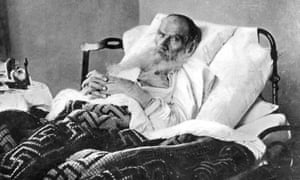
Morning thoughts … Tolstoy puts in a shift. c.1903-10. Photograph: Ullstein Bild/Getty Images

2. Leo Tolstoy and HP Lovecraft – pick the hours that work best for you

Tolstoy believed in starting first thing: “I always write in the morning. I was pleased to hear lately that Rousseau, too, after he got up in the morning, went for a short walk and sat down to work. In the morning one’s head is particularly fresh. The best thoughts most often come in the morning after waking while still in bed or during the walk.”


Or stay up late as HP Lovecraft did: “At night, when the objective world has slunk back into its cavern and left dreamers to their own, there come inspirations and capabilities impossible at any less magical and quiet hour. No one knows whether or not he is a writer unless he has tried writing at night.”
3. William Faulkner – read to write

“Read, read, read everything – trash, classics, good and bad, and see how they do it. Just like a carpenter who works as an apprentice and studies the master. Read! You’ll absorb it. Then write. If it is good, you’ll find out. If it’s not, throw it out the window.”

4. Katherine Mansfield – writing anything is better than nothing

“Looking back I imagine I was always writing. Twaddle it was too. But better far write twaddle or anything, anything, than nothing at all.”

5. Ernest Hemingway – stop while the going is good

“Always stop while you are going good and don’t worry about it until you start to write the next day. That way your subconscious will work on it all the time. But if you think about it consciously or worry bout it you will kill it and your brain will be tired before you start.”


FacebookPinterest
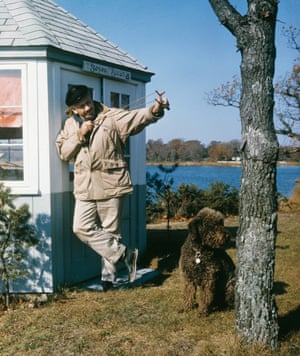
 John Steinbeck at Sag Harbor, 1962 … presumably after he’d finished his daily schedule. Photograph: Rolls Press/Popperfoto/Getty Images

6. John Steinbeck – take it a page at a time

“Abandon the idea that you are ever going to finish. Lose track of the 400 pages and write just one page for each day. It helps.”

7. Miranda July – don’t worry about the bad drafts

“I was a lot dumber when I was writing the novel. I felt like worse of a writer … would come home every day from my office and say, ‘Well, I still really like the story, I just wish it was better written.’ At that point, I didn’t realise I was writing a first draft. And the first draft was the hardest part. From there, it was comparatively easy. It was like I had some Play-Doh to work with and could just keep working with it – doing a million drafts and things changing radically and characters appearing and disappearing and solving mysteries: Why is this thing here? Should I just take that away? And then realising, no, that is there, in fact, because that is the key to this. I love that sort of detective work, keeping the faith alive until all the questions have been sleuthed out.”


FacebookPinterest
 ‘The first draft was the hardest part’ ... Miranda July. Photograph: Richard Saker for the Observer

8. F Scott Fitzgerald – don’t write and drink

“It has become increasingly plain to me that the very excellent organisation of a long book or the finest perceptions and judgment in time of revision do not go well with liquor. A short story can be written on the bottle, but for a novel you need the mental speed that enables you to keep the whole pattern inside your head and ruthlessly sacrifice the sideshows … I would give anything if I hadn’t written Part III of Tender Is the Night entirely on stimulant.”

9. Zadie Smith – get offline

“Work on a computer that is disconnected from the internet.”


10. Muriel Spark* – get a cat

“If you want to concentrate deeply on some problem, and especially on some piece of writing or paper-work, you should acquire a cat. Alone with the cat in the room where you work … the cat will invariably get up on your desk and settle under the desk lamp. The light from a lamp … gives the cat great satisfaction. The cat will settle down and be serene, with a serenity that passes all understanding. And the tranquillity of the cat will gradually come to affect you, sitting there at your desk, so that all the excitable qualities that impeded your concentration compose themselves and give your mind back the self-command it has lost. You need not watch the cat all the time. Its presence alone is enough. The effect of a cat on your concentration is remarkable, and very mysterious.’ 
*(or rather, the character of Mrs Hawkins in A Far Cry from Kensington.)

  • Being a Writer by Travis Elborough and Helen Gordon is published by Frances Lincoln, priced £15.

  • THE GUARDIAN


Sunday, June 24, 2012

Classics corner 140 / Dracula by Bram Stoker / Review


Illustration by Fernando Vicente

Classics corner

No 140 

Dracula by Bram Stoker – review


Colm Tóibín's introduction to Bram Stoker's Dracula puts the work precisely into biographical and historical context

Anita Sethi
Sun 24 Jun 2012

M
arking the centenary of Bram Stoker's death, this new edition has an incisive introduction by Colm Tóibín. With razor-sharp acuity, Tóibín examines the context which produced popular culture's most frightening vampire. 

Tóibín unmasks the connections between the Irish author's life – as servant to the tyrannical actor Henry Irving, who relished diabolic roles – and literature. Intriguingly, he identifies a "haunting, an interest in doubleness" in work by many writers who, like Stoker, came to London as outsiders in the era: in Stevenson's The Strange Case of Dr Jekyll and Mr Hyde, Henry James's The Turn of the Screw, and Oscar Wilde's The Picture of Dorian Gray. And he finds "an intense exploration of the drama surrounding visitors, travellers, intruders", which use violence, disguise, and stark imagery of isolation. 

Dracula itself opens with Jonathan Harker's evocative journal of a journey through Budapest to the "vast ruined castle" of Count Dracula located "on the edge of a terrible precipice", where the only sound is the howling of wolves. Here, he becomes prisoner. The "rather cruel-looking" Dracula is a compelling creation: a creature who has no reflection in a mirror, he unleashes his "demoniac fury". It is plot as well as place and people that give Dracula longevity: Tóibín describes "a fierce clarity in the outline" and "in how events twist and turn".

This "haunted work" was a conduit for ideas about the rational versus the unconscious being formulated by Freud. "I read that every known superstition in the world is gathered into the horseshoe of the Carpathians, as if it were the centre of some sort of imaginative whirlpool," confesses Harker in his journal. Stoker pulls the reader deep into this "imaginative whirlpool". 

Originally published in 1897, Dracula has spawned many modern-day vampires, but this most iconic character still unleashes the mind's deepest, darkest fears.

THE GUARDIAN


CLASSICS CORNER