Spent by Alison Bechdel review – the graphic novelist faces up to midlife
In this playfully fictionalised memoir, Alison runs a pygmy goat sanctuary while making a name for herself on stage and screen
James Smart
Wed 28 May 2025 07.01
Alison Bechdel emerged in the 1980s with Dykes to Watch Out For, a groundbreaking weekly strip that featured a group of mostly lesbian friends. Since then, her acclaimed graphic novels have focused mainly on herself and her family. Fun Home in 2006 (exploring her closeted, funeral-director father’s suicide and her coming out) was followed by Are You My Mother?(psychoanalysis and her relationship with her mother) and The Secret to Superhuman Strength (her compulsive exercising, from karate and crunches to snowshoeing).
Short-listed for the Myriad First Graphic Novel Competition
"Splashes of color interrupt the blue haze of Dorrance’s poignant memoir, which hovers over her mother as she develops dementia and follows Dorrance’s journey home to the Midwest to care for her one winter."
Polar Vortex by Denise Dorrance review – hazards of a homecoming
The American cartoonist’s story of a trip to tackle her frail mother’s needs is funny, wise and magical
Denise Dorrance’s graphic memoir, Polar Vortex, is enchanting, every page lovely to look at, so funny and plangent and full of sly wisdom. But it’s also (dread word) strikingly relevant. Its principal subject being old age, by rights it should bring vast crowds of new readers to comics. There can, after all, be few people now who haven’t at least some experience of caring for – or just worrying about – an older relative, as the author does in her book; even those who aren’t yet there know full well what lies ahead: the care bills that will have to be paid, the attics that must be cleared out. After I finished reading it, I thought of my own boxes of photographs, my heaving bookshelves. To whom am I leaving the burden of sorting them out? I pushed the thought away, but it cannot be avoided for ever.
Dorrance has lived in London since 1995, but she was born in Cedar Rapids, Iowa, and in Polar Vortex, her first full-length graphic book, she returns to it, somewhat reluctantly. Her elderly, widowed mother is in hospital after a fall; decisions need to be made. On paper, this sounds a bit grinding. Please, no commodes! But Dorrance has a delicate touch, and a feeling for the rich territory on which she finds herself.
A page from Polar Vortex. Illustration: Denise Dorrance
There is a lot going on, and not all of it has to do with her mother’s dementia. When we go home, we become children again – even, sometimes, at the moments when we most need to be adult – and she’s amusing about this. Then again, what constitutes home, when you’ve been away for so long? She gives us lots of fish-out-of-water jokes: culture clashes born not only of her metropolitan sophistication, but of what the locals regard as her Englishness (they can’t get enough of her accent, which to their ears makes her sound like the queen).
The weather is bad – the book’s title refers not only to hard emotional terrain, but to an incoming storm that will deposit many feet of snow – and this gives her pages a kind of reverse-fairytale feel. The whiteness casts a spell; introversion is impossible when distractions cannot easily be trekked to (especially if you’re wearing, not layers of nylon padding, but a woollen London coat). In her drawings, as expressive and as deft as those of Alison Bechdel or even Posy Simmonds, Dorrance plays up to this. Death appears, like a pantomime villain; the Cedar Rapids hospital, red-brick and Victorian-looking, rises in the blizzard like some impenetrable castle.
But she’s creative in so many other ways, too, deploying old photographs, postcards and letters – and even, at one point, a wagon train – as a means of pacing the narrative. When it comes to her mother’s (limited) options post-hospital, the ghost of the cheesy TV host Monty Hall appears to turn the whole thing into a primetime quizshow (“Number two! Become a resident at Living Care!”). It is all, in short, magical: a triumph of art and feeling. I loved it. I can’t say enough good things about it. Buy it for everyone you know.
Polar Vortex by Denise Dorrance is published by New River (£18.99).
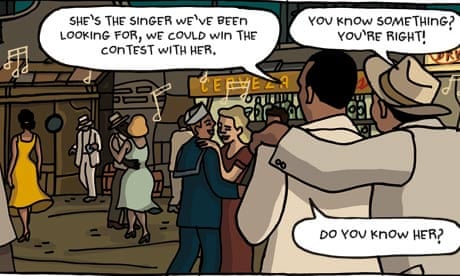
Chico & Rita: 'exuberant, passionate and melancholy'.
Graphic novel of the month Film
Chico & Rita by Fernando Trueba and Javier Mariscal – review
The book of the animated film about the lives of two Latin musicians leaves Rachel Cooke feeling exhilarated
Rachel Cooke
Sunda 5 June 2011
T
en years ago, the Spanish film director Fernando Trueba asked the artist Javier Mariscal to create a poster for his Latin jazz documentary, Calle 54. Though neither of them knew it at the time, this was to be the beginning of a long and fruitful partnership and, last year, the pair finally released Chico & Rita, an animated film. Chico & Rita tells the story of a gifted piano player and a beautiful singer and their adventures in 50s Havana, Las Vegas, Hollywood and New York – and it has a superb soundtrack by the Cuban pianist Bebo Valdés (it also features numbers by Thelonious Monk, Cole Porter, and Dizzy Gillespie). When it hit the festivals, it was widely acclaimed – our own Philip French called it "utterly delightful... affecting, funny... erotic" – and no wonder. Truly, you'd have to have a heart of stone not to love it.
The Russian Detective by Carol Adlam review – exquisitely illustrated celebration of early crime fiction
This richly evocative tale – part of a project drawing on the work of long-forgotten contemporaries of Dostoevsky – bears repeated readings
Rachel Cooke
Monday 25 March 2024
Everyone knows – even if they haven’t actually read them – about the fat novels of Fyodor Dostoevsky and Leo Tolstoy. But The Russian Detective, a remarkable new graphic novel by Carol Adlam, takes its inspiration from more obscure sources. For some years, Adlam, an associate professor in the Nottingham School of Art and Design at Nottingham Trent University, and Claire Whitehead, a reader in modern languages at the University of St Andrew’s, have been working together on the Lost Detective Project: a collaboration that draws on the work of long-forgotten writers of crime fiction who were contemporaries of Dostoevsky. As part of this project, Adlam has created several cross-media adaptations of their stories, of which The Russian Detective is one – and it could not be more rich or more beautiful if it tried. This is a book that repays multiple readings (and, for added pleasure, perhaps a little background reading).
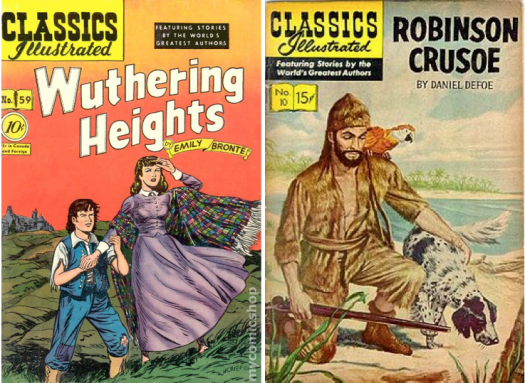
For my generation, comic books received a bad rap. Parents were convinced comics were a contributing factor to a great epidemic of juvenile delinquency and a concomitant claim that the readers of comics were, by definition, stupid. It was not until the publication of Art Speigelman’s Pulitzer Prize-winning Maus: A Survivor’s Tale (Pantheon, 1986) that the cultural stature of comics, now called “graphic novels,” underwent revision. Though there was some of the usual grousing by interested parties about what defined the “new genre,” my sense of the distinction between the old-style superhero comics and their more recent cousins is something approximating the difference between cartoons featuring Mickey Mouse or Tom & Jerry and recent films like Toy Story and Shrek.
Although he is fixated on American culture, French cartoonist Blutch is not widely known in English-speaking countries. Blutch is admired and influential for his daring draughtsmanship and ceaseless innovation of his bandes dessinées. He was born Christian Hincker in 1967 in Strasbourg, France. He would go on to win the Grand Prix in Angoulême in 2009. With Peplum, one of his masterworks, newly translated from New York Review Comics (below). it’s the right time to talk to this acclaimed, ever-challenging creator.
Paul Gravett: Why did you choose the name Blutch?
Blutch: I didn’t really choose this name, which is not so much a pseudonym as a nickname. Everybody has called me this since I was 15. It’s the name of a character from a popular comic at the time [The Blue Tunics by Lambil & Cauvin, in English from Cinebook]. My friends thought I resembled Blutch, in physique and attitude. Originally, it came from the rather puerile wish to cut yourself from your background, your parents, to be reborn as someone different. And then the nom-de-plume is a tradition in comics since the 19th century, in Europe at least, like Hergé and Moebius.
The man known as Blutch is one of the giants of contemporary comics, and Peplum may be his masterpiece: a grand, strange dream of ancient Rome. At the edge of the empire, a gang of bandits discovers the body of a beautiful woman in a cave; she is encased in ice but may still be alive. One of the bandits, bearing a stolen name and with the frozen maiden in tow, makes his way toward Rome—seeking power, or maybe just survival, as the world unravels.
Thrilling and hallucinatory, vast in scope yet unnervingly intimate, Peplum weaves together threads from Shakespeare and the Satyricon along with Blutch’s own distinctive vision. His hypnotic storytelling and stark, gorgeous art pull us into one of the great works of graphic literature, translated into English for the first time.
Blutch’s Peplum, a graphic novel, is out this month from New York Review Comics. A phantasmagoric take on the Satyricon, it was originally serialized in the French magazine À suivre in 1996; this is its first appearance in English. In his new introduction, Blutch’s translator, Edward Gauvin, writes, “Taking as its title the European term for the sword-and-sandal cinematic subgenre, Peplum offers a decidedly different take on the toga epic—one of aporia and ambiguity, a fractured tale of antiquity in all its alien majesty.”