Showing posts with label Short Stories by Jack London. Show all posts

Thursday, November 10, 2022

The Son of the Wolf by Jack London


The Son of the Wolf

 by Jack London


Man rarely places a proper valuation upon his womankind, at least not until deprived of them. He has no conception of the subtle atmosphere exhaled by the sex feminine, so long as he bathes in it; but let it be withdrawn, and an ever-growing void begins to manifest itself in his existence, and he becomes hungry, in a vague sort of way, for a something so indefinite that he cannot characterize it. If his comrades have no more experience than himself, they will shake their heads dubiously and dose him with strong physic. But the hunger will continue and become stronger; he will lose interest in the things of his everyday life and wax morbid; and one day, when the emptiness has become unbearable, a revelation will dawn upon him.

The White Silence by Jack London


The White Silence

 by Jack London


'Carmen won't last more than a couple of days.' Mason spat out a chunk of ice and surveyed the poor animal ruefully, then put her foot in his mouth and proceeded to bite out the ice which clustered cruelly between the toes.

An Odyssey of the North by Jack London


An Odyssey of the North 

Jack London


The sleds were singing their eternal lament to the creaking of the harness and the tinkling bells of the leaders; but the men and dogs were tired and made no sound. The trail was heavy with new-fallen snow, and they had come far, and the runners, burdened with flint-like quarters of frozen moose, clung tenaciously to the unpacked surface and held back with a stubbornness almost human.

“South of the Slot” by Jack London

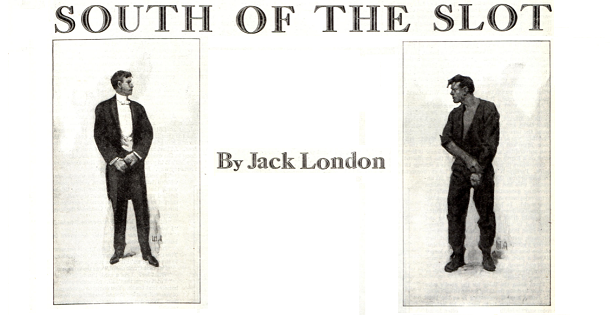
 A man in a tux, and a man in work clothes

South of the Slot

 by Jack London

Old San Francisco, which is the San Francisco of only the other day, the day before the earthquake, was divided midway by the Slot. The Slot was an iron crack that ran along the center of Market Street, and from the Slot arose the burr of the ceaseless, endless cable that was hitched at will to the cars it dragged up and down.

“The Benefit of the Doubt” by Jack London

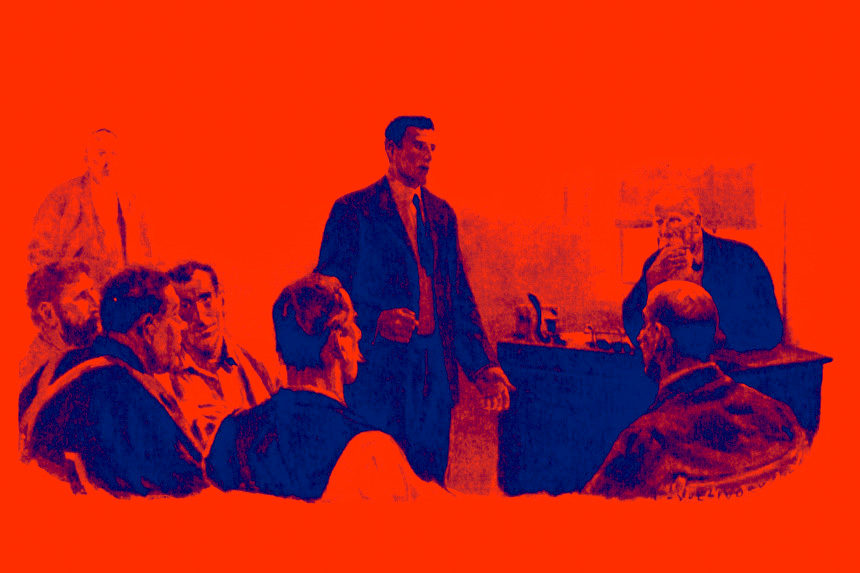
 illustration of men gathered in courtroom


The Benefit of the Doubt

 by Jack London

“There were no short cuts, no sudden regenerations. The betterment of mankind must be worked out in agony and misery just as all past social betterments had been worked out.”

Jack London’s short stories in the Post concerned adventurers, criminals, workingmen, society folks, and — sometimes — wild animals. In “The Benefit of the Doubt,” from 1910, a class-concerned sociologist gets a hands-on lesson in justice and corruption when he ducks in to the wrong dive bar in his hometown.

Published on November 12, 1910

Wednesday, November 9, 2022

“Under the Deck Awnings” by Jack London

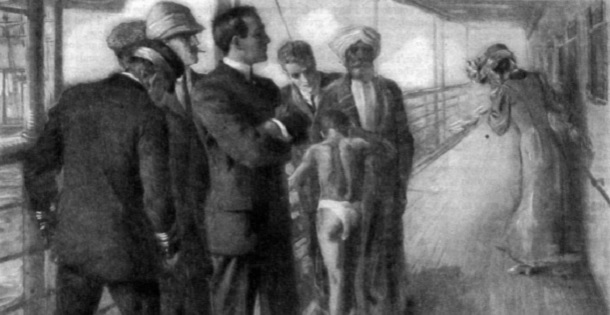
Men on a dock

Under the Deck Awnings 

by Jack London

Jack London / Bajo los toldos de cubierta


In this short story, a frivolous game turns deadly.

“Can any man — a gentleman, I mean — call a woman a pig?” The little man flung this challenge forth to the whole group, then leaned back in his deckchair, sipping lemonade with an air commingled of certitude and watchful belligerence. Nobody made answer. They were used to the little man and his sudden passions and high elevations.

A Nose for the King by Jack London


A Nose for the King 

by Jack London


In the morning calm of Korea, when its peace and tranquility truly merited its ancient name, "Cho-sen," there lived a politician by name Yi Chin Ho. He was a man of parts, and—who shall say?—perhaps in no wise worse than politicians the world over. But, unlike his brethren in other lands, Yi Chin Ho was in jail. Not that he had inadvertently diverted to himself public moneys, but that he had inadvertently diverted too much. Excess is to be deplored in all things, even in grafting, and Yi Chin Ho's excess had brought him to most deplorable straits.

“The Hobo and the Fairy” by Jack London

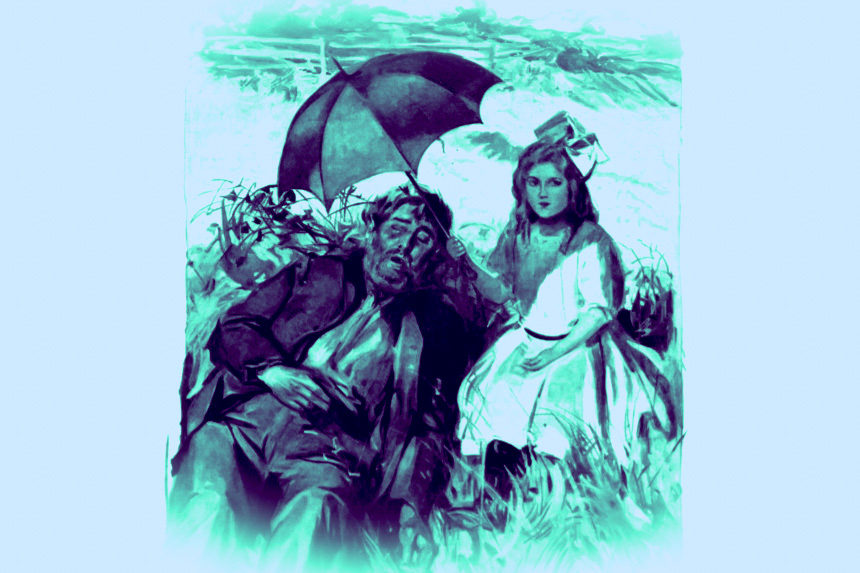
A young girl holds an umbrella over a homeless man.
Illustrated by C.D. Williams


The Hobo and the Fairy 

by Jack London


“After this outburst the man slept gently on while the little girl still held the parasol aloft and looked down with a great wonder at the frowsy, unkempt creature, trying to reconcile it with the little part of life that she knew.”

Jack London

Jack London’s short stories in the Post concerned adventurers, criminals, working men, society folks, and — sometimes — wild animals. In “The Hobo and the Fairy,” from 1911, London tells the heartwarming tale of a homeless man and a bright-eyed, middle class child as they form an unlikely bond on a warm October’s day.

Published on February 2, 1911

Tuesday, November 8, 2022

To Build a Fire by Jack London


To Build a Fire

by Jack London


Day had broken cold and grey, exceedingly cold and grey, when the man turned aside from the main Yukon trail and climbed the high earth-bank, where a dim and little-travelled trail led eastward through the fat spruce timberland.  It was a steep bank, and he paused for breath at the top, excusing the act to himself by looking at his watch.  It was nine o’clock.  There was no sun nor hint of sun, though there was not a cloud in the sky.  It was a clear day, and yet there seemed an intangible pall over the face of things, a subtle gloom that made the day dark, and that was due to the absence of sun.  This fact did not worry the man.  He was used to the lack of sun.  It had been days since he had seen the sun, and he knew that a few more days must pass before that cheerful orb, due south, would just peep above the sky-line and dip immediately from view.

War by Jack London


War

 by Jack London

Jack London / Guerra


He was a young man, not more than twenty-four or five, and he might have sat his horse with the careless grace of his youth had he not been so catlike and tense. His black eyes roved everywhere, catching the movements of twigs and branches where small birds hopped, questing ever onward through the changing vistas of trees and brush, and returning always to the clumps of undergrowth on either side. And as he watched, so did he listen, though he rode on in silence, save for the boom of heavy guns from far to the west. This had been sounding monotonously in his ears for hours, and only its cessation would have aroused his notice. For he had business closer to hand. Across his saddle-bow was balanced a carbine.

A Goboto Night by Jack London


The Card Players
by Erich Wolfsfeld

A Goboto Night 

by Jack London


At Goboto the traders come off their schooners and the planters drift in from far wild coasts, and one and all they assume shoes, white duck trousers and various other appearances of civilization. At Goboto mail is received, bills are paid, and newspapers, rarely more than five weeks old, are accessible; for the little island, belted with its coral reefs, affords safe anchorage, is the steamer port of call, and serves as the distributing point for the whole wide-scattered group.

“A Piece of Steak” by Jack London


A Piece of Steak

 by Jack London

Jack London / Un buen bistec


Jack London’s short stories in the Post concerned adventurers, criminals, workingmen, society folks, and — sometimes — wild animals. In “A Piece of Steak,” from 1909, a desperate, aging boxer is pitted against a young pugilist in a fight for his dignity. London’s work examines human nature on the edge of survival, and his keen perception of competition reveals a different kind of toil: “not like a modern workingman going to his machine grind, but in the old, primitive, royal, animal way, by fighting for it.”

Content Warning: Racial slur

With the last morsel of bread Tom King wiped his plate clean of the last particle of flour gravy and chewed the resulting mouthful in a slow and meditative way. When he arose from the table he was oppressed by the feeling that he was distinctly hungry. Yet he alone had eaten. The two children in the other room had been sent early to bed in order that in sleep they might forget they had gone supperless. His wife had touched nothing, and had sat silently and watched him with solicitous eyes. She was a thin, worn woman of the working class, though signs of an earlier prettiness were not wanting in her face. The flour for the gravy she had borrowed from the neighbor across the hall. The last two ha’pennies had gone to buy the bread.

“To Kill a Man” by Jack London


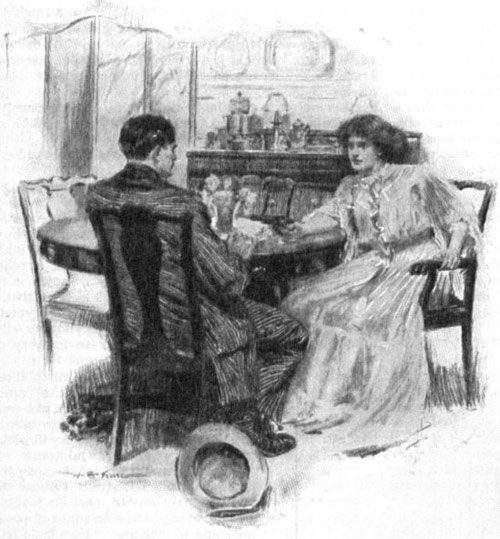
Woman talking to a man at a table.

To Kill a Man

 by Jack London


Though dim night-lights burned, she moved familiarly through the big rooms and wide halls, seeking vainly the half-finished book of verse she had mislaid and only now remembered. When she turned on the lights in the drawing room she disclosed herself clad in a sweeping negligée gown of soft rose-colored stuff, throat and shoulders smothered in lace. Her rings were still on her fingers, her massed yellow hair had not yet been taken down. She was delicately, gracefully beautiful, with slender oval face, red lips, a faint color in the cheeks, and blue eyes of the chameleon sort that, at will, stare wide with the innocence of girlhood, go hard and gray and brilliantly cold, or flame up in hot willfulness and mastery.