Showing posts with label John Barth. Show all posts

Wednesday, April 3, 2024

John Barth, American postmodernist novelist, dies aged 93


John Barth

John Barth, American postmodernist novelist, dies aged 93

The author of Giles Goat-Boy and The Sot-Weed Factor was part of a wave of writers in the 1960s who challenged standards of language and plot

Associated Press

Wednesday 3 April 2024

John Barth, the playfully erudite author whose darkly comic and complicated novels revolved around the art of literature and launched countless debates over the art of fiction, has died aged 93.

John Barth / The Art of Fiction


undefined
 Photo by Nancy Crampton


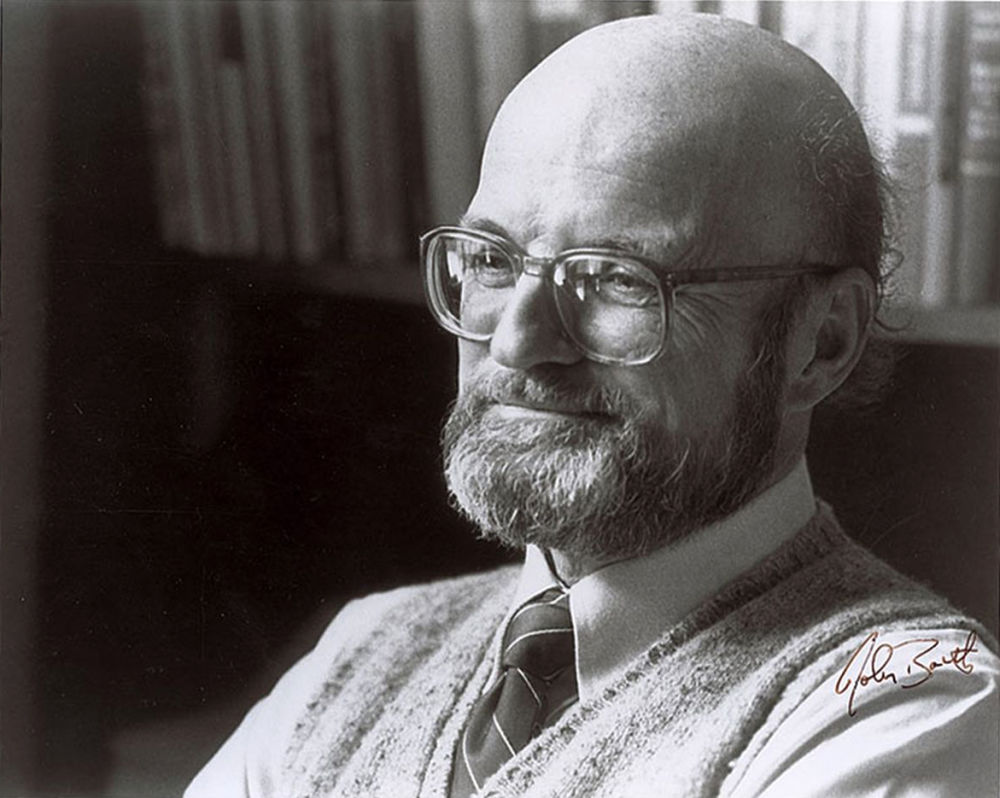
This interview with John Barth was conducted in the studios of KUHT in Houston, Texas, for a series entitled The Writer in Society. The stage set was made up to resemble a writer’s den—the decor including a small globe of the world, bronze Remington-like animal statuary, a stand-up bookshelf with glass shelves on which were placed some potted plants and a haphazard collection of books, a few volumes of the Reader’s Digest condensed novel series among them. Large pots of plants were set about. Barth sat amongst them in a cane chair. He is a tall man with a domed forehead; a pair of very large-rimmed spectacles give him a professorial, owlish look. He is a caricaturist’s delight. He sports a very wide and straight mustache. Recently he had grown a beard. In manner, Barth has been described as a combination of British officer and Southern gentleman.

That's What John Barth Said


That's What John Barth Said

Barth-chimeraWhat was in my way? Chekhov makes a remark to his brother, the brother he was always hectoring in letters, “What the aristocrats take for granted, we pay for with our youth.” I had to pay my tuition in literature that way. I came from a fairly unsophisticated family from the rural, southern Eastern Shore of Maryland—which is very “deep South” in its ethos. I went to a mediocre public high school (which I enjoyed), fell into a good university on a scholarship, and then had to learn, from scratch, that civilization existed, that literature had been going on. That kind of innocence is the reverse of the exquisite sophistication with which a writer like Vladimir Nabokov comes to the medium—knowing it already, as if he’s been in on the conversation since it began. Yet the innocence that writers like myself have to overcome, if it doesn’t ruin us altogether, can become a sort of strength. You’re not intimidated by your distinguished predecessors, the great literary dead. You have a chutzpah in your approach to the medium that may carry you through those apprentice days when nobody’s telling you you’re any good because you aren’t yet. Everything is a discovery. I read Mark Twain’s Huckleberry Finn when I was about twenty-five. If I had read it when I was nineteen, I might have been intimidated; the same with Dickens and other great novelists. In my position I remained armed with a kind of “invincible innocence”—I think that’s what the Catholics call it—that with the best of fortune can survive even later experience and sophistication and carry you right to the end of the story.

From The Paris Review: The Art of Fiction No. 86 interview with John Barth in 1985, conducted by none other than George Plimpton himself. While reading it, be sure to look for the discussion of "word-processing" and becoming a "green-screener."