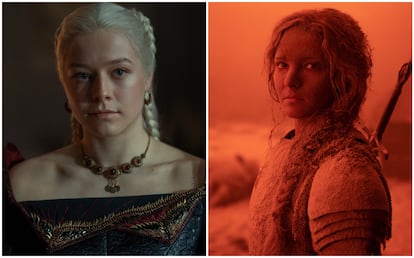
Emma D’Arcy in ‘House of the Dragon’ and Morfydd Clark in ‘The Lord of the Rings.’
‘Rings of Power’ vs ‘House of the Dragon’: Which show is winning the popularity battle?
Audience and social media data give a sense of the results of the confrontation between the two epic fantasies
NATALIA MARCOS
Madrid, 3 November 2022
It wasn’t a battle, but it was. It wasn’t, because there didn’t have to be a victor and a loser – both could have triumphed (and lost). But the simultaneous release ofHouse of the Dragon and The Lord of the Rings: The Rings of Powerinevitably pitted them against one another. Now that the voyages back to Middle Earth and to Westeros have ended, and the first seasons are over, which has won in terms of popularity.
Translating Game of Thrones into Turkish: The Man who Brought Jon Snow to Turkey
POSTED ON MAY 4, 2016
Asher Kohn
Asher was born in Indiana and raised in Chicago, so he thought he understood the concept of “flat” before he landed in Ashgabat in 2007. He did not. Time as an exchange student at Bogazici University made him fall in love with the Turkic world; a love that not even law school could shutter. Asher focuses his research on land use and disuse in West and Central Asia. If that sounds broad, you should hear about his other interests.
EMILIA CLARKE | PUT A RECORD ON, WATCH THE WORLD GROW
Jenny Cusak
May 10, 2019
“When I watch telly or a movie, it’s escapism. I just want to not think about my fucking life for a minute. I want to sit there, and be transported,” says Emilia Clarke, the 32-year-old English actor at the epicenter of one of the biggest, highest grossing, most culturally significant and revered shows on the planet: Game of Thrones.
'No one gets beheaded!' – Nathalie Emmanuel on life after Game of Thrones
Women we love / Nathalie Emmanual Nathalie Emmanuel / Head Strong
She blazed through Westeros. Then her brutal death – in chains – caused outrage. The star talks about the highs and lows of GoT – and feeling liberated by the Four Weddings remake
Hannah J Davies
Wednesday 11 December 2019
N
athalie Emmanuel arrives mildly flustered. There’s been a last minute change of plans and, as we walk, she talks about a disappointing meal she had the night before at one of her favourite vegan restaurants. As she sits down in a London cafe with a matcha almond latte, I wonder if this could this be the start of a showbiz rant. But it soon becomes obvious that that isn’t Emmanuel’s style. Despite spending much of the past decade in what many consider the greatest TV series ever, Game of Thrones, she’s warm and unpretentious, quickly telling me she picked up her fancy, spangled jumper at a discount sale.
SOPHIE TURNER POSES IN NEUTRAL HUES FOR PORTER EDIT
PUBLISHED ON JULY 3, 2019
Sophie Turnergraces the May 31st, 2019, cover ofPORTER Editfrom Net-a-Porter.Photographed byYelena Yemchuk, she wears a bi-color Givenchy coat and Sophie Bille Brahe earring.StylistNatasha Roytselects neutral hues for these effortlessly chic looks.Sophie charms in designs from labels like Givenchy, Bottega Veneta and Theory.For beauty,Christian Woodworks on hair with makeup byRomy Soleimani.
COVER SHOOT: SOPHIE TURNER FOR PORTER EDIT MAY 2019
Marriage is a private thing between two people and I think that’s how it should always be. It’s not about the dress, it’s not about the food.It’s about being husband and wife, and being dedicated to each other forever.
Game of Thrones: how it dominated the decade – then lost its way
It was the fantasy juggernaut that everyone from Obama to Snoop Dogg loved. So why did it fall from grace so swiftly?
Sarah Hughes
Monday 30 December 2019
In the 2010s, there were TV shows and then there was Game of Thrones. HBO’s adaptation of George RR Martin’s epic fantasy series dominated the entire television landscape. Endlessly dissected online and beloved by everyone from former president Barack Obama to Snoop Dogg, it became the subject of countless fan videos and closed out the decade as the most popular show on earth, averaging more than 25 million viewers per episode (an official figure that didn’t even take into account the illegal downloads, which also saw it win the dubious accolade of the globe’s most pirated TV show).
It was also the last piece of true event television in an age where our viewing is increasingly splintered by the rise of streaming. While other shows exist to be binged in one greedy gulp, Game of Thrones had to be watched weekly – a fact that only boosted its appeal, making it the show on everyone’s lips every Monday.
For so long it was the only show on everyone’s lips ... Jaime and Cersei in Game of Thrones. Photograph: Helen Sloan/HBO
Most of all, though, it changed the way the world thought about fantasy on the small screen. Prior to Game of Thrones, accepted wisdom said it was impossible to turn fantasy into a TV hit. Post-Game of Thrones, TV executives seem unable to stop commissioning variations on the theme.
Westeros DNA can be spied in everything from straightforward historical epics such as The Last Kingdom to the weird, wild world of Sky Atlantic’s Britannia. Netflix’s The Witcher is the latest show to conform to the fantasy juggernaut’s template of gruesome violence and largely gratuitous nudity.
It wasn’t always this way. When Game of Thrones began in 2011, the focus was as much on the sharp one-liners and the cunning political machinations as it was on the big twists and even bigger spectacle. But as the show progressed – and crucially, as creators David Benioff and DB Weiss were forced away from Martin’s books due to lack of new material – the show became less character driven and ever more bombastic.
Never was this clearer and more devastating than in the season six finale, The Winds of Winter. At the time of airing, the episode – in which Cersei Lannister wiped out Baelor’s Sept and with it much of the cast – was hailed as a triumph, a sure sign that Benioff and Weiss had a thrilling endgame in mind. In reality, it was the moment that fatally weakened the foundations on which the series was built – and provided proof that, when in doubt, the writers would always blow things up first and ask questions later.
Blow things up, ask questions later ... was The Winds of Winter the show’s death knell? Photograph: HBO
Having established Cersei as a master villain, Benioff and Weiss appeared to have no idea what to do with her, largely deserting the intrigue in King’s Landing to concentrate on the epic fights. That was understandable given the importance of a final showdown between the Night King’s undead army and the rest of humanity, but the gaping hole where politics used to be ensured that the last two seasons prized showy did-you-see-that? moments – the sudden death of Littlefinger, Daenerys’s fiery destruction of King’s Landing – over carefully nurtured plots and character development.
This obsession with style over substance also had a knock-on effect on the shows that came after. Many of those big-budget projects such as Troy, The Bastard Executioner and American Gods were flops, made in the most shallow image of Game of Thrones and ignoring the fact that what originally made the show a hit were its quieter moments.
Conversely, the series that have worked – Outlander, Penny Dreadful, the BBC’s recent adaptation of Philip Pullman’s His Dark Materials – did so because, like Game of Thrones, they put the story they were telling above flashy special effects. Each also exuded the feeling that this was fantasy adapted by people who adored the source material, not just executives scrabbling around for a hit.
Not that the high-profile failures have stopped the commissions coming. Huge adaptations of Lord of the Rings, Robert Jordan’s classic fantasy The Wheel of Time and Patrick Rothfuss’s cult series The Kingkiller Chronicle are in the works.
Some may prove to be worth the wait, although it’s hard not to wonder if TV will already have moved on by the time they arrive because perhaps the most interesting thing about Game of Thrones is the way that – despite all its noise and thunder – it faded so swiftly from the collective memory, slipping down the best-of-the-decade lists and increasingly attacked for being not so much the story of Shakespearian grandeur it promised to be but instead, in Macbeth’s words, a tale “full of sound and fury signifying nothing”.
At its best, though, Game of Thrones was addictive and unmissable TV, filled with great lines and genuinely surprising and well-earned moments. But history can be cruel to shows once lauded as the best of their era.
Its limitations were built in ... Game of Thrones. Photograph: HBO
It is also true that its limitations were built in. Race was badly handled from the beginning, with the Dothraki presented as violent savages and Daenerys’s storyline constantly flirting with white saviour tropes. It also consistently courted controversy over its handling of sex, from the decision to shoot Sansa’s brutal wedding to Ramsay entirely through Theon’s gaze to the mishandling of a scene between incestuous siblings Jaime and Cersei that turned it from reunion to rape.
Such issues – coupled with the sense that this was ultimately a show comprised more of bombast than brilliance – means that Game of Thrones’ greatest legacy may turn out not to be the myriad copycat shows it spawned but rather the silly sums of money the makers of those shows willingly spent. Game of Thrones is dead; long live Game of Thrones.
Is Arya Death? The questions we need answered in Game of Throne
The saga comes to a close in what promises to be an epic finale. But who will kill Daenerys, will Bran warg again – and are the White Walkers gone for good?
Warning: this article contains spoilers.
Many of the big season eight questions have already been answered, like how the White Walkers are defeated, how Cersei bites the dust, and whether or not the showrunners knew where they were going all along. After a, shall we say, divisive penultimate episode, we are left with a deeply twisted happily-ever-after – the exiled ‘rightful’ queen Daenerys has claimed the throne, ready to rid Westeros of tyrants. Unfortunately, she blew everything up in the process. Where does that leave us for the finale? Here are the questions that still need to be answered.
On Thursday, the New Yorker published a personal essay by Emilia Clarke, the famed actress who plays Daenerys Targaryen on Game of Thrones. Clarke writes, in compelling, thorough detail, about her private, grueling battle with life-threatening brain aneurysms, which set in after she filmed the first season of the show.
Clarke's health problems first emerged when she was 24. She recalls the exact date—February 11, 2011—and the crippling headache that came on at the beginning of a session with a personal trainer. She writes that, almost immediately, she realized she had sustained brain damage, and was taken to the emergency room in Whittington, England, in immense pain. An MRI revealed she'd had a subarachnoid hemorrhage—a life-threatening stroke—and needed immediate brain surgery to seal off the aneurysm.
"I remember being told that I should sign a release form for surgery," Clarke writes in the New Yorker. "Brain surgery? I was in the middle of my very busy life—I had no time for brain surgery."
Two weeks after the surgery, Clarke wrote that she was unable to remember her own full name, and felt "blind panic" at the thought that she might not be able to recall lines in order to do her job. She was suffering from aphasia, a type of language impairment.
"I knew I was faltering," Clarke writes. "In my worst moments, I wanted to pull the plug. I asked the medical staff to let me die. My job—my entire dream of what my life would be—centered on language, on communication. Without that, I was lost."
After about a week, the aphasia passed. A month later, she was already back on set. But the hospital had informed her there was another smaller aneurysm on the other side of her brain that could potentially "pop" without warning. She was constantly exhausted and in pain throughout the filming of season two, and during a publicity tour in London, she needed to take morphine between interviews.
"On the set, I didn’t miss a beat, but I struggled," Clarke writes. "Season 2 would be my worst. I didn’t know what Daenerys was doing. If I am truly being honest, every minute of every day I thought I was going to die."
In 2013, Clarke's routine brain scans revealed the second aneurysm had doubled in size and needed to be operated on immediately. But the surgery was unsuccessful, and required an immediate, invasive second surgery through her skull. She spent a month at the hospital in order to recover, and struggled with "terrible anxiety" and panic attacks.
Clarke writes that, thankfully, she has since made a complete recovery.
"I have healed beyond my most unreasonable hopes," she writes. "I am now at a hundred per cent."
It's staggering to think that Clarke managed to push through filming a show as intense as Game of Thrones—complete with stress-inducing battle sequences, sex scenes, and 55-day shoots—all while grappling with a potentially fatal condition. That's to say nothing of the strength it takes to keep something like that to yourself.
"But I survived," she writes in the New Yorker. "There is something gratifying, and beyond lucky, about coming to the end of Thrones. I’m so happy to be here to see the end of this story and the beginning of whatever comes next."
Actor Emilia Clarke reveals she had life-threatening stroke in 2011
Game of Thrones star could not remember her name after subarachnoid haemorrhage
Press Association
THU 21 MAR 2019
The Game of Thrones star Emilia Clarke has revealed she had a life-threatening stroke eight years ago that left her unable to remember her name.
The actor experienced a potentially fatal brain haemorrhage in 2011 before undergoing major surgery.
Clarke, who plays Daenerys Targaryen in the fantasy TV series, lived with an aneurysm in her skull for two years before again sustaining a bleed on her brain. Doctors immediately operated by opening up her skull.
Clarke has launched SameYou, a charity aimed at supporting young people with brain injuries and helping them access resources to aid recovery.
She said she wanted to break her silence over her near-fatal brain injuries to help others with the “invisible illness”.
“I know from personal experience that the impact of brain injury is shattering,” Clarke said. “Recovery is long term and rehabilitation can be difficult to access.
“Brain injury can be an invisible illness and the subject is often taboo. We must help young adults take control of their recovery and allow them to open up without fear of stigma or shame.”
The actor was relatively new to her role as Daenerys when she felt enormous pressure on her brain during a workout.
“I reached the toilet, sank to my knees and proceeded to be violently, voluminously ill,” she wrote in the New Yorker.
“Meanwhile, the pain – shooting, stabbing, constricting pain – was getting worse. At some level, I knew what was happening – my brain was damaged.”
She was revealed to have had a subarachnoid haemorrhage – a type of stroke – and underwent surgery. Many people do not survive the initial haemorrhage.
When Clarke awoke from surgery, she could not remember her name. She was told she still had an aneurysm in her skull but chose not to have it removed.
“Let’s face it, I’m an actor. Vanity comes with the job. I spent way too much time thinking about how I looked,” she wrote.
Clarke again underwent surgery in 2013 after sustaining a bleed on the brain and has made a full recovery over the years.
The actor now wants to support others who have experienced the same fears and pain. “The degree to which people can adapt and face the future after neurological trauma is dependent on the quality and provision of rehabilitation care,” Clarke said.
“While I was recovering, I saw that access to integrated mental and physical health recovery programmes are limited and not affordable for all. I am determined to help.”