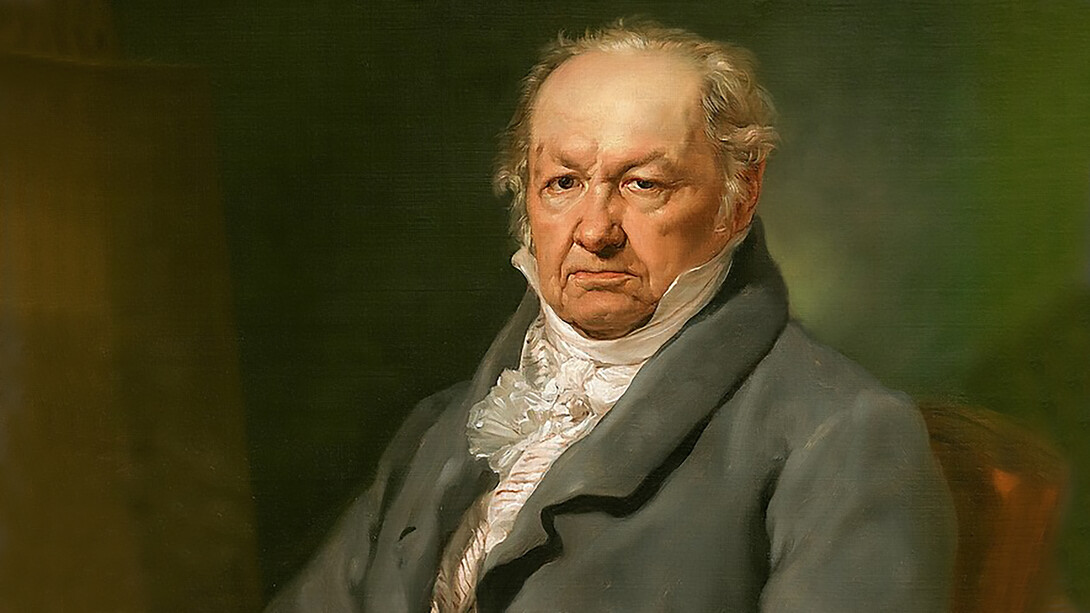
Francisco José de Goya y Lucientes, known as Goya (1746–1828), is one of the most important Spanish artists who influenced many others that came after him in the 18th and 19th centuries. He lived in a period of great change, such as the Enlightenment, the French Revolution, and Napoleon’s invasions of Spain. Being greatly influenced by the Enlightenment, he developed an expressive language on his own by rejecting the acceptable aesthetics of his time and limitations such as being under patronage. His “free” and extensive artistic production captured aspects of everyday life, the effects of war, and Spain’s political, social, and economic issues. Throughout his artistic development, Goya’s early inclination was in-between rococo and classicism while being influenced by Italian masters. After maturing, his works transformed in such a way that Goya is considered the predecessor of the Romantic movement.
In 2017, I had the opportunity to see the Salvador Dalí exhibition in Berlin. Dali's chaotic, genius pieces have always captivated me. His ability to project our crazy dreams and subconscious onto canvas is truly remarkable. What's even more fascinating is how his work, some more futuristic and others more questionable, seems to fit perfectly into today's reality. Dali's influence on modern art and culture is undeniably profound, shaping our perceptions and sparking new artistic expressions. His work has not only left an indelible mark on our collective consciousness but has also inspired a myriad of transformative impacts. Personally, I am deeply moved and inspired by the unparalleled influence of his art, and I believe his work will continue to inspire generations to come.
Hidden Portraits: The Untold Stories of Six Women Who Loved Picasso by Sue Roe review – artist as lothario
This article is more than 2 months old
Françoise Gilot is the most compelling figure in this biography of the painter’s lovers – but you get the feeling she would have loathed this book
Rachel Cooke Monday 24 March 2025
“No woman leaves a man like me,” Pablo Picasso is supposed to have declared to Françoise Gilot, his partner and the mother of two of his children, in the spring of 1953. The couple had by this point been together for a decade, their first encounter having taken place in 1943 in a black market cafe in Paris (Picasso, who was then 61, had approached the 21-year-old Gilot bearing a bowl of cherries). But now he’d become involved with Jacqueline Roque, the woman with whom he’d go on to spend the final years of his life.
What to do about this? Gilot would not confront him. Better simply to call his bluff. “I am very secretive,” she said in an interview in 2016. “I smile and I’m polite, but that doesn’t mean that… I will do as I said I will do… He thought I would react like all his other women. That was a completely wrong opinion.” The following year, the question of her relationship with Picasso was resolved when she married a painter called Luc Simon.
Jacqueline Picasso, 1977. Photograph: Andre SAS/Gamma-Rapho/Getty Images
Gilot, clever and hard working, was an artist in her own right whose relationship to Picasso even in later life was vexed. In 1964, she published a brilliant, bestselling memoir of her time with him (he was enraged, and so was the French establishment on his behalf), but thereafter, she often disdained to talk of him. She preferred to discuss her work, which is held by, among other institutions, the Museum of Modern Art in New York and the Pompidou Centre in Paris. If Picasso’s influence on her art was clear, she was adamant that it had made its mark before she met him (she had studied his pictures). Leaving him hadn’t been liberating, she insisted, for the simple reason that she hadn’t been a prisoner in the first place.
Gilot appears on the cover of Sue Roe’s new book, Hidden Portraits: The Untold Stories of Six Women Who Loved Picasso, in a famous photograph by Robert Doisneau, and from the moment you look at it – her famous lover reclines on a divan in the background, wearing a Breton shirt – the feeling grows that there’s something wrong here. She would surely have loathed this book, and not only because it defines all its subjects only in relation to Picasso; try as Roe might to insist that each of her women is equally worthy of attention, there’s no getting away from the fact that this is not the case. Several books have been written about Gilot, and I’d be happy to read any of them (I recommend About Women, a collection of conversations between her and the American writer Lisa Alther). But about other of Picasso’s lovers there is, I’m afraid, somewhat less to be said.
Russian ballet dancer Olga Khokhlova, c1920s. Photograph: Heritage Images/Getty Images
The book comprises six biographical essays, though self-containment is tricky given that Picasso usually began his next relationship before he had ended his last (the book’s structure isn’t always fit for the time frames involved). It begins with Fernande Olivier, the artist’s model who lived with him in Montmartre between 1905 and 1912, and who appears, in various guises, in many of the Rose Period portraits. She is succeeded by the Russian ballet dancer Olga Khokhlova, and she, in turn, by the model Marie-Thérèse Walter. Next comes Dora Maar, the photographer and painter, to be followed by Gilot and Roque, a saleswoman in a pottery shop. After Gilot, Maar is the most interesting, not least for her influence on Picasso’s Guernica(she first caught Picasso’s attention in a cafe by peeling off her gloves and stabbing between her fingers with a penknife).
Sometimes, there’s light relief. The scene – possibly unreliable, since several different accounts of it exist – in which Walter and Maar physically fight as Picasso looks on is straight out of a film by François Ozon. But mostly – Gilot being the exception – Picasso leaves these women devastated. It’s not only his restlessness and unthinking cruelty; while once they were living in Technicolor, now they’re back in black and white. Roe tells her stories straightforwardly, though she can be both repetitive and a touch Mills & Boon (“We can only imagine the chemistry between the charismatic, seductive, black-eyed painter, who by all accounts exuded charisma even when standing still; and the poised, serious dancer…”). If this territory is new to you, the book won’t be without interest. But as a feminist project, however well-intentioned, it misfires badly.
The Artist and his Model (Le peintre et son modèle)
Pen and black ink and white chalk on light brown card.
Dated 30.6.70. and signed Picasso at the upper left.
Dated and numbered 30.6.70. / I in brush and black ink and white chalk on the reverse.
224 x 309 mm. (8 3/4 x 12 1/8 in.)
In the last two decades of his career Picasso produced a very large number of paintings, drawings and prints on the theme of the artist and model. Indeed, as one scholar has noted, ‘the theme [is] one of the most frequently recurring motifs of Picasso’s late period…During Picasso’s later years, as he grew ever more obsessed with the theme, the repeated focus on the artist and his model became a means by which he could explore the mysteries of the creative process, parody the effects of aging and his own image as a living Old Master, while also, on a deeper level, actively denying his own fear of death.’ These works take a variety of forms, but in general depict a painter, armed with a palette and brushes, facing a canvas, usually seen from the side, and a nude model, either sitting or reclining. Sometimes the painter is shown alone with the canvas but without the model, while at times the scene is set in a studio, or else out of doors.
Pen and brown ink on a page from a large sketchbook.
Dated and numbered 1.1.59 / 111 at the upper left.
Numbered 331 and 5790 on the verso.
370 x 270 mm. (14 1/2 x 10 5/8 in.)
This drawing is likely to have come from one of two spiral-bound sketchbooks used by Picasso in 1958 and 1959. As the scholar Brigitte Léal has noted, ‘sketchbooks form an integral part of the whole of Picasso’s creative activity’, and some 175 sketchbooks by the artist are known or recorded, dating between 1894 and 1967. The earliest known example dates from when the artist was thirteen years old, and he continued the practice of using sketchbooks throughout almost the whole of his career. He often carried a small notebook in his pocket for making quick sketches, while larger sketchbooks or notebooks were used in the studio. While several of Picasso’s carnets have survived - notably twenty-nine examples today in the collection of the Musée Picasso in Paris – many other sketchbooks have been broken up, while others are known only from a handful of individual pages.
Drawn on the 1st of January 1959, this large sheet was Picasso’s third drawing of the New Year. The previous drawing executed by the artist that day was a closely related composition of a dancing or embracing couple, and shared the same provenance as the present sheet until it was sold at auction in 2017. Both drawings come from one of the few late sketchbooks by Picasso. While the last two decades of his career were a time of great productivity for Picasso, not many sketchbooks are known from this fecund period. With the exception of 1962, when the artist filled eight sketchbooks with drawings inspired by Edouard Manet’s Le Déjeuner sur l’herbe and Jacques-Louis David’s Rape of the Sabines, only eight other sketchbooks are known from the final decade and a half of his career, before his last known carnet of 1967. As Léal has written of Picasso’s late sketchbooks, ‘The carnets are no longer places for preparatory studies for the paintings, which they accompany rather than precede, but supports for exercises combining relaxation…and discipline…, dominated by the theme of the nude, a pretext for variations on the arabesque, which appears clearly, through these final notebooks, as the formal link connecting him to the heritage of Delacroix, Ingres and Manet.’
The artist’s son Claude has written of Picasso’s sketchbooks, that ‘They are, from one page to the next, an adventure – a diary of the painter...They are the notes working up to something or bouncing off something else, perhaps a sculpture onto a painting and back. The pages of the notebooks are the sketches for paintings but they are also often the afterwords. Sometimes they stand as elaborate works on their own. Picasso’s notebooks are stepping-stones to trampolines for somersaults.’
The present sheet was until recently in the collection of the artist’s granddaughter Marina Ruiz Picasso (b.1951), the only daughter of Picasso’s eldest son Paulo. Though her relationships with both her father and grandfather were troubled, she was the only legitimate grandchild of the artist alive at the time of his death in 1973, and therefore received the second-largest inheritance, after that of Picasso’s second wife Jacqueline. As Picasso’s biographer John Richardson has noted, Marina Picasso ‘differs from the artist’s other five heirs in that she has made a point of exhibiting as much as possible of her magnificent collection in a succession of traveling exhibitions…for students of modern art in cities which have never seen a Picasso retrospective, these exhibitions have been a revelation.’ This drawing from Marina Picasso’s collection, however, appears not to have previously been exhibited.
A photo-certificate from Claude Picasso, dated 12 November 2019, accompanies the present sheet.