On the short walk from the churchyard to her car, Mrs. Crasthorpe was aware of a profound humiliation. A lone mourner at her husband’s funeral, she had sensed it first in the modest country church he had insisted upon for what he had called his obsequies. A woman cleric unknown to Mrs. Crasthorpe had conducted a bleak service, had said the necessary words in an accent that appalled Mrs. Crasthorpe, and then had scuttled off without so much as a glance in Mrs. Crasthorpe’s direction. Two men were waiting, leaning on their shovels in the nearby graveyard, and within minutes had returned the clay to where they had dug it from, making a little mound, the coffin gone forever and with it Arthur, all of it a mockery. She was wrong, Mrs. Crasthorpe knew, to blame Arthur for the arrangements he’d put in hand before he went, but she’d become used to blaming him in his lifetime and couldn’t help doing so still.
“The Brahms?” she said. “Shall we struggle through the Brahms?”
The boy, whose first lesson with Miss Nightingale this was, said nothing. But, gazing at the silent metronome, he smiled a little, as if the silence pleased him. Then his fingers touched the piano keys and, when the first notes sounded, Miss Nightingale knew that she was in the presence of genius.
The Subjective Real in William Trevor’s “Justina’s Priest”
Eugene O'Brien Autumn 2014
As a genre, the short story is one which can be seen as neither/nor or both/and: it does not have the length and scope of a novel, nor does it have the intense yet disciplined formal structure of a poem, and it is for this reason that it is, perhaps, the most under-examined of all literary genres. Despite the fact that it has been practiced by some of the greatest writers in world literature—Chekov, Maupassant, Faulkner, Steinbeck and Hemingway—as well as a significant number of Irish writers—O’Faolain, O’Connor, Joyce, Banville and McGahern—it remains an elusive genre. Studies seldom focus on a single story, as there does not seem to be sufficient material in one story to carry the weight of sustained analysis. In this article, that trend will be reversed, as the focus here is on a single short story by William Trevor, entitled “Justina’s Priest,” from his 2005 collection A Bit on the Side, a collection which Paul Delaney has termed “masterful” (183). The title is part of an ongoing trope of Trevor’s fiction in that “women’s names provide the titles for several of his novels and many of his short stories” (Fitzgerald-Hoyt 143). The reason for the choice of this story is that it offers a fictive and complex perspective on the socio-cultural demise of the influence of the Catholic Church in Ireland. This is a topic that has been the subject of a significant amount of comment, but the fluctuations and consequences of the hegemonic power of this institution have never, I would contend, been dealt with so subtly as in this story.
He could always reinvent and refresh his imagination and surprise his readers in story after story, novel after novel
Wednesday, November 23, 2016
William Trevor once described himself in modest terms as “a storyteller”, suggesting that his fiction “may, now and again, illuminate the human condition”. But his empathetic apprehension of that condition and its mysteries was one of his greatest gifts as a storyteller.
William Trevor: an Irish writer, an international writer, a great writer.
William Trevor made the ordinary and familiar, new and shocking
Trevor was a world class writer who chronicled the lives of the forgotten, the despairing losers, the innocent and the devious, the lonely and the unloved
Eileen Battersby
Monday 21 November 2016
Detached sympathy, irony and a masterful grasp of the essential menace lurking at the heart of human existence partly – although only partly – attempts to explain the fluid, diverse genius of William Trevor’s singular art.
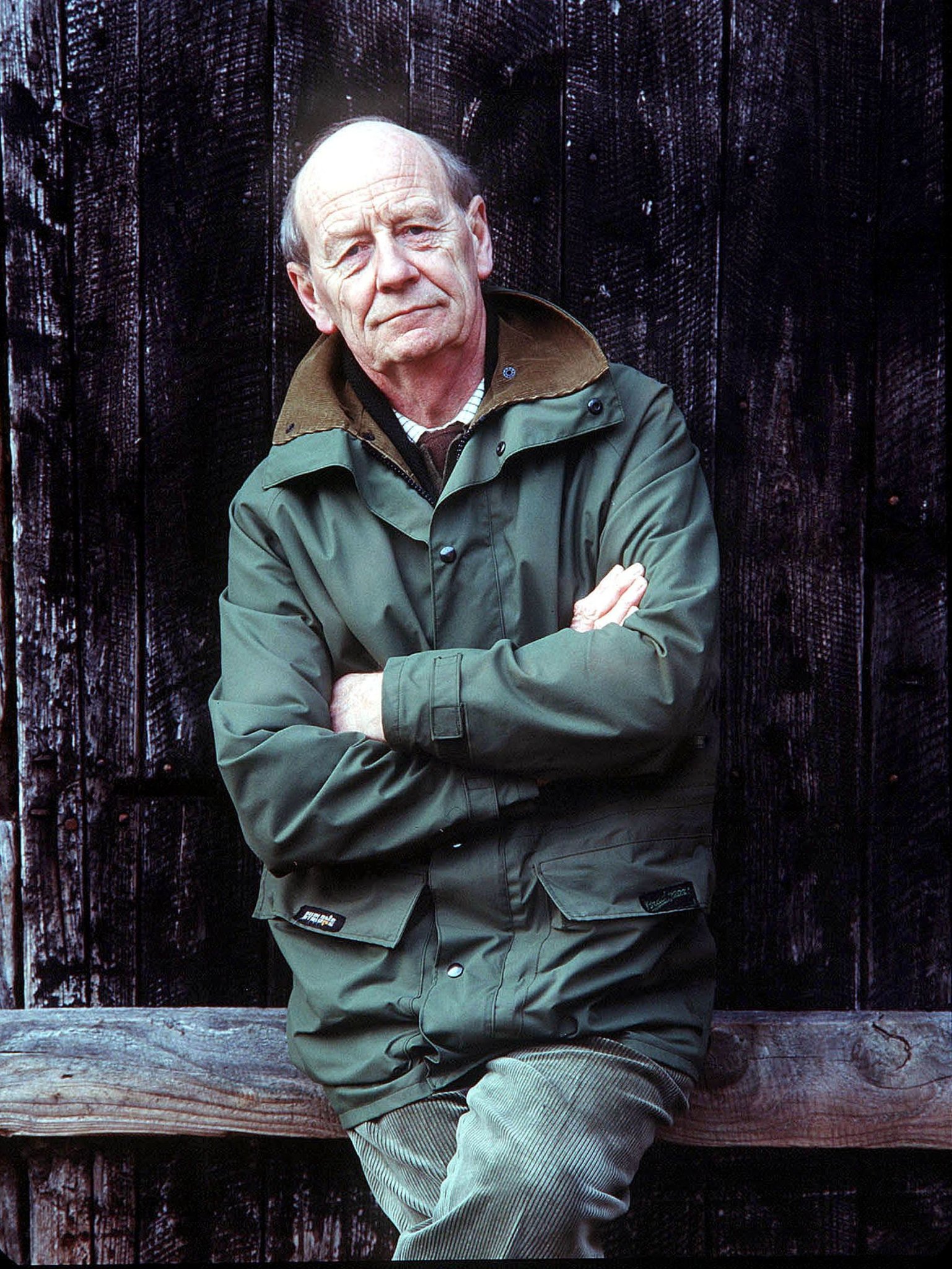
William Trevor at home in Exeter. Photograph- Eamonn McCabe.
William Trevor: the keen-eyed chronicler
The author, widely believed to be the most astute observer of the human condition currently writing in fiction, is up for his fifth Booker Prize shortlist at the age of 81. Will he finally be given the recognition he deserves?
Tim Adams
Sunday 2 August 2009
The following correction was printed in the Observer's For the record column, Sunday 16 August 2009
Our profile of William Trevor below described the author's parents as "the Trevors" but he was born William Trevor Cox.
"In the age that we live in," William Trevor once observed, "we all tend to be pigeonholed, because there are things called images and we all have these images and I don't believe them. I don't believe in the black and white; I believe in the grey shadows and the murkiness: in the fact that you shouldn't ever say 'old spinster' or 'dirty old man'. In a way, I suppose, I write to prove that theory."
'I would use anything in order to tell a story, anything at all to make the story work'
Lisa Allardice Saturday 5 September 2009
"I have been interviewed by the Guardian before," William Trevor declares triumphantly when, finally, we meet. "It was way back in 1964, so maybe it doesn't count." For such a prolific and internationally celebrated writer, Trevor's reluctance to submit to the demands of today's publicity machine almost qualifies him for reclusive author status. It's no exaggeration to say this interview has taken several years – and a small cache of postcards in the author's tiny handwriting – to set up. "But I do always say no," he concedes. "It kills you in the end, anything you are doing that isn't just writing. It's no joke."
The leaves had begun to fall. All along Sunderland Avenue on the pavement beneath the beech trees there was a sprinkling, not yet the mushy inconvenience they would become when more fell and rain came, which inevitably would be soon. Not many people were about; it was after midnight, almost one o’clock, the widely spaced lampposts casting pools of misty, yellow illumination. A man walked his dog in Blenning Road in the same blotchy lamplight, the first of autumn’s leaves gathering there also. An upstairs window opened in Verdun Crescent, hands clapped to dismiss a cat rooting in a flower bed. A car turned into Sunderland Avenue, its headlights dimmed and then extinguished, its alarm set for the night with a flurry of flashing orange and red. The traffic of the city was a hum that only faintly reached these leisurely streets, the occasional distant shriek of a police siren or an ambulance more urgently disturbing their peace.
Growing up in the listless nineteen-eighties, Cecilia Normanton knew her father well, her mother not at all. Mr. Normanton was handsome and tall, with steely gray hair brushed carefully every day so that it was as he wished it to be. His shirts and suits gave the impression of being part of him, as his house in Buckingham Street did, and the family business that bore his name. Only Mr. Normanton’s profound melancholy was entirely his own. It was said by people who knew him well that melancholy had not always been his governing possession, that once upon a time he had been carefree and a little wild, that the loss of his wife—not to the cruelty of an early death but to her preference for another man—had left him wounded in a way that was irreparable.
“The Women” by William Trevor from the January 14, 2013 issue of The New Yorker
Trevor
I
t was a beautiful thing to find a new William Trevor story in this week’s issue of The New Yorker. To my knowledge William Trevor has not published anything anywhere in the last four years. I assumed that, at age 84, he was done, as much as I hoped this day would arrive. I was not disappointed in the slightest.
“The Women” is, in part, about quiet sadness, the type that doesn’t go away as we age even though those who know us best may not even know what caused it. They just see it on our faces. We tell each other and ourselves lies and find consolation in anything that lends doubt to the cause of the sadness. We are first introduced to the sadness of Mr. Normanton. In most ways, Mr. Normanton has it all together. He brushes his gray hair “carefully every day so that it was as he wished it to be.”
“Well, there’s that if you’d want it,” the crippled man said. “It’s a long time waiting for attention. You’d need tend the mortar.”
The two men who had come to the farmhouse consulted one another, not saying anything, only nodding and gesturing. Then they gave a price for painting the outside walls of the house and the crippled man said it was too much. He quoted a lesser figure, saying that had been the cost the last time. The men who had come looking for work said nothing. The tall one hitched up his trousers.
Julian Barnes on William Trevor's final stories – a master of the short form
The great Irish writer displays all his trademark evasive precision in Last Stories, a posthumous collection
Julian Barnes Saturday 19 May 2018
W
illiam Trevor is one major writer about whose life I know only odd scraps; yet this feels appropriate. I know that he was of southern Irish Protestant stock; that his real name was Trevor Cox; that he worked in the same advertising agency as the poet Peter Porter; that he took holidays on Porquerolles, a Mediterranean island with no vehicular traffic; and that he shared the Irish short story writer’s traditional fate of being called “an Irish Chekhov”. But I can’t think of any public statement he made, or any cause he publicly adhered to, or any time when the non-literary pages of newspapers were interested in him. Was he knighted? Did they make a South Bank Show about him? I met him once, in 1999, after he won the David Cohen prize, but was left with only a strong impression of courtliness, charm and reserve.
Lately I’ve been reading quite a bit of William Trevor – the esteemed Irish writer, widely considered to be a master of the short story form. (I’ve previously written about some of his novels here.) First published in 1996, After Rain comprises twelve beautifully-crafted stories, not a dud amongst them. Like much of Trevor’s work, they centre on ordinary people – perhaps more specifically, the day-to-day developments that shape their lives in the most poignant of ways.
This essay -assuming a Shakespearean allusion- could have been called “Domestic Malice”; or taking its cue respectively from soap opera or pulp fiction, “The Mischievous and the Malign” or “The Malign and the Malicious”. Trevor’s fiction, in fact, explores some of the same territory as popular novels do, though its landmarks are the ruined lives of tragedy. Trevor tells stories, offering fictional “realities” in a clear, matter-of-fact style. He does not burden the reader with philosophizing speculation or arguments for a particular political point of view. Newspaper reviewers and literary prize committees praise his work and, more recently, he has been recognized by academic critics. Some recent examples are Michael W. Thomas (1999), whose essay “Worlds of Their Own: A Host of Trevor’s Obsessives” appeared in The Canadian Journal of Irish Studies, my own essays (1997 and 1995 respectively), “Reading Trevor, Reading Turgenev” in The CUHK Journal of the Humanities and “The Outsider in the Novels of William Trevor” in The Canadian Journal of Irish Studies, and Ian Sansom (1999) “New Fiction: Reading Trevor” in Salmagundi. Richard Bonoccorso published two pieces on Trevor in 1996 and 1997 respectively. More substantially, Kristin Morrison published a book, William Trevor (1993), as have Suzanne Paulson with William Trevor: A Study of the Short Fiction (1993), and Dolores MacKenna, with William Trevor, The Writer and His Work (1999). My purpose here, though, is not to review previous critical works. I am more interested in continuing to record my own experience of reading Trevor. Since previously I have written about his novels, I am now looking mainly at Trevor’s copious harvest of short fiction, including the fairly recent collection, After Rain (1996) and the even more recent novel, Death in Summer(1998).
While ageing can easily leave some frightened, the likes of Alec Guinness, Nora Ephron and Julian Barnes have produced wry, positive takes on old age, says septuagenarian author Christopher Matthews
Christopher Matthew
Wednesday 13 October 2017
W
e have all seen old age in action and often it is not a pretty sight. Chances are, it strikes suddenly. “It is,” said James Thurber, “one of the most unexpected of all the things that can happen to a man.” In Paolo Sorrentino’s film Youth, an elderly composer played by Michael Caine sums it up: “I’ve become old and I don’t know how I got here.”
But we should never allow catastrophe to get in the way of good humour and practical common sense. “One of the most irritating things about getting old,” a friend of mine once said at lunch, “is not having any idea of how much longer one has got. Take George’s dinner jacket. He’s nearly 80. His old one is practically falling to bits, but what is the point of getting a new one if he isn’t going to get decent use out of it?”
I am confident that my own dinner jacket will see me out. Being a mere 78, I am still enjoying late middle age. However, I am all too aware that senectitude is lurks around the corner and it occurred to me that, before it strikes, I could do worse than fill the unforgiving minute with a few light-hearted observations on the perils and pleasures it may bring. Most of the writers below have taken a positive, and often wry, look at old age, while never forgetting that beneath the eccentricities that accompany advancing years lie uncertainty, grief and thoughts of mortality.
Mortimer was only too aware that the price to be paid for getting old is making oneself looking ridiculous. The opening sentence says it all: “The day will come in your life, it will almost certainly come, when the voice of God will thunder at you from a cloud: ‘From this day forth thou shalt not be able to put on thine own socks.’” Reading this collection of theatrical anecdotes, gossip, fond memories of friends and witty observations made while growing old disgracefully reminds one that possibly the greatest pleasures of old age is reminiscence.
2. A Positively Final Appearance by Alec Guinness
Guinness is equally reassuring to those of us who wonder what enjoyment can be found in old age. Chock-a-block with opinions on books read, plays and films seen, stories of happy times spent with old friends such as Alan Bennett, Irene Worth and John Wells, and the joys of life at home in Hampshire, this diary is interspersed with poignant accounts of the death of friends and funerals attended.
Nora Ephron never made it to old age: she died aged 71, from pneumonia brought on by acute myeloid leukaemia. Yet the screenwriter and author knew as well anyone what it feels like to grow older and – as her title declaims – some of the annoying and often absurd failings that the advancing years bring with them. Not being able to remember a damned thing is only one; she cheerfully lists almost a dozen people she met who she can’t remember anything about (Groucho Marx, Cary Grant, Jacqueline Kennedy Onassis and Peter Ustinov).
Moggach’s novel, on which the film of The Best Exotic Marigold Hotel is based, not only has a different title but also a more purposeful premise. Convinced that Britain is not good at looking after the elderly, and that no one is better at it than the Indians (“Know what our pension scheme is called? It’s called the family!”), wheeler dealer Sonny’s notion of converting an old guest house in his home town of Bangalore into a retirement home turns out to be a stroke of genius. Moggach’s story also contains a serious message for those struggling to cope with care in the community.
Gray has been a wonderful companionfor many oldies, including myself, thanks to the four volumes of utterly addictive diaries he started writing at 65 and continued until his death in 2008 aged 71. When he is not describing dinner with holidays in Greece with his beloved Victoria, trying to give up smoking or being in lights on Broadway, he is wondering – and often worrying – about almost any subject, however trivial, that drifts into his head. As well as being one of the funniest writers I have ever read, he is terribly moving, especially in this final volume, as he battles cancer in what he describes as “the beginning of my dying”.
Athill will be 100 on 21 December and is more qualified than most to reflect on the losses – and more importantly the gains – that old age brings. Never one to harbour regrets, her spirits are as high as ever in this wonderful book of reflections on loves, friendships and events in her long life. She cheerfully offers readers wonderful, wise and often comforting thoughts as she contemplates death.
Reading this book is like going on a long walk with a friend who is as erudite and serious as he is entertaining. Barnes is at his most contemplative as he takes us through his family and childhood and into arguments about the existence of God (“I don’t believe in God, but I miss Him”) and startling exchanges with his philosopher brother. But what preoccupies him most is death and the fear of death – his, mainly. What will it be like when it comes? A good one, or one filled with pain and regret?
“Mortality can be a treacherous subject,” writes surgeon Atul Gawande in this extraordinary book about ageing and death in the 21st century. For many people, medicines have turned the end of life into a thoroughly grim affair. But it need not be so, says Gawande. Dying should not be meaningless and something to be dreaded. To rely on medicines that addle our brains is to deprive us of useful and coherent last days on Earth. It is not a good death we should be hoping for, but a good life – to the very end.
Having nicked his title, the least I can do is nod in admiration at Hemingway’s legendary story of a young boy, an old man and a huge fish. Told in the sparest language, the respect that exists between the fisherman and the boy is perfect and touching, as is the respect the old man shows for the fish, with which he converses as it drags him far out to sea.
10. The Old Boys by William Trevor
The coming election for the presidency of the Old Boys’ Association brings out all the decades-old enmities held by these rather sad old men, in this funny if grim book. Yet old age has it benefits, as General Sanctuary points out to a fellow spectator at the Old Boys’ cricket match. “We are lucky, Lady Ponders: it is pleasanter to be over 70, as it was to be very young. Nothing new will happen to us again. To have everything to come, to have nothing to come – one can cope.”
The Old Man and the Knee by Christopher Matthew is published by Little Brown