Showing posts with label Pink Floyd. Show all posts

Monday, March 20, 2023

Roger Waters threatens legal action over German concert cancellations


Roger Waters


Roger Waters threatens legal action over German concert cancellations


Waters was accused of being ‘a widely known antisemite’ in Frankfurt council instruction to cancel concert, with other German cities also proposing cancellations

Ben Beaumont-Thomas
Thursday 16 March 2023

Roger Waters has said he will take legal action against city authorities in Germany over the threatened cancellation of concerts there, after the former Pink Floyd frontman was accused of antisemitism, which he denies.

Pink Floyd's burning man / Aubrey Powell's best photograph


‘It’s dangerous for a man on fire to stand still’ … cover art for Pink Floyd’s Wish You Were Here. 
Photograph: Aubrey Powell


Pink Floyd's burning man: Aubrey Powell's best photograph

‘A gust of wind blew the fire into the stuntman’s face. His team piled in with blankets to put him out – but he still lost an eyebrow and some of his moustache’


Interviews by Joobin Bekhrad
Wed 12 Aug 2020 14.34 BST


Storm Thorgerson and I had created most of the artwork for Pink Floyd’s albums, including Dark Side of the Moon. One day we were asked to Abbey Road Studios to listen to tracks from the band’s new record. The lyrics were mostly about absence, and the album’s title, Wish You Were Here, was a reference to Syd Barrett, who had left the band some years earlier due to issues with LSD. They were also making a statement about record company executives who regarded musicians as money-making machines, demanding one hit song after another – an absence of a different kind.

Thursday, July 10, 2014

My favourite album / Dark Side of the Moon by Pink Floyd

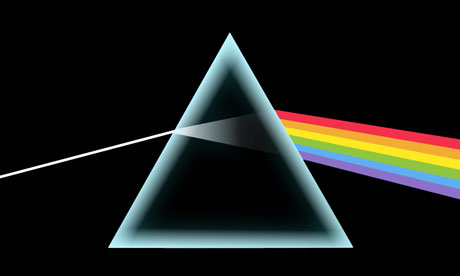
The sleeve for Pink Floyd's Dark Side of the Moon

My favourite album: Dark Side of the Moon by Pink Floyd

Guardian and Observer writers are picking their favourite albums – with a view that you might do the same. Here, Simon Hattenstone ventures over to the dark side with Pink Floyd

Friday 26 August 2011 
'Everything about it is perfect' … Pink Floyd's Dark Side of the Moon
I was 11 years old, had spent two years in bed with encephalitis, and had just started listening to music again. My parents bought me a music centre – massive speakers, radio, tape recorder, record player, stereo, the works. The ultimate in hi-tech. And I was buying like crazy – Mum and Dad were so pleased I had made it, they didn't notice, or care, that I was constantly blagging money off them for more records. Then I bought Dark Side of the Moon, and didn't get another record for months. I didn't need one.

  1. Pink Floyd
  2. Dark Side of the Moon
  3. EMI
  4. 1994
Everything about the album was perfect – the black cover, the prism image, the poster of those unearthly pyramids, the great curly sounds that came out of Rick Wright's synthesisers, Roger Waters's puckered lips, Dave Gilmour's hippy hair, the anti-capitalist onslaught (or so I thought), the ghostly despair of the music and, of course, the lyrics.
I knew nothing about Syd Barrett at the time, but I knew everything about me. And this was my album. I had had inflammation of the brain, almost died, had gone the full circle of lunacy, and withdrawn from the world. Now I was getting better, and Dark Side of the Moon helped me make a mad sense of everything that had happened.
It also brought me and Dad back together. Our relationship had virtually broken down when I first became ill. His best friend Bert was my doctor, and Bert had thought I was making it all up. Dad was caught between loyalties – me or Bert. And for a long time it looked as if he had chosen Bert. Eventually, he came back to me, but we needed to do a lot of bridge building. And this was where the Floyd came in.
It was summer 1974, and he would take afternoons off work (a massive sacrifice for him because he was a workaholic) and come into my bedroom and listen to the Floyd with me. There were two beds in my room. I lay on mine, he lay on the other, and we shut our eyes and concentrated. I didn't know what was going through his head, but I knew what was going through mine – how could any prog-rock group understand me so well? Every bit of my fucked-up personality was reflected in that record – Money was about all the greedy bastards out there, Us and Them was about me against the world, Time was about dying ("Hanging on in quiet desperation is the English way" is one of thegreat lyrics), as was The Great Gig in the Sky.
Meanwhile, Brain Damage might as well have been called Simon Hattenstone: My Story: "You lock the door/ And throw away the key/ There's someone in my head but it's not me."
Exactly. My head had exploded with dark forebodings, my dam had broken open many years too soon. The band that I was in had not only started playing different tunes – they'd stopped inviting me to the gigs. The lunatics were in my hall, in my head, every bleedin' where. When I sang along to Brain Damage I felt as if I was singing my life. Back then, I didn't understand that all those years Dad was crippled by depression, so perhaps Dark Side of the Moon meant just as much to him in the same way. Every day that summer he'd come into my room, and we'd lie on our respective beds, and listen to it all the way through in silence with eyes shut. And at the end, without fail, he'd say: "Best bleddy record in the world that, Si."
• You can write your own review of this record: once you're signed into the Guardian website, visit the album's dedicated page.
Or you could simply star rate it, or add it to one of your album lists. There are more than 3m new pages for you to explore as well as 600,000-plus artists' pages. So maybe your prog-rock radar picks out King Crimson's In the Court of the Crimson King as the greater masterpiece? Maybe you'd sooner blow it out of the water with a review of the Sex Pistols' Never Mind the Bollocks? Either way, here's your chance to find those albums and get to work!


Wednesday, July 9, 2014

Obituaries / Syd Barrett

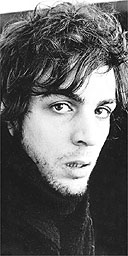
Syd Barrett

Former lead singer of Pink Floyd whose drug-induced breakdown and reclusive retirement created a musical legend
By Alan Clayson
The Guardian, Tuesday 11 July 2006

Syd Barrett, the maverick frontman and creative force behind early Pink Floyd, who has died from cancer aged 60, was the ultimate of pop recluses. His departure from the band in 1968 - then on the threshold of global eminence - and his retirement as a professional musician to lead an outwardly unproductive life was on a par with, say, Mick Jagger leaving the Rolling Stones in 1964 to live quietly with his parents.
Syd BarrettThe fourth of five siblings, he was born Roger Barrett in Cambridge. If blighted by the death of his father, a hospital pathologist, his upbringing was more liberal and steeped in culture than most. Before he graduated to Cambridge High School, he showed promise as a classical pianist and, more so, as a visual artist. However, intrigued by an elder brother's skiffle combo, he taught himself guitar, mostly by playing along to records. He and a kindred spirit, David Gilmour, practised together, but did not progress much further than talking about starting a group.
It was around this time that Roger acquired the nickname "Syd". At 16, he was playing with local beat groups, sometimes sharing a stage with bass guitarist Roger Waters. On obtaining respective scholarships at Camberwell Art College and Regent Street Polytechnic, Barrett and Waters moved to London where their band, the Pink Floyd, smouldered into form, with Barrett, Waters, drummer Nick Mason and Rick Wright on keyboards.
The gradual introduction of adventurous self-written material and lengthy monochordal improvisations made them popular fixtures in the capital's underground clubs where light shows simulated psychedelic experience. Snapped up by EMI, their debut single, Arnold Layne, was, as expected, self-consciously "weird" - and a Top 30 entry, despite airplay restrictions. The follow-up, a tartly-arranged See Emily Play - also composed by Syd - climbed to Number Six. Perhaps more satisfying for the group was recognition by the Beatles, who looked in during a Floyd session for 1967's groundbreaking The Piper At The Gates Of Dawn. The maiden album was penned almost entirely by the charismatic Barrett, who, as a guitarist was as capable of severe dissonance as serene, if echo-laden, melody, and whose vocal style was as English as Elvis Presley's was American.
With the other personnel keeping pace, he'd gone far into the cosmos and back musically with Astronomy Domine, and disconnected with Earth altogether on Interstellar Overdrive. Moreover, Gnome, Matilda Mother, Flaming and medieval-flavoured Scarecrow cornered pop's gingerbread castle hour more effectively and instinctively than, for example, the Beatles' Lucy In The Sky With Diamonds.
Fortunately for the Fab Four, a now drug-addled Barrett was already proving ill equipped to cope with pop stardom, particularly after a troubled US tour and the disappointment of a flop third single, Apples and Oranges. In 1968, David Gilmour was enlisted as the increasingly unreliable Barrett's understudy and then his successor during the making of a transitional second album, A Saucerful Of Secrets. Although happier as concert performers, Pink Floyd - as they were now called - were initially at a loss without Barrett's input.
Attempting to master his more absolute inner chaos, Barrett released two curate's egg solo albums in 1970, The Madcap Laughs and the more focused Barrett, with help from members of Soft Machine, Humble Pie - and Pink Floyd, and was persuaded to undertake disinclined promotional stage appearances. Eventually, he returned to Cambridge where he fronted a trio called Stars, who struggled through a solitary official booking at the city's Corn Exchange in 1972.
The years left to Barrett were almost perversely unremarkable. Though he was known to be a painter, he neither exhibited nor sold any work. Nevertheless, a legend took shape, bringing out strange stories, the most verifiable of which was of Barrett presenting himself, portly and shaven-headed, in the studio when Pink Floyd were recording the 1975 album Wish You Were Here - which included the Barrett tribute Shine On You Crazy Diamond.
Since then, intrusive press photographs of Barrett have portrayed him looking as middle-aged as his now multi-millionaire colleagues. In the teeth of dull truth, Barrett continued to fascinate countless fans as well as record company moguls, scraping the barrel for anything on which he so much as breathed - such as the big-selling 1993 CD box set, Crazy Diamond, incorporating hitherto-unreleased tracks.
Barrett's income of invalidity benefit and fluctuating royalties was buoyed by tributes paid by other artists, most conspicuously David Bowie who revived See Emily Play on his 1973 Pin-Ups album, and more recently Arnold Layne which he performed with David Gilmour in London. Yet few of the faithful expected or even wanted Barrett to make a comeback, no matter how rejuvenated or contemporary. They preferred him as an ever-silent, "no return" saga rather than one in which he was likely to try and fail to debunk the myth of an artistic death.
· Syd Barrett (Roger Keith Barrett, musician, composer, born January 6 1946; died July 7 2006

THE GUARDIAN


See also


Syd Barrett / Gallery

pink floyd

Syd Barret
GALLERY


syd barrett

fanart

rock

imagenes

Tuesday, July 8, 2014

Pink Floyd / The Endless River

Pink Floyd to release a new album in 2014, entitled The Endless River

David Gilmour's wife Polly Samson has described the new album, out in October, as 'Rick Wright's swansong'

by Sean Michaels
The Guardian, Monday 7 July 2014

Pink Floyd publicity shotPink Floyd, England, 1973. Left to right: Rick Wright, Dave Gilmour, Nick Mason, Roger Waters. Photograph: Michael Ochs Archives
David Gilmour's wife has revealed that Pink Floyd will release a new album this October. The Endless River is the group's first album since 1994's The Division Bell, and was reportedly inspired by the same recording sessions.
Polly Samson, who married Gilmour in 1994, unveiled Pink Floyd's secret plans on her Twitter account. In addition to announcing the album's title and release date, she referred to the record as "Rick Wright's swansong". Wright, who co-founded Pink Floyd with Syd Barrett, Nick Mason and Roger Waters, died in 2008.

Btw Pink Floyd album out in October is called "The Endless River". Based on 1994 sessions is Rick Wright's swansong and very beautiful.

Vocalist Durga McBroom-Hudson, who has toured with Gilmour and Pink Floyd, subsequently shared some further details. "The recording did start during The Division Bell sessions (and yes, it was the side project originally titled The Big Spliff that Nick Mason spoke about)," she wrote en Facebook. "David and Nick have gone in and done a lot more since then." That "Big Spliff" session was described in Mason's memoir Inside Out, where he called it "ambient mood music" akin to "bands like the Orb".
According to McBroom-Hudson, The Endless River "was originally to be a completely instrumental recording". But Gilmour gradually changed his mind, inviting McBroom-Hudson to record backup vocals last December and adding more singing since then. Gilmour has "done a lead on at least one [track]," she said, and Samson, who co-wrote seven of The Division Bell's tracks, described herself on Twitter as one of The Endless River's lyricists. 
In addition to finishing Pink Floyd's 15th studio album, Gilmour is also allegedly still working on a new solo album. And McBroom-Hudson said that the band could indeed mount a new tour. "STAY TUNED," she wrote. When Pink Floyd last hit the road, in 1994, it was the highest-grossing rock tour in history.
The Division Bell, which originally debuted at No 1, was reissued in a deluxe set on 30 June. This new edition landed at No 52.